Peptide Glossary
587 terms · 17 topics
587 terms from peptide chemistry, pharmacokinetics, trial design and the regulatory machinery around them — written for people reading spec sheets, trial abstracts and FDA letters rather than marketing pages. Each entry says what the term means, what it is worth in practice, and where it gets misused. We publish no dosing protocols and sell nothing.
Clinical Trials & Study Design
33 termsHow a study is built determines what its result can support. These are the design terms that decide whether a finding is evidence of effect or an artefact of the way the question was asked.
- Active Comparator
- Adaptive Trial Design
- Allocation Concealment
- Blinding
- Case Report and Case Series
- Case-Control Study
- Cohort Study
- Composite Endpoint
- Data Monitoring Committee (DMC)
- Dose Escalation
- Dropout and Loss to Follow-Up
- Hard Clinical Endpoint
- Inclusion and Exclusion Criteria
- Intention-to-Treat vs Per-Protocol Analysis
- Interim Analysis and Stopping Rules
- Non-Inferiority and Equivalence Trials
- Open-Label Extension Study
- Open-Label Study
- Parallel-Group vs Crossover Design
- Phase 1 Trial
- Phase 2 Trial
- Phase 3 Trial
- Phase 4 Trial
- Placebo and Placebo Control
- Preclinical Study and Animal Model
- Primary vs Secondary Endpoint
- Randomisation and Stratification
- Randomised Controlled Trial (RCT)
- Real-World Evidence (RWE)
- Run-In Period
- Sample Size and Power Calculation
- Surrogate Endpoint
- Trial Registration and Prospective Protocol
Dermatology & Cosmetic
33 termsTopical peptides sit on the line between cosmetic and drug, and the claim language is regulated accordingly. This section covers skin biology, the measurement methods behind before-and-after claims, and where those methods are weakest.
- 500 Dalton Rule
- Carrier Peptide
- Comedogenicity
- Corneometry
- Cosmetic Claim vs Drug Claim
- Cutometry
- Dermal Collagen
- Dermis
- Elastin
- Epidermis
- Glycosaminoglycans (GAGs)
- Human Dermal Fibroblast (HDF)
- Hyaluronic Acid
- Hyperpigmentation
- In-Vitro Fibroblast Assay vs Clinical Outcome
- Keratinocyte
- Matrikine
- Melanocortin-1 Receptor (MC1R)
- Melanogenesis
- Melasma
- Neurotransmitter-Inhibiting Peptide
- Patch Testing and Skin Irritation
- Percutaneous Absorption
- Photoaging
- Signal Peptide (Cosmetic)
- Skin Barrier Function
- Skin Penetration Enhancer
- Split-Face Study
- Standardized Before-and-After Photography
- Stratum Corneum
- Transepidermal Water Loss (TEWL)
- Tyrosinase
- Wrinkle Depth Measurement (Profilometry)
Evidence & Statistics
34 termsReading a result correctly is a separate skill from running the study. This section covers the statistics that get quoted in headlines and the ones that decide whether the headline means anything.
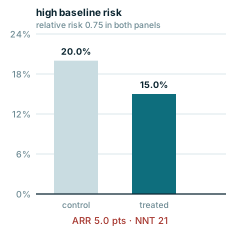
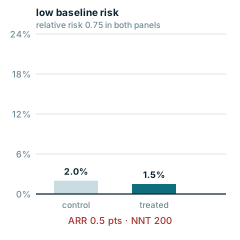
- Absolute vs Relative Risk Reduction
- Bradford Hill Considerations
- Confidence Interval (CI)
- Confounding
- Correlation vs Causation
- Effect Size
- External Validity (Generalisability)
- Forest Plot
- Funnel Plot
- GRADE Certainty of Evidence
- HARKing (Hypothesising After Results Are Known)
- Hazard Ratio (HR)
- Heterogeneity (I²)
- Hierarchy of Evidence
- Mean Difference and Standardised Mean Difference
- Meta-Analysis
- Minimal Clinically Important Difference (MCID)
- Multiplicity and Subgroup Analysis
- Number Needed to Harm (NNH)
- Number Needed to Treat (NNT)
- Odds Ratio (OR)
- P-Hacking
- P-Value
- Post Hoc Analysis
- Precision of an Estimate
- Preregistration
- Publication Bias
- Recall Bias
- Regression to the Mean
- Reproducibility and Replication
- Risk Ratio (Relative Risk)
- Selection Bias
- Statistical vs Clinical Significance
- Systematic Review
Formulation & Delivery
34 termsRoute, formulation and handling decide how much of a dose reaches circulation and how stable it is on the way. This section covers the vocabulary of dosage forms and storage — it describes how these things work, and deliberately publishes no dosing instructions.
- Adsorption to Container Surfaces
- Autoinjector
- Bacteriostatic Water vs Sterile Water
- Benzyl Alcohol Preservative
- Beyond-Use Date (BUD)
- Buffer and pH Adjustment
- Cold Chain and Refrigerated Storage
- Depot Formulation
- Diluent
- Excipient
- Injection Site Rotation
- Intramuscular Injection (IM)
- Intranasal Delivery
- Intravenous Administration (IV)
- Isotonicity
- Lyophilized Powder
- Needle Gauge and Length
- Oral Peptide Delivery
- Pen Injector
- Permeation Enhancer
- Prefilled Syringe
- Reconstitution
- Room-Temperature Stability
- Shaking and Interfacial Denaturation
- Silicone Oil
- Single-Dose vs Multi-Dose Vial
- Subcutaneous Implant
- Subcutaneous Injection (SC)
- Sublingual and Buccal Delivery
- Surfactant Stabilizer (Polysorbate)
- Syringe Unit Markings vs Volume
- Tonicity Agent
- Transdermal Delivery
- Visual Particulate Inspection
Growth Hormone Axis
34 termsThe somatotropic axis is tightly regulated by feedback and released in pulses, which is why stimulating it and replacing it are not the same intervention. Much of the marketing around this category depends on eliding that difference.
- Acid-Labile Subunit (ALS)
- Acromegaly
- Adult Growth Hormone Deficiency (AGHD)
- Anti-Ageing GH Claims
- Epiphyseal Closure
- Exogenous GH vs Endogenous Stimulation
- GH Doping Detection
- GH Stimulation Test
- GH-Induced Insulin Resistance
- GH-Mediated Lipolysis
- GH-Related Fluid Retention and Carpal Tunnel Syndrome
- Ghrelin
- GHRH Analogue
- Growth Hormone (GH)
- Growth Hormone Receptor (GHR)
- Growth Hormone Secretagogue (GHS)
- Growth Hormone Secretagogue Receptor (GHS-R1a)
- Growth Hormone-Releasing Hormone (GHRH)
- Growth Hormone-Releasing Peptide (GHRP)
- Hypothalamic-Pituitary-Somatotropic Axis
- IGF-1 Negative Feedback
- IGF-1 Standard Deviation Score (IGF-1 SDS)
- Insulin Tolerance Test (ITT)
- Insulin-Like Growth Factor 1 (IGF-1)
- Insulin-Like Growth Factor Binding Protein 3 (IGFBP-3)
- Nitrogen Balance
- Nocturnal GH Pulse
- Oral Glucose GH Suppression Test
- Prolactin and Cortisol Cross-Stimulation
- Pulsatile GH Secretion
- Secretagogue Desensitisation
- Somatostatin
- Somatostatin Analogue
- Somatotroph
Hormonal & Reproductive
34 termsEndocrine axes are feedback systems, so intervening at one point moves several others. These terms cover the axes, the assays used to read them, and the recovery questions that follow any suppression.
- Adrenocorticotropic Hormone (ACTH)
- Aromatization
- Axis Suppression
- Cortisol
- Estradiol (E2)
- Follicle-Stimulating Hormone (FSH)
- Free vs Total Hormone
- GnRH Agonist vs Antagonist
- GnRH Pulsatility
- Gonadotropin-Releasing Hormone (GnRH)
- Hormone Assay Interference
- Human Chorionic Gonadotropin (hCG)
- Hypothalamic-Pituitary-Adrenal (HPA) Axis
- Hypothalamic-Pituitary-Gonadal (HPG) Axis
- Hypothalamic-Pituitary-Thyroid (HPT) Axis
- Kisspeptin
- Luteinizing Hormone (LH)
- MC3R vs MC4R
- Melanocortin System
- Menopause and Andropause
- Menstrual Cycle Phases
- Negative Feedback (Endocrine)
- Ovulation Induction
- Oxytocin
- Post-Cycle Axis Recovery
- Primary vs Secondary Hypogonadism
- Prolactin
- Sex Hormone-Binding Globulin (SHBG)
- Sexual Desire vs Arousal
- Spermatogenesis
- Testosterone
- Thyroid Hormones (T3 and T4)
- Thyroid-Stimulating Hormone (TSH)
- Vasopressin
Immune & Inflammatory
34 termsImmune vocabulary is borrowed heavily by peptide marketing, usually without the qualifiers. These entries define the mechanisms precisely enough that you can tell a described mechanism from a demonstrated effect.
- Acute vs Chronic Inflammation
- Adaptive Immunity
- Antibody (Immunoglobulin)
- Antigen Presentation
- Antimicrobial Peptide (AMP)
- Autoimmunity
- Biofilm
- C-Reactive Protein (CRP)
- Chemokine
- Complement System
- Cytokine
- Cytokine Storm
- Defensin
- Endotoxin (Lipopolysaccharide)
- Erythrocyte Sedimentation Rate (ESR)
- Immunomodulation
- Immunosenescence
- Immunosuppression
- Innate Immunity
- Interferon
- Interleukin
- Macrophage Polarisation
- Major Histocompatibility Complex (MHC)
- Mast Cell Degranulation
- Membrane Disruption
- Natural Killer Cell (NK Cell)
- Nuclear Factor Kappa B (NF-kB)
- Regulatory T Cell (Treg)
- T Cell
- Th1/Th2 Balance
- Thymic Peptide
- Thymus
- Toll-Like Receptor (TLR)
- Tumour Necrosis Factor Alpha (TNF-alpha)
Manufacturing & Analysis
37 termsHow a peptide is made and what a test can actually prove about the vial in front of you. A purity figure is a narrower claim than most readers assume, and several of the things buyers most want verified are not what the certificate reports.
- Analytical Counterfeit Detection
- Average vs Monoisotopic Mass
- Batch and Lot Number
- Bioburden
- Boc Chemistry
- CAS Registry Number
- Certificate of Analysis (COA)
- Chemical Database Identifiers (PubChem, DrugBank, UniProt, InChIKey)
- Cleavage and Deprotection
- Cold Chain
- Coupling Reagent
- Crude vs Purified Peptide
- Deletion Sequence
- Diastereomer Impurity
- Endotoxin Testing
- Fmoc Chemistry
- Forced Degradation Study
- Good Manufacturing Practice (GMP)
- High-Performance Liquid Chromatography (HPLC)
- Limulus Amebocyte Lysate (LAL) Assay
- Liquid-Phase Peptide Synthesis (LPPS)
- Lyophilisation
- Mass Spectrometry Identity Confirmation
- Net Peptide Content
- Potency Assay
- Purity Percentage
- Recombinant Expression
- Residual Solvents
- Reversed-Phase HPLC (RP-HPLC)
- Solid-Phase Peptide Synthesis (SPPS)
- Stability Testing
- Sterility Testing
- Synthesis Resin
- Trifluoroacetate (TFA) Counterion
- Truncated Sequence
- USP and Compendial Standards
- Water Content by Karl Fischer
Metabolic & Incretin Biology
33 termsThe biology the incretin drugs act on, and the measurements used to judge them. Understanding why glucose-dependent insulin release behaves differently from insulin itself explains most of what is distinctive about this drug class.
- Adiposity
- Amylin
- Body Mass Index (BMI)
- Body Weight Set Point
- Dipeptidyl Peptidase-4 (DPP-4)
- Dyslipidaemia
- Enteroendocrine L-Cell
- Euglycaemia
- Fasting and Postprandial Glucose
- Food Noise
- Gastric Emptying
- Glucagon
- Glucagon-Like Peptide-1 (GLP-1)
- Glucose-Dependent Insulin Secretion
- Glucose-Dependent Insulinotropic Polypeptide (GIP)
- Glycaemic Variability
- Glycated Haemoglobin (HbA1c)
- Homeostatic Model Assessment of Insulin Resistance (HOMA-IR)
- Hypoglycaemia
- Hypothalamic Appetite Circuits
- Insulin Resistance
- Lean Mass Loss
- Leptin
- Metabolic Adaptation
- Metabolic Dysfunction-Associated Steatohepatitis (MASH)
- Metabolic Dysfunction-Associated Steatotic Liver Disease (MASLD)
- Obesity as a Chronic Disease
- Resting Energy Expenditure (REE)
- Satiety vs Satiation
- The Incretin Effect
- Visceral Adipose Tissue (VAT)
- Waist Circumference
- Weight Regain
Neurology & Cognition
33 termsGetting a peptide into the brain is the hard problem this whole category orbits. Terms here cover the barrier itself, the signalling that gets claimed, and why so many compounds with striking rodent cognition data have gone nowhere in humans.
- Blood-Brain Barrier (BBB)
- Brain-Derived Neurotrophic Factor (BDNF)
- Central Nervous System (CNS) Penetration
- Cerebrospinal Fluid (CSF)
- Cholinergic Signalling
- Cognitive Endpoint
- Cortisol Awakening Response (CAR)
- Dopaminergic Signalling
- Excitotoxicity
- Glymphatic System
- Ischaemic Penumbra
- Long-Term Potentiation (LTP)
- Microglia
- Middle Cerebral Artery Occlusion (MCAO) Model
- Nerve Growth Factor (NGF)
- Neurodegeneration
- Neurogenesis
- Neuroinflammation
- Neuropeptidase
- Neuroplasticity
- Neuroprotection
- Neurotrophic Factor
- Nootropic
- Nose-to-Brain Delivery
- Orexin
- P-Glycoprotein (P-gp) Efflux
- Rodent Cognition Model
- Serotonergic Signalling
- Sleep Architecture
- Slow-Wave Sleep (SWS)
- Subjective Cognitive Decline (SCD)
- Synaptogenesis
- Traumatic Brain Injury (TBI)
Peptide Chemistry & Structure
46 termsAlmost every property a peptide has — how long it survives in plasma, whether it can be swallowed, whether the immune system notices it — traces back to its sequence and the modifications hung off it. These are the structural terms that spec sheets assume you already know.
- Aib (2-Aminoisobutyric Acid)
- Alpha Helix
- Amino Acid
- Amino Acid Residue
- Amino Acid Side Chain
- Amphipathicity
- Beta Sheet
- C-Terminal Amidation
- C-Terminus
- Cell-Penetrating Peptide (CPP)
- Chirality
- Counterion and Salt Form
- Cyclization and Cyclic Peptides
- D-Amino Acid Substitution
- Dalton (Da)
- Disulfide Bond
- Drug Affinity Complex (DAC)
- Fc Fusion Peptide
- Glycosylation
- Hydrophobicity
- Isoelectric Point (pI)
- Lipidation and Fatty Acid Acylation
- Metal Complex (Copper–Peptide Complex)
- Molecular Weight (MW)
- N-Terminal Acetylation
- N-Terminus
- Net Charge
- Non-Natural Amino Acid
- Norleucine (Nle)
- PEGylation
- Peptide Aggregation
- Peptide Backbone
- Peptide Bond
- Peptide Fragment and Residue-Range Notation
- Peptide Solubility
- Peptide Stapling
- Peptide vs Polypeptide vs Protein
- Phosphorylation
- Primary Structure
- Proteolytic Stability
- Pyroglutamate (pGlu) N-Terminus
- Retro-Inverso Peptide
- Secondary Structure
- Sequence Notation and Residue Numbering
- Side-Chain Modification
- Tertiary Structure
Pharmacokinetics & Dosing Concepts
34 termsPharmacokinetics is where peptide engineering shows its hand. The same peptide backbone can be cleared in two minutes or last a week depending on what has been done to it, and the numbers on a spec sheet only mean something once you know which quantity they name.
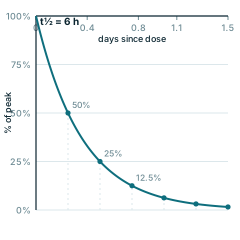
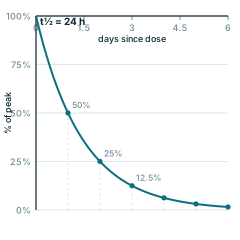
- Absorption Rate Constant
- Absorption, Distribution, Metabolism, and Excretion (ADME)
- Accumulation Ratio
- Area Under the Curve (AUC)
- Bioavailability
- Compartmental Model
- Depot Release
- Dose Proportionality
- Dose Titration
- Dosing Interval
- DPP-4 Cleavage
- Drug Clearance (CL)
- Effective Half-Life
- Enzymatic Degradation
- Exposure-Response Relationship
- First-Order Elimination
- First-Pass Metabolism
- Flip-Flop Kinetics
- Hepatic Metabolism
- Loading Dose
- Maintenance Dose
- Peak Plasma Concentration (Cmax)
- Peak-to-Trough Ratio
- PK/PD Relationship
- Plasma Protein Binding
- Renal Elimination
- Steady State
- Terminal Half-Life
- Therapeutic Window
- Time to Peak Concentration (Tmax)
- Trough Concentration (Cmin)
- Volume of Distribution
- Washout Period
- Zero-Order Elimination
Pharmacology & Mechanism
34 termsWhat a molecule does at its receptor, and the vocabulary for saying it precisely. The distinctions here are the ones marketing copy most often collapses: potency is not efficacy, affinity is not activity, and a compound that binds is not thereby a compound that works.
- Agonist
- Allosteric Modulation
- Beta-Arrestin Signalling
- Biased Agonism
- Binding Affinity
- Competitive vs Non-Competitive Antagonism
- Dissociation Constant (Kd)
- Dose-Response Curve
- G Protein-Coupled Receptor (GPCR)
- Half-Maximal Effective Concentration (EC50)
- Half-Maximal Inhibitory Concentration (IC50)
- Inverse Agonist
- Ligand
- Maximal Effect (Emax)
- Mechanism of Action (MOA)
- Negative Feedback Loop
- Off-Target Activity
- Partial Agonist
- Peptide Analog
- Peptidomimetic
- Pharmacodynamics (PD)
- Potency vs Efficacy
- Prodrug
- Pulsatile vs Tonic Signalling
- Receptor Antagonist
- Receptor Desensitisation
- Receptor Downregulation
- Receptor Internalisation
- Receptor Occupancy
- Receptor Selectivity
- Second Messenger
- Secretagogue
- Synergy vs Additivity
- Tachyphylaxis
Regulation & Approval
34 termsApproved, cleared, authorised, compounded and unapproved are five different things, and the difference is the whole subject of this section. Regulatory positions move, so treat the mechanisms here as durable and the current status of any given compound as something to check.
- 503A Compounding
- 503B Outsourcing Facility
- 505(b)(2) Pathway
- Abbreviated New Drug Application (ANDA)
- Accelerated Approval and Confirmatory Trials
- Approved vs Cleared vs Authorised
- Biologic vs Small Molecule and the Peptide Boundary
- Biologics License Application (BLA)
- Biosimilar
- Breakthrough Therapy Designation
- Bulk Drug Substances Lists
- Controlled Substance Scheduling
- Dietary Supplement Health and Education Act (DSHEA)
- European Medicines Agency (EMA)
- Fast Track Designation
- FDA Drug Shortage List
- Food and Drug Administration (FDA)
- FTC Advertising Enforcement
- Generic vs Follow-On Peptide
- Import Alert
- International Regulatory Divergence
- Investigational New Drug (IND) Application
- Medicines and Healthcare Products Regulatory Agency (MHRA)
- New Dietary Ingredient (NDI) Notification
- New Drug Application (NDA)
- Off-Label Use
- Orphan Drug Designation
- Prescribing Information and the Label
- Prescription-Only Status (Rx-Only)
- Priority Review
- Regulatory Exclusivity
- Structure/Function Claim
- Unapproved New Drug
- Warning Letter
Safety & Pharmacovigilance
32 termsHarm is characterised, coded and reported through a specific machinery, and knowing that machinery tells you what the absence of a reported signal does and does not mean. These terms cover adverse events, monitoring, and the limits of spontaneous reporting.
- Adverse Drug Reaction (ADR)
- Adverse Event (AE)
- Anaphylaxis
- Anti-Drug Antibodies (ADA)
- Boxed Warning
- Carcinogenicity Signal
- Causality Assessment
- Contraindication vs Precaution
- Dose-Limiting Toxicity (DLT)
- Drug-Drug Interaction (DDI)
- FDA Adverse Event Reporting System (FAERS)
- Hypersensitivity Reaction
- Immunogenicity
- Injection-Site Reaction (ISR)
- Medical Dictionary for Regulatory Activities (MedDRA)
- Monitoring Parameters
- Neutralising Antibodies (NAbs)
- Off-Target Toxicity
- Pharmacovigilance
- Post-Marketing Surveillance
- Pregnancy Labelling Categories
- Renal and Hepatic Dose Adjustment
- Risk Evaluation and Mitigation Strategy (REMS)
- Safety Signal Detection
- Self-Experimentation Risk
- Serious Adverse Event (SAE)
- Sterile Abscess
- Teratogenicity
- Therapeutic Index
- Treatment-Emergent Adverse Event (TEAE)
- Withdrawal and Rebound
- Yellow Card Scheme
Sourcing, Markets & Misuse
34 termsHow peptides actually reach people, and where that supply chain fails them. These entries describe the market and its failure modes; none of them is a guide to obtaining anything, and pepteyes.com links to no supplier.
- Adulteration
- Anti-Doping Rule Violation (ADRV)
- Athlete Biological Passport (ABP)
- Biohacking
- Certificate of Analysis Forgery
- Compounding Pharmacy Sourcing
- Conflict of Interest Disclosure
- Counterfeit Medicine
- Direct-to-Consumer Marketing
- Drug Shortage Arbitrage
- Grey Market
- Harm Reduction versus Promotion
- In-Competition vs Out-of-Competition Testing
- Influencer Promotion
- Insurance Coverage and Cash-Pay Models
- Medical Tourism
- Peptide and Wellness Clinics
- Personal Importation
- Price per Milligram
- Product Substitution
- Research Chemical Market
- Research Use Only (RUO) Labeling
- Self-Experimentation
- Sports Supplement Contamination
- Substandard and Falsified Medical Products
- Telehealth Prescribing
- Testimonial and Anecdote as Evidence
- Therapeutic Use Exemption (TUE)
- Third-Party Testing
- Underdosed and Overdosed Product
- Undisclosed Affiliation and Affiliate Marketing
- Unregulated Online Marketplace
- Vendor Sponsorship in Health Media
- WADA Prohibited List
Tissue Repair & Musculoskeletal
34 termsThis is the category with the widest gap between what is claimed and what has been shown in humans. The biology of healing is well described; the evidence that any given peptide accelerates it in people is, for most compounds here, thin or absent.
- Angiogenesis
- Animal Tendon Model
- Articular Cartilage
- Bone Mineral Density (BMD)
- Bone Remodelling
- Chondrocyte
- Collagen Type I
- Collagen Type III
- Delayed Union and Nonunion
- Delayed-Onset Muscle Soreness (DOMS)
- Disuse Atrophy
- Enthesis
- Extracellular Matrix (ECM)
- Fibroblast
- Fibrosis
- Granulation Tissue
- Growth Factors in Healing
- Inflammatory Phase
- Ligament
- Matrix Metalloproteinase (MMP)
- Muscle Hypertrophy
- Muscle Protein Synthesis (MPS)
- Myostatin
- Nitric Oxide
- Osteoarthritis
- Osteoblast
- Osteoclast
- Phases of Wound Healing
- Satellite Cell
- Scar Remodelling
- Tendinopathy vs Tendonitis
- Tendon Structure
- Tissue Perfusion
- Vascular Endothelial Growth Factor (VEGF)