Number Needed to Harm (NNH)
Number needed to harm is the number of patients who must receive a treatment for one additional person to suffer a specified adverse outcome, the reciprocal of the absolute risk increase.
Number needed to harm is the reciprocal of the absolute risk increase, the arithmetic of number needed to treat pointed at an unwanted outcome. If a harm occurs in 7 percent of treated participants and 3 percent of controls, the absolute increase is 4 percentage points and the NNH is 1 divided by 0.04, or 25 people treated for the trial's duration per extra event. The figure means nothing without its time horizon and population attached, since both risks accumulate with exposure.
Gastrointestinal intolerance in the GLP-1 receptor agonist trials shows the calculation at a scale that is easy to check. In the 68-week STEP 1 trial of weekly semaglutide 2.4 mg, discontinuation for adverse events ran at roughly 7 percent on drug against roughly 3 percent on placebo, putting the NNH for stopping treatment in the mid-twenties. Rarer labelled signals such as gallbladder disease give NNH values orders of magnitude larger and far less precisely estimated.
NNH earns its keep beside NNT over the same horizon, in the same population, with the severity of each outcome stated. An NNT of 60 for a prevented myocardial infarction against an NNH of 25 for transient nausea is a favourable trade; the same numbers with the outcomes swapped are not favourable. Both quantities move with baseline risk, so a benefit-harm balance struck in a high-risk trial population does not transfer to a lower-risk one.
Two misreadings recur. A large or undefined NNH is read as reassurance, when a trial recording no events of a rare harm supports only an upper bound: by the rule of three, zero events in 200 people is compatible with a true rate near 1.5 percent. The second is comparing an NNH from a short trial with an NNT from a long one, which credits the drug with years of benefit while charging it weeks of risk.
Worked examples — the same relative risk, two different stories
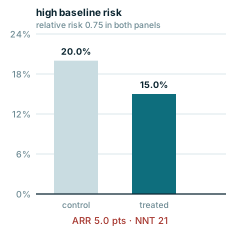
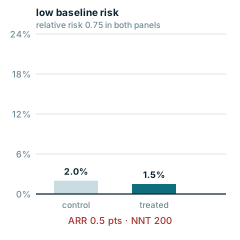
Both panels apply an identical relative risk of 0.75 — a headline "25% reduction". Only the baseline risk differs, and the absolute benefit differs seventeen-fold with it. NNT = 1 ÷ ARR is where that difference becomes visible.
Every panel is redrawn from its own equation by scripts/glossary-figures.js — no traced or stock artwork, and a rebuild is byte-identical.