Peptide Reconstitution Calculator
Enter what is in the vial, how much bacteriostatic water you are adding, the dose you have been given and how often you take it. This works out the concentration, the exact reading on a U-100 insulin syringe, how many doses the vial holds and how long it lasts. It does not recommend a dose — that number has to come from a prescriber. If you choose a peptide, the figures from its protocol on our Cheat Sheet are filled in so you can see them on a syringe. They are community figures, not a recommendation.
Simple mode
Choosing one fills in the vial, water, schedule and dose steps from its protocol on our Cheat Sheet. They are community figures, not a recommendation. Change any of them to match your own vial and prescription.
What size is your syringe?
How much peptide is in the vial?
How much bacteriostatic water are you adding?
How often is a dose?
How much peptide in each daily dose?
Dose steps in this protocol
These are round numbers for quick entry, not recommended doses. The dose has to come from whoever is prescribing it. 1 mg is 1000 mcg — the switch above only changes how you type it, never the amount.
To have a dose of 250 mcg, pull the syringe to 5
250 mcg is the same as 0.25 mg
The vial holds 40 whole doses, but at this frequency only 28 fall inside a 28-day window — 12 would be discarded unused.
Work backwards: how much water should I add?
The other way round. You know what is in the vial and what your dose is, and you have decided what each shot should read on the syringe. This works out the diluent volume that produces exactly that — the calculation most often got wrong by hand, and the one a forward-only calculator cannot answer at all.
The dose is yours to supply. This tool converts it; it does not suggest one.
Add
2 mL of bacteriostatic water
That makes 5 mg in every 1 mL, so a 1 mg dose is 0.2 mL — which reads 20 units.
If a round number is easier to measure
An exact figure is not always easy to draw accurately. These are the nearby round volumes and what each would make your shot read instead.
| Water added | Concentration | Your shot reads |
|---|---|---|
| 0.5 mL | 20 mg/mL | 5 units |
| 1 mL | 10 mg/mL | 10 units |
| 1.5 mL | 6.6667 mg/mL | 15 units |
| 2 mL exact | 5 mg/mL | 20 units |
| 2.5 mL | 4 mg/mL | 25 units |
| 3 mL | 3.3333 mg/mL | 30 units |
| 4 mL | 2.5 mg/mL | 40 units |
| 5 mL | 2 mg/mL | 50 units |
The arithmetic, so you can check it
- A shot of 20 units is 0.2 mL, because one unit on a U-100 syringe is 0.01 mL.
- You want 1 mg to fit in that 0.2 mL, so the liquid has to be 5 mg per mL.
- The vial holds 10 mg, so it needs 10 ÷ 5 = 2 mL of water.
In one line: water = vial × units ÷ (dose × 100)
A worked example. A 60 mg vial, a 15 mg dose, and you want each shot to read 30 units. Thirty units is 0.3 mL, so the liquid must be 15 ÷ 0.3 = 50 mg/mL, so you add 60 ÷ 50 = 1.2 mL. Adding 1 mL instead would give 60 mg/mL, making a 15 mg dose 0.25 mL — a 25-unit shot, not 30.
The vial holds 40 whole doses, but at this frequency only 28 fall inside a 28-day window — 12 would be discarded unused.
In plain words
The same answer without the jargon. Every line below updates as you change the numbers above.
- 1Your bottle holds 10 mg of dry powder.
- 2You mixed it with 2 mL of bacteriostatic water.
- 3So the liquid is 5 mg in every 1 mL. One unit on the syringe holds 50 mcg.
- 4For your 250 mcg dose you need 0.05 mL of the liquid — which is 5 units on a U-100 insulin syringe. Not 0.05 units, and not 5 mL. Units and millilitres are different things.
- 5The bottle contains 40 whole doses (10 mg ÷ 0.25 mg per dose). At 7 a week that is 40 days of doses.
- 6The real-world limit. Once mixed, if you discard the vial after 28 days you would use 28 of those 40 doses and throw the rest away. How long a mixed vial keeps is set by the product's label, not by this arithmetic. Many multi-dose products state a window measured in weeks. A compound with no approval has no established figure at all — nobody has run the stability or sterility work that would produce one.
The three mistakes people actually make
- Reading units as millilitres. On a U-100 syringe one unit is 0.01 mL. Drawing to "0.2" on a unit scale when you meant 0.2 mL gives you a fiftieth of the dose; the reverse gives you fifty times it.
- Thinking more water means a weaker dose. It does not. The bottle holds the same milligrams whatever you dissolve them in. More water simply means you draw more units to get the same amount.
- Planning around the arithmetic instead of the label. The maths will happily tell you a vial holds forty doses. Whether the liquid is still fit to use by then is a completely separate question, and the answer is on the product's label if it has one.
The same vial and dose, at four diluent volumes
This is the comparison people actually want: what changes if you use 1 mL instead of 2. The dose is identical in every row. Only the reading on the syringe moves.
| Water added | Concentration | One unit holds | Your dose is |
|---|---|---|---|
| 1 mL | 10 mg/mL | 100 mcg | 2.5 units |
| 2 mL | 5 mg/mL | 50 mcg | 5 units |
| 3 mL | 3.3333 mg/mL | 33.33 mcg | 7.5 units |
| 5 mL | 2 mg/mL | 20 mcg | 12.5 units |
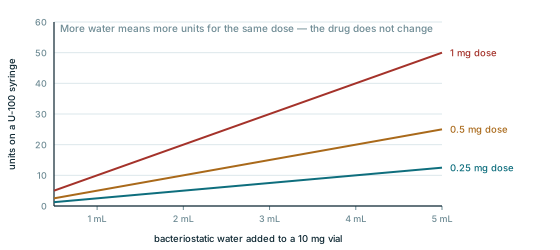
What reconstitution actually changes
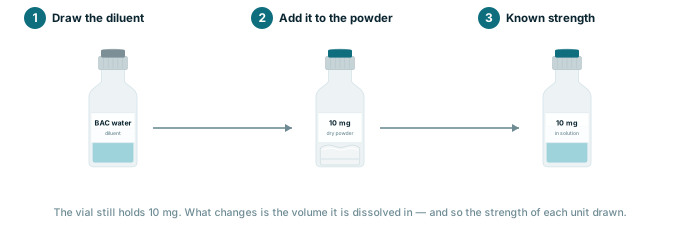
A lyophilised vial holds a fixed mass of peptide as a dry cake. Adding bacteriostatic water dissolves it and creates a solution of known strength. The mass in the vial never changes. What the diluent volume decides is the concentration, and therefore how far along the syringe barrel a given dose sits.
That is why the choice of 1 mL versus 2 mL is not a question about potency. It is a question about whether the dose you need lands somewhere you can read accurately. A dose that works out to 1.2 units on a syringe graduated every 2 units cannot be measured; the same dose at half the concentration is 2.4 units, which still cannot be read precisely, and at a quarter it is 4.8 units, which can.
The number that goes wrong: units are not millilitres
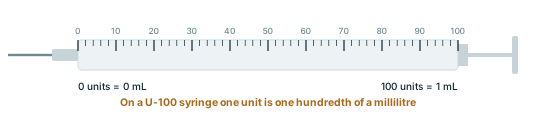
On a U-100 syringe, one unit is one hundredth of a millilitre. A calculation that produces "0.25 mL" and a syringe reading of "25 units" describe the same volume. Reading one as the other is a hundred-fold error in whichever direction it is made, and it is not a hypothetical: regulators have attributed reported overdoses of self-measured injectable products to people drawing to a millilitre figure on a unit scale.
The safeguard is to work in one currency and check the other. If the calculator says 5 units, that is 0.05 mL, which is a twentieth of a 1 mL syringe — a short draw near the bottom of the barrel. If that does not match what you are looking at, the arithmetic and the syringe disagree, and the arithmetic is not the thing to trust blindly.
The arithmetic, if you want to check it
Concentration is the vial amount divided by the diluent volume. Dose volume is the dose divided by that concentration. Units are that volume multiplied by one hundred. Doses per vial is the vial amount divided by the dose, rounded down, because a partial dose left at the bottom is not a dose.
Worked through with the defaults on this page: 10 mg into 2 mL is 5 mg/mL. A 250 microgram dose is 0.25 mg, and 0.25 divided by 5 is 0.05 mL. Multiplied by one hundred that is 5 units. The vial holds 10 divided by 0.25, which is 40 whole doses, and at seven a week that is a little under six weeks — assuming the solution is still sound that long, which is a separate question the arithmetic cannot answer.
What this calculator cannot tell you
It cannot tell you what dose is appropriate, and it does not try. It has no per-compound presets for that reason: a suggested dose for a compound that has never completed a human trial is not a calculation, it is an invention. Many of the peptides people reconstitute are not approved for human use in any country, and for those there is no established human dose to look up.
It also knows nothing about sterility, about how long a reconstituted vial remains usable, about whether the vial contains what the label claims, or about how much of the labelled mass is peptide rather than counterion and water. Those are the questions that decide whether the number on the syringe means anything, and they are covered elsewhere on this site.
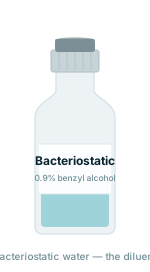
The two vials
Common questions
If I put 1 mL of bacteriostatic water into a 10 mg vial, how many units is one dose?
Does adding more water make the dose weaker?
What is the difference between a unit and a millilitre?
How many doses will one vial give me?
How much bacteriostatic water should I use?
Does this calculator tell me what dose to take?
Is bacteriostatic water the same as sterile water?
This is an arithmetic tool, not medical advice. It converts a dose you supply into a syringe reading and nothing more. It does not tell you what to take, whether to take it, or whether obtaining it is lawful where you are. Many compounds people reconstitute have never been approved for human use anywhere. Speak to a qualified healthcare professional who knows your history, and never rely on a number from a web page for something you are about to inject.