Pharmacokinetics & Dosing Concepts
Loading Dose
A loading dose is a larger initial amount given to fill the volume of distribution and reach the target concentration at once, instead of waiting several half-lives for accumulation.
A loading dose exists to solve a timing problem. Concentration after a single dose is set by the volume of distribution, so the amount needed to reach a target concentration immediately is that target multiplied by the volume, adjusted for bioavailability. Clearance does not appear in the calculation at all, which is the useful part: the loading dose depends on how widely a drug spreads, while the maintenance dose depends on how fast it is removed.
Loading is standard where the wait would be clinically unacceptable and the drug tolerates a high peak, as with vancomycin in serious infection or with amiodarone. Therapeutic peptides are usually the opposite case. Incretin analogues were introduced by stepwise escalation over weeks in the trials supporting their approval, because gastrointestinal tolerability rather than plasma accumulation is the limiting factor. Escalation and loading pull in opposite directions.
The decision turns on comparing half-life with urgency. Four to five half-lives to the plateau is negligible for a drug cleared in hours and means more than a month for one with a week-long half-life. Against that, a loading dose deliberately produces the highest peak the patient will ever see, so it is defensible only when harm tracks total exposure rather than peak concentration.
In peptide forums, front-loading is presented as a way to reach the benefit sooner, and it generally is not. A loading dose raises concentration faster but does not raise the eventual steady state, and where response is limited by receptor adaptation or by tolerability the plasma curve was never the constraint. It also concentrates every concentration-related adverse effect into the first dose.
Worked examples — accumulation to steady state
Repeat doses are summed by superposition: every dose still in the body keeps decaying while the next one lands. Peak and trough have closed forms — 1/(1−e^(−kτ)) and that value times e^(−kτ) — so the plateau height is set entirely by the dosing interval relative to the half-life.
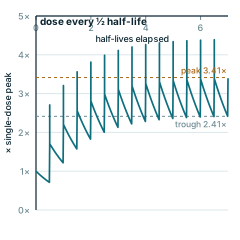
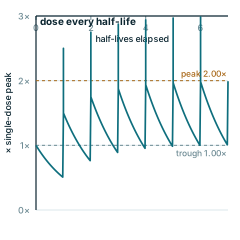
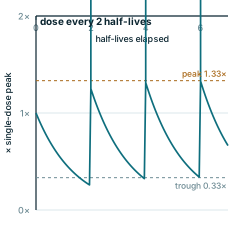
Every panel is redrawn from its own equation by scripts/glossary-figures.js — no traced or stock artwork, and a rebuild is byte-identical.