Pharmacokinetics & Dosing Concepts
Terminal Half-Life
Terminal half-life is the time taken for drug concentration to fall by half during the final, slowest phase of elimination, and it sets the dosing interval.
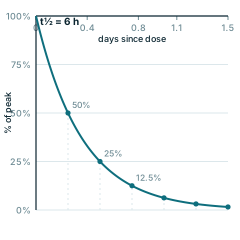
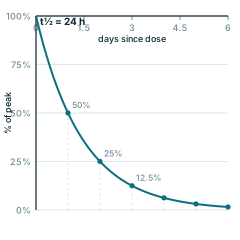
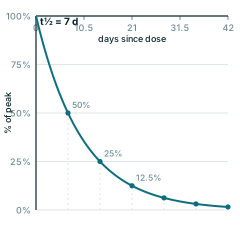
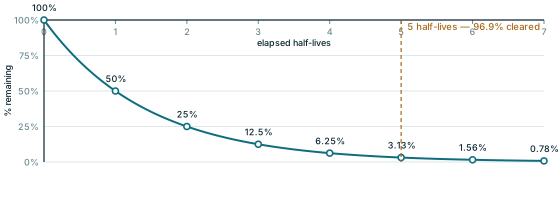
Terminal half-life is the time it takes for the concentration of a drug in plasma to fall by half once the slowest elimination phase has taken over. It is derived, not measured: ln2 divided by the elimination rate constant, which is why it comes out the same whether you start from a peak or from a trough. Because the decline is exponential, the same fraction disappears in every interval — half gone after one half-life, three quarters after two, and about 97 percent after five, which is the arithmetic behind the usual washout convention.
The spread across peptides is enormous. Native GLP-1 is cleared in roughly two minutes because DPP-4 cuts it almost immediately. Liraglutide, acylated with a C16 chain that binds albumin, lasts about 13 hours and is dosed daily. Semaglutide, carrying a C18 diacid and a substitution that blocks DPP-4, runs to roughly a week and is dosed weekly. The molecule is recognisably the same shape in all three cases; the half-life difference is engineering, not biology.
Half-life sets the dosing interval, how long accumulation takes to plateau, and how long a compound lingers after the last dose. Dosing at intervals far shorter than the half-life accumulates drug until input matches elimination; dosing far further apart barely accumulates at all and swings widely between peak and trough. The same number tells a surgeon how long a washout takes and an anti-doping laboratory how wide its detection window must be.
The common error is treating half-life as the duration of effect. They are different quantities and can diverge badly. A peptide that binds its receptor near-irreversibly, or that triggers a downstream change lasting days, keeps acting long after plasma concentrations have fallen away. Grey-market listings quoting a half-life as though it were a dosing schedule get this backwards, and often quote a rodent value at that.
Worked examples — first-order elimination
Each curve solves C(t) = C₀·e^(−kt) with k = ln2 ÷ t½. The dots mark successive half-lives, which is why the same fraction disappears in every interval regardless of where you start.
Every panel is redrawn from its own equation by scripts/glossary-figures.js — no traced or stock artwork, and a rebuild is byte-identical.