Pharmacokinetics & Dosing Concepts
First-Order Elimination
First-order elimination removes a constant fraction of the drug present per unit time, so the rate falls as concentration falls and the half-life stays the same at any dose.
Under first-order elimination the rate of removal is proportional to how much drug is there. The consequence is exponential decay: a fixed fraction disappears in each equal interval, so concentration halves in the same period whether the starting point is a peak or a trough. Plotted on a logarithmic axis the decline is a straight line whose slope is the elimination rate constant. This is what makes half-life a usable descriptor at all; under any other regime it would depend on the dose.
Peptides almost universally behave this way in the clinical range, because the systems clearing them are nowhere near saturation. Glomerular filtration is not saturable for a freely filtered molecule, and non-specific proteolysis has enormous capacity relative to therapeutic peptide concentrations. The contrast case is small-molecule: ethanol saturates alcohol dehydrogenase and is eliminated at a fixed amount per hour regardless of concentration, and phenytoin crosses from proportional to saturated behaviour inside its own therapeutic range.
First-order behaviour is what licenses the arithmetic everyone uses. About ninety-seven percent of a dose is gone after five half-lives, and by symmetry a repeated regimen reaches about that share of its plateau in the same time, whatever the dose or interval.
The assumption breaks at both ends of the concentration range. In overdose, capacity-limited processes that were invisible at therapeutic levels saturate and elimination slows disproportionately. At the low end, target-mediated disposition does the reverse: when receptor binding is a significant clearance route, that route saturates at higher concentrations, so clearance is fastest when little drug is present and the apparent half-life shortens at low concentrations. A half-life quoted from one dose level therefore need not hold at another.
Worked examples — first-order elimination
Each curve solves C(t) = C₀·e^(−kt) with k = ln2 ÷ t½. The dots mark successive half-lives, which is why the same fraction disappears in every interval regardless of where you start.
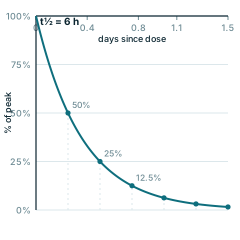
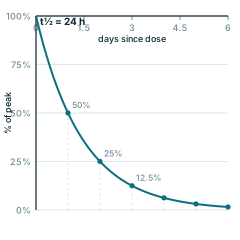
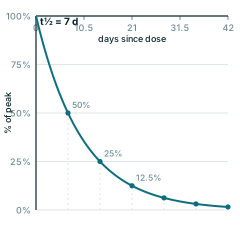
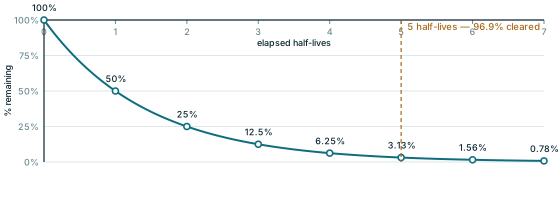
Every panel is redrawn from its own equation by scripts/glossary-figures.js — no traced or stock artwork, and a rebuild is byte-identical.