Pharmacokinetics & Dosing Concepts
Washout Period
A washout period is a drug-free interval long enough for concentrations, and ideally effects, to fall to a level that no longer influences whatever comes next.
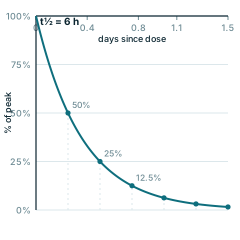
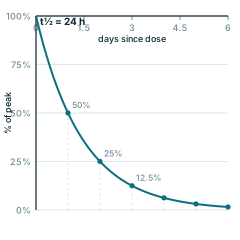
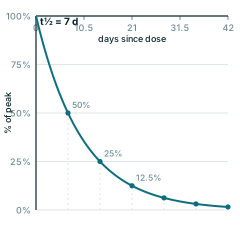
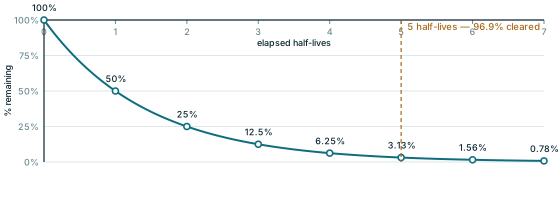
A washout period is the interval during which no drug is given so that what remains from earlier exposure stops mattering. The arithmetic is exponential decay: about 97 percent of a dose is gone after five half-lives and 99 percent after seven, which is where the conventional five-half-life washout comes from. The convention assumes the terminal half-life is the relevant one, that elimination is first order, and that no depot is still releasing drug.
In crossover trials the washout separates treatment periods so the first sequence does not contaminate the second, and its adequacy is tested by looking for carryover in the data. In clinical practice the same calculation appears as a discontinuation interval: semaglutide labelling advises stopping at least two months before a planned pregnancy, far longer than five half-lives precisely because the margin is deliberate.
The length that matters is whichever is longer, the pharmacokinetic washout or the pharmacodynamic one. Receptor downregulation, anti-drug antibodies and physiological adaptation each persist on their own timetable, and a crossover design that clears the molecule but not its effect has washed out nothing useful. Anti-doping detection windows pose the inverse question, asking how long a compound remains findable rather than how long it remains active.
Applying the five-half-life rule to a depot formulation is the frequent error, because the depot rather than the molecule sets the decline and the relevant half-life is the apparent one. The larger misconception is that a washout resets the system. Withdrawal of semaglutide in the STEP 4 trial was followed by weight regain, which is physiology reasserting itself rather than a pharmacokinetic effect.
Worked examples — first-order elimination
Each curve solves C(t) = C₀·e^(−kt) with k = ln2 ÷ t½. The dots mark successive half-lives, which is why the same fraction disappears in every interval regardless of where you start.
Every panel is redrawn from its own equation by scripts/glossary-figures.js — no traced or stock artwork, and a rebuild is byte-identical.