Pharmacokinetics & Dosing Concepts
Flip-Flop Kinetics
Flip-flop kinetics describes a drug absorbed more slowly than it is eliminated, so its apparent terminal half-life measures release from the injection site rather than clearance by the body.
Flip-flop kinetics is what happens when a drug reaches the circulation more slowly than the body removes it. In a model with first-order input and output, the terminal slope of the curve always belongs to the smaller of the two rate constants. Normally absorption is far faster, so that slope is elimination. Reverse the ranking and the constants swap roles: the apparent terminal half-life is now measuring the depot, and true elimination is hidden in the early part of the curve.
Long-acting subcutaneous products make this routine rather than exotic. Insulin degludec forms soluble multihexamers in the tissue that dissolve slowly, giving an apparent half-life near 25 hours for a molecule the circulation clears far faster. Extended-release exenatide microspheres deliver drug as the polymer erodes over weeks, while the immediate-release form is gone in hours. Semaglutide is the counterexample: its slow decline is real elimination, driven by albumin binding.
The distinction decides what the half-life predicts. If the terminal slope is absorption, renal or hepatic impairment will not lengthen it, and reformulating the depot changes the number without touching the molecule. Clearance cannot be estimated from that slope either, because the fitted parameter is describing the injection site rather than any organ.
The recurring error is quoting a subcutaneous half-life as an intrinsic property of the peptide and citing it as evidence of proteolytic stability. A slow depot says nothing about how fast plasma peptidases work. The companion mistake is comparing a subcutaneous number from one source with an intravenous number from another and calling the difference an improvement.
Worked examples — absorption shapes
All three solve the Bateman function, C(t) ∝ e^(−ke·t) − e^(−ka·t), and differ only in the ratio of absorption to elimination rate. Tmax is not a property you choose; it falls out as ln(ka/ke)/(ka−ke). The shaded area is AUC, the exposure the body actually sees.
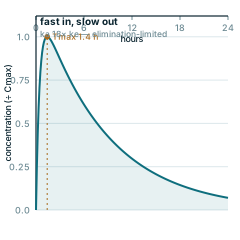
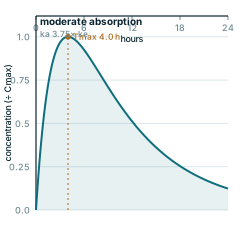
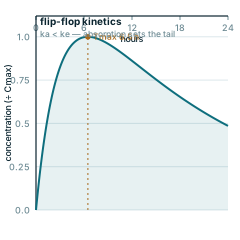
Every panel is redrawn from its own equation by scripts/glossary-figures.js — no traced or stock artwork, and a rebuild is byte-identical.