Pharmacokinetics & Dosing Concepts
Depot Release
Depot release is the slow, formulation-controlled escape of drug from a reservoir left at the injection site, making absorption rather than elimination the rate-limiting step.
An injection into subcutaneous tissue or muscle leaves a local reservoir, and if the formulation is designed for it, that reservoir empties over weeks or months rather than hours. The controlling step is physical: dissolution of a poorly soluble salt, diffusion from a polymer matrix, erosion of a carrier, or precipitation at physiological pH. Because release is slower than the molecule's intrinsic clearance, plasma concentration tracks the depot rather than the elimination process, and the apparent half-life belongs to the formulation.
Approved products show the range of engineering involved. Leuprolide is supplied in polymer microsphere depots covering one to six months from a single injection. Octreotide long-acting release uses the same microsphere principle for monthly dosing of a peptide whose own half-life is measured in hours. Lanreotide instead forms a supersaturated aqueous gel that releases slowly without any polymer, and degarelix gels in situ after subcutaneous injection. Insulin glargine takes the precipitation route, dissolving out of a microcrystalline deposit formed at tissue pH.
This converts a short-lived molecule into a long-interval product without altering the molecule. A depot cannot be withdrawn. Once injected, exposure continues on the formulation's timetable, so an adverse reaction to a multi-month depot is managed rather than stopped.
The term gets stretched to cover any slow-acting injection. An albumin-binding acylated peptide is not a depot product: it is long-acting because binding shields it from filtration and slows clearance, and it can be stopped by omitting the next dose. Depot products also frequently show an initial burst as surface-associated drug releases quickly, so the first days after injection are not representative of the interval that follows.
Worked examples — absorption shapes
All three solve the Bateman function, C(t) ∝ e^(−ke·t) − e^(−ka·t), and differ only in the ratio of absorption to elimination rate. Tmax is not a property you choose; it falls out as ln(ka/ke)/(ka−ke). The shaded area is AUC, the exposure the body actually sees.
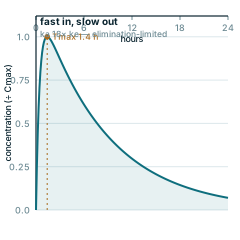
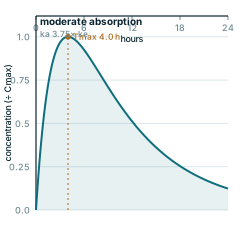
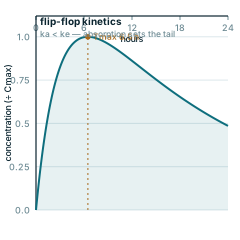
Every panel is redrawn from its own equation by scripts/glossary-figures.js — no traced or stock artwork, and a rebuild is byte-identical.