Systematic Review
A systematic review answers a defined question using a prespecified protocol, an explicit multi-database search, stated eligibility criteria and formal risk-of-bias assessment, unlike a narrative review.
What makes a review systematic is its protocol, written and ideally registered before searching begins. It states the question as a population, intervention, comparator and outcome; the databases and search strings; the eligibility criteria; the process by which two reviewers screen and extract independently; and the risk-of-bias tool, commonly Cochrane's RoB 2 for randomised trials or ROBINS-I for non-randomised ones. Meta-analysis is optional and separate: a review may find the studies too heterogeneous or too few to pool, and should then say so.
The surrounding infrastructure is standardised. PROSPERO registers review protocols in advance. The PRISMA 2020 statement supplies a reporting checklist and the flow diagram accounting for every record from search through screening to exclusion with reasons. A scoping review maps what literature exists without producing an effect estimate, and a narrative review is an expert essay in which the choice of studies is unrecorded.
What the method buys is a search someone else can repeat and exclusions someone else can inspect. What it cannot buy is certainty beyond its inputs. A flawless review of six small, unblinded, industry-funded trials yields a low-certainty conclusion, which is what GRADE ratings in a summary-of-findings table exist to say. A review concluding that no eligible studies were found is a real and useful result, not a failed project.
The label is applied loosely: marketing pages call a systematic review what is a narrative summary with no protocol, search string or exclusion count. Two checks pay off: whether the included studies are clinical at all, since reviews of research peptides often pool in-vitro and rodent work into an apparently clinical conclusion, and whether the risk-of-bias table has been read, because it frequently contradicts the abstract.
Worked example — how a meta-analysis pools trials
Six trials, each with real event counts. Log risk ratios and their Katz standard errors come straight from those counts; the weight of each box is inverse-variance, so the 2,050-patient trial moves the diamond and the 88-patient trial barely does. Cochran’s Q and I² are computed from the same numbers.
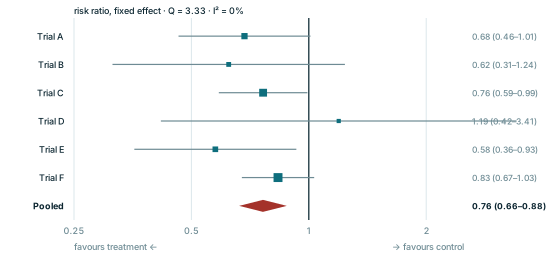
Every panel is redrawn from its own equation by scripts/glossary-figures.js — no traced or stock artwork, and a rebuild is byte-identical.