Publication Bias
Publication bias is the tendency for studies to reach the literature according to what they found rather than how well they were done, leaving the published record more favourable than the research conducted.
The mechanism is selection on results. Negative and null studies are submitted less often, published later, placed in smaller journals and cited less, while positive ones move quickly into print. The file drawer is the crudest version. Selective outcome reporting operates inside published papers, where endpoints that moved appear and those that did not are dropped. Time-lag bias delays unfavourable results by years, and duplicate publication lets one favourable dataset enter a meta-analysis twice.
The most complete measurement compared journals with regulators. Turner and colleagues in 2008 matched the antidepressant trials registered with the FDA to their publications: nearly all the trials the agency judged positive appeared in print, whereas of those judged negative or questionable, most went unpublished and several that did appear were written up as positive. The published literature implied that about 94 percent of trials succeeded; the FDA's review of the same trials put it near 51 percent.
This is why a meta-analysis inherits rather than repairs the bias of its inputs. Pooling a selected set of studies gives a precise estimate of a biased quantity, and the narrower interval makes the result more persuasive without making it more correct. It is also why searching registries, conference abstracts and regulatory review documents belongs to a competent systematic review.
The error to watch here is counting studies. When every published report on a research compound is small and positive, that consistency is what selection looks like, not what a real effect looks like, since genuinely studied interventions produce a scatter that includes null results. Ask instead what the registry lists that never reported.
Worked examples — what a censored literature looks like
Both panels start from the same 46 simulated trials drawn at their own standard errors around a true risk ratio of 0.82. The second panel simply withholds the small studies that came out null or unfavourable — exactly what publication bias does — and the funnel goes lopsided.
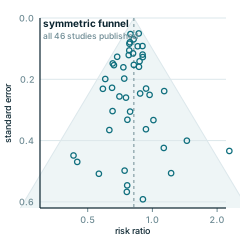
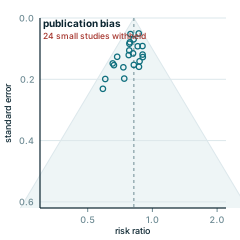
Every panel is redrawn from its own equation by scripts/glossary-figures.js — no traced or stock artwork, and a rebuild is byte-identical.