Preregistration
Preregistration is the public, timestamped deposit of a study's hypothesis, design, primary outcome and analysis plan before data are collected or unblinded, so the plan can be checked against the report.
A preregistration fixes the question, the design, the primary and secondary outcomes with their timing, the analysis population and the statistical methods, at a date a third party can verify. For clinical trials it is a registry entry, on ClinicalTrials.gov or a World Health Organization primary register. A registered report goes further: the protocol is peer reviewed and accepted for publication before results exist, so acceptance cannot depend on how they come out. Deviations remain permitted, but are visible as deviations.
The International Committee of Medical Journal Editors has required prospective registration as a condition of publication since 2005, and the FDA Amendments Act of 2007 added a results-reporting duty for applicable trials. The effect is documented: an analysis of large National Heart, Lung, and Blood Institute cardiovascular trials found that around 57 percent of those published before 2000 reported a benefit, against roughly 8 percent of those run after registration and prespecified analysis plans became the norm.
Preregistration turns an unfalsifiable claim about intent into a document. You can check whether the endpoint in the abstract is the endpoint in the registry, whether the follow-up matches, and whether registered outcomes are missing from the paper. Without that record, prespecified is an assertion no reader can test.
Treating the existence of a registry entry as a mark of quality is the common mistake. Entries are posted retrospectively, sometimes after the last participant was seen. Outcomes are entered so vaguely, changes in relevant biomarkers, that almost any result satisfies them. And a registration is a plan, not a result: a listed trial may have finished years ago, reported nothing, and still be cited as evidence a compound is being studied.
Worked examples — what a censored literature looks like
Both panels start from the same 46 simulated trials drawn at their own standard errors around a true risk ratio of 0.82. The second panel simply withholds the small studies that came out null or unfavourable — exactly what publication bias does — and the funnel goes lopsided.
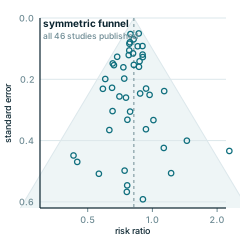
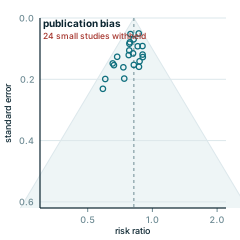
Every panel is redrawn from its own equation by scripts/glossary-figures.js — no traced or stock artwork, and a rebuild is byte-identical.