Precision of an Estimate
Precision is how tightly a study pins down its estimate, expressed by the width of the confidence interval, and it is separate from accuracy, which concerns whether the estimate is centred on the truth.
Precision is about random error alone. The standard error of a mean is the standard deviation over the square root of the sample size, so an interval narrows with the square root of n and quadrupling a trial halves its width. For binary outcomes the driver is the number of events rather than participants, so a large trial in a low-risk population can still be imprecise. Precision says nothing about bias: a miscalibrated assay run on 10,000 people yields a precise wrong answer, and adding participants only tightens the interval around the same wrong centre.
The fragility index makes the point in whole patients. It counts how many participants in the treatment arm would have to be reclassified from non-event to event before a significant result stopped being so. Reviews of trials in major general medical journals have repeatedly found median fragility indices in the single digits, often smaller than the number of patients lost to follow-up in the same trial.
Both ends of the interval carry information, and the lower bound usually decides. An interval that excludes no effect but whose lower half sits below the minimal clinically important difference is compatible with a benefit nobody would notice. An interval spanning meaningful benefit and meaningful harm is not a negative finding but an uninformative one, which is what GRADE downgrades for imprecision rather than reading as evidence of absence.
The characteristic error here is reading a large point estimate from a twelve-person open-label study as a large effect. Small studies produce more extreme estimates in both directions and only the extreme ones get published, so the earliest number is usually the biggest. The mirror error quotes no significant difference from a study too small to detect anything as though it established equivalence, which needs a prespecified margin.
Worked example — what sample size buys
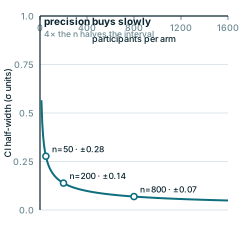
The 95% interval half-width is 1.96·σ/√n. Because n sits under a square root, precision is bought slowly: going from 50 to 200 participants per arm halves the interval, and you need 800 to halve it again.
Every panel is redrawn from its own equation by scripts/glossary-figures.js — no traced or stock artwork, and a rebuild is byte-identical.