Clinical Trials & Study Design
Sample Size and Power Calculation
Statistical power is the probability that a trial detects a real effect of a specified size, and the sample size calculation is the arithmetic that fixes how many participants that requires.
Power is the chance of obtaining a statistically significant result when an effect of a stated size genuinely exists, conventionally set at 80 or 90 percent with a two-sided alpha of 0.05. The sample size that delivers it grows with the outcome's variability and falls with the square of the difference you want to detect, so halving the target difference roughly quadruples the number needed. For binary outcomes the driver is the number of events accrued rather than the number of people enrolled.
That arithmetic explains the spread of trial sizes. A pharmacokinetic crossover answers its question with twenty to forty subjects because each participant serves as their own control. A weight-loss trial needs a few hundred because the effect is large relative to the spread. SELECT randomised 17,604 people and ran for years because major adverse cardiovascular events are uncommon per patient-year and only event counts buy precision.
Power is a property of the design, computed before any data exist, and it determines what a null result means. A large trial reporting no difference has genuinely excluded an effect of clinically useful size; a small one has excluded almost nothing, and absence of significance there is not evidence of absence. The confidence interval around the observed estimate tells you which situation you are in far better than the p-value does.
Two errors recur. The first is post hoc power, recomputed from the observed effect after the fact, which is a deterministic function of the p-value and carries no new information. The second is the winner's curse: among underpowered studies, only those that overestimate the effect reach significance at all, so the published small-trial literature is systematically inflated. That mechanism is a large part of why promising Phase 2 effect sizes shrink when a properly powered trial is finally run.
Worked example — what sample size buys
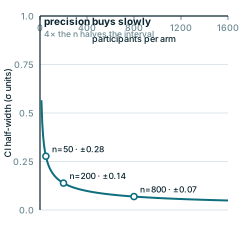
The 95% interval half-width is 1.96·σ/√n. Because n sits under a square root, precision is bought slowly: going from 50 to 200 participants per arm halves the interval, and you need 800 to halve it again.
Every panel is redrawn from its own equation by scripts/glossary-figures.js — no traced or stock artwork, and a rebuild is byte-identical.