Pharmacokinetics & Dosing Concepts
First-Pass Metabolism
First-pass metabolism is the loss of an orally absorbed drug in the gut wall and liver before it reaches the systemic circulation, and it can consume most of a swallowed dose.
Anything absorbed from the intestine travels by the portal vein to the liver before it enters the general circulation, and it can be metabolised in the enterocyte or extracted by the liver on that first pass. Oral bioavailability is therefore a product of three fractions: what is absorbed, what survives the gut wall, and what escapes hepatic extraction. A drug efficiently extracted by the liver can be almost fully absorbed and still deliver very little to the body, which is why some oral doses are far larger than the intravenous equivalent.
For peptides the arithmetic is dominated by the earlier terms. Gastric acid and pepsin, then pancreatic trypsin and chymotrypsin, degrade most of a swallowed peptide before absorption is even in question, and what remains is too large and too polar to cross the intestinal epithelium. The oral peptide products that exist solve those problems rather than the hepatic one: semaglutide tablets rely on the carrier SNAC to raise local gastric pH and assist absorption, and oral octreotide, approved in 2020 for acromegaly, uses a transient permeability enhancer.
The concept identifies which barrier a formulation is actually addressing. For a small molecule with high hepatic extraction, bypassing the portal circulation genuinely rescues the dose. For a peptide, bypassing the liver solves the least of its problems.
That is exactly where the marketing claim fails. Sublingual, buccal and transdermal peptide products are routinely promoted on the grounds that they avoid first-pass metabolism, as though that were the reason oral peptides fail. It is not. The sublingual mucosa offers a small surface area and no mechanism for moving a multi-kilodalton hydrophilic molecule across it. Avoiding the liver does nothing for a molecule that cannot cross an epithelium.
Worked examples — absorption shapes
All three solve the Bateman function, C(t) ∝ e^(−ke·t) − e^(−ka·t), and differ only in the ratio of absorption to elimination rate. Tmax is not a property you choose; it falls out as ln(ka/ke)/(ka−ke). The shaded area is AUC, the exposure the body actually sees.
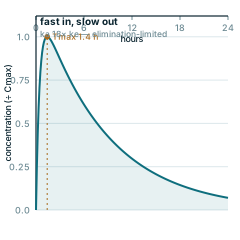
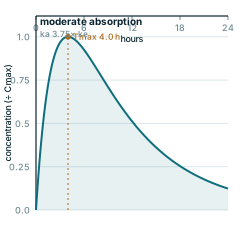
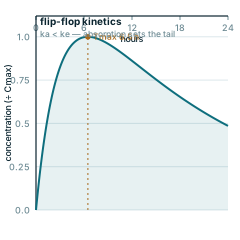
Every panel is redrawn from its own equation by scripts/glossary-figures.js — no traced or stock artwork, and a rebuild is byte-identical.