Pharmacokinetics & Dosing Concepts
Bioavailability
Bioavailability is the fraction of an administered dose that reaches the systemic circulation chemically unchanged, measured against an intravenous dose of the same drug.
Bioavailability is a fraction, conventionally written F, capturing how much of what was administered actually arrived intact in the bloodstream. Absolute bioavailability is obtained by comparing dose-normalised exposure by the route in question with dose-normalised exposure from an intravenous dose, which is complete by definition. Relative bioavailability compares two non-intravenous routes or formulations and cannot tell you the absolute figure.
The spread across peptide routes is the most instructive thing about it. Subcutaneous injection of a peptide is usually efficient, with most of the dose reaching circulation, partly by lymphatic uptake. Swallowing an unprotected peptide is close to futile, because gastric and pancreatic proteases dismantle it and what survives cannot cross the intestinal epithelium. Oral semaglutide only exists because it is co-formulated with the absorption enhancer SNAC, and even then it delivers on the order of one percent, which is why its tablet strengths are numerically far above the injectable amounts used weekly.
Bioavailability decides whether a route is viable at all, and low is not automatically fatal. A reproducible one percent can be dosed around; a figure that swings several-fold between subjects, with food, or with gastric pH cannot, because the prescriber has no way to know what a given administration delivered.
The word is heavily abused in marketing, where bioavailable is used as an adjective rather than a measured quantity. Sublingual, nasal, transdermal and liposomal peptide products routinely claim it with no comparison against an intravenous reference, which is the only thing that can establish it. Detecting the compound in blood is not the same as absorbing a useful fraction of it, and a positive assay says nothing about how much of the label amount ever arrived.
Worked examples — absorption shapes
All three solve the Bateman function, C(t) ∝ e^(−ke·t) − e^(−ka·t), and differ only in the ratio of absorption to elimination rate. Tmax is not a property you choose; it falls out as ln(ka/ke)/(ka−ke). The shaded area is AUC, the exposure the body actually sees.
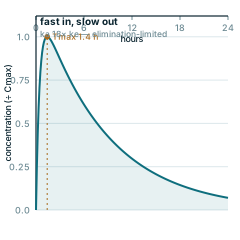
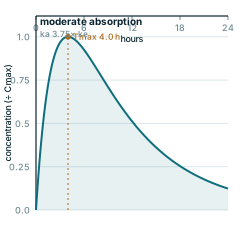
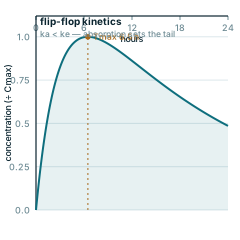
Every panel is redrawn from its own equation by scripts/glossary-figures.js — no traced or stock artwork, and a rebuild is byte-identical.