Supplied as a lyophilised powder to reconstitute
Growth Hormone Axis
At a glance
Ten answers, each one line. Open any row for the detail behind it.
What it does The most selective of the growth hormone-releasing peptides — it triggers GH release with…
The most selective of the growth hormone-releasing peptides — it triggers GH release with minimal effect on cortisol, prolactin or appetite. That selectivity is real and is why it displaced GHRP-6 in clinical practice. Efficacy for the outcomes people actually want it for is not established.
Half-life ~2 hours — Documented
~2 hours
Typical studied dose None established. No dose has ever been set for a human being, because… — Nothing established
None established. No dose has ever been set for a human being, because the studies that would set one have not been done. Any figure circulating for this compound was chosen by somebody selling it or by somebody guessing.
How often it is used No schedule exists. Cycles and intervals quoted for this compound come… — Nothing established
No schedule exists. Cycles and intervals quoted for this compound come from forums rather than from any study, and they vary because nothing anchors them.
How it is taken Subcutaneous (research) — Documented
Subcutaneous (research)
Main side effects No proven clinical benefit · Unapproved and unregulated · No human safety data at the durations people actually use it — Carries serious risk
No proven clinical benefit — The trials that were run targeted gut motility and were discontinued. Body-composition and recovery claims are untested.
Unapproved and unregulated — Available only through compounding or grey-market suppliers, with corresponding quality uncertainty.
No human safety data at the durations people actually use it — The entire human record is short exposure: single intravenous doses in volunteers, and intravenous dosing for up to a week after bowel surgery in the phase 2 programme. There is no controlled human data on months or years of subcutaneous use, which is how it is used outside trials. The nearest long-term comparator in the class is two years of a sustained-release oral secretagogue, a different drug with a different release pattern.
Storage before mixing As a sealed lyophilised powder, refrigerated is typical and a freezer…
As a sealed lyophilised powder, refrigerated is typical and a freezer suits long storage; both should be dark and dry. A dry powder tolerates a few days out of the cold far better than anything in solution — which is why it ships that way.
Shelf life after mixing Once mixed it is refrigerated and treated as short-lived. Bacteriostatic…
Once mixed it is refrigerated and treated as short-lived. Bacteriostatic water contains a preservative and buys the longer window; sterile water contains none and buys a much shorter one. Peptides in solution also degrade on their own, so the container is only half the question.
Evidence level 2/5 · Limited — Nothing established
Preclinical work plus scattered human reports, uncontrolled use, or negative trials.
Regulatory status Research Use Only — Nothing established
Investigational only, and not approved anywhere. Two phase 2 trials in postoperative recovery of gastrointestinal function were completed without demonstrating benefit, after which development was abandoned. Widely supplied through wellness clinics and research-chemical sellers, which is not the same as being lawfully available. Not approved by the FDA, the EMA or any comparable regulator for any indication, and not eligible for lawful pharmacy compounding in the United States. Selling it for human use is unlawful. “Research use only” or “not for human consumption” labelling is a seller’s disclaimer about intended use, not a regulatory category, and confers nothing on the buyer. The compounding position is disputed and moving; the dated record is on this page.
Overview
The most selective of the growth hormone-releasing peptides — it triggers GH release with minimal effect on cortisol, prolactin or appetite. That selectivity is real and is why it displaced GHRP-6 in clinical practice. Efficacy for the outcomes people actually want it for is not established.
Not approved for human use anywhereNo approval anywhere for human use. Sold under research-use labelling. Not approved by the FDA, the EMA or any comparable regulator for any indication, and not eligible for lawful pharmacy compounding in the United States. Selling it for human use is unlawful. “Research use only” or “not for human consumption” labelling is a seller’s disclaimer about intended use, not a regulatory category, and confers nothing on the buyer. The compounding position is disputed and moving; the dated record is on this page.
| Regulatory status | Investigational only, and not approved anywhere. Two phase 2 trials in postoperative recovery of gastrointestinal function were completed without demonstrating benefit, after which development was abandoned. Widely supplied through wellness clinics and research-chemical sellers, which is not the same as being lawfully available. |
|---|---|
| Drug class | Selective ghrelin receptor (GHS-R1a) agonist — pentapeptide |
| Route | Subcutaneous (research) |
| Half-life | ~2 hours |
| Evidence rating |
2/5 Limited
Evidence rating 2 out of 5: Limited
Preclinical work plus scattered human reports, uncontrolled use, or negative trials. |
| Studied in | Healthy-volunteer intravenous pharmacokinetics and GH response (1999); two completed phase 2 trials of postoperative recovery of gastrointestinal function, neither positive, after which development stopped; rodent studies of gut motility, longitudinal bone growth and bone mineral content. |
Ipamorelin sequence & structure
Ipamorelin is a 5-residue linear peptide with a C-terminal amide, carrying D-amino acid substitutions, non-standard residues; molecular weight 711.87 Da.
lowercase = D-amino acid[bracketed] = non-standard residue
| Three-letter | H-Aib-His-D-2-Nal-D-Phe-Lys-NH2 |
|---|---|
| Length | 5 amino acid residues |
| Modifications |
|
| Molecular formula | C38H49N9O5 |
| Molecular weight | 711.87 Da (average, free base) |
| SMILES | CC(C)(N)C(=O)N[C@@H](Cc1c[nH]cn1)C(=O)N[C@H](Cc1ccc2ccccc2c1)C(=O)N[C@H](Cc1ccccc1)C(=O)N[C@@H](CCCCN)C(N)=O |
| Identifiers | CAS 170851-70-4 · PubChem CID 9831659 · DrugBank DB12370 |
| Sources | Raun K et al. 1998, Eur J Endocrinol 139:552-61 (primary paper; PMID 9849822)ChEBI CHEBI:748259PubChem CID 9831659 (properties, synonyms, DrugBank xref)ChEMBL CHEMBL58547 (HELM sequence, MW) |
Novo Nordisk code NNC 26-0161; INN ipamorelin. Formula and MW (711.87 average, 711.386 monoisotopic) are for the free base; research vendors sell the acetate or TFA salt, so vendor-quoted MW is often higher. Stereochemistry (L-His, D-2-Nal, D-Phe, L-Lys; Aib achiral) is confirmed by the PubChem IUPAC name and the ChEMBL HELM string PEPTIDE1{[Aib].H.[dNal].[dF].K.[am]}.
Record confidence: high — two independent authoritative sources agree on the sequence and modifications. Every sequence on the site is listed with its sources on the peptide sequences index.
How it works
Agonises the ghrelin receptor on pituitary somatotrophs, amplifying GH pulse amplitude and suppressing somatostatin tone. Unlike earlier GHRPs it has little affinity for the pathways that drive ACTH/cortisol and prolactin release.
Evidence base
Rated 2 of 5 — Limited. Preclinical work plus scattered human reports, uncontrolled use, or negative trials.
- Human data limited to discontinued phase 2 work in an unrelated indication.
- The selectivity claim traces to a single 1998 paper from the developer's own laboratory (Raun and colleagues at Novo Nordisk), which named ipamorelin the first selective growth hormone secretagogue. The work was done in rat pituitary cells, anaesthetised rats and conscious swine; in swine neither ipamorelin nor the comparators changed FSH, LH, prolactin or TSH, while GHRP-6 and GHRP-2 both raised ACTH and cortisol and ipamorelin did not, even at exposures more than 200-fold above the level producing half-maximal GH release. That is a strong and specific finding about ACTH and cortisol. Note two limits usually dropped in retelling: prolactin sparing was not what separated ipamorelin in that experiment, since none of the peptides raised prolactin in swine, and the whole selectivity comparison is animal work by the compound's originator.
- Two phase 2 trials exist and neither is positive. A 117-patient multicentre, double-blind, placebo-controlled proof-of-concept study in bowel-resection patients measured time from first dose to tolerance of a standardised solid meal: median 25.3 hours on ipamorelin versus 32.6 hours on placebo, p = 0.15, with no significant difference in the key or any secondary efficacy analysis. A larger 320-patient quadruple-masked dose-ranging study of recovery of gastrointestinal function, completed in 2014, has no results posted on ClinicalTrials.gov and no publication. Both registry records read COMPLETED — the trials finished and read negative, the programme is what was abandoned. No trial of ipamorelin has ever measured recovery, body composition, strength, sleep or any anti-ageing outcome, so no efficacy for any of those is established.
- The honest ceiling for raising GH comes from the wider secretagogue class, not from ipamorelin. The longest controlled trial is two years of the oral ghrelin mimetic MK-677 in 65 healthy adults aged 60 to 81, double-blind, placebo-controlled, modified-crossover. It did everything it set out to do biochemically: GH and IGF-1 restored to young-adult levels, fat-free mass up about 1 kg where placebo lost about half a kilogram, body cell mass up. Isokinetic strength and physical function did not change. Fasting glucose rose and insulin sensitivity fell; limb fat and body weight rose more than in placebo. The authors noted the trial was underpowered for functional endpoints — a real caveat — but this remains the best-designed test of the premise, and it showed that restoring GH to youthful levels buys lean mass on a scan without buying capability, at a measurable metabolic cost.
Benefits and risks, weighed against the evidence
Every entry below carries the strength of the evidence behind it — three bars for strong human data, two for moderate, one for preliminary or preclinical work. The two columns are not equal by design: where a compound has more documented risk than demonstrated benefit, the lists say so.
Reported benefits
7 entries
-
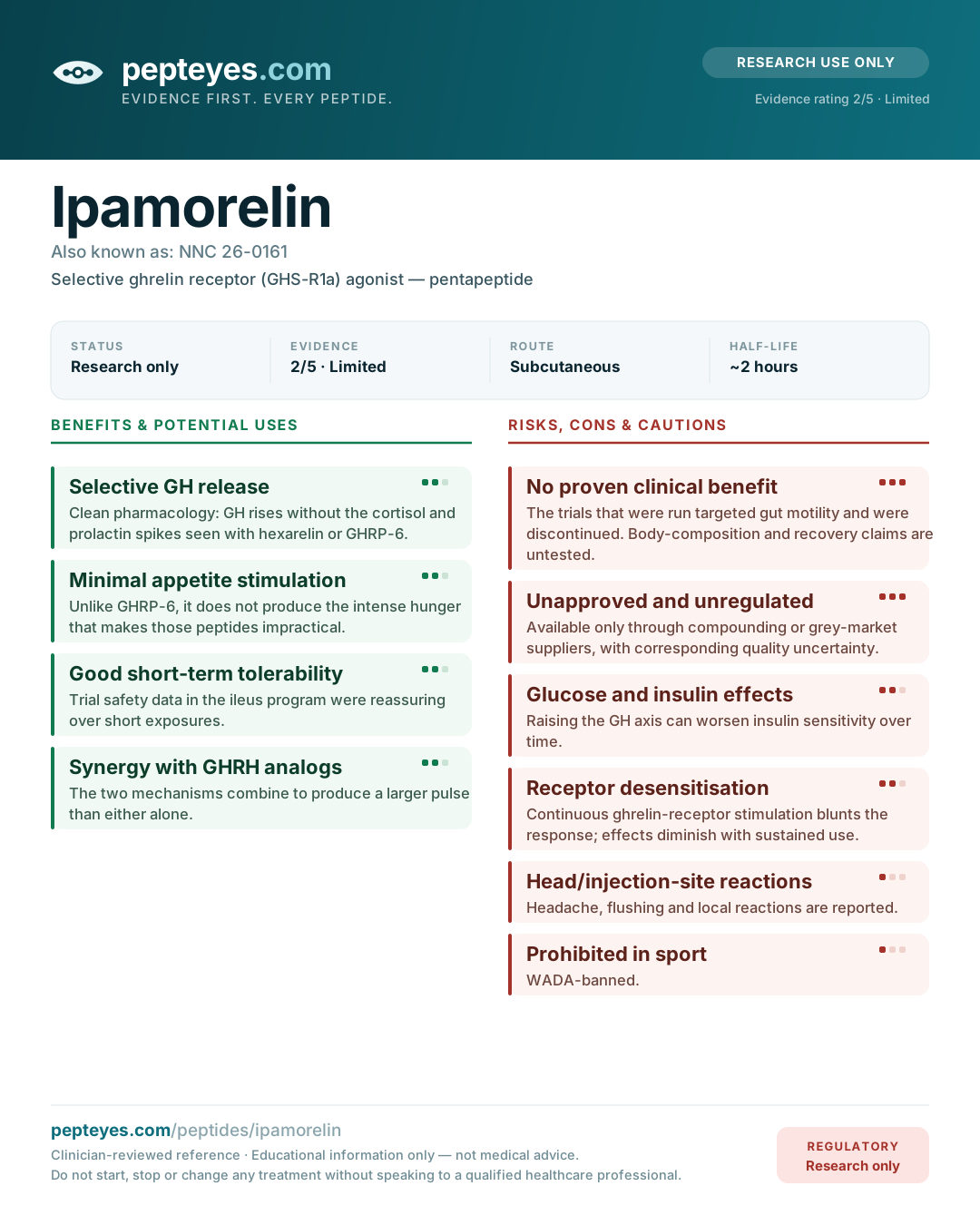
Selective GH release
Clean pharmacology: GH rises without the cortisol and prolactin spikes seen with hexarelin or GHRP-6.
Evidence: Moderate evidence -
Minimal appetite stimulation
Unlike GHRP-6, it does not produce the intense hunger that makes those peptides impractical.
Evidence: Moderate evidence -
Good short-term tolerability
Trial safety data in the ileus program were reassuring over short exposures.
Evidence: Moderate evidence -
Synergy with GHRH analogs
The two mechanisms combine to produce a larger pulse than either alone.
Evidence: Moderate evidence -
A measurable, reproducible GH pulse in healthy humans
A 1999 dose-escalation study in healthy male volunteers (eight men at each of five ascending intravenous infusion rates) found dose-proportional pharmacokinetics, a terminal half-life near two hours, and a single episode of GH release peaking around 40 minutes and decaying to negligible concentrations at every exposure tested. This is the clearest human evidence the compound does what it says — and it is evidence about a hormone measurement, not about anything a person would notice.
Evidence: Moderate evidence -
Accelerated gut transit in rodent models of postoperative ileus
In rats subjected to laparotomy and intestinal manipulation, intravenous ipamorelin shortened time to first bowel movement and accelerated gastric emptying, and repeated dosing increased faecal output, food intake and weight gain over 48 hours. This was the rationale for the human programme, and it is the only efficacy signal in the compound's file that was ever pursued into patients — where it did not reproduce.
Evidence: Preliminary -
Bone effects in rats, smaller than they first appear
Two rat studies are cited as bone evidence. In adult female rats a 15-day course dose-dependently increased tibial longitudinal growth rate, but total IGF-1, IGF binding proteins and serum markers of bone formation and resorption were all unchanged. In a 12-week continuous-infusion study bone mineral content rose, but the increase disappeared once corrected for the accompanying weight gain, and areal bone mineral density at the spine did not change. Nothing here has been tested in a human bone endpoint.
Evidence: Preliminary
Risks and cautions
9 entries · 3 serious or common
-
No proven clinical benefit
The trials that were run targeted gut motility and were discontinued. Body-composition and recovery claims are untested.
Evidence: Serious -
Unapproved and unregulated
Available only through compounding or grey-market suppliers, with corresponding quality uncertainty.
Evidence: Serious -
Glucose and insulin effects
Raising the GH axis can worsen insulin sensitivity over time.
Evidence: Moderate evidence -
Receptor desensitisation
Continuous ghrelin-receptor stimulation blunts the response; effects diminish with sustained use.
Evidence: Moderate evidence -
Head/injection-site reactions
Headache, flushing and local reactions are reported.
Evidence: Minor -
Prohibited in sport
WADA-banned.
Evidence: Minor -
Selectivity is a statement about what it spares, not evidence of benefit
This is the single most misread fact about the compound. Sparing cortisol, prolactin and appetite removes three side effects that made the earlier GHRPs awkward; it does not add a benefit, and it says nothing about whether raising GH helps anyone. Everything the GH axis does downstream — reduced insulin sensitivity, fluid retention and nerve compression, IGF-1-driven tissue growth — is unchanged by being selective about which other pituitary hormones stay put. A cleaner side-effect profile on an unproven effect is still an unproven effect.
Evidence: Moderate evidence -
Fluid retention, joint pain and nerve compression
Dose-dependent oedema, arthralgia, myalgia and nerve-compression symptoms including carpal tunnel and paraesthesia are documented consequences of raising GH and appear in approved GH labelling; transient lower-extremity oedema and muscle pain were among the most frequent adverse effects in the two-year oral secretagogue trial in older adults. Usually reversible on stopping, but a real consideration in heart failure, renal impairment or anyone already retaining fluid.
Evidence: Moderate evidence -
No human safety data at the durations people actually use it
The entire human record is short exposure: single intravenous doses in volunteers, and intravenous dosing for up to a week after bowel surgery in the phase 2 programme. There is no controlled human data on months or years of subcutaneous use, which is how it is used outside trials. The nearest long-term comparator in the class is two years of a sustained-release oral secretagogue, a different drug with a different release pattern.
Evidence: Serious
Counts are not a score. A single serious risk can outweigh several well-supported benefits, and a long benefit list built on preclinical work outweighs nothing at all.
Opinion — what people actually report
6 themes · 2 reported benefits · 2 reported problems
This is the weakest tier on this site. These are themes drawn from public discussion — forums, subreddits and patient threads — not from trials. There is no control group, no denominator, and no way to confirm that what someone injected matched its label. People post when a result is dramatic and when something goes wrong, and rarely when nothing happens, so treat everything below as a description of the conversation rather than of the compound. The bars count how often a thing is said, not how well it is supported.
-
Reputation as the "clean" one Reported benefit. Dominant theme: Comes up in most discussions of this compound.
Its defining feature in discussion. Widely reported as producing far less hunger than GHRP-6 and far less cortisol and prolactin worry than GHRP-2, which is why clinics favour it.
-
Better sleep Reported benefit. Dominant theme: Comes up in most discussions of this compound.
The most consistently claimed benefit, and often the only one people can point to with confidence.
-
Frequently described as too mild Reported problem. Recurring: Raised regularly, though not by everyone.
The flip side of the clean reputation. A recurring complaint is that nothing much happens, particularly from people who expected visible body composition change.
-
Rarely used alone Practical note. Dominant theme: Comes up in most discussions of this compound.
Standard practice is to pair it with a GHRH analogue, which again makes single-compound attribution nearly impossible.
-
Mild flush or headache after injection Reported problem. Occasional: Reported by a minority, or in specific contexts.
A minority report brief warmth or a mild headache shortly after injecting, usually settling within the hour.
-
The most common clinic prescription in this class Practical note. Recurring: Raised regularly, though not by everyone.
A large share of reports come from telehealth and wellness clinic patients rather than from grey-market use, which is unusual for this category.
Where the reports and the evidence part ways
The selectivity claim is genuinely supported — ipamorelin was designed to release growth hormone without meaningfully raising cortisol, prolactin or ACTH, and the preclinical and early human data back that. Beyond selectivity, the evidence thins abruptly. Development was discontinued, no trials established efficacy for any body composition or recovery outcome in healthy people, and it holds no approval anywhere. The community reads "clean and well tolerated" as "safe and effective"; the record supports the first half of that and is silent on the second.
Cheat sheet
The full sheet, all 77 compounds →The community reference numbers for this compound — reconstitution, working dose, cycle and bloodwork. Research and education only, not medical advice, and not part of the evidence-rated monograph above. Doses assume a 1mL / 100-unit insulin syringe — the calculator does the units for you.
Protocol overview
Dosing & reconstitution 10 mg vial
| WEEK | DAILY DOSE | UNITS PER INJECTION |
|---|---|---|
| Weeks 1 to 2 | 100 mcg | 1 units (0.01 mL) |
| Weeks 3 to 4 | 150 mcg | 1.7 units (0.02 mL) |
| Weeks 5 to 8 | 200 mcg | 2 units (0.02 mL) |
| Weeks 9 to 12 | 250 mcg | 2.7 units (0.03 mL) |
Frequency: Inject once daily subcutaneously, ideally 30 to 60 minutes before bedtime on an empty stomach to synergize with natural nocturnal GH secretion. For doses at or under 3.3 units (0.03 mL), consider 30- or 50-unit insulin syringes for improved readability.
On the master sheet
- Vial
- 10mg
- BAC
- 2mL
- Dose
- 100–300mcg daily
- Route
- SubQ
- Cycle
- 8–12 wks
- Time Off
- 3–4 wks
- Bloodwork
- IGF-1, glucose
Side-effect family — GH Secretagogues (CJC, Ipa, GHRP): Water retention and bloat · Carpal tunnel or tingling hands · Increased hunger (GHRP-6) · Drowsiness. What helps, and the red flags →
Readers on Ipamorelin
Questions and answers from readers, under generated names. Nothing here has been checked or reviewed by the site and none of it is medical advice. It is the least verified thing on this page — and it is here because people ask each other these things anyway, and most of the other places they can ask are run by sellers.
1 question · 1 answer
-
Early Birch desk — written by the site's editorial desk asked
Did the July 2026 FDA advisory vote change anything for ipamorelin?
Reply
Show 1 answerCollapse 1 answer
- Winter Harbour desk — written by the site's editorial desk answered
No. Ipamorelin was not on that agenda. It stays in Category 2 with CJC-1295 while the litigation runs and the final rule is written, which is due by March 2027. The dated record is on the compounding-status page; check that rather than any thread.
How names work, and the house rules
Names. Every verified address is given one generated name — two ordinary words — and keeps it. Nobody chooses a name and nobody can take another's. Posts marked desk were written by the site's own editorial desk, usually to open a thread; they carry a generated name like everyone else's and are held to the site's rules, which means they never state an amount.
What is not allowed. Selling, sourcing, vendor names, coupon codes and "message me" — posts that read that way are held and usually removed. Personal medical details you would not want public. Abuse. Instructions framed as what someone else should do.
What this is not. A reader's report of what happened to them is a report, not a finding, and an answer here is one person's view. Nothing in this section changes the evidence rating above it. If something you read here would change what you take, take it to a pharmacist or physician first.
Your data. Delete any post of yours at any time, or remove everything you have written together with your name. Details in the privacy notice.
Who should avoid it
- Active malignancy
- Pregnancy
- Poorly controlled diabetes
If used under medical supervision, monitor
- IGF-1
- Fasting glucose
- Cortisol only if symptomatic
Interactions
Not exhaustive. Always have a pharmacist or physician review your full medication list — including supplements.
- Insulin, sulfonylureas and other glucose-lowering drugs — inferred from the GH axis, not from any ipamorelin study: growth hormone is diabetogenic and reduces insulin sensitivity, and approved somatropin labelling states that the dose of insulin or oral agents may need adjustment once GH therapy begins. The two-year trial of the oral secretagogue MK-677 in older adults saw fasting glucose rise about 0.3 mmol/L with a measurable fall in insulin sensitivity. Watch fasting glucose and HbA1c.
- Somatostatin analogues — octreotide and lanreotide, and the closest thing to a genuine pharmacological antagonism here. They act on somatostatin receptors on the same pituitary somatotrophs and directly oppose GH release; in ten healthy men a somatostatin receptor-2/-5 agonist cut the GH secretory burst mass and pulse frequency produced by GHRP-2, the closest studied analogue of ipamorelin. Anyone taking one for acromegaly or a neuroendocrine tumour should expect the GH pulse — ipamorelin's only measurable effect — to be blunted or abolished.
- Corticosteroids — the direction is not simple and no human study has tested the pair. Chronic glucocorticoid excess suppresses spontaneous GH secretion by raising hypothalamic somatostatin tone, while ghrelin-receptor agonists partly bypass that blockade; in glucocorticoid-treated rats ipamorelin partly restored periosteal bone formation and calf-muscle tetanic tension. Separately, GH inhibits 11beta-hydroxysteroid dehydrogenase type 1 and lowers cortisol production from cortisone, so anyone on glucocorticoid replacement may need that dose revisited rather than left alone.
- Levothyroxine and thyroid hormone replacement — inferred from GH pharmacology: untreated hypothyroidism blunts the response to a GH stimulus, and raising GH can make previously unrecognised central hypothyroidism apparent. Relevant mainly to people with pituitary or hypothalamic disease, in whom thyroid status should be known before interpreting anything the GH axis does.
- Anything that adds to fluid retention — corticosteroids, NSAIDs, calcium-channel blockers, high-dose licorice. Inferred from the GH axis: GH excess produces dose-dependent oedema, arthralgia, myalgia and nerve-compression symptoms including carpal tunnel, and transient lower-limb oedema and muscle pain were among the commonest adverse effects in the two-year MK-677 trial. These effects add rather than cancel, and matter most in heart failure, renal impairment or established oedema.
- GHRH analogues — sermorelin, CJC-1295, tesamorelin. Not a hazard to look up so much as the way it is actually used: the two mechanisms combine to produce a GH pulse larger than either alone, so the exposure being created is greater than the label on either vial suggests. No combination of a GHRH analogue with ipamorelin has been tested for safety or efficacy in any trial, and the glucose, fluid-retention and tissue-growth considerations track the size of the GH exposure, not the number of compounds.
Commonly confused with
These mix-ups cause real harm — two products sold under one name, or two molecules whose effects run in opposite directions.
Both ghrelin receptor agonists. Ipamorelin is selective and spares cortisol and prolactin; GHRP-2 is more potent at releasing GH but raises both.
Compare side by sideSame receptor, but MK-677 is an oral non-peptide with sustained rather than pulsatile action — and the only one of the two with a long-term human trial, which found a heart failure signal.
Compare side by sideRoutinely sold and discussed as a single pre-mixed product, which means side effects and benefits get attributed to whichever name the user prefers. They are different mechanisms: CJC-1295 is a GHRH analogue, and the DAC version has a half-life measured in days, producing a sustained rise in GH and IGF-1 rather than a pulse. That removes the pulsatility that is the stated rationale for choosing ipamorelin in the first place, and it is the sustained pattern, not the pulsatile one, that the long-term secretagogue data link to falling insulin sensitivity.
Compare side by sideMacimorelin is an oral ghrelin-receptor agonist that is FDA-approved, and that approval is sometimes cited as proof the class is legitimate therapy. It is approved as a single-dose diagnostic test for adult growth hormone deficiency — the point is to provoke one GH pulse and measure it, not to treat anything. An approval for a one-off diagnostic says nothing about repeated use of ipamorelin for recovery or body composition.
Compare side by sideRegulatory & legal status
Not approved by the FDA, the EMA or any comparable regulator for any indication, and not eligible for lawful pharmacy compounding in the United States. Selling it for human use is unlawful. “Research use only” or “not for human consumption” labelling is a seller’s disclaimer about intended use, not a regulatory category, and confers nothing on the buyer. The compounding position is disputed and moving; the dated record is on this page.
Still in Category 2 of the 503A review, so not eligible for lawful pharmacy compounding in the United States.
- Listed since
- September 2023
- Court challenge
- Placement under challenge; a final rule is expected no later than March 2027
- Approved as a drug?
- No. Compounding status and drug approval are separate questions; this compound has no approval for the uses it is sold for.
The full dated record, with sources, and every affected peptide →
Infographic
What this entry was checked against
The specific records this monograph was verified against on its last research pass. We link live literature searches below as well, because these are a snapshot and the literature is not.
- Raun K et al. Ipamorelin, the first selective growth hormone secretagogue. Eur J Endocrinol 1998;139:552-61 (PMID 9849822)
- Gobburu JV, Agersø H, Jusko WJ. Pharmacokinetic-pharmacodynamic modeling of ipamorelin in human volunteers. Pharm Res 1999;16:1412-6 (PMID 10496658)
- Beck DE et al. Randomized, controlled, proof-of-concept study of ipamorelin for postoperative ileus in bowel resection patients. Int J Colorectal Dis 2014;29:1527-34 (PMID 25331030)
- ClinicalTrials.gov NCT01280344 — phase 2, 320 patients, recovery of gastrointestinal function; completed 2014, no results posted
- Nass R et al. Effects of an oral ghrelin mimetic (MK-677) on body composition and clinical outcomes in healthy older adults: a randomized trial. Ann Intern Med 2008;149:601-11 (PMID 18981485)
- Iranmanesh A, Bowers CY, Veldhuis JD. Somatostatin receptor-2/-5 activation suppresses GHRP-2-stimulated GH secretion in men. J Clin Endocrinol Metab 2004;89:4581-7 (PMID 15356066)
- Johansen PB et al. Ipamorelin induces longitudinal bone growth in rats. Growth Horm IGF Res 1999;9:106-13 (PMID 10373343)
- GENOTROPIN (somatropin) prescribing information, DailyMed — drug interactions (11beta-HSD-1 and glucocorticoids, insulin and oral agents, CYP450, oral estrogen) and warnings on fluid retention and glucose intolerance
Where to read further
We link to live literature searches rather than a frozen citation list, so you always see current results — including anything published after our last review.
- PubMed — all published literature on Ipamorelin
- PubMed — randomized controlled trials only
- ClinicalTrials.gov — registered human trials
Related peptides in Growth Hormone Axis
Terms used on this page
- Growth Hormone-Releasing Peptide (GHRP)
- GHRPs are small synthetic peptides that release growth hormone by activating the ghrelin receptor GHS-R1a on pituitary and hypothalamic cells rather than the GHRH receptor.
- Receptor Selectivity
- Receptor selectivity is the degree to which a ligand acts on its intended receptor rather than related ones, expressed as the ratio between its potency at the target and at each off-target.
- Prolactin
- Prolactin is a 199-amino-acid anterior pituitary hormone held under tonic dopamine inhibition, central to lactation and the marker of prolactinomas and drug-induced hyperprolactinaemia.
- Cortisol
- Cortisol is the principal human glucocorticoid, secreted by the adrenal cortex under ACTH control on a pronounced daily rhythm and carried in plasma largely bound to corticosteroid-binding globulin.
- Growth Hormone Secretagogue Receptor (GHS-R1a)
- GHS-R1a is the G protein-coupled ghrelin receptor mediating growth hormone release and appetite, notable for unusually high constitutive activity in the complete absence of any ligand.
- Somatostatin
- Somatostatin is a cyclic inhibitory peptide, circulating as 14- and 28-residue forms, that suppresses growth hormone release and broadly inhibits endocrine and exocrine secretion.
This page is educational information, not medical advice. It cannot account for your medical history, medications, or risk factors. Do not start, stop or change any treatment based on it. Speak to a qualified healthcare professional who knows your case.