Supplied as a lyophilised powder to reconstitute
Growth Hormone Axis
At a glance
Ten answers, each one line. Open any row for the detail behind it.
What it does Two different molecules are sold under one name, and the difference is not a detail.
Two different molecules are sold under one name, and the difference is not a detail. CJC-1295 with DAC — ConjuChem's actual clinical compound — binds covalently to albumin and acts for days. "CJC-1295 no DAC" is modified GRF(1-29), cleared in minutes and behaving like sermorelin. Every human study cited for this peptide used the DAC molecule; the no-DAC version has none of its own. Neither is approved, and the single efficacy trial ever run was stopped early and never reported.
Half-life CJC-1295 with DAC: 5.8–8.1 days in healthy adults, once bound… — Nothing established
CJC-1295 with DAC: 5.8–8.1 days in healthy adults, once bound to albumin. CJC-1295 without DAC (modified GRF(1-29)): minutes — no human half-life has ever been published for it, and the figure usually quoted is inferred from sermorelin and native GRF(1-29).
Typical studied dose None established. No dose has ever been set for a human being, because… — Nothing established
None established. No dose has ever been set for a human being, because the studies that would set one have not been done. Any figure circulating for this compound was chosen by somebody selling it or by somebody guessing.
How often it is used No schedule exists. Cycles and intervals quoted for this compound come… — Nothing established
No schedule exists. Cycles and intervals quoted for this compound come from forums rather than from any study, and they vary because nothing anchors them.
How it is taken Subcutaneous (research) — Documented
Subcutaneous (research)
Main side effects Continuous GH exposure is non-physiological · Development discontinued · Theoretical cancer promotion — Carries serious risk
Continuous GH exposure is non-physiological — Natural GH is pulsatile. Chronic flat elevation is the pattern seen in acromegaly, and its long-term consequences with this drug are untested.
Development discontinued — The sponsor stopped work; no phase 2 or 3 efficacy or safety data exist.
Theoretical cancer promotion — IGF-1 is mitogenic; chronic elevation in people with occult neoplasia is a genuine unknown.
Storage before mixing As a sealed lyophilised powder, refrigerated is typical and a freezer…
As a sealed lyophilised powder, refrigerated is typical and a freezer suits long storage; both should be dark and dry. A dry powder tolerates a few days out of the cold far better than anything in solution — which is why it ships that way.
Shelf life after mixing Once mixed it is refrigerated and treated as short-lived. Bacteriostatic…
Once mixed it is refrigerated and treated as short-lived. Bacteriostatic water contains a preservative and buys the longer window; sterile water contains none and buys a much shorter one. Peptides in solution also degrade on their own, so the container is only half the question.
Evidence level 2/5 · Limited — Nothing established
Preclinical work plus scattered human reports, uncontrolled use, or negative trials.
Regulatory status Research Use Only — Nothing established
Investigational; clinical development discontinued. Not approved. Widely sold grey-market. Not approved for human use in the US, EU or UK. Sale for human consumption is unlawful.
Overview
Two different molecules are sold under one name, and the difference is not a detail. CJC-1295 with DAC — ConjuChem's actual clinical compound — binds covalently to albumin and acts for days. "CJC-1295 no DAC" is modified GRF(1-29), cleared in minutes and behaving like sermorelin. Every human study cited for this peptide used the DAC molecule; the no-DAC version has none of its own. Neither is approved, and the single efficacy trial ever run was stopped early and never reported.
Not approved for human use anywhereNo approval anywhere for human use. Sold under research-use labelling. Not approved for human use in the US, EU or UK. Sale for human consumption is unlawful.
| Regulatory status | Investigational; clinical development discontinued. Not approved. Widely sold grey-market. |
|---|---|
| Drug class | GHRH analog; the DAC version bears a maleimide linker that binds serum albumin |
| Route | Subcutaneous (research) |
| Half-life | CJC-1295 with DAC: 5.8–8.1 days in healthy adults, once bound to albumin. CJC-1295 without DAC (modified GRF(1-29)): minutes — no human half-life has ever been published for it, and the figure usually quoted is inferred from sermorelin and native GRF(1-29). |
| Evidence rating |
2/5 Limited
Evidence rating 2 out of 5: Limited
Preclinical work plus scattered human reports, uncontrolled use, or negative trials. |
| Studied in | CJC-1295 with DAC: two randomised, double-blind, placebo-controlled ascending-dose trials in healthy adults running 28 and 49 days, measuring GH, IGF-1 and drug pharmacokinetics, plus one overnight GH-pulsatility study. One phase 2 efficacy trial — 12 weeks, multicentre, randomised, double-blind, placebo-controlled, in HIV-associated visceral adiposity — was terminated in July 2006 with no results posted or published, and it is the only CJC-1295 study ever entered on ClinicalTrials.gov. The peptide sold without DAC has no controlled human study at all. |
CJC-1295 sequence & structure
CJC-1295 is a 30-residue linear peptide with a C-terminal amide, carrying D-amino acid substitutions; molecular weight 3,647.25 Da.
* K: 3-maleimidopropionyl
lowercase = D-amino acid* = side-chain modification
| Three-letter | H-Tyr-D-Ala-Asp-Ala-Ile-Phe-Thr-Gln-Ser-Tyr-Arg-Lys-Val-Leu-Ala-Gln-Leu-Ser-Ala-Arg-Lys-Leu-Leu-Gln-Asp-Ile-Leu-Ser-Arg-Lys(3-maleimidopropionyl)-NH2 |
|---|---|
| Length | 30 amino acid residues |
| Modifications |
|
| Molecular formula | C165H269N47O46 |
| Molecular weight | 3,647.25 Da (average, free base) |
| Identifiers | CAS 446262-90-4 · PubChem CID 91971820 |
| Which molecule | This record is CJC-1295 proper (CJC-1295 with DAC, ConjuChem's clinical compound): the tetrasubstituted GHRH(1-29) amide extended by a Lys30 carrying a 3-maleimidopropionyl group — FDA UNII 62RC32V9N7, CAS 446262-90-4, PubChem CID 91971820, C165H269N47O46, MW 3647.25. The peptide sold as 'Modified GRF (1-29)' or 'CJC-1295 no DAC' is the same substituted sequence stopping at an amidated Arg29 with no Lys(maleimide): YaDAIFTQSYRKVLAQLSARKLLQDILSR-NH2, C152H252N44O42, MW 3367.9 (PubChem CID 56841945, CAS 863288-34-0). The pepteyes monograph covers both under one name, and this block describes the DAC molecule. |
| Sources | FDA/NCATS GSRS — CJC-1295, UNII 62RC32V9N7 (protein record: subunit sequence, D-Ala2, Lys30 maleimidopropionyl, CAS 446262-90-4)PubChem CID 91971820 — CJC-1295, C165H269N47O46, MW 3647.2PubChem CID 56841945 — the 29-mer without DAC, C152H252N44O42, MW 3367.9, CAS 863288-34-0Jetté L et al. Endocrinology 2005;146(7):3052-8 — identification of CJC-1295 as a long-lasting GRF analog (PMID 15817669)Teichman SL et al. J Clin Endocrinol Metab 2006;91(3):799-805 — CJC-1295 in healthy adults (PMID 16352683) |
Beware the CAS/MW crossover: vendors attach 863288-34-0 and MW 3367.9 to both variants, and PubChem CID 56841945 itself carries 'CJC 1295 with DAC' synonyms although its deposited structure is the plain 29-mer amide with no maleimide — that formula only fits the no-DAC peptide. Formula and MW here are the free base; commercial material is normally an acetate or trifluoroacetate salt. GSRS lists an auto-estimated formula (C155H258O42N44, ~3500 Da) that ignores the Lys30 maleimide and should not be used. In vivo the maleimide alkylates albumin Cys34, so the circulating species is a peptide-albumin conjugate with a ~6-8 day half-life.
Record confidence: high — two independent authoritative sources agree on the sequence and modifications. Every sequence on the site is listed with its sources on the peptide sequences index.
How it works
GHRH-receptor agonism at the pituitary somatotroph — the same receptor sermorelin and tesamorelin act on. The two products sold under this name differ only in what hangs off the end of the peptide, and that difference is the entire pharmacology. CJC-1295 with DAC carries a maleimidopropionyl lysine that reacts with cysteine-34 of circulating albumin after injection, so the drug travels as a peptide-albumin conjugate and holds the receptor under near-continuous stimulation for days. CJC-1295 without DAC has no linker, is cleared in minutes, and gives one short GH pulse in the manner of sermorelin. Continuous stimulation does not flatten GH as commonly claimed: a week after a single DAC injection, pulse frequency and amplitude were unchanged while the inter-pulse trough rose about seven-fold — the pulses persist, riding on a raised floor, and it was the raised floor rather than larger peaks that drove IGF-1.
Evidence base
Rated 2 of 5 — Limited. Preclinical work plus scattered human reports, uncontrolled use, or negative trials.
- Human data limited to phase 1 pharmacokinetics.
- No efficacy trial for any clinical outcome has been completed.
- What the human studies measured was concentrations, not outcomes. The two phase 1 trials — randomised, double-blind, placebo-controlled, ascending-dose, in healthy adults aged 21 to 61, running 28 and 49 days — had peak and area-under-the-curve GH and IGF-1 as their pre-specified outcome measures, alongside the drug's own pharmacokinetics. GH rose two- to ten-fold for six days or more, IGF-1 one-and-a-half to three-fold for nine to eleven days, and with repeated administration IGF-1 stayed above baseline for up to 28 days. A raised IGF-1 is a biomarker of pituitary stimulation; no trial has tested whether that translates into better recovery, body composition, strength, sleep or function in healthy adults.
- The evidence rating belongs to the DAC molecule. Every human pharmacokinetic and pharmacodynamic finding on this page comes from CJC-1295 with DAC. For the 29-mer sold as "CJC-1295 no DAC" or modified GRF(1-29), the peer-reviewed human literature reports no half-life and no route of administration; a 2026 review of GH-axis performance peptides concluded it remains essentially uncharacterised in humans and that claims about preserved pulsatility or body-composition change are extrapolation.
- The pulsatility question rests on a single study: one overnight sampling session in a small group of healthy young men, before and one week after one injection, at one centre. It is the only human evidence about what the DAC version does to the shape of GH secretion rather than its amount, and it has never been replicated or extended beyond a week.
Benefits and risks, weighed against the evidence
Every entry below carries the strength of the evidence behind it — three bars for strong human data, two for moderate, one for preliminary or preclinical work. The two columns are not equal by design: where a compound has more documented risk than demonstrated benefit, the lists say so.
Reported benefits
6 entries
-
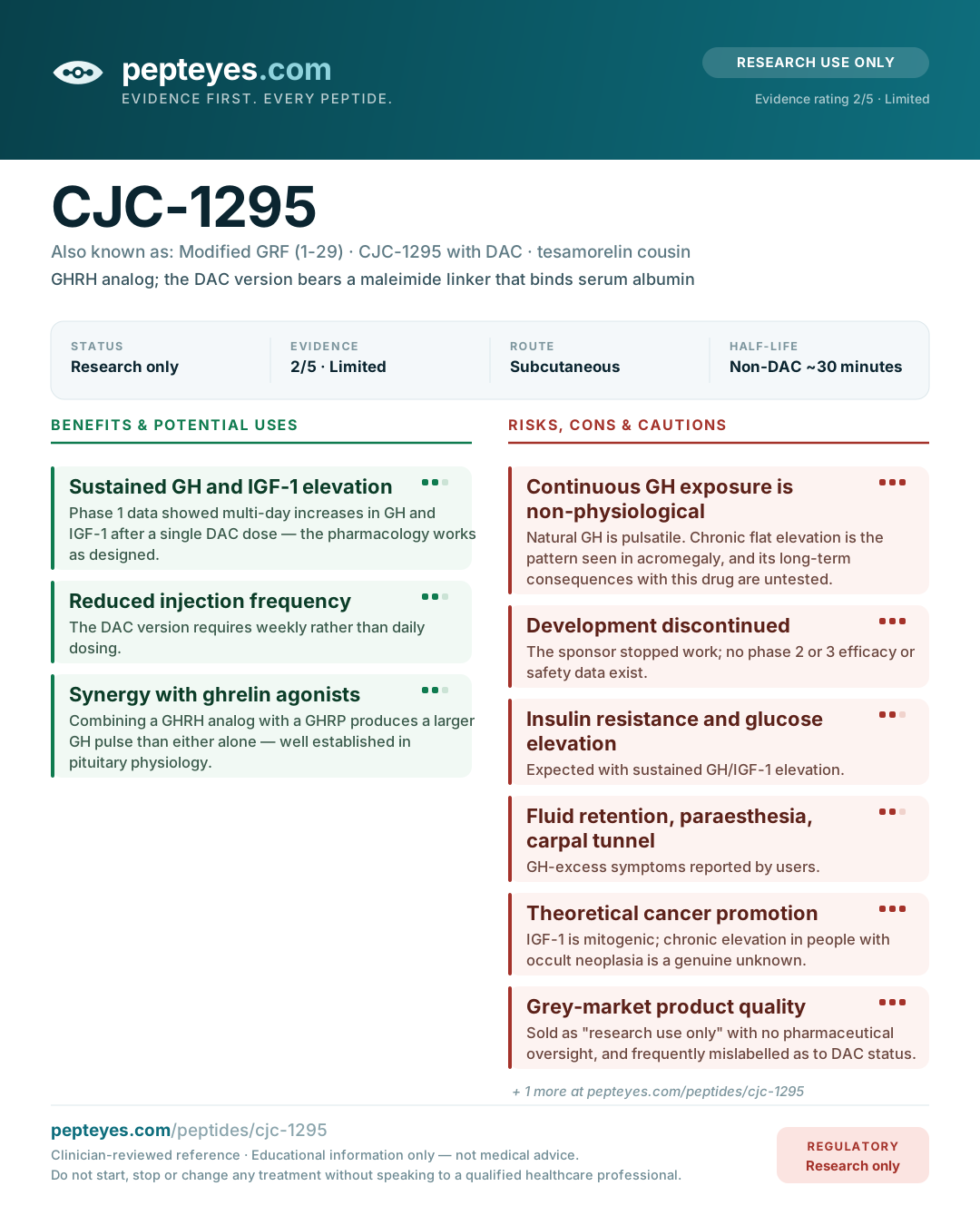
Sustained GH and IGF-1 elevation
Phase 1 data showed multi-day increases in GH and IGF-1 after a single DAC dose — the pharmacology works as designed.
Evidence: Moderate evidence -
Reduced injection frequency
The DAC version requires weekly rather than daily dosing.
Evidence: Moderate evidence -
Synergy with ghrelin agonists
Combining a GHRH analog with a GHRP produces a larger GH pulse than either alone — well established in pituitary physiology.
Evidence: Moderate evidence -
GH pulsatility survives continuous stimulation
Healthy young men sampled every 20 minutes across an overnight period, before and one week after a single injection of the DAC version, showed unchanged GH pulse frequency and amplitude while trough GH rose about seven-fold; mean GH rose 46% and IGF-1 45%. Unlike injected growth hormone, the rise stays pituitary-mediated rather than replacing pituitary output. One small single-dose study, one lab.
Evidence: Preliminary -
The response appears to plateau rather than climb
In that same study the two doses compared produced no different GH or IGF-1 response, and the IGF-1 rise correlated with no measured parameter of GH secretion — consistent with a ceiling set by somatotroph capacity rather than by how much drug arrives. Never confirmed in a larger study.
Evidence: Preliminary -
Normalised growth in GHRH-deficient mice
GHRH-knockout mice treated for five weeks from one week of age reached normal body weight, body length, femur and tibia length and normal lean and subcutaneous fat mass at the most frequent of three dosing intervals; wider intervals gave partial catch-up only. This is the compound's only whole-animal efficacy demonstration, and it is in animals that make no GHRH of their own.
Evidence: Preliminary
Risks and cautions
10 entries · 5 serious or common
-
Continuous GH exposure is non-physiological
Natural GH is pulsatile. Chronic flat elevation is the pattern seen in acromegaly, and its long-term consequences with this drug are untested.
Evidence: Serious -
Development discontinued
The sponsor stopped work; no phase 2 or 3 efficacy or safety data exist.
Evidence: Serious -
Insulin resistance and glucose elevation
Expected with sustained GH/IGF-1 elevation.
Evidence: Moderate evidence -
Fluid retention, paraesthesia, carpal tunnel
GH-excess symptoms reported by users.
Evidence: Moderate evidence -
Theoretical cancer promotion
IGF-1 is mitogenic; chronic elevation in people with occult neoplasia is a genuine unknown.
Evidence: Serious -
Grey-market product quality
Sold as "research use only" with no pharmaceutical oversight, and frequently mislabelled as to DAC status.
Evidence: Serious -
Banned in sport
Prohibited by WADA at all times.
Evidence: Minor -
The only efficacy trial ended in a death that was never publicly adjudicated
ConjuChem's 12-week phase 2 study in HIV-associated visceral adiposity was stopped in July 2006 after a participant at a South American site died a few hours after an injection late in the trial. The company released almost no detail; secondary accounts describe a myocardial infarction that the attending physician attributed to undiagnosed coronary artery disease, but no causality assessment was ever published, no results were posted to the registry, and the programme was not resumed. Development was discontinued without published efficacy results — that is the entire public record.
Evidence: Serious -
Sustained GHRH-receptor stimulation is trophic to the pituitary
Chronic GHRH excess is not only a secretion signal. Mice transgenic for human GHRH develop somatotroph hyperplasia within months and adenomas later in life, and in people ectopic GHRH secretion produces somatotroph hyperplasia and acromegaly. The DAC version holds the receptor occupied continuously, and no human study of it has run longer than 49 days, so what happens to the pituitary over months is simply unknown.
Evidence: Moderate evidence -
Its legal position is disputed, not decided
CJC-1295 is one of a small group of peptides whose US regulatory placement is under active administrative challenge, with the outcome still pending. Reading the current position as final — in either direction — misreads it; anyone acting on today's status is acting on an unresolved question.
Evidence: Moderate evidence
Counts are not a score. A single serious risk can outweigh several well-supported benefits, and a long benefit list built on preclinical work outweighs nothing at all.
Opinion — what people actually report
7 themes · 2 reported benefits · 3 reported problems
This is the weakest tier on this site. These are themes drawn from public discussion — forums, subreddits and patient threads — not from trials. There is no control group, no denominator, and no way to confirm that what someone injected matched its label. People post when a result is dramatic and when something goes wrong, and rarely when nothing happens, so treat everything below as a description of the conversation rather than of the compound. The bars count how often a thing is said, not how well it is supported.
-
Two different molecules share the name Practical note. Dominant theme: Comes up in most discussions of this compound.
The most consequential confusion in this corner of the space. "CJC-1295 with DAC" is the long-acting version; "CJC-1295 no DAC" is modified GRF(1-29), a different compound with a half-life measured in minutes. People routinely buy one believing they are getting the other.
-
Sleep depth improving first Reported benefit. Dominant theme: Comes up in most discussions of this compound.
The effect reported earliest and most consistently, usually within the first week and usually ahead of anything visible in the mirror.
-
Skin, nails and recovery Reported benefit. Recurring: Raised regularly, though not by everyone.
Softer skin and faster nail growth come up repeatedly as the first noticeable physical signs. Recovery between training sessions is the next most common claim.
-
Water retention and the "GH gut" flush Reported problem. Dominant theme: Comes up in most discussions of this compound.
Puffy face, ringed fingers and wrist tingling are the standard complaints, and they are the most common reason people reduce.
-
A head rush or flush right after injection Reported problem. Recurring: Raised regularly, though not by everyone.
Widely described as brief warmth, facial flushing and light-headedness in the minutes after dosing. Generally treated as expected rather than alarming.
-
Almost always stacked with ipamorelin Practical note. Dominant theme: Comes up in most discussions of this compound.
The combination is so standard that isolated reports on this compound alone are hard to find, which makes attribution of any effect unreliable.
-
Numbness in the hands on waking Reported problem. Occasional: Reported by a minority, or in specific contexts.
A carpal-tunnel-like complaint, reported as dose-related and reversible.
Where the reports and the evidence part ways
CJC-1295 with DAC does what the community says it does at the level of biochemistry — human pharmacokinetic studies confirm sustained elevation of growth hormone and IGF-1 for days after a single dose. What is missing is the next step. There are no trials showing that this translates into the body composition, recovery or anti-ageing outcomes people are pursuing, and the compound was never approved for anything. The forum habit of treating raised IGF-1 as the endpoint substitutes a marker for a result. Two further gaps: the DAC and no-DAC confusion means many reports describe a different molecule from the one named, and because it is nearly always stacked with a secretagogue, almost no account isolates its effect.
Cheat sheet
The full sheet, all 77 compounds →The community reference numbers for this compound — reconstitution, working dose, cycle and bloodwork. Research and education only, not medical advice, and not part of the evidence-rated monograph above. Doses assume a 1mL / 100-unit insulin syringe — the calculator does the units for you.
Protocol overview CJC-1295 with DAC
Dosing & reconstitution 5 mg vial
| WEEK | PER-INJECTION DOSE | UNITS PER INJECTION | WEEKLY TOTAL |
|---|---|---|---|
| Weeks 1 to 2 | 300 mcg | 3 units (0.03 mL) | 600 mcg/wk |
| Weeks 3 to 4 | 500 mcg | 5 units (0.05 mL) | 1,000 mcg/wk |
| Weeks 5 to 6 | 750 mcg | 7.5 units (0.07 mL) | 1,500 mcg/wk |
| Weeks 7 to 12 | 1,000 mcg | 10 units (0.10 mL) | 2,000 mcg/wk |
Frequency: Inject twice weekly subcutaneously (e.g., Monday/Thursday or Tuesday/Friday). The extended 6 to 8 day half-life from the DAC modification supports less frequent dosing compared to non-DAC GHRH analogs. Once-weekly dosing is also studied; adjust frequency based on protocol requirements. For 10 unit (0.10 mL) or smaller administrations, consider 30- or 50-unit insulin syringes for improved readability.
On the master sheet
- Vial
- 10mg blend
- BAC
- 2mL
- Dose
- 100–300mcg each, daily (PM fasted)
- Route
- SubQ
- Cycle
- 8–12 wks
- Time Off
- 3–4 wks
- Bloodwork
- IGF-1, glucose
- Vial
- 5mg
- BAC
- 2mL
- Dose
- 300–1000mcg, 1–2x weekly
- Route
- SubQ
- Cycle
- 8–12 wks
- Time Off
- 3–4 wks
- Bloodwork
- IGF-1, glucose
Side-effect family — GH Secretagogues (CJC, Ipa, GHRP): Water retention and bloat · Carpal tunnel or tingling hands · Increased hunger (GHRP-6) · Drowsiness. What helps, and the red flags →
Readers on CJC-1295
Questions and answers from readers, under generated names. Nothing here has been checked or reviewed by the site and none of it is medical advice. It is the least verified thing on this page — and it is here because people ask each other these things anyway, and most of the other places they can ask are run by sellers.
1 question · 1 answer
-
Ember Wharf desk — written by the site's editorial desk asked
Are CJC-1295 and ipamorelin still on the FDA's do-not-compound list, or did that change with the BPC-157 vote?
Reply
Show 1 answerCollapse 1 answer
- Amber Thrush desk — written by the site's editorial desk answered
Still listed, as of this month. The July 2026 advisory vote recommended that BPC-157, TB-500 and MOTS-c be allowed; CJC-1295 and ipamorelin were not on that agenda and remain in Category 2, with litigation ongoing and a final rule due by March 2027.
The compounding-status page on this site tracks the dated record, and it is the thing to check rather than a forum post — including this one.
How names work, and the house rules
Names. Every verified address is given one generated name — two ordinary words — and keeps it. Nobody chooses a name and nobody can take another's. Posts marked desk were written by the site's own editorial desk, usually to open a thread; they carry a generated name like everyone else's and are held to the site's rules, which means they never state an amount.
What is not allowed. Selling, sourcing, vendor names, coupon codes and "message me" — posts that read that way are held and usually removed. Personal medical details you would not want public. Abuse. Instructions framed as what someone else should do.
What this is not. A reader's report of what happened to them is a report, not a finding, and an answer here is one person's view. Nothing in this section changes the evidence rating above it. If something you read here would change what you take, take it to a pharmacist or physician first.
Your data. Delete any post of yours at any time, or remove everything you have written together with your name. Details in the privacy notice.
Who should avoid it
- Active or prior malignancy
- Pregnancy
- Diabetes or insulin resistance
- Anyone in tested sport
If used under medical supervision, monitor
- IGF-1
- Fasting glucose, HbA1c
- Blood pressure, oedema
Interactions
Not exhaustive. Always have a pharmacist or physician review your full medication list — including supplements.
- Insulin and oral hypoglycemics — GH elevation opposes insulin action, and requirements may increase
- Corticosteroids — blunt the GH response
- Thyroid hormone — GH axis changes can alter thyroid function testing
- Somatostatin analogues (octreotide, lanreotide) — inferred: they suppress GH release directly at the somatotroph, so they blunt or abolish the response to any GHRH analogue; no human interaction study exists for this compound
- Ghrelin-receptor secretagogues (ipamorelin, GHRP-2, GHRP-6, hexarelin, MK-677) — inferred: GHRH and ghrelin-receptor signalling are synergistic at the somatotroph, so combined use pushes GH and IGF-1 past anything the phase 1 studies characterised, and this is also the most common real-world combination
- Cortisone acetate and prednisone — GH inhibits 11-beta-hydroxysteroid dehydrogenase type 1, the enzyme that converts both prodrugs to their active metabolites, so glucocorticoid replacement can become inadequate and previously unrecognised hypoadrenalism can be unmasked; this warning sits on the label of tesamorelin, the approved GRF analogue
- Drugs cleared by CYP450 — GH can alter CYP450-mediated clearance of corticosteroids, sex steroids, anticonvulsants and ciclosporin; inferred from the tesamorelin label, and it matters most for narrow-therapeutic-index drugs
Commonly confused with
These mix-ups cause real harm — two products sold under one name, or two molecules whose effects run in opposite directions.
CJC-1295 without DAC is functionally a sermorelin analog with a slightly longer half-life. CJC-1295 with DAC lasts about a week and produces continuous rather than pulsatile GH elevation — a fundamentally different exposure pattern. Vendors frequently do not specify which one they are selling.
Compare side by sideDifferent mechanisms, routinely combined. CJC-1295 acts on the GHRH receptor; ipamorelin acts on the ghrelin receptor. Neither combination has been tested in a clinical trial.
Compare side by sideTesamorelin is a different GRF(1-29) analogue that completed phase 3 and is FDA-approved for HIV-associated lipodystrophy — the same indication in which CJC-1295's own phase 2 was terminated and never reported. Calling CJC-1295 a "tesamorelin cousin" borrows an approval and an efficacy dataset belonging to another molecule while leaving behind the label that comes with them, which requires IGF-1 and glucose monitoring and forbids use in active malignancy.
Compare side by sideRegulatory & legal status
Not approved for human use in the US, EU or UK. Sale for human consumption is unlawful.
Still in Category 2 of the 503A review, so not eligible for lawful pharmacy compounding in the United States.
- Listed since
- September 2023
- Court challenge
- Placement under challenge; a final rule is expected no later than March 2027
- Approved as a drug?
- No. Compounding status and drug approval are separate questions; this compound has no approval for the uses it is sold for.
The full dated record, with sources, and every affected peptide →
Infographic
What this entry was checked against
The specific records this monograph was verified against on its last research pass. We link live literature searches below as well, because these are a snapshot and the literature is not.
- Teichman SL et al. Prolonged stimulation of GH and IGF-I secretion by CJC-1295 in healthy adults. J Clin Endocrinol Metab 2006;91(3):799-805 (PMID 16352683)
- Ionescu M, Frohman LA. Pulsatile secretion of GH persists during continuous stimulation by CJC-1295. J Clin Endocrinol Metab 2006;91(12):4792-7 (PMID 17018654)
- Alba M et al. Once-daily CJC-1295 normalizes growth in the GHRH knockout mouse. Am J Physiol Endocrinol Metab 2006;291(6):E1290-4 (PMID 16822960)
- Luque RM et al. GHRH-receptor hyperactivation, somatotrope hyperplasia and adenoma formation in hGHRH transgenic mice. Endocrinology 2009;150(7):3177-85 (PMID 19342460)
- ClinicalTrials.gov NCT00267527 — ConjuChem phase 2 of CJC-1295 in HIV-associated visceral obesity: status Terminated, no results posted (the only registered CJC-1295 trial)
- aidsmap, 31 July 2006 — Lipodystrophy study halted after patient death (contemporaneous account of ConjuChem stopping the trial)
- Dominikowski A et al. The emerging landscape of performance-enhancing peptides modulating the GH-IGF1 axis. Front Endocrinol 2026;17:1822475 — DAC vs no-DAC evidence base
- DailyMed — EGRIFTA WR (tesamorelin) label: GRF-analogue drug interactions (11beta-HSD-1, CYP450), IGF-1 monitoring, malignancy and glucose warnings
Where to read further
We link to live literature searches rather than a frozen citation list, so you always see current results — including anything published after our last review.
- PubMed — all published literature on CJC-1295
- PubMed — randomized controlled trials only
- ClinicalTrials.gov — registered human trials
Related peptides in Growth Hormone Axis
Terms used on this page
- Interim Analysis and Stopping Rules
- An interim analysis is a prespecified look at accumulating trial data before completion, governed by stopping rules that preserve the overall false-positive rate despite the repeated testing.
- Pulsatile vs Tonic Signalling
- Pulsatile signalling delivers a hormone in discrete bursts whose frequency and amplitude carry the message, while tonic signalling exposes the receptor continuously, and the two can produce opposite effects.
- Somatotroph
- Somatotrophs are the acidophilic anterior pituitary cells that synthesise and store growth hormone, and they are the target on which GHRH, somatostatin and ghrelin converge.
- Pulsatile GH Secretion
- Pulsatile GH secretion is the discontinuous release of growth hormone in discrete bursts separated by near-undetectable troughs, generated by alternating GHRH and somatostatin drive.
- Agonist
- An agonist is a ligand that binds a receptor and stabilises its active conformation, producing a biological response rather than merely occupying the binding site.
- Insulin-Like Growth Factor 1 (IGF-1)
- IGF-1 is a 70-amino-acid, proinsulin-like peptide produced mainly by the liver under growth hormone control, and it mediates most of the anabolic effects attributed to growth hormone.
This page is educational information, not medical advice. It cannot account for your medical history, medications, or risk factors. Do not start, stop or change any treatment based on it. Speak to a qualified healthcare professional who knows your case.