Supplied as a lyophilised powder to reconstitute
Growth Hormone Axis
At a glance
Ten answers, each one line. Open any row for the detail behind it.
What it does The most potent GH releaser of the classical GHRP family, and the one that desensitises…
The most potent GH releaser of the classical GHRP family, and the one that desensitises fastest. Its more interesting biology may be cardiac rather than pituitary — it binds CD36 in heart tissue independently of GH.
Half-life Not measured in humans; ~2 h after IV in dogs. The widely… — Documented
Not measured in humans; ~2 h after IV in dogs. The widely quoted 55 min is the decay of the GH response, not of the peptide.
Typical studied dose None established. No dose has ever been set for a human being, because… — Nothing established
None established. No dose has ever been set for a human being, because the studies that would set one have not been done. Any figure circulating for this compound was chosen by somebody selling it or by somebody guessing.
How often it is used No schedule exists. Cycles and intervals quoted for this compound come… — Nothing established
No schedule exists. Cycles and intervals quoted for this compound come from forums rather than from any study, and they vary because nothing anchors them.
How it is taken Subcutaneous or intravenous (research) — Documented
Subcutaneous or intravenous (research)
Main side effects No approved indication · Cardiac effects unstudied in chronic human use · Unregulated supply — Carries serious risk
No approved indication — Development was not completed for any use.
Cardiac effects unstudied in chronic human use — The CD36 biology is interesting but entirely uncharacterised long-term in people.
Unregulated supply — Research-chemical market.
Storage before mixing As a sealed lyophilised powder, refrigerated is typical and a freezer…
As a sealed lyophilised powder, refrigerated is typical and a freezer suits long storage; both should be dark and dry. A dry powder tolerates a few days out of the cold far better than anything in solution — which is why it ships that way.
Shelf life after mixing Once mixed it is refrigerated and treated as short-lived. Bacteriostatic…
Once mixed it is refrigerated and treated as short-lived. Bacteriostatic water contains a preservative and buys the longer window; sterile water contains none and buys a much shorter one. Peptides in solution also degrade on their own, so the container is only half the question.
Evidence level 2/5 · Limited — Nothing established
Preclinical work plus scattered human reports, uncontrolled use, or negative trials.
Regulatory status Research Use Only — Nothing established
Not approved. Studied in cardiac research; abandoned for therapeutic development. Not approved for human use.
Overview
The most potent GH releaser of the classical GHRP family, and the one that desensitises fastest. Its more interesting biology may be cardiac rather than pituitary — it binds CD36 in heart tissue independently of GH.
Not approved for human use anywhereNo approval anywhere for human use. Sold under research-use labelling. Not approved for human use.
| Regulatory status | Not approved. Studied in cardiac research; abandoned for therapeutic development. |
|---|---|
| Drug class | Synthetic hexapeptide GH secretagogue |
| Route | Subcutaneous or intravenous (research) |
| Half-life | Not measured in humans; ~2 h after IV in dogs. The widely quoted 55 min is the decay of the GH response, not of the peptide. |
| Evidence rating |
2/5 Limited
Evidence rating 2 out of 5: Limited
Preclinical work plus scattered human reports, uncontrolled use, or negative trials. |
| Studied in | Acute GH-release pharmacology in humans; preclinical cardiac ischemia models; small human cardiac studies. |
Hexarelin sequence & structure
Hexarelin is a 6-residue linear peptide with a C-terminal amide, carrying D-amino acid substitutions, non-standard residues; molecular weight 887.06 Da.
lowercase = D-amino acid[bracketed] = non-standard residue
| Three-letter | H-His-D-Trp(2-Me)-Ala-Trp-D-Phe-Lys-NH2 |
|---|---|
| Length | 6 amino acid residues |
| Modifications |
|
| Molecular formula | C47H58N12O6 |
| Molecular weight | 887.06 Da (average, free base) |
| SMILES | CC1=C(C2=CC=CC=C2N1)C[C@H](C(=O)N[C@@H](C)C(=O)N[C@@H](CC3=CNC4=CC=CC=C43)C(=O)N[C@H](CC5=CC=CC=C5)C(=O)N[C@@H](CCCCN)C(=O)N)NC(=O)[C@H](CC6=CN=CN6)N |
| Identifiers | CAS 140703-51-1 · PubChem CID 6918297 |
| Sources | PubChem CID 6918297 (properties)PubChem CID 6918297 (synonyms, CAS, UNII)ChEMBL CHEMBL108335 (Examorelin)Deghenghi et al. 1994, Life Sci 54(18) (PMID 7910650) and Imbimbo et al. 1994, Eur J Clin Pharmacol 46(5) (PMID 7957536) — primary papers stating the sequence His-D-2Me-Trp-Ala-Trp-D-Phe-Lys-NH2, via Europe PMCNovoPro Labs Hexarelin product page |
INN is examorelin (research codes EP-23905, MF-6003); it is a GHRP-6 analogue in which D-Trp2 is replaced by D-2-methyl-Trp. PubChem also lists a second CAS 208251-52-9 (salt form); UNII 09QF37C617; no DrugBank entry could be confirmed. Usually sold as the acetate salt, so vendor MW values differ; the NovoPro page prints 877.04, a typo for 887.04-887.06.
Record confidence: high — two independent authoritative sources agree on the sequence and modifications. Every sequence on the site is listed with its sources on the peptide sequences index.
How it works
Ghrelin receptor agonism producing a large GH pulse, plus binding to the CD36 scavenger receptor in cardiac and vascular tissue, which mediates GH-independent cardioprotective effects in animal models.
Evidence base
Rated 2 of 5 — Limited. Preclinical work plus scattered human reports, uncontrolled use, or negative trials.
- Acute human pharmacology well described; no chronic efficacy or safety data.
Benefits and risks, weighed against the evidence
Every entry below carries the strength of the evidence behind it — three bars for strong human data, two for moderate, one for preliminary or preclinical work. The two columns are not equal by design: where a compound has more documented risk than demonstrated benefit, the lists say so.
Reported benefits
3 entries
-
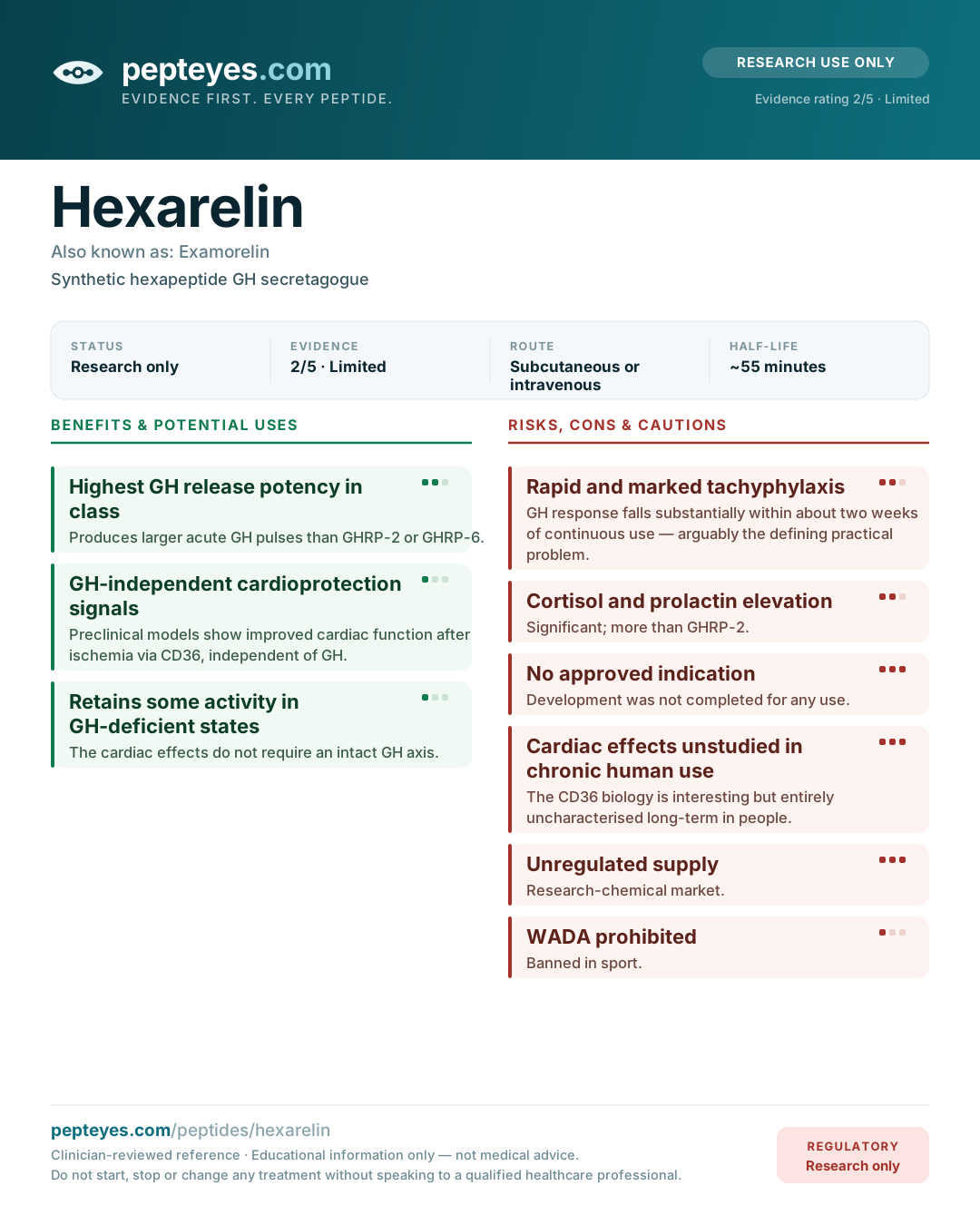
Highest GH release potency in class
Produces larger acute GH pulses than GHRP-2 or GHRP-6.
Evidence: Moderate evidence -
GH-independent cardioprotection signals
Preclinical models show improved cardiac function after ischemia via CD36, independent of GH.
Evidence: Preliminary -
Retains some activity in GH-deficient states
The cardiac effects do not require an intact GH axis.
Evidence: Preliminary
Risks and cautions
6 entries · 3 serious or common
-
Rapid and marked tachyphylaxis
GH response falls substantially within about two weeks of continuous use — arguably the defining practical problem.
Evidence: Moderate evidence -
Cortisol and prolactin elevation
Significant; more than GHRP-2.
Evidence: Moderate evidence -
No approved indication
Development was not completed for any use.
Evidence: Serious -
Cardiac effects unstudied in chronic human use
The CD36 biology is interesting but entirely uncharacterised long-term in people.
Evidence: Serious -
Unregulated supply
Research-chemical market.
Evidence: Serious -
WADA prohibited
Banned in sport.
Evidence: Minor
Counts are not a score. A single serious risk can outweigh several well-supported benefits, and a long benefit list built on preclinical work outweighs nothing at all.
Opinion — what people actually report
4 themes · 1 reported benefit · 2 reported problems
This is the weakest tier on this site. These are themes drawn from public discussion — forums, subreddits and patient threads — not from trials. There is no control group, no denominator, and no way to confirm that what someone injected matched its label. People post when a result is dramatic and when something goes wrong, and rarely when nothing happens, so treat everything below as a description of the conversation rather than of the compound. The bars count how often a thing is said, not how well it is supported.
-
Reported as the strongest pulse in the class Reported benefit. Recurring: Raised regularly, though not by everyone.
Chosen by people who found the others underwhelming, and described as noticeably more potent.
-
Tolerance builds fast Reported problem. Dominant theme: Comes up in most discussions of this compound.
The dominant theme. Reports consistently describe the effect fading within weeks, far faster than for the other secretagogues, driving very short cycles.
-
Prolactin and cortisol concerns are highest here Reported problem. Recurring: Raised regularly, though not by everyone.
Treated as the least clean option in the category.
-
Cardiac effects discussed with interest and unease Practical note. Occasional: Reported by a minority, or in specific contexts.
A minority strand notes the cardiovascular research and is unsure whether to read it as a benefit or a warning.
Where the reports and the evidence part ways
Desensitisation is the one community claim here with clear support — human studies do show attenuated growth hormone response with continued administration, so the short-cycle folklore has a real basis for once. The cardiac literature people cite is preclinical work on cardioprotection via CD36, not evidence of benefit or harm in healthy users, and it is regularly overread in both directions. As with the rest of the class, there are no human efficacy trials for the physique and recovery outcomes being pursued.
Readers on Hexarelin
Questions and answers from readers, under generated names. Nothing here has been checked or reviewed by the site and none of it is medical advice. It is the least verified thing on this page — and it is here because people ask each other these things anyway, and most of the other places they can ask are run by sellers.
0 questions · 0 answers
No questions yet. Ask the first one above — it takes one box and an email address.
How names work, and the house rules
Names. Every verified address is given one generated name — two ordinary words — and keeps it. Nobody chooses a name and nobody can take another's. Posts marked desk were written by the site's own editorial desk, usually to open a thread; they carry a generated name like everyone else's and are held to the site's rules, which means they never state an amount.
What is not allowed. Selling, sourcing, vendor names, coupon codes and "message me" — posts that read that way are held and usually removed. Personal medical details you would not want public. Abuse. Instructions framed as what someone else should do.
What this is not. A reader's report of what happened to them is a report, not a finding, and an answer here is one person's view. Nothing in this section changes the evidence rating above it. If something you read here would change what you take, take it to a pharmacist or physician first.
Your data. Delete any post of yours at any time, or remove everything you have written together with your name. Details in the privacy notice.
Who should avoid it
- Active malignancy
- Pregnancy
- Cardiac disease outside a research setting
- Hyperprolactinemia
If used under medical supervision, monitor
- IGF-1, prolactin, cortisol
- Glucose
Regulatory & legal status
Not approved for human use.
Infographic
Where to read further
We link to live literature searches rather than a frozen citation list, so you always see current results — including anything published after our last review.
- PubMed — all published literature on Hexarelin
- PubMed — randomized controlled trials only
- ClinicalTrials.gov — registered human trials
Related peptides in Growth Hormone Axis
Terms used on this page
- Growth Hormone-Releasing Peptide (GHRP)
- GHRPs are small synthetic peptides that release growth hormone by activating the ghrelin receptor GHS-R1a on pituitary and hypothalamic cells rather than the GHRH receptor.
- Growth Hormone Secretagogue Receptor (GHS-R1a)
- GHS-R1a is the G protein-coupled ghrelin receptor mediating growth hormone release and appetite, notable for unusually high constitutive activity in the complete absence of any ligand.
- Preclinical Study and Animal Model
- Preclinical studies are the laboratory, cell and animal experiments done before any human exposure, establishing mechanism, target engagement and the toxicology package that permits a first trial.
- Pulsatile GH Secretion
- Pulsatile GH secretion is the discontinuous release of growth hormone in discrete bursts separated by near-undetectable troughs, generated by alternating GHRH and somatostatin drive.
- Agonist
- An agonist is a ligand that binds a receptor and stabilises its active conformation, producing a biological response rather than merely occupying the binding site.
- Tissue Perfusion
- Tissue perfusion is the volume of blood delivered through the capillary bed per unit of tissue mass per minute, the quantity that determines local oxygen and drug delivery.
This page is educational information, not medical advice. It cannot account for your medical history, medications, or risk factors. Do not start, stop or change any treatment based on it. Speak to a qualified healthcare professional who knows your case.