Supplied as capsules or tablets
Growth Hormone Axis
At a glance
Ten answers, each one line. Open any row for the detail behind it.
What it does Technically a spiropiperidine, not a peptide — but it sits in every peptide catalogue, so…
Technically a spiropiperidine, not a peptide — but it sits in every peptide catalogue, so it belongs here. It has more human trial data than most peptides on this page, and that data includes the reason it was abandoned.
Half-life ~4-6 h in beagles; no published human half-life. A single oral… — Documented
~4-6 h in beagles; no published human half-life. A single oral dose keeps GH and IGF-1 raised for about 24 hours.
Typical studied dose None established. No dose has ever been set for a human being, because… — Nothing established
None established. No dose has ever been set for a human being, because the studies that would set one have not been done. Any figure circulating for this compound was chosen by somebody selling it or by somebody guessing.
How often it is used No schedule exists. Cycles and intervals quoted for this compound come… — Nothing established
No schedule exists. Cycles and intervals quoted for this compound come from forums rather than from any study, and they vary because nothing anchors them.
How it is taken Oral, once daily — Documented
Oral, once daily
Main side effects Failed its key clinical trial · Congestive heart failure signal · Insulin resistance and hyperglycemia — Carries serious risk
Failed its key clinical trial — The hip-fracture recovery program did not meet endpoints, and development was stopped. Fat-free mass gains did not translate into functional benefit.
Congestive heart failure signal — A trial in frail elderly patients was halted after an increase in congestive heart failure cases in the treatment arm. This is the most serious concern with the compound.
Insulin resistance and hyperglycemia — Consistent and dose-dependent; fasting glucose rises and insulin sensitivity falls.
Storage before mixing Kept dry, sealed and at room temperature unless the label says…
Kept dry, sealed and at room temperature unless the label says otherwise. Moisture is what shortens the life of a capsule or tablet.
Shelf life after mixing Nothing to mix — it is not supplied as a powder. The relevant date is…
Nothing to mix — it is not supplied as a powder. The relevant date is the one printed on the product.
Evidence level 3/5 · Moderate — Depends on the study
Small or early-phase human trials, or good controlled topical human data.
Regulatory status Not a Peptide — Nothing established
Not a peptide. Investigational drug; development discontinued. Not approved. Prohibited in sport. Unapproved investigational drug. Not lawful as a dietary supplement in the US. WADA-prohibited.
Overview
Technically a spiropiperidine, not a peptide — but it sits in every peptide catalogue, so it belongs here. It has more human trial data than most peptides on this page, and that data includes the reason it was abandoned.
This is not a peptideIncluded because it is marketed alongside peptides, but is a different class of molecule. Unapproved investigational drug. Not lawful as a dietary supplement in the US. WADA-prohibited.
| Regulatory status | Not a peptide. Investigational drug; development discontinued. Not approved. Prohibited in sport. |
|---|---|
| Drug class | Non-peptide, orally active ghrelin receptor agonist — listed here because it is universally marketed alongside peptides |
| Route | Oral, once daily |
| Half-life | ~4-6 h in beagles; no published human half-life. A single oral dose keeps GH and IGF-1 raised for about 24 hours. |
| Evidence rating |
3/5 Moderate
Evidence rating 3 out of 5: Moderate
Small or early-phase human trials, or good controlled topical human data. |
| Studied in | Multiple phase 2 trials including elderly hip-fracture recovery, sarcopenia, GH deficiency, and a 2-year trial in healthy older adults. |
MK-677 (Ibutamoren) sequence & structure
MK-677 (Ibutamoren) is not a peptide. It has no amino-acid sequence; its formula and molecular weight (528.68 Da) are given for reference.
Not a peptide: a spiro[indoline-3,4'-piperidine] (spiropiperidine) small-molecule ghrelin receptor (GHS-R1a) agonist from Merck (research code L-163,191; also LUM-201), IUPAC 2-amino-2-methyl-N-[(2R)-1-(1-methylsulfonylspiro[2H-indole-3,4'-piperidine]-1'-yl)-1-oxo-3-phenylmethoxypropan-2-yl]propanamide; the single stereocentre is (R), derived from O-benzyl-D-serine, and the SMILES here canonicalises identically to the PubChem and Guide to Pharmacology structures. UNII GJ0EGN38UL; PDB ligand code 1KD. PubChem CID 9939050 (cited by Wikipedia) is the stereo-unspecified entry, not the drug. Vendors often quote the mesylate CAS (159752-10-0) or MW (624.8) against the free-base name; 'Nutrobal' is a vendor brand. Not approved anywhere (Guide to Pharmacology: not approved; ChEMBL max phase 2); FDA warning letters cover products sold containing it.
Record confidence: high — two independent authoritative sources agree on the sequence and modifications. Every sequence on the site is listed with its sources on the peptide sequences index.
How it works
Orally bioavailable ghrelin receptor agonist producing sustained increases in GH and IGF-1 without injection. The sustained rather than pulsatile elevation is central to both its effects and its problems.
Evidence base
Rated 3 of 5 — Moderate. Small or early-phase human trials, or good controlled topical human data.
- Unusually good human evidence for this category — including the negative results that ended development.
Benefits and risks, weighed against the evidence
Every entry below carries the strength of the evidence behind it — three bars for strong human data, two for moderate, one for preliminary or preclinical work. The two columns are not equal by design: where a compound has more documented risk than demonstrated benefit, the lists say so.
Reported benefits
5 entries · 2 on strong human evidence
-
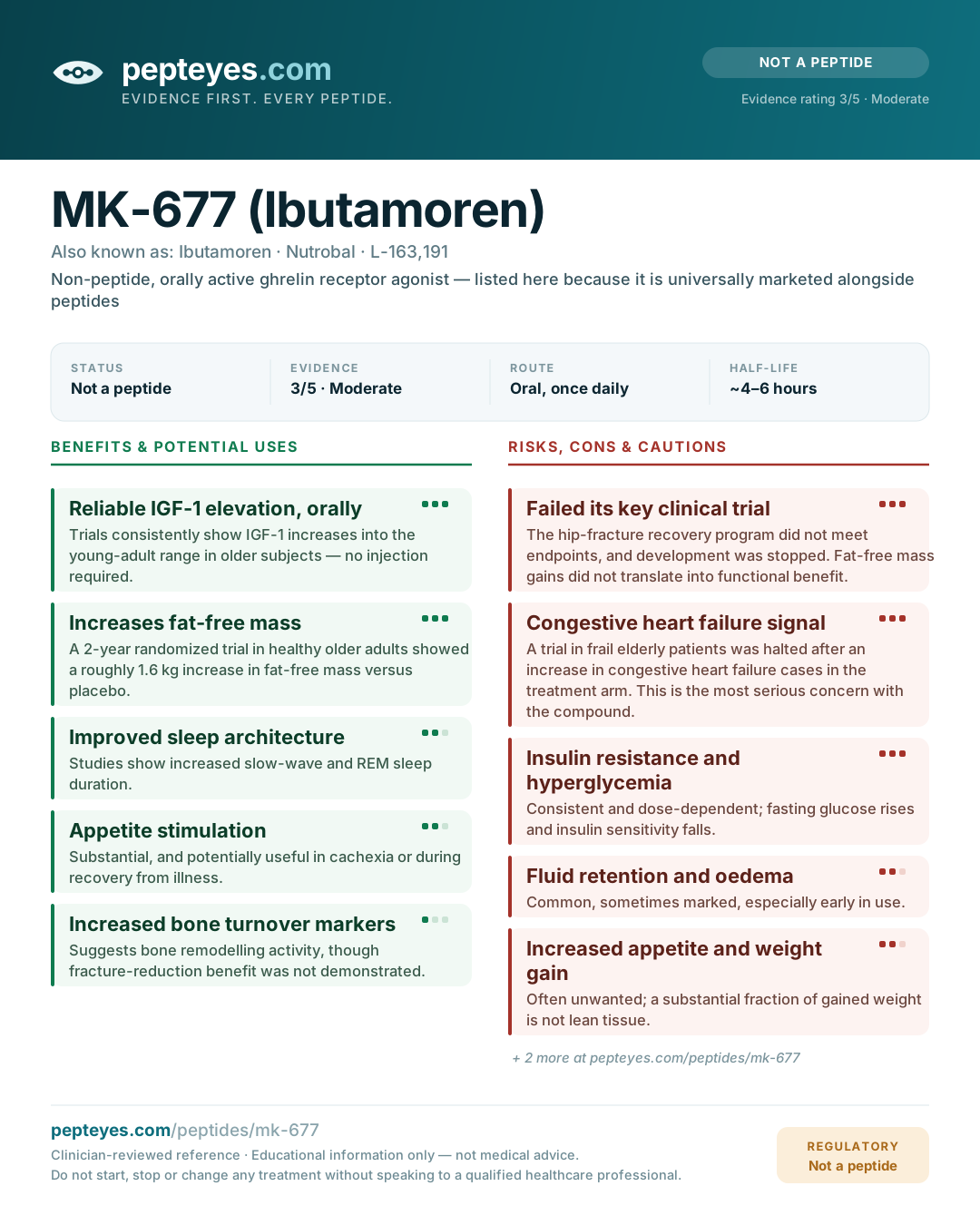
Reliable IGF-1 elevation, orally
Trials consistently show IGF-1 increases into the young-adult range in older subjects — no injection required.
Evidence: Strong evidence -
Increases fat-free mass
A 2-year randomized trial in healthy older adults showed a roughly 1.6 kg increase in fat-free mass versus placebo.
Evidence: Strong evidence -
Improved sleep architecture
Studies show increased slow-wave and REM sleep duration.
Evidence: Moderate evidence -
Appetite stimulation
Substantial, and potentially useful in cachexia or during recovery from illness.
Evidence: Moderate evidence -
Increased bone turnover markers
Suggests bone remodelling activity, though fracture-reduction benefit was not demonstrated.
Evidence: Preliminary
Risks and cautions
7 entries · 4 serious or common
-
Failed its key clinical trial
The hip-fracture recovery program did not meet endpoints, and development was stopped. Fat-free mass gains did not translate into functional benefit.
Evidence: Serious -
Congestive heart failure signal
A trial in frail elderly patients was halted after an increase in congestive heart failure cases in the treatment arm. This is the most serious concern with the compound.
Evidence: Serious -
Insulin resistance and hyperglycemia
Consistent and dose-dependent; fasting glucose rises and insulin sensitivity falls.
Evidence: Serious -
Fluid retention and oedema
Common, sometimes marked, especially early in use.
Evidence: Moderate evidence -
Increased appetite and weight gain
Often unwanted; a substantial fraction of gained weight is not lean tissue.
Evidence: Moderate evidence -
Lethargy and joint pain
Frequently reported by users at higher doses.
Evidence: Minor -
Sold illegally as a supplement
FDA has issued warning letters; it is not a lawful dietary ingredient. Prohibited by WADA.
Evidence: Serious
Counts are not a score. A single serious risk can outweigh several well-supported benefits, and a long benefit list built on preclinical work outweighs nothing at all.
Opinion — what people actually report
7 themes · 2 reported benefits · 3 reported problems
This is the weakest tier on this site. These are themes drawn from public discussion — forums, subreddits and patient threads — not from trials. There is no control group, no denominator, and no way to confirm that what someone injected matched its label. People post when a result is dramatic and when something goes wrong, and rarely when nothing happens, so treat everything below as a description of the conversation rather than of the compound. The bars count how often a thing is said, not how well it is supported.
-
Appetite increase that is hard to overstate Reported benefit. Dominant theme: Comes up in most discussions of this compound.
The most consistent effect reported anywhere in the growth hormone space. Frequently described as overwhelming rather than helpful, and it is the main reason people stop.
-
Deeper sleep and vivid dreams Reported benefit. Dominant theme: Comes up in most discussions of this compound.
Very widely reported and generally the effect people value most. Vivid or unusually intense dreaming comes up almost as often as the sleep quality itself.
-
Water retention, puffiness and numb hands Reported problem. Dominant theme: Comes up in most discussions of this compound.
Swollen fingers, puffy face and carpal-tunnel-like tingling are the classic complaints. Usually dose-related and reported to settle when people reduce.
-
Rising blood glucose Reported problem. Recurring: Raised regularly, though not by everyone.
The concern the more informed posters push hardest, often with their own fasting glucose or HbA1c numbers attached. Widely described as the reason to keep courses short.
-
Lethargy despite the better sleep Reported problem. Recurring: Raised regularly, though not by everyone.
A common paradox in reports: sleep improves but daytime energy drops.
-
Weight gain is mostly water and food Practical note. Recurring: Raised regularly, though not by everyone.
Long-term posters routinely warn newcomers that the fast scale movement is not tissue, and that much of it disappears on stopping.
-
Not a peptide, and often sold as one Practical note. Occasional: Reported by a minority, or in specific contexts.
Regularly corrected in threads — it is an orally active non-peptide secretagogue, which is why it is sold as a capsule.
Where the reports and the evidence part ways
Community and evidence agree on the mechanism and on most of the effects: MK-677 does raise IGF-1 durably, and the appetite, water retention and glucose effects are all documented. The divergence is over what that buys. Forums treat raised IGF-1 as equivalent to benefit; the trial that matters most here — a two-year study in older adults — raised IGF-1 to youthful levels and increased lean mass, but produced no improvement in strength or function, and raised fasting glucose and insulin resistance. A separate hip-fracture trial was stopped early for congestive heart failure signals. That is a considerably less favourable picture than the forum consensus, and it is rarely mentioned in it.
Readers on MK-677 (Ibutamoren)
Questions and answers from readers, under generated names. Nothing here has been checked or reviewed by the site and none of it is medical advice. It is the least verified thing on this page — and it is here because people ask each other these things anyway, and most of the other places they can ask are run by sellers.
1 question · 1 answer
-
Golden Crane desk — written by the site's editorial desk asked
Does the MK-677 hunger ever settle down, or is it the reason everyone eventually stops?
Reply
Show 1 answerCollapse 1 answer
- Indigo Sparrow desk — written by the site's editorial desk answered
Both, from the reports. Some people say it fades after the first weeks; a large share say it never did and that it is why they stopped. The sleep and the vivid dreams are what people value; the water retention and numb hands are what they tolerate.
The point the more careful posters push is fasting glucose, and that is one forum habit the literature agrees with: the trials that exist found it raised fasting glucose and reduced insulin sensitivity.
How names work, and the house rules
Names. Every verified address is given one generated name — two ordinary words — and keeps it. Nobody chooses a name and nobody can take another's. Posts marked desk were written by the site's own editorial desk, usually to open a thread; they carry a generated name like everyone else's and are held to the site's rules, which means they never state an amount.
What is not allowed. Selling, sourcing, vendor names, coupon codes and "message me" — posts that read that way are held and usually removed. Personal medical details you would not want public. Abuse. Instructions framed as what someone else should do.
What this is not. A reader's report of what happened to them is a report, not a finding, and an answer here is one person's view. Nothing in this section changes the evidence rating above it. If something you read here would change what you take, take it to a pharmacist or physician first.
Your data. Delete any post of yours at any time, or remove everything you have written together with your name. Details in the privacy notice.
Who should avoid it
- Any heart failure history
- Diabetes or prediabetes
- Active malignancy
- Pregnancy
- Tested athletes
If used under medical supervision, monitor
- Fasting glucose, HbA1c, insulin
- IGF-1
- Weight and oedema
- Cardiac symptoms
Interactions
Not exhaustive. Always have a pharmacist or physician review your full medication list — including supplements.
- Insulin and antidiabetic drugs — MK-677 consistently worsens insulin sensitivity and raises fasting glucose
- Corticosteroids — additive metabolic effects
- Heart failure — a phase 2b trial in elderly patients recovering from hip fracture was terminated early after congestive heart failure appeared in a small number of participants, and the investigators concluded the compound had an unfavourable safety profile in that population. Fluid retention and lower-limb oedema were also among the commonest effects in the two-year trial in healthy older adults. The signal comes from one frail elderly population and has not been characterised in anyone else
- Biotin - the interaction with the one laboratory value that tracks this compound. Biotin at supplement strengths interferes with immunoassays built on biotin and streptavidin, and IGF-1 is measured that way; laboratories advise stopping high-strength biotin well before a sample is drawn, and interference has been shown directly on an IGF-1 platform. The error can run high or low.
- No supplement has been shown to offset what this compound does to glucose. The two-year randomised trial found fasting glucose rose and insulin sensitivity fell, and nothing has been tested against that effect - not chromium, not berberine, not inositol or cinnamon. The absence is complete, and the claims that circulate are all borrowed from studies in people who were not taking it.
- Chromium - the supplement most often proposed for insulin sensitivity. Pooled trials found no effect on fasting glucose in people without diabetes, and results in type 2 diabetes are inconsistent, with reviewers concluding that few studies produced changes that were clinically meaningful. It has never been studied with this compound.
- Berberine - the best-evidenced glucose-lowering supplement, and still not evidence for this use. Its trials are in type 2 diabetes, largely small and of low methodological quality, with none alongside a growth hormone secretagogue. A controlled human study found repeated berberine reduced CYP2D6, CYP2C9 and CYP3A4 activity, so it brings interactions of its own.
- L-arginine - the supplement with genuine growth hormone pharmacology, which is why it gets stacked here. It suppresses somatostatin, and a meta-analysis of randomised trials found it raises growth hormone release, more so with growth hormone releasing hormone. Yet oral arginine before resistance exercise blunted rather than added to that response, and nothing has combined it with a secretagogue.
Regulatory & legal status
Unapproved investigational drug. Not lawful as a dietary supplement in the US. WADA-prohibited.
Infographic
What this entry was checked against
The specific records this monograph was verified against on its last research pass. We link live literature searches below as well, because these are a snapshot and the literature is not.
- Nass R et al. Effects of an oral ghrelin mimetic on body composition and clinical outcomes in healthy older adults: a randomized trial. Ann Intern Med 2008;149:601-11 - two years, placebo-controlled; fasting glucose rose, insulin sensitivity fell, cortisol rose, and appetite increase and transient mild lower-extremity oedema were the commonest effects
- Adunsky A et al. MK-0677 (ibutamoren mesylate) for patients recovering from hip fracture: a multicenter, randomized, placebo-controlled phase IIb study. Arch Gerontol Geriatr 2011;53:183-9 - terminated early for a congestive heart failure safety signal; unfavourable safety profile in that population
- Labcorp test information for insulin-like growth factor 1 - instructs that patients be cautioned to stop high-dose biotin well before sample collection because of assay interference, and notes that malnutrition lowers IGF-1 independently
- Biotin interference in routine IDS-iSYS immunoassays for aldosterone, renin, insulin-like growth factor 1, growth hormone and bone alkaline phosphatase (2021) - direct testing of biotin interference on an IGF-1 platform
- Chromium - Linus Pauling Institute Micronutrient Information Center: no effect on fasting glucose in people without diabetes in pooled trials, inconsistent results in type 2 diabetes, and few clinically meaningful changes
- Goli P et al. Growth hormone response to L-arginine alone and combined with different doses of growth hormone-releasing hormone: a systematic review and meta-analysis. Int J Endocrinol 2022 - arginine raises growth hormone release, more so with growth hormone releasing hormone
- Collier SR, Collins E, Kanaley JA. Oral arginine attenuates the growth hormone response to resistance exercise. J Appl Physiol 2006;101:848-52 - arginine before exercise produced a smaller growth hormone response than exercise alone
- Guo Y et al. Repeated administration of berberine inhibits cytochromes P450 in humans. Eur J Clin Pharmacol 2012;68:213-7
Where to read further
We link to live literature searches rather than a frozen citation list, so you always see current results — including anything published after our last review.
- PubMed — all published literature on MK-677 (Ibutamoren)
- PubMed — randomized controlled trials only
- ClinicalTrials.gov — registered human trials
Related peptides in Growth Hormone Axis
Terms used on this page
- Growth Hormone Secretagogue Receptor (GHS-R1a)
- GHS-R1a is the G protein-coupled ghrelin receptor mediating growth hormone release and appetite, notable for unusually high constitutive activity in the complete absence of any ligand.
- Bioavailability
- Bioavailability is the fraction of an administered dose that reaches the systemic circulation chemically unchanged, measured against an intravenous dose of the same drug.
- Agonist
- An agonist is a ligand that binds a receptor and stabilises its active conformation, producing a biological response rather than merely occupying the binding site.
- Insulin-Like Growth Factor 1 (IGF-1)
- IGF-1 is a 70-amino-acid, proinsulin-like peptide produced mainly by the liver under growth hormone control, and it mediates most of the anabolic effects attributed to growth hormone.
- Randomised Controlled Trial (RCT)
- A randomised controlled trial assigns participants to intervention or control by chance and follows them prospectively, which is what allows an outcome difference to be attributed to the treatment itself.
- Lean Mass Loss
- Lean mass loss is the fat-free component of weight lost during an energy deficit, encompassing muscle, organ tissue, glycogen and water rather than muscle alone.
This page is educational information, not medical advice. It cannot account for your medical history, medications, or risk factors. Do not start, stop or change any treatment based on it. Speak to a qualified healthcare professional who knows your case.