Supplied as capsules or tablets
Growth Hormone Axis
At a glance
Ten answers, each one line. Open any row for the detail behind it.
What it does The only orally administered growth hormone secretagogue with full FDA approval — and it…
The only orally administered growth hormone secretagogue with full FDA approval — and it is approved as a diagnostic test, taken once, not as a therapy. That distinction is the whole point of including it.
Half-life ~4 hours — Documented
~4 hours
Typical studied dose Set on the approved label, which states the starting dose, how it is… — On the label
Set on the approved label, which states the starting dose, how it is increased and the maximum. Read it there rather than anywhere else — including here.
How often it is used Set on the approved label. The interval follows the half-life above… — On the label
Set on the approved label. The interval follows the half-life above, which is why some of these are weekly and others daily.
How it is taken Oral, single diagnostic dose — Documented
Oral, single diagnostic dose
Main side effects Diagnostic use only · QT interval prolongation · False results with interfering drugs — Carries serious risk
Diagnostic use only — It is not a treatment. There is no evidence base for repeated dosing, and no approval for therapeutic use.
QT interval prolongation — The main safety concern; concurrent QT-prolonging drugs must be stopped before testing.
False results with interfering drugs — Strong CYP3A4 inducers and recent GH therapy can invalidate the test.
Storage before mixing Kept dry, sealed and at room temperature unless the label says…
Kept dry, sealed and at room temperature unless the label says otherwise. Moisture is what shortens the life of a capsule or tablet.
Shelf life after mixing Nothing to mix — it is not supplied as a powder. The relevant date is…
Nothing to mix — it is not supplied as a powder. The relevant date is the one printed on the product.
Evidence level 5/5 · Very strong — Documented
Multiple phase 3 randomized trials plus regulatory approval in a major market.
Regulatory status FDA Approved — Documented
FDA-approved (2017) and EMA-approved for the diagnosis of adult growth hormone deficiency. Prescription diagnostic agent, administered under medical supervision.
Overview
The only orally administered growth hormone secretagogue with full FDA approval — and it is approved as a diagnostic test, taken once, not as a therapy. That distinction is the whole point of including it.
FDA ApprovedFDA-approved (2017) and EMA-approved for the diagnosis of adult growth hormone deficiency.
| Regulatory status | FDA-approved (2017) and EMA-approved for the diagnosis of adult growth hormone deficiency. |
|---|---|
| Drug class | Orally active ghrelin receptor agonist — peptidomimetic |
| Route | Oral, single diagnostic dose |
| Half-life | ~4 hours |
| Evidence rating |
5/5 Very strong
Evidence rating 5 out of 5: Very strong
Multiple phase 3 randomized trials plus regulatory approval in a major market. |
| Studied in | Pivotal randomized crossover trial against the insulin tolerance test, the previous reference standard. |
Macimorelin sequence & structure
Macimorelin is a 3-residue linear peptide with a free C-terminal acid, carrying D-amino acid substitutions, non-standard residues; molecular weight 474.57 Da.
lowercase = D-amino acid[bracketed] = non-standard residue
| Three-letter | H-Aib-D-Trp-D-gTrp-CHO |
|---|---|
| Length | 3 amino acid residues |
| Modifications |
|
| Molecular formula | C26H30N6O3 |
| Molecular weight | 474.57 Da (average, free base) |
| SMILES | CC(C)(N)C(=O)N[C@H](Cc1c[nH]c2ccccc12)C(=O)N[C@H](Cc1c[nH]c2ccccc12)NC=O |
| Identifiers | CAS 381231-18-1 · PubChem CID 9804938 · DrugBank DB13074 |
| Which molecule | Macrilen (US) and Ghryvelin (EU) are supplied as macimorelin acetate (C28H34N6O5, MW 534.6; each pouch/sachet contains 60 mg macimorelin, equivalent to 68 mg macimorelin acetate). This record describes the free base. |
| Sources | PubChem CID 9804938 (properties)FDA GSRS – MACIMORELIN, UNII 8680B21W73 (substance record and codes)FDA label – MACRILEN (macimorelin acetate) NDA 205598, section 11 DescriptionEMA – Ghryvelin (macimorelin) SmPC, section 2ChEMBL CHEMBL278623 |
Macimorelin (EP-1572 / JMV 1843 / AEZS-130) is a peptidomimetic pseudotripeptide, H-Aib-D-Trp-D-gTrp-CHO, in which the C-terminal residue is a tryptophan gem-diamine capped with formyl, so there is no acid or amide terminus; the free Aib alpha-amine is the only basic amine. ChEMBL classifies it as a small molecule (FDA label chemical name: D-tryptophanamide, 2-methylalanyl-N-[(1R)-1-(formylamino)-2-(1H-indol-3-yl)ethyl]-, acetate). Identifiers (CAS 381231-18-1, DB13074, CID 9804938, CHEMBL278623, UNII 8680B21W73, ATC V04CD06) confirmed in the FDA GSRS record; MW 474.57 is the calculated average (GSRS lists 474.55, PubChem 474.6).
Record confidence: high — two independent authoritative sources agree on the sequence and modifications. Every sequence on the site is listed with its sources on the peptide sequences index.
How it works
Ghrelin receptor agonism producing a reliable, reproducible growth hormone pulse. Its diagnostic value rests on that reproducibility: a peak GH below a defined threshold after a single oral dose confirms adult GH deficiency.
Evidence base
Rated 5 of 5 — Very strong. Multiple phase 3 randomized trials plus regulatory approval in a major market.
- Head-to-head validation against the previous reference standard — the right trial design for a diagnostic.
Benefits and risks, weighed against the evidence
Every entry below carries the strength of the evidence behind it — three bars for strong human data, two for moderate, one for preliminary or preclinical work. The two columns are not equal by design: where a compound has more documented risk than demonstrated benefit, the lists say so.
Reported benefits
4 entries · 3 on strong human evidence
-
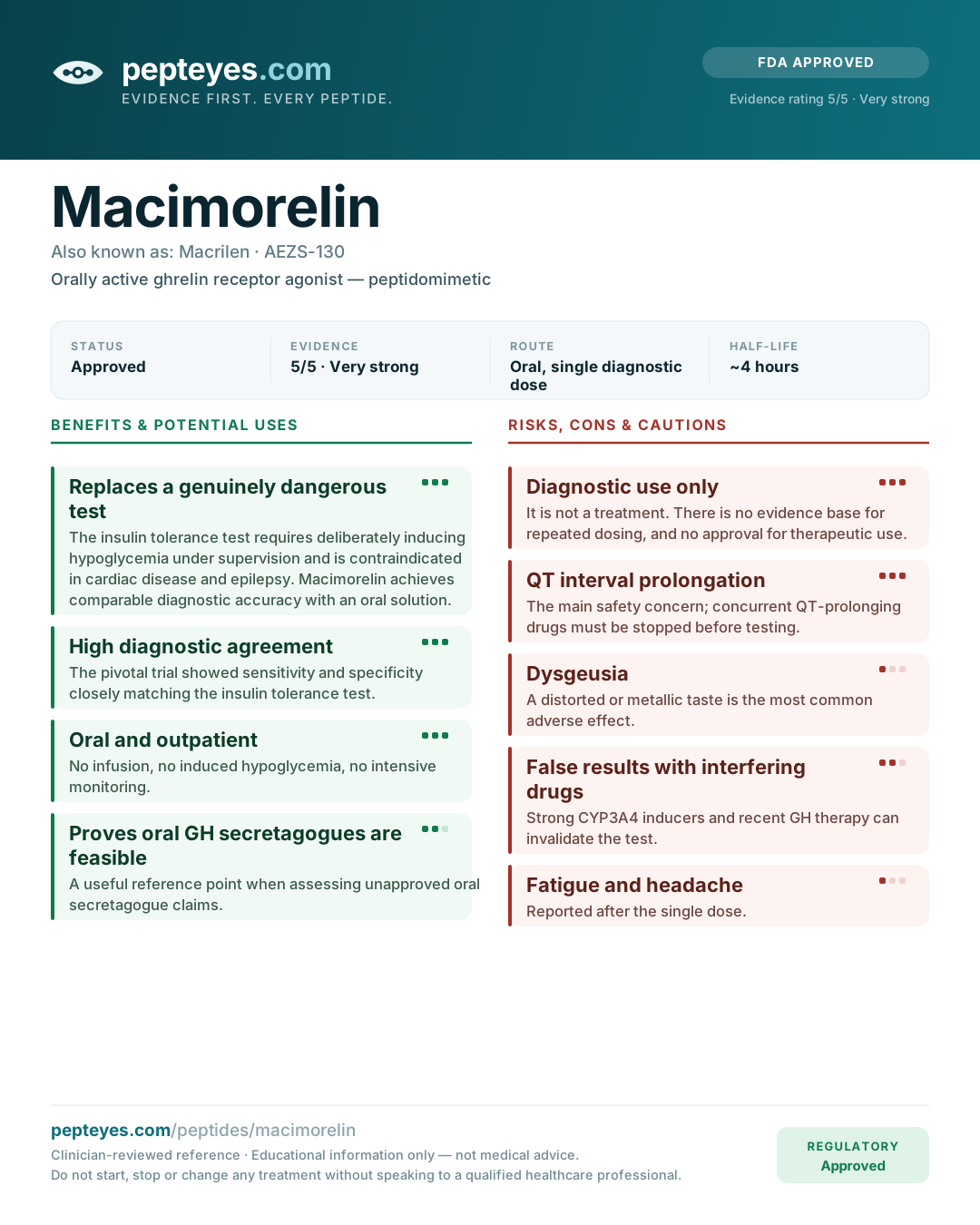
Replaces a genuinely dangerous test
The insulin tolerance test requires deliberately inducing hypoglycemia under supervision and is contraindicated in cardiac disease and epilepsy. Macimorelin achieves comparable diagnostic accuracy with an oral solution.
Evidence: Strong evidence -
High diagnostic agreement
The pivotal trial showed sensitivity and specificity closely matching the insulin tolerance test.
Evidence: Strong evidence -
Oral and outpatient
No infusion, no induced hypoglycemia, no intensive monitoring.
Evidence: Strong evidence -
Proves oral GH secretagogues are feasible
A useful reference point when assessing unapproved oral secretagogue claims.
Evidence: Moderate evidence
Risks and cautions
5 entries · 2 serious or common
-
Diagnostic use only
It is not a treatment. There is no evidence base for repeated dosing, and no approval for therapeutic use.
Evidence: Serious -
QT interval prolongation
The main safety concern; concurrent QT-prolonging drugs must be stopped before testing.
Evidence: Serious -
Dysgeusia
A distorted or metallic taste is the most common adverse effect.
Evidence: Minor -
False results with interfering drugs
Strong CYP3A4 inducers and recent GH therapy can invalidate the test.
Evidence: Moderate evidence -
Fatigue and headache
Reported after the single dose.
Evidence: Minor
Counts are not a score. A single serious risk can outweigh several well-supported benefits, and a long benefit list built on preclinical work outweighs nothing at all.
Opinion — what people actually report
4 themes · 1 reported benefit · 1 reported problem
This is the weakest tier on this site. These are themes drawn from public discussion — forums, subreddits and patient threads — not from trials. There is no control group, no denominator, and no way to confirm that what someone injected matched its label. People post when a result is dramatic and when something goes wrong, and rarely when nothing happens, so treat everything below as a description of the conversation rather than of the compound. The bars count how often a thing is said, not how well it is supported.
-
A diagnostic test, not a treatment Practical note. Dominant theme: Comes up in most discussions of this compound.
Nearly all discussion comes from patients undergoing growth hormone deficiency testing, describing the procedure rather than an ongoing therapy.
-
Far preferable to insulin tolerance testing Reported benefit. Recurring: Raised regularly, though not by everyone.
Patients who have had both describe the oral test as vastly less unpleasant than being made deliberately hypoglycaemic.
-
Taste and transient dizziness Reported problem. Recurring: Raised regularly, though not by everyone.
An unpleasant taste and brief light-headedness during the test are the usual complaints, and both pass within the appointment.
-
Access and cost vary widely Practical note. Recurring: Raised regularly, though not by everyone.
Availability is inconsistent between countries and payers, which is a frequent frustration.
Where the reports and the evidence part ways
Little disagreement — this is an approved diagnostic agent, validated against the insulin tolerance test, and patient reports of it being more tolerable match the reason it was developed. The only thing worth noting is that it occasionally appears in physique forums as a growth hormone secretagogue, which misreads a single-use diagnostic agent as a therapeutic one.
Readers on Macimorelin
Questions and answers from readers, under generated names. Nothing here has been checked or reviewed by the site and none of it is medical advice. It is the least verified thing on this page — and it is here because people ask each other these things anyway, and most of the other places they can ask are run by sellers.
0 questions · 0 answers
No questions yet. Ask the first one above — it takes one box and an email address.
How names work, and the house rules
Names. Every verified address is given one generated name — two ordinary words — and keeps it. Nobody chooses a name and nobody can take another's. Posts marked desk were written by the site's own editorial desk, usually to open a thread; they carry a generated name like everyone else's and are held to the site's rules, which means they never state an amount.
What is not allowed. Selling, sourcing, vendor names, coupon codes and "message me" — posts that read that way are held and usually removed. Personal medical details you would not want public. Abuse. Instructions framed as what someone else should do.
What this is not. A reader's report of what happened to them is a report, not a finding, and an answer here is one person's view. Nothing in this section changes the evidence rating above it. If something you read here would change what you take, take it to a pharmacist or physician first.
Your data. Delete any post of yours at any time, or remove everything you have written together with your name. Details in the privacy notice.
Who should avoid it
- Concurrent QT-prolonging medication
- Known congenital long QT syndrome
- Use as a therapy rather than a diagnostic
If used under medical supervision, monitor
- ECG before testing where QT risk exists
- Serial GH sampling per the test protocol
- Review of interfering medications
Interactions
Not exhaustive. Always have a pharmacist or physician review your full medication list — including supplements.
- QT-prolonging drugs — must be discontinued before testing
- Strong CYP3A4 inducers — can cause false results
- Recent growth hormone therapy — invalidates the test
Commonly confused with
These mix-ups cause real harm — two products sold under one name, or two molecules whose effects run in opposite directions.
Both are orally active ghrelin receptor agonists. Macimorelin is FDA-approved for a single diagnostic dose; MK-677 is an unapproved compound taken daily, and its long-term trial found a heart failure signal.
Compare side by sideRegulatory & legal status
Prescription diagnostic agent, administered under medical supervision.
Infographic
Where to read further
We link to live literature searches rather than a frozen citation list, so you always see current results — including anything published after our last review.
- PubMed — all published literature on Macimorelin
- PubMed — randomized controlled trials only
- ClinicalTrials.gov — registered human trials
- DailyMed — official FDA prescribing information
Related peptides in Growth Hormone Axis
Terms used on this page
- Growth Hormone Secretagogue (GHS)
- A growth hormone secretagogue is any compound that stimulates endogenous GH release, a class spanning GHRH analogues and ghrelin-mimetic agents acting at the GHS receptor.
- Growth Hormone Secretagogue Receptor (GHS-R1a)
- GHS-R1a is the G protein-coupled ghrelin receptor mediating growth hormone release and appetite, notable for unusually high constitutive activity in the complete absence of any ligand.
- Reproducibility and Replication
- Reproducibility is obtaining the same result from the same data and analysis, while replication is obtaining a consistent result from new data, and only the second shows the finding is real.
- Growth Hormone (GH)
- Growth hormone is a 191-amino-acid pituitary protein secreted in pulses that acts directly on tissues and indirectly through hepatic IGF-1, and is approved for a defined list of indications.
- Adult Growth Hormone Deficiency (AGHD)
- Adult growth hormone deficiency is a confirmed failure of pituitary somatotroph secretion, established by provocative testing, and the only adult indication for which growth hormone replacement is approved.
- Agonist
- An agonist is a ligand that binds a receptor and stabilises its active conformation, producing a biological response rather than merely occupying the binding site.
This page is educational information, not medical advice. It cannot account for your medical history, medications, or risk factors. Do not start, stop or change any treatment based on it. Speak to a qualified healthcare professional who knows your case.