Supplied ready in solution
Metabolic & Weight
At a glance
Ten answers, each one line. Open any row for the detail behind it.
What it does A precision-medicine peptide.
A precision-medicine peptide. It restores signalling in a specific broken hypothalamic pathway, and in the right genetic patient the effect is dramatic. In everyone else, it does very little — a useful reminder that peptides are not interchangeable.
Half-life ~11 hours — Documented
~11 hours
Typical studied dose Set on the approved label, which states the starting dose, how it is… — On the label
Set on the approved label, which states the starting dose, how it is increased and the maximum. Read it there rather than anywhere else — including here.
How often it is used The label schedule is once daily. Dosing intervals follow the half-life… — On the label
The label schedule is once daily. Dosing intervals follow the half-life above, and the prescribing information is what sets them.
How it is taken Subcutaneous, once daily — Documented
Subcutaneous, once daily
Main side effects Depression and suicidal ideation warning · Skin hyperpigmentation · No benefit in common polygenic obesity — Carries serious risk
Depression and suicidal ideation warning — Labelled warning requiring psychiatric monitoring, particularly in adolescents.
Skin hyperpigmentation — Very common, because MC1R cross-activation increases melanin. New or darkening naevi need dermatologic assessment.
No benefit in common polygenic obesity — It is not a general weight-loss drug and should not be sought as one.
Storage before mixing Supplied already in solution and kept refrigerated, not frozen. Freezing…
Supplied already in solution and kept refrigerated, not frozen. Freezing a protein solution can aggregate it, which is not always visible.
Shelf life after mixing Nothing to mix — it is not supplied as a powder. The relevant date is…
Nothing to mix — it is not supplied as a powder. The relevant date is the one printed on the product.
Evidence level 5/5 · Very strong — Documented
Multiple phase 3 randomized trials plus regulatory approval in a major market.
Regulatory status FDA Approved — Documented
FDA-approved for obesity due to POMC, PCSK1 or LEPR deficiency, and for Bardet-Biedl syndrome Prescription drug restricted to labelled genetic indications.
Overview
A precision-medicine peptide. It restores signalling in a specific broken hypothalamic pathway, and in the right genetic patient the effect is dramatic. In everyone else, it does very little — a useful reminder that peptides are not interchangeable.
FDA ApprovedFDA-approved for obesity due to POMC, PCSK1 or LEPR deficiency, and for Bardet-Biedl syndrome
| Regulatory status | FDA-approved for obesity due to POMC, PCSK1 or LEPR deficiency, and for Bardet-Biedl syndrome |
|---|---|
| Drug class | Melanocortin-4 receptor (MC4R) agonist — cyclic octapeptide |
| Route | Subcutaneous, once daily |
| Half-life | ~11 hours |
| Evidence rating |
5/5 Very strong
Evidence rating 5 out of 5: Very strong
Multiple phase 3 randomized trials plus regulatory approval in a major market. |
| Studied in | Pivotal open-label trials in POMC/LEPR deficiency and a randomized trial in Bardet-Biedl syndrome. |
Setmelanotide sequence & structure
Setmelanotide is a 8-residue cyclic peptide with a C-terminal amide, carrying D-amino acid substitutions; molecular weight 1,117.3 Da.
lowercase = D-amino acid
| Three-letter | Ac-Arg-Cys-D-Ala-His-D-Phe-Arg-Trp-Cys-NH2 |
|---|---|
| Length | 8 amino acid residues |
| Modifications |
|
| Molecular formula | C49H68N18O9S2 |
| Molecular weight | 1,117.3 Da (average, free base) |
| SMILES | CC(=O)N[C@@H](CCCNC(=N)N)C(=O)N[C@H]1CSSC[C@@H](C(N)=O)NC(=O)[C@H](Cc2c[nH]c3ccccc23)NC(=O)[C@H](CCCNC(=N)N)NC(=O)[C@@H](Cc2ccccc2)NC(=O)[C@H](Cc2c[nH]cn2)NC(=O)[C@@H](C)NC1=O |
| Identifiers | CAS 920014-72-8 · PubChem CID 11993702 · DrugBank DB11700 |
| Sources | FDA label — IMCIVREE (setmelanotide) injection, NDA 213793, section 11 DescriptionChEMBL CHEMBL3301624 (Setmelanotide) — HELM notation, formula, MW, SMILESKEGG DRUG D11927 (Setmelanotide) — formula, MW, CASPubChem CID 11993702 (Setmelanotide) — propertiesPubChem CID 11993702 — synonyms (CAS, UNII, DrugBank ID, ChEMBL ID, code names) |
Formula and MW (1117.3 Da) are for the anhydrous free base; the drug substance in Imcivree is setmelanotide acetate (2–4 molar equivalents of acetate, per the FDA label), so vendor MWs quoted for the acetate salt will be higher. Development codes RM-493, BIM-22493, IRC-022493; UNII N7T15V1FUY; ChEMBL CHEMBL3301624. Chemical name per label: acetyl-L-arginyl-L-cysteinyl-D-alanyl-L-histidinyl-D-phenylalanyl-L-arginyl-L-tryptophanyl-L-cysteinamide cyclic (2→8)-disulfide; ChEMBL HELM PEPTIDE1{[ac].R.C.[dA].H.[dF].R.W.C.[am]} with the 2–8 disulfide agrees.
Record confidence: high — two independent authoritative sources agree on the sequence and modifications. Every sequence on the site is listed with its sources on the peptide sequences index.
How it works
Agonises MC4R downstream of the leptin-melanocortin pathway. In patients whose obesity stems from an upstream defect (POMC, PCSK1, LEPR) or from ciliopathy-related signalling failure, bypassing the lesion restores satiety signalling.
Evidence base
Rated 5 of 5 — Very strong. Multiple phase 3 randomized trials plus regulatory approval in a major market.
- Small trials by design — the target populations are ultra-rare — but with unambiguous effect sizes.
Benefits and risks, weighed against the evidence
Every entry below carries the strength of the evidence behind it — three bars for strong human data, two for moderate, one for preliminary or preclinical work. The two columns are not equal by design: where a compound has more documented risk than demonstrated benefit, the lists say so.
Reported benefits
3 entries · 3 on strong human evidence
-
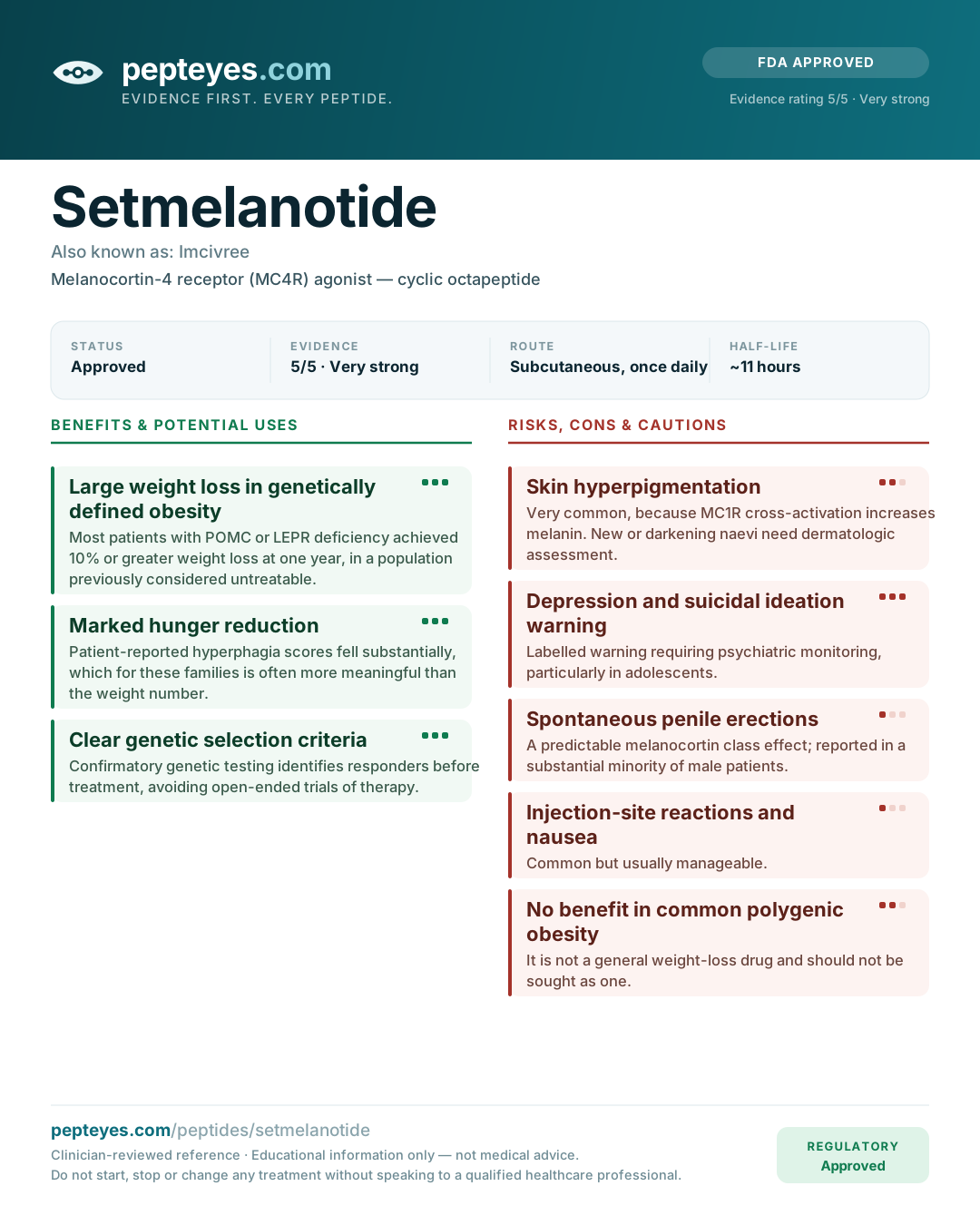
Large weight loss in genetically defined obesity
Most patients with POMC or LEPR deficiency achieved 10% or greater weight loss at one year, in a population previously considered untreatable.
Evidence: Strong evidence -
Marked hunger reduction
Patient-reported hyperphagia scores fell substantially, which for these families is often more meaningful than the weight number.
Evidence: Strong evidence -
Clear genetic selection criteria
Confirmatory genetic testing identifies responders before treatment, avoiding open-ended trials of therapy.
Evidence: Strong evidence
Risks and cautions
5 entries · 1 serious or common
-
Skin hyperpigmentation
Very common, because MC1R cross-activation increases melanin. New or darkening naevi need dermatologic assessment.
Evidence: Moderate evidence -
Depression and suicidal ideation warning
Labelled warning requiring psychiatric monitoring, particularly in adolescents.
Evidence: Serious -
Spontaneous penile erections
A predictable melanocortin class effect; reported in a substantial minority of male patients.
Evidence: Minor -
Injection-site reactions and nausea
Common but usually manageable.
Evidence: Minor -
No benefit in common polygenic obesity
It is not a general weight-loss drug and should not be sought as one.
Evidence: Moderate evidence
Counts are not a score. A single serious risk can outweigh several well-supported benefits, and a long benefit list built on preclinical work outweighs nothing at all.
Opinion — what people actually report
6 themes · 1 reported benefit · 4 reported problems
This is the weakest tier on this site. These are themes drawn from public discussion — forums, subreddits and patient threads — not from trials. There is no control group, no denominator, and no way to confirm that what someone injected matched its label. People post when a result is dramatic and when something goes wrong, and rarely when nothing happens, so treat everything below as a description of the conversation rather than of the compound. The bars count how often a thing is said, not how well it is supported.
-
Described as transformative by the right patients Reported benefit. Dominant theme: Comes up in most discussions of this compound.
Among the most striking reports in this library, from families dealing with genetic hyperphagia. The relief described is about the constant hunger stopping rather than about weight.
-
Skin darkening is expected and universal Reported problem. Dominant theme: Comes up in most discussions of this compound.
A direct melanocortin effect that patients are counselled about in advance and that comes up in nearly every account.
-
Daily injection and injection site reactions Reported problem. Recurring: Raised regularly, though not by everyone.
A practical burden, particularly for paediatric patients.
-
Spontaneous erections in male patients Reported problem. Recurring: Raised regularly, though not by everyone.
A known melanocortin off-target effect, reported and managed.
-
Genetic testing is the gatekeeper Practical note. Dominant theme: Comes up in most discussions of this compound.
A large share of discussion is about obtaining testing and confirming an eligible variant, since the drug only works for specific defects.
-
Depression and suicidal ideation are monitored for Reported problem. Occasional: Reported by a minority, or in specific contexts.
A labelled concern raised in patient communities and taken seriously.
Where the reports and the evidence part ways
This is one of the closest report-to-evidence matches on the site. Trials in POMC, PCSK1 and LEPR deficiency showed large, durable reductions in hunger and weight, and hyperpigmentation was near-universal — exactly what families describe. The important divergence is at the edges: people with common polygenic obesity sometimes discuss it as a general option, and it is not one. Efficacy is confined to specific genetic defects in the melanocortin pathway, and outside those it has no established benefit. The drug is a demonstration that mechanism-matched treatment works, not a general obesity therapy.
Readers on Setmelanotide
Questions and answers from readers, under generated names. Nothing here has been checked or reviewed by the site and none of it is medical advice. It is the least verified thing on this page — and it is here because people ask each other these things anyway, and most of the other places they can ask are run by sellers.
0 questions · 0 answers
No questions yet. Ask the first one above — it takes one box and an email address.
How names work, and the house rules
Names. Every verified address is given one generated name — two ordinary words — and keeps it. Nobody chooses a name and nobody can take another's. Posts marked desk were written by the site's own editorial desk, usually to open a thread; they carry a generated name like everyone else's and are held to the site's rules, which means they never state an amount.
What is not allowed. Selling, sourcing, vendor names, coupon codes and "message me" — posts that read that way are held and usually removed. Personal medical details you would not want public. Abuse. Instructions framed as what someone else should do.
What this is not. A reader's report of what happened to them is a report, not a finding, and an answer here is one person's view. Nothing in this section changes the evidence rating above it. If something you read here would change what you take, take it to a pharmacist or physician first.
Your data. Delete any post of yours at any time, or remove everything you have written together with your name. Details in the privacy notice.
Who should avoid it
- Patients without a qualifying genetic diagnosis
- Pregnancy
- Untreated significant depression (relative)
If used under medical supervision, monitor
- Full skin examination before and during treatment
- Depression screening
- Weight and hyperphagia scores
- Growth in pediatric patients
Interactions
Not exhaustive. Always have a pharmacist or physician review your full medication list — including supplements.
- No major pharmacokinetic interactions established
- Other melanocortin agonists — additive pigmentation and cardiovascular effects
Commonly confused with
These mix-ups cause real harm — two products sold under one name, or two molecules whose effects run in opposite directions.
Both melanocortin agonists. Setmelanotide targets MC4R for genetic obesity and is dosed daily; PT-141 targets MC3R/MC4R for sexual desire and is dosed on demand.
Compare side by sideRegulatory & legal status
Prescription drug restricted to labelled genetic indications.
Infographic
Where to read further
We link to live literature searches rather than a frozen citation list, so you always see current results — including anything published after our last review.
- PubMed — all published literature on Setmelanotide
- PubMed — randomized controlled trials only
- ClinicalTrials.gov — registered human trials
- DailyMed — official FDA prescribing information
Related peptides in Metabolic & Weight
Terms used on this page
- Satiety vs Satiation
- Satiation is the set of signals that ends a meal in progress, while satiety is the post-meal inhibition that determines how long it takes before eating begins again.
- MC3R vs MC4R
- MC3R and MC4R are the two central melanocortin receptors, with MC4R driving satiety and energy expenditure and MC3R tuning nutrient partitioning and the timing of puberty.
- Melanocortin System
- The melanocortin system is the POMC-derived signalling network in which alpha-MSH and ACTH act on five receptors to control pigmentation, adrenal steroid output, appetite and energy balance.
- Effect Size
- Effect size is the magnitude of a difference or an association, expressed on a scale that does not depend on how many participants were studied, unlike a p-value.
- Melanocortin-1 Receptor (MC1R)
- MC1R is the G protein-coupled receptor on melanocytes that, when bound by alpha-MSH or ACTH, raises cyclic AMP and switches pigment synthesis from pheomelanin toward eumelanin.
- Off-Target Toxicity
- Off-target toxicity is harm produced when a compound binds a receptor, enzyme or tissue other than its intended target, as distinct from exaggerated effects at the target itself.
This page is educational information, not medical advice. It cannot account for your medical history, medications, or risk factors. Do not start, stop or change any treatment based on it. Speak to a qualified healthcare professional who knows your case.