Supplied as a lyophilised powder to reconstitute
Metabolic & Weight
At a glance
Ten answers, each one line. Open any row for the detail behind it.
What it does Amylin is the pancreatic hormone co-secreted with insulin that signals meal termination…
Amylin is the pancreatic hormone co-secreted with insulin that signals meal termination through a pathway separate from GLP-1. Combining the two mechanisms is the leading strategy for pushing weight loss past the incretin ceiling.
Half-life ~7 days — Documented
~7 days
Typical studied dose No established dose. Each trial protocol fixes its own and publishes it… — Depends on the study
No established dose. Each trial protocol fixes its own and publishes it in the registry entry, under medical supervision that is part of the dose. There is no approved amount for use outside a study.
How often it is used Whatever the protocol specifies. The registry entry for a given study… — Depends on the study
Whatever the protocol specifies. The registry entry for a given study states its interval; nothing establishes one outside a study.
How it is taken Subcutaneous, once weekly (investigational) — Documented
Subcutaneous, once weekly (investigational)
Main side effects Not approved · Grey-market availability · GI adverse effects — Carries serious risk
Not approved — No regulatory authorisation anywhere; safety profile is still being characterised.
Grey-market availability — Sold illicitly as a "research peptide" with no quality control.
GI adverse effects — Nausea and vomiting remain the dominant tolerability limit in combination.
Storage before mixing As a sealed lyophilised powder, refrigerated is typical and a freezer…
As a sealed lyophilised powder, refrigerated is typical and a freezer suits long storage; both should be dark and dry. A dry powder tolerates a few days out of the cold far better than anything in solution — which is why it ships that way.
Shelf life after mixing Once mixed it is refrigerated and treated as short-lived. Bacteriostatic…
Once mixed it is refrigerated and treated as short-lived. Bacteriostatic water contains a preservative and buys the longer window; sterile water contains none and buys a much shorter one. Peptides in solution also degrade on their own, so the container is only half the question.
Evidence level 3/5 · Moderate — Depends on the study
Small or early-phase human trials, or good controlled topical human data.
Regulatory status In Clinical Trials — Depends on the study
Phase 3 (REDEFINE program) as a fixed combination with semaglutide. Not approved. Investigational. Not lawfully available for human use.
Overview
Amylin is the pancreatic hormone co-secreted with insulin that signals meal termination through a pathway separate from GLP-1. Combining the two mechanisms is the leading strategy for pushing weight loss past the incretin ceiling.
Investigational — not approvedInvestigational. Not lawfully available for human use.
| Regulatory status | Phase 3 (REDEFINE program) as a fixed combination with semaglutide. Not approved. |
|---|---|
| Drug class | Long-acting amylin analog |
| Route | Subcutaneous, once weekly (investigational) |
| Half-life | ~7 days |
| Evidence rating |
3/5 Moderate
Evidence rating 3 out of 5: Moderate
Small or early-phase human trials, or good controlled topical human data. |
| Studied in | REDEFINE phase 3 program in obesity; earlier phase 2 combination trials. |
Cagrilintide sequence & structure
Cagrilintide is a 37-residue disulfide-bridged peptide with a C-terminal amide, carrying a fatty-acid side chain; molecular weight 4,409.01 Da.
| Three-letter | Eicosanedioyl-γGlu-Lys-Cys-Asn-Thr-Ala-Thr-Cys-Ala-Thr-Gln-Arg-Leu-Ala-Glu-Phe-Leu-Arg-His-Ser-Ser-Asn-Asn-Phe-Gly-Pro-Ile-Leu-Pro-Pro-Thr-Asn-Val-Gly-Ser-Asn-Thr-Pro-NH2 |
|---|---|
| Length | 37 amino acid residues |
| Modifications |
|
| Molecular formula | C194H312N54O59S2 |
| Molecular weight | 4,409.01 Da (average, free base) |
| Identifiers | CAS 1415456-99-3 · PubChem CID 171397054 · DrugBank DB18887 · UniProt P10997 |
| Which molecule | Describes cagrilintide itself; CagriSema is a fixed-dose co-formulation of this same peptide with semaglutide, not a different molecule. |
| Sources | NCATS GSRS substance record, CAGRILINTIDE (UNII AO43BIF1U8) — sequence, Cys2–Cys7 disulfide, N-terminal acylation, C-terminal amide, CASPubChem CID 171397054 — formula, MW, CAS, UNII, full systematic nameChEMBL molecule CHEMBL4802169 — sequence cross-checkUniProt P10997 IAPP_HUMAN — parent human amylin (mature chain 34–70) |
Also AM833 / NNC0174-0833 (Novo Nordisk); UNII AO43BIF1U8; 'analogue 23' of Kruse et al., J Med Chem 2021 (PMID 34288673). Numbering here follows the 37-residue amylin backbone (Lys1…Pro37); the CAS/vendor systematic name counts the γGlu spacer as residue 1 and so writes the same bridge as cyclic (3→8). MW 4409.01 is the free peptide; commercial material is usually an acetate or TFA salt.
Record confidence: high — two independent authoritative sources agree on the sequence and modifications. Every sequence on the site is listed with its sources on the peptide sequences index.
How it works
Activates amylin and calcitonin receptor complexes in the area postrema, slowing gastric emptying and producing satiation. Because the receptor population differs from GLP-1, effects are additive rather than redundant.
Evidence base
Rated 3 of 5 — Moderate. Small or early-phase human trials, or good controlled topical human data.
- Phase 3 topline data reported; full peer-reviewed publication and regulatory review pending.
Benefits and risks, weighed against the evidence
Every entry below carries the strength of the evidence behind it — three bars for strong human data, two for moderate, one for preliminary or preclinical work. The two columns are not equal by design: where a compound has more documented risk than demonstrated benefit, the lists say so.
Reported benefits
3 entries
-
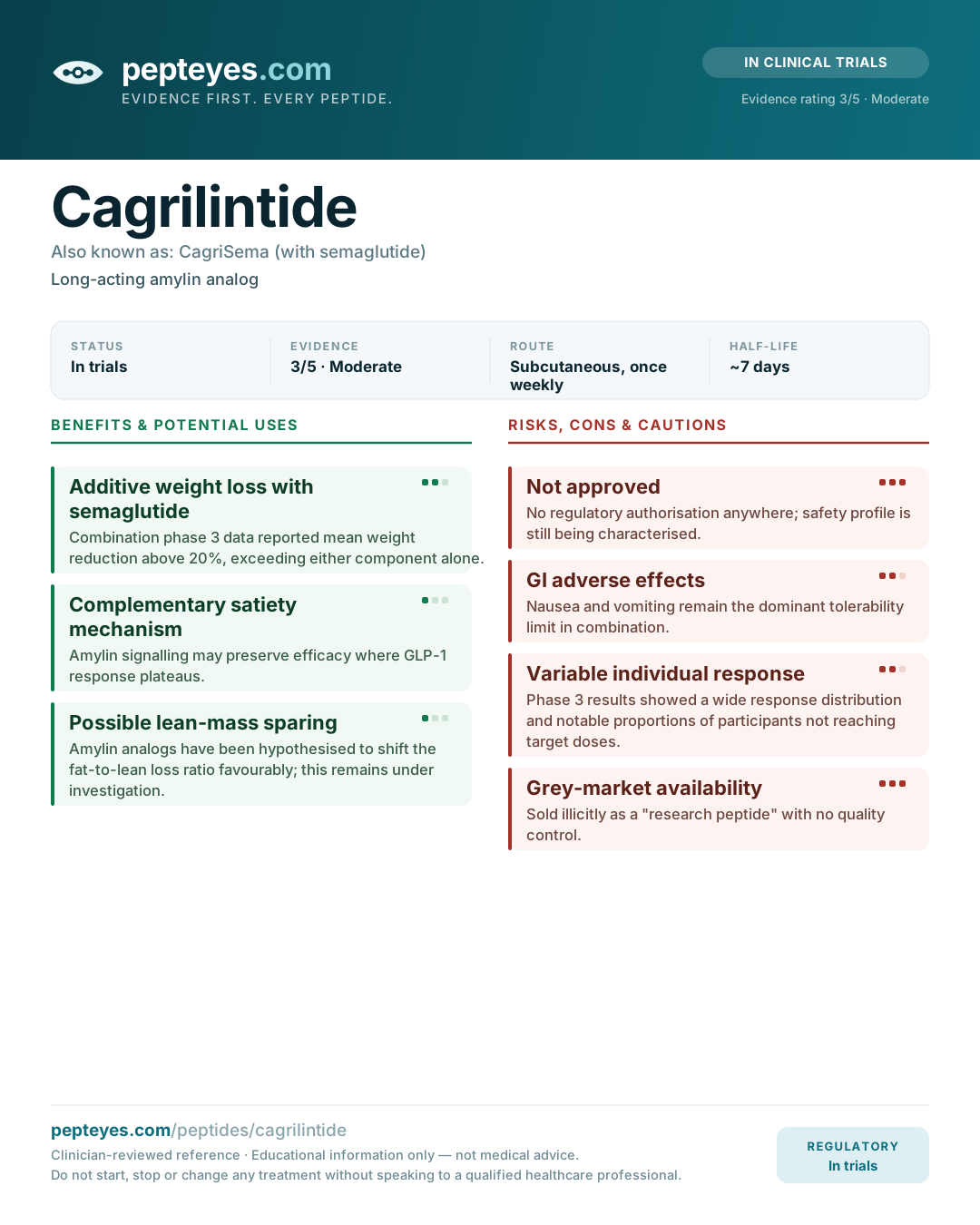
Additive weight loss with semaglutide
Combination phase 3 data reported mean weight reduction above 20%, exceeding either component alone.
Evidence: Moderate evidence -
Complementary satiety mechanism
Amylin signalling may preserve efficacy where GLP-1 response plateaus.
Evidence: Preliminary -
Possible lean-mass sparing
Amylin analogs have been hypothesised to shift the fat-to-lean loss ratio favourably; this remains under investigation.
Evidence: Preliminary
Risks and cautions
4 entries · 2 serious or common
-
Not approved
No regulatory authorisation anywhere; safety profile is still being characterised.
Evidence: Serious -
GI adverse effects
Nausea and vomiting remain the dominant tolerability limit in combination.
Evidence: Moderate evidence -
Variable individual response
Phase 3 results showed a wide response distribution and notable proportions of participants not reaching target doses.
Evidence: Moderate evidence -
Grey-market availability
Sold illicitly as a "research peptide" with no quality control.
Evidence: Serious
Counts are not a score. A single serious risk can outweigh several well-supported benefits, and a long benefit list built on preclinical work outweighs nothing at all.
Opinion — what people actually report
4 themes · 1 reported benefit · 1 reported problem
This is the weakest tier on this site. These are themes drawn from public discussion — forums, subreddits and patient threads — not from trials. There is no control group, no denominator, and no way to confirm that what someone injected matched its label. People post when a result is dramatic and when something goes wrong, and rarely when nothing happens, so treat everything below as a description of the conversation rather than of the compound. The bars count how often a thing is said, not how well it is supported.
-
Discussed almost entirely as half of CagriSema Practical note. Dominant theme: Comes up in most discussions of this compound.
Very few accounts treat it as a standalone compound. Interest is driven by the combination with semaglutide and by the trial headlines around it.
-
Reported to reduce appetite differently from GLP-1s Reported benefit. Recurring: Raised regularly, though not by everyone.
People running it alongside a GLP-1 describe fullness arriving earlier in a meal rather than reduced interest in food, which they contrast with "food noise" going quiet.
-
Nausea stacks with the GLP-1 Reported problem. Recurring: Raised regularly, though not by everyone.
The most common complaint from combination use, and the reason people describe slower titration.
-
All non-trial use is grey-market Practical note. Dominant theme: Comes up in most discussions of this compound.
No approved product exists, so every account outside a study comes from research-chemical vials of unverified content.
Where the reports and the evidence part ways
The mechanism people describe is broadly right — cagrilintide is a long-acting amylin analogue, and amylin signalling does promote satiation through a pathway distinct from GLP-1, which is the rationale for combining them. The trial results are also genuinely strong. But the REDEFINE programme readouts came in somewhat below the most optimistic expectations that had circulated in forums, and the compound is not approved anywhere as a standalone. Community accounts describe a drug that has not completed its development, sourced from vials nobody has verified.
Cheat sheet
The full sheet, all 77 compounds →The community reference numbers for this compound — reconstitution, working dose, cycle and bloodwork. Research and education only, not medical advice, and not part of the evidence-rated monograph above. Doses assume a 1mL / 100-unit insulin syringe — the calculator does the units for you.
Protocol overview
Dosing & reconstitution 5 mg vial
| WEEK/PHASE | WEEKLY DOSE | UNITS PER INJECTION | VOLUME |
|---|---|---|---|
| Weeks 1 to 2 | 0.6 mg | 12 units | 0.12 mL |
| Weeks 3 to 4 | 1.2 mg | 24 units | 0.24 mL |
| Weeks 5 to 6 | 2.4 mg | 48 units | 0.48 mL |
| Weeks 7 to 16 (Maintenance) | 4.5 mg | 90 units | 0.90 mL |
On the master sheet
- Vial
- 5mg
- BAC
- 2mL
- Dose
- 0.6–4.5mg weekly
- Route
- SubQ
- Cycle
- 12–24 wks
- Time Off
- None standard
- Bloodwork
- Same as GLP-1s
Readers on Cagrilintide
Questions and answers from readers, under generated names. Nothing here has been checked or reviewed by the site and none of it is medical advice. It is the least verified thing on this page — and it is here because people ask each other these things anyway, and most of the other places they can ask are run by sellers.
0 questions · 0 answers
No questions yet. Ask the first one above — it takes one box and an email address.
How names work, and the house rules
Names. Every verified address is given one generated name — two ordinary words — and keeps it. Nobody chooses a name and nobody can take another's. Posts marked desk were written by the site's own editorial desk, usually to open a thread; they carry a generated name like everyone else's and are held to the site's rules, which means they never state an amount.
What is not allowed. Selling, sourcing, vendor names, coupon codes and "message me" — posts that read that way are held and usually removed. Personal medical details you would not want public. Abuse. Instructions framed as what someone else should do.
What this is not. A reader's report of what happened to them is a report, not a finding, and an answer here is one person's view. Nothing in this section changes the evidence rating above it. If something you read here would change what you take, take it to a pharmacist or physician first.
Your data. Delete any post of yours at any time, or remove everything you have written together with your name. Details in the privacy notice.
Who should avoid it
- Use outside clinical trials
If used under medical supervision, monitor
- Not applicable outside trials
Regulatory & legal status
Investigational. Not lawfully available for human use.
Infographic
Where to read further
We link to live literature searches rather than a frozen citation list, so you always see current results — including anything published after our last review.
- PubMed — all published literature on Cagrilintide
- PubMed — randomized controlled trials only
- ClinicalTrials.gov — registered human trials
Related peptides in Metabolic & Weight
Terms used on this page
- Satiety vs Satiation
- Satiation is the set of signals that ends a meal in progress, while satiety is the post-meal inhibition that determines how long it takes before eating begins again.
- The Incretin Effect
- The incretin effect is the larger insulin response to oral glucose than to intravenous glucose matched for the same blood glucose profile, and it is mediated mainly by GLP-1 and GIP.
- Amylin
- Amylin is a 37-residue hormone co-secreted with insulin from pancreatic beta cells that slows gastric emptying, suppresses glucagon and signals meal termination.
- Glucagon-Like Peptide-1 (GLP-1)
- Glucagon-like peptide-1 is an incretin hormone released by intestinal L-cells after a meal that stimulates glucose-dependent insulin secretion and suppresses appetite.
- Gastric Emptying
- Gastric emptying is the rate at which stomach contents pass into the duodenum, a major determinant of postprandial glucose and of incretin therapy tolerability.
- Phase 3 Trial
- A Phase 3 trial is the large confirmatory study, powered for a prespecified clinical endpoint, on which a marketing application and the resulting product label are built.
This page is educational information, not medical advice. It cannot account for your medical history, medications, or risk factors. Do not start, stop or change any treatment based on it. Speak to a qualified healthcare professional who knows your case.