Supplied ready in solution
Metabolic & Weight
At a glance
Ten answers, each one line. Open any row for the detail behind it.
What it does The first GLP-1 agonist ever approved, and a genuinely strange origin story: it is a…
The first GLP-1 agonist ever approved, and a genuinely strange origin story: it is a near-copy of a peptide in Gila monster saliva that happens to resist the enzyme that destroys human GLP-1 within minutes. Every drug in this class descends from that observation.
Half-life ~2.4 hours (immediate release) — Documented
~2.4 hours (immediate release)
Typical studied dose Set on the approved label, which states the starting dose, how it is… — On the label
Set on the approved label, which states the starting dose, how it is increased and the maximum. Read it there rather than anywhere else — including here.
How often it is used The label schedule is twice daily. Dosing intervals follow the half-life… — On the label
The label schedule is twice daily. Dosing intervals follow the half-life above, and the prescribing information is what sets them.
How it is taken Subcutaneous twice daily, or extended-release weekly — Documented
Subcutaneous twice daily, or extended-release weekly
Main side effects Renal impairment cautions · Pancreatitis reports · Superseded on efficacy — Carries serious risk
Renal impairment cautions — Not recommended in severe renal impairment; acute kidney injury has been reported, often with dehydration from GI effects.
Pancreatitis reports — Class effect; uncommon but serious.
Superseded on efficacy — Weight loss and glycemic effects are substantially smaller than newer agents. There is little reason to start it today.
Storage before mixing Supplied already in solution and kept refrigerated, not frozen. Freezing…
Supplied already in solution and kept refrigerated, not frozen. Freezing a protein solution can aggregate it, which is not always visible.
Shelf life after mixing Nothing to mix — it is not supplied as a powder. The relevant date is…
Nothing to mix — it is not supplied as a powder. The relevant date is the one printed on the product.
Evidence level 5/5 · Very strong — Documented
Multiple phase 3 randomized trials plus regulatory approval in a major market.
Regulatory status FDA Approved — Documented
FDA-approved for type 2 diabetes (2005). Several formulations have since been discontinued commercially. Prescription drug; commercial availability of individual formulations has narrowed.
Overview
The first GLP-1 agonist ever approved, and a genuinely strange origin story: it is a near-copy of a peptide in Gila monster saliva that happens to resist the enzyme that destroys human GLP-1 within minutes. Every drug in this class descends from that observation.
FDA ApprovedFDA-approved for type 2 diabetes (2005). Several formulations have since been discontinued commercially.
| Regulatory status | FDA-approved for type 2 diabetes (2005). Several formulations have since been discontinued commercially. |
|---|---|
| Drug class | GLP-1 receptor agonist — synthetic exendin-4, from Gila monster venom |
| Route | Subcutaneous twice daily, or extended-release weekly |
| Half-life | ~2.4 hours (immediate release) |
| Evidence rating |
5/5 Very strong
Evidence rating 5 out of 5: Very strong
Multiple phase 3 randomized trials plus regulatory approval in a major market. |
| Studied in | AMIGO trials in type 2 diabetes; EXSCEL cardiovascular outcomes trial; DURATION program for the extended-release formulation. |
Exenatide sequence & structure
Exenatide is a 39-residue linear peptide with a C-terminal amide; molecular weight 4,186.6 Da.
| Three-letter | H-His-Gly-Glu-Gly-Thr-Phe-Thr-Ser-Asp-Leu-Ser-Lys-Gln-Met-Glu-Glu-Glu-Ala-Val-Arg-Leu-Phe-Ile-Glu-Trp-Leu-Lys-Asn-Gly-Gly-Pro-Ser-Ser-Gly-Ala-Pro-Pro-Pro-Ser-NH2 |
|---|---|
| Length | 39 amino acid residues |
| Modifications |
|
| Molecular formula | C184H282N50O60S |
| Molecular weight | 4,186.6 Da (average, free base) |
| Identifiers | CAS 141758-74-9 · PubChem CID 45588096 · UniProt P26349 |
| Which molecule | Exenatide is the synthetic version of exendin-4 (Heloderma suspectum salivary peptide), identical in sequence to the natural mature peptide (UniProt P26349 residues 48-86, C-terminally amidated); Byetta (twice-daily) and Bydureon/Bydureon BCise (once-weekly PLGA microsphere depot) contain the same molecule and differ only in formulation. |
| Sources | DailyMed - BYETTA (exenatide) injection prescribing information, Description sectionChEBI CHEBI:64073 (exendin-4) - full three-letter sequence with C-terminal NH2, formula, average mass 4186.637, CAS 141758-74-9KEGG DRUG D04121 (Exenatide, JAN/USAN/INN) - 39-residue sequence, formula, MW 4186.57ChEMBL CHEMBL414357 (EXENATIDE) - formula, MW 4186.64UniProt P26349 EXE4_HELSU - exendin-4 precursor; residues 48-86 match the drug sequence |
All 39 residues are L-amino acids; the only modification is the C-terminal amide. The FDA label gives MW 4186.6, ChEBI 4186.637, ChEMBL 4186.64 and KEGG 4186.57 (free peptide); commercial API is usually supplied as the acetate salt, whose CAS differs from the free-peptide CAS given here. DrugBank (DB01276) could not be opened for verification, so no DrugBank ID is recorded.
Record confidence: high — two independent authoritative sources agree on the sequence and modifications. Every sequence on the site is listed with its sources on the peptide sequences index.
How it works
Exendin-4 shares roughly 53% sequence identity with human GLP-1 but lacks the DPP-4 cleavage site, so it survives in circulation long enough to be a drug. It produces the same glucose-dependent insulin secretion, glucagon suppression and delayed gastric emptying.
Evidence base
Rated 5 of 5 — Very strong. Multiple phase 3 randomized trials plus regulatory approval in a major market.
- Two decades of trials and post-marketing data.
- Its cardiovascular trial was neutral, not positive — a useful contrast with semaglutide.
Benefits and risks, weighed against the evidence
Every entry below carries the strength of the evidence behind it — three bars for strong human data, two for moderate, one for preliminary or preclinical work. The two columns are not equal by design: where a compound has more documented risk than demonstrated benefit, the lists say so.
Reported benefits
4 entries · 4 on strong human evidence
-
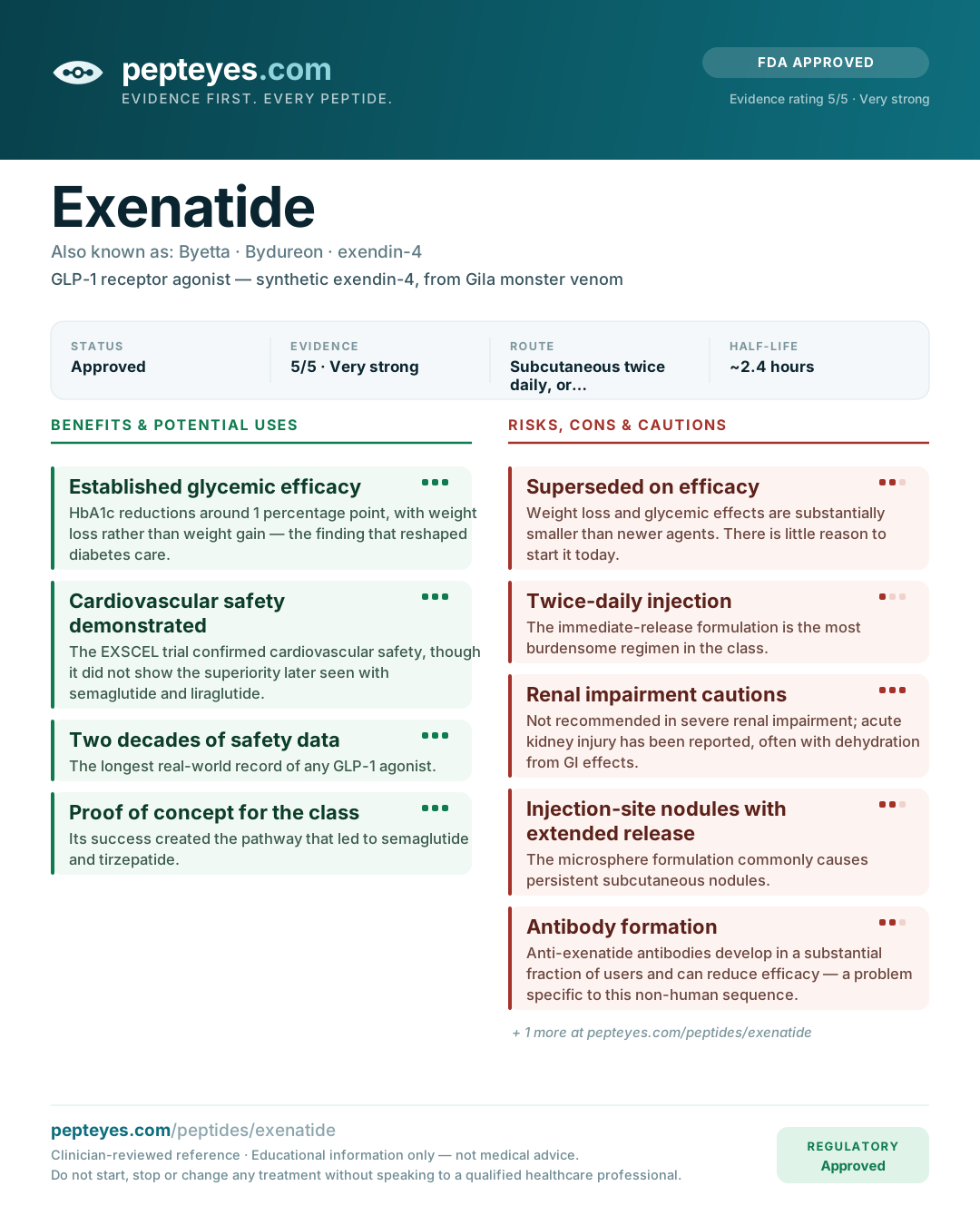
Established glycemic efficacy
HbA1c reductions around 1 percentage point, with weight loss rather than weight gain — the finding that reshaped diabetes care.
Evidence: Strong evidence -
Cardiovascular safety demonstrated
The EXSCEL trial confirmed cardiovascular safety, though it did not show the superiority later seen with semaglutide and liraglutide.
Evidence: Strong evidence -
Two decades of safety data
The longest real-world record of any GLP-1 agonist.
Evidence: Strong evidence -
Proof of concept for the class
Its success created the pathway that led to semaglutide and tirzepatide.
Evidence: Strong evidence
Risks and cautions
6 entries · 2 serious or common
-
Superseded on efficacy
Weight loss and glycemic effects are substantially smaller than newer agents. There is little reason to start it today.
Evidence: Moderate evidence -
Twice-daily injection
The immediate-release formulation is the most burdensome regimen in the class.
Evidence: Minor -
Renal impairment cautions
Not recommended in severe renal impairment; acute kidney injury has been reported, often with dehydration from GI effects.
Evidence: Serious -
Injection-site nodules with extended release
The microsphere formulation commonly causes persistent subcutaneous nodules.
Evidence: Moderate evidence -
Antibody formation
Anti-exenatide antibodies develop in a substantial fraction of users and can reduce efficacy — a problem specific to this non-human sequence.
Evidence: Moderate evidence -
Pancreatitis reports
Class effect; uncommon but serious.
Evidence: Serious
Counts are not a score. A single serious risk can outweigh several well-supported benefits, and a long benefit list built on preclinical work outweighs nothing at all.
Opinion — what people actually report
4 themes · 2 reported problems
This is the weakest tier on this site. These are themes drawn from public discussion — forums, subreddits and patient threads — not from trials. There is no control group, no denominator, and no way to confirm that what someone injected matched its label. People post when a result is dramatic and when something goes wrong, and rarely when nothing happens, so treat everything below as a description of the conversation rather than of the compound. The bars count how often a thing is said, not how well it is supported.
-
Largely historical in current discussion Practical note. Dominant theme: Comes up in most discussions of this compound.
Mostly appears as context — the first GLP-1 agonist, referenced by people who used it years ago.
-
Injection site nodules with the weekly form Reported problem. Recurring: Raised regularly, though not by everyone.
The most distinctive complaint, attributed to the microsphere formulation and reported as persisting for weeks.
-
Twice-daily dosing on the original form Reported problem. Recurring: Raised regularly, though not by everyone.
Remembered as burdensome relative to everything that followed.
-
Occasional interest from Parkinson's research Practical note. Occasional: Reported by a minority, or in specific contexts.
A separate strand following trials of exenatide in Parkinson's disease, discussed hopefully and separately from diabetes use.
Where the reports and the evidence part ways
Little to reconcile — this drug has largely been superseded and the community treats it that way, accurately. The Parkinson's strand deserves care: an encouraging phase 2 generated real interest, but a subsequent larger randomized trial did not confirm benefit, and hopeful forum discussion has not always caught up with that result.
Readers on Exenatide
Questions and answers from readers, under generated names. Nothing here has been checked or reviewed by the site and none of it is medical advice. It is the least verified thing on this page — and it is here because people ask each other these things anyway, and most of the other places they can ask are run by sellers.
0 questions · 0 answers
No questions yet. Ask the first one above — it takes one box and an email address.
How names work, and the house rules
Names. Every verified address is given one generated name — two ordinary words — and keeps it. Nobody chooses a name and nobody can take another's. Posts marked desk were written by the site's own editorial desk, usually to open a thread; they carry a generated name like everyone else's and are held to the site's rules, which means they never state an amount.
What is not allowed. Selling, sourcing, vendor names, coupon codes and "message me" — posts that read that way are held and usually removed. Personal medical details you would not want public. Abuse. Instructions framed as what someone else should do.
What this is not. A reader's report of what happened to them is a report, not a finding, and an answer here is one person's view. Nothing in this section changes the evidence rating above it. If something you read here would change what you take, take it to a pharmacist or physician first.
Your data. Delete any post of yours at any time, or remove everything you have written together with your name. Details in the privacy notice.
Who should avoid it
- Severe renal impairment (eGFR under 30)
- Prior pancreatitis (relative)
- Pregnancy
- Medullary thyroid carcinoma history (extended-release formulation)
If used under medical supervision, monitor
- HbA1c, weight
- Renal function, particularly during GI illness
- Injection sites
Interactions
Not exhaustive. Always have a pharmacist or physician review your full medication list — including supplements.
- Warfarin — INR monitoring advised
- Oral antibiotics and contraceptives — take at least 1 hour before exenatide
- Insulin and sulfonylureas — hypoglycemia risk
Regulatory & legal status
Prescription drug; commercial availability of individual formulations has narrowed.
Infographic
Where to read further
We link to live literature searches rather than a frozen citation list, so you always see current results — including anything published after our last review.
- PubMed — all published literature on Exenatide
- PubMed — randomized controlled trials only
- ClinicalTrials.gov — registered human trials
- DailyMed — official FDA prescribing information
Related peptides in Metabolic & Weight
Terms used on this page
- Agonist
- An agonist is a ligand that binds a receptor and stabilises its active conformation, producing a biological response rather than merely occupying the binding site.
- Glucagon-Like Peptide-1 (GLP-1)
- Glucagon-like peptide-1 is an incretin hormone released by intestinal L-cells after a meal that stimulates glucose-dependent insulin secretion and suppresses appetite.
- Glucose-Dependent Insulin Secretion
- Glucose-dependent insulin secretion is beta-cell insulin release that scales with ambient glucose, so incretin amplification fades as concentrations approach the normal range.
- Gastric Emptying
- Gastric emptying is the rate at which stomach contents pass into the duodenum, a major determinant of postprandial glucose and of incretin therapy tolerability.
- DPP-4 Cleavage
- DPP-4 cleavage is the removal of an N-terminal dipeptide by dipeptidyl peptidase-4, the enzymatic step that inactivates incretin hormones within minutes of their release.
- Glucagon
- Glucagon is a 29-amino-acid pancreatic alpha-cell hormone that raises blood glucose by driving hepatic glycogenolysis and gluconeogenesis, and also increases energy expenditure.
This page is educational information, not medical advice. It cannot account for your medical history, medications, or risk factors. Do not start, stop or change any treatment based on it. Speak to a qualified healthcare professional who knows your case.