Supplied as a lyophilised powder to reconstitute
Metabolic & Weight
At a glance
Ten answers, each one line. Open any row for the detail behind it.
What it does An NNMT inhibitor with a real preclinical story and no human one.
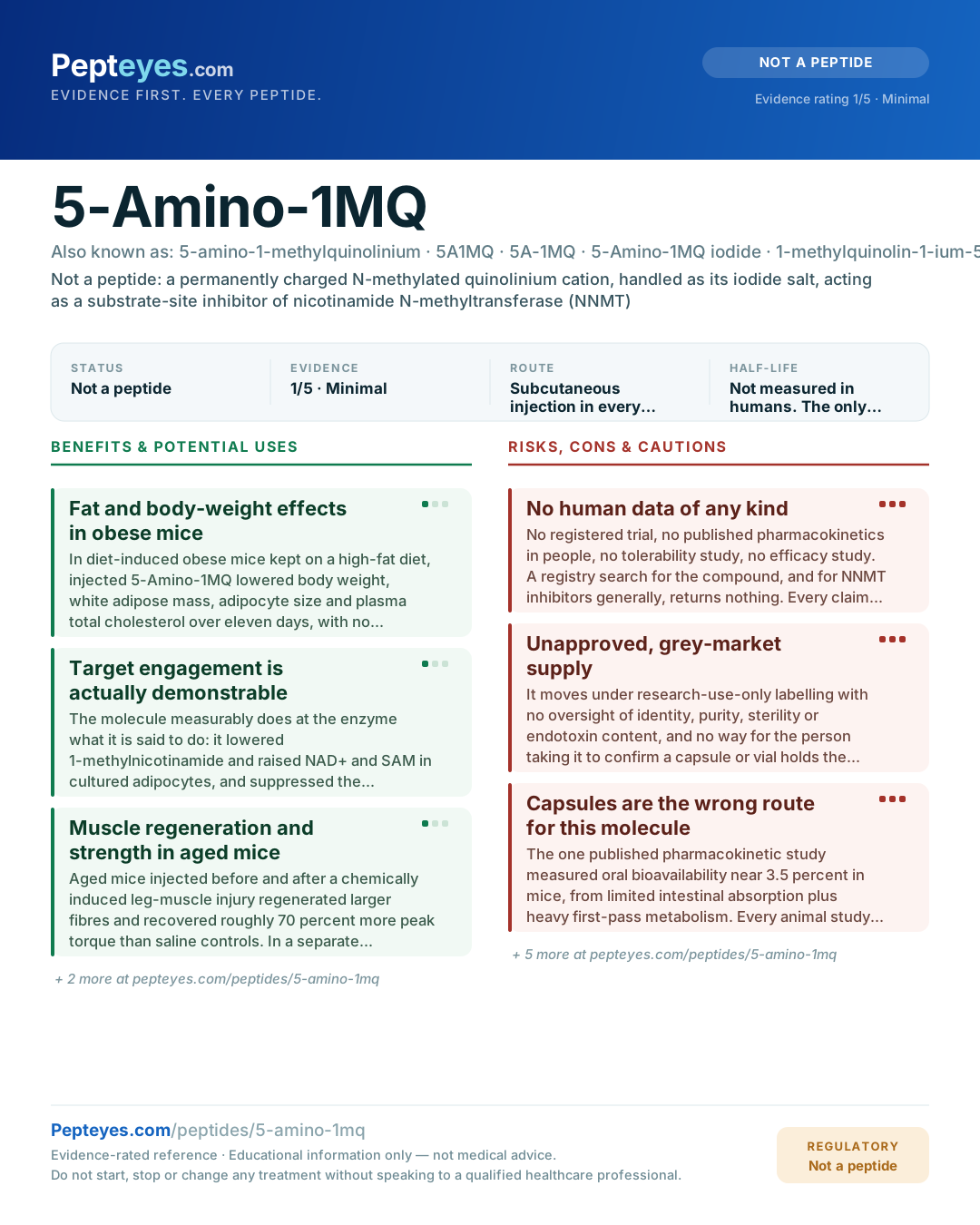
An NNMT inhibitor with a real preclinical story and no human one. Every result behind the fat-loss marketing comes from mice given the compound by injection, almost all of it from one laboratory and the company founded out of it. No human trial of 5-Amino-1MQ has ever been registered or published. The only pharmacokinetic study that tested swallowing it measured oral bioavailability near 3.5 percent in mice, and capsules are the format most people are given. It is also not a peptide.
Half-life Not measured in humans. The only published data are in rats… — Documented
Not measured in humans. The only published data are in rats: about 3.8 h after IV and 6.9 h after oral dosing, with 38% oral bioavailability.
Typical studied dose None established. No dose has ever been set for a human being, because… — Nothing established
None established. No dose has ever been set for a human being, because the studies that would set one have not been done. Any figure circulating for this compound was chosen by somebody selling it or by somebody guessing.
How often it is used No schedule exists. Cycles and intervals quoted for this compound come… — Nothing established
No schedule exists. Cycles and intervals quoted for this compound come from forums rather than from any study, and they vary because nothing anchors them.
How it is taken Subcutaneous injection in every published animal efficacy study… — Documented
Subcutaneous injection in every published animal efficacy study. Circulated for human use as oral capsules and as injectable vials, neither of which has been tested in a person.
Main side effects No human data of any kind · Unapproved, grey-market supply · Capsules are the wrong route for this molecule — Carries serious risk
No human data of any kind — No registered trial, no published pharmacokinetics in people, no tolerability study, no efficacy study. A registry search for the compound, and for NNMT inhibitors generally, returns nothing. Every claim made for it in a human being is an extrapolation from mice.
Unapproved, grey-market supply — It moves under research-use-only labelling with no oversight of identity, purity, sterility or endotoxin content, and no way for the person taking it to confirm a capsule or vial holds the stated compound at all. Salt form and free-cation content are quoted inconsistently across listings.
Capsules are the wrong route for this molecule — The one published pharmacokinetic study measured oral bioavailability near 3.5 percent in mice, from limited intestinal absorption plus heavy first-pass metabolism. Every animal study that produced an effect used injection. Swallowing it does not reproduce the exposure any of the evidence describes.
Storage before mixing As a sealed lyophilised powder, refrigerated is typical and a freezer…
As a sealed lyophilised powder, refrigerated is typical and a freezer suits long storage; both should be dark and dry. A dry powder tolerates a few days out of the cold far better than anything in solution — which is why it ships that way.
Shelf life after mixing Once mixed it is refrigerated and treated as short-lived. Bacteriostatic…
Once mixed it is refrigerated and treated as short-lived. Bacteriostatic water contains a preservative and buys the longer window; sterile water contains none and buys a much shorter one. Peptides in solution also degrade on their own, so the container is only half the question.
Evidence level 1/5 · Minimal — Nothing established
Animal or laboratory data only. No human efficacy evidence.
Regulatory status Not a Peptide — Nothing established
Not a peptide: a small-molecule quinolinium salt, listed here because it is sold and argued about inside the peptide market. Not approved anywhere, and no human trial of it has ever been registered or published. 5-Amino-1MQ is not an approved medicine in the United States, the European Union, the United Kingdom or anywhere else. It has never been reviewed as a dietary ingredient in the United States, and a synthetic chemical of this kind does not become a lawful supplement by being packaged as one. It circulates under research-use-only labelling, which is a labelling convention and confers no permission to give it to a person. It is not named individually on the WADA Prohibited List, but the S0 clause covering substances with no approval by any government health authority reaches it, so it is prohibited at all times in tested sport.
Overview
An NNMT inhibitor with a real preclinical story and no human one. Every result behind the fat-loss marketing comes from mice given the compound by injection, almost all of it from one laboratory and the company founded out of it. No human trial of 5-Amino-1MQ has ever been registered or published. The only pharmacokinetic study that tested swallowing it measured oral bioavailability near 3.5 percent in mice, and capsules are the format most people are given. It is also not a peptide.
This is not a peptideIncluded because it is marketed alongside peptides, but is a different class of molecule. 5-Amino-1MQ is not an approved medicine in the United States, the European Union, the United Kingdom or anywhere else. It has never been reviewed as a dietary ingredient in the United States, and a synthetic chemical of this kind does not become a lawful supplement by being packaged as one. It circulates under research-use-only labelling, which is a labelling convention and confers no permission to give it to a person. It is not named individually on the WADA Prohibited List, but the S0 clause covering substances with no approval by any government health authority reaches it, so it is prohibited at all times in tested sport.
| Regulatory status | Not a peptide: a small-molecule quinolinium salt, listed here because it is sold and argued about inside the peptide market. Not approved anywhere, and no human trial of it has ever been registered or published. |
|---|---|
| Drug class | Not a peptide: a permanently charged N-methylated quinolinium cation, handled as its iodide salt, acting as a substrate-site inhibitor of nicotinamide N-methyltransferase (NNMT) |
| Route | Subcutaneous injection in every published animal efficacy study. Circulated for human use as oral capsules and as injectable vials, neither of which has been tested in a person. |
| Half-life | Not measured in humans. The only published data are in rats: about 3.8 h after IV and 6.9 h after oral dosing, with 38% oral bioavailability. |
| Evidence rating |
1/5 Minimal
Evidence rating 1 out of 5: Minimal
Animal or laboratory data only. No human efficacy evidence. |
| Studied in | Enzyme and cell assays, then mice only: diet-induced obese male mice on a high-fat diet, the same model combined with a switch to a lean diet, and aged mice with a chemically injured leg muscle or running on weighted wheels. All in vivo work used injection, and nearly all of it traces to one university group and the company its founder started. |
5-Amino-1MQ sequence & structure
5-Amino-1MQ is not a peptide. It has no amino-acid sequence; its formula and molecular weight (286.11 Da) are given for reference.
| Molecular formula | C10H11IN2 |
|---|---|
| Molecular weight | 286.11 Da (average, free base) |
| SMILES | C[N+]1=CC=CC2=C(C=CC=C21)N.[I-] |
| Identifiers | CAS 42464-96-0 · PubChem CID 66522933 |
| Which molecule | The formula, weight and CAS given here describe the iodide salt, 5-amino-1-methylquinolinium iodide (PubChem CID 66522933, InChIKey JPEZFBFIRRAFNR-UHFFFAOYSA-N, UNII K9G33W2TTZ, ChEMBL4088008), which is the form actually weighed and handled. The active species is the free cation 5-amino-1-methylquinolinium, C10H11N2+, average mass 159.21, PubChem CID 950107, CAS 685079-15-6, InChIKey ZMJBCEIHNOWCMC-UHFFFAOYSA-O, ChEMBL4116828, UNII PMX593N4N3. The cation is permanently charged and has no neutral free base, so a certificate of analysis will normally quote the salt; roughly 1.8 parts of iodide carry 1 part of cation by weight, and the 2018 mouse study stated its amounts as free cation for exactly that reason. Papers abbreviate the molecule 5-amino-1MQ, 5A1MQ, 5A-1MQ or simply NNMTi; the medicinal-chemistry series calls it compound 1k. |
| Sources | PubChem CID 66522933 — 5-amino-1-methylquinolinium iodide: formula C10H11IN2, MW 286.11, SMILES, InChIKey, CAS 42464-96-0, UNII K9G33W2TTZPubChem CID 950107 — 5-amino-1-methylquinolinium free cation: formula C10H11N2+, MW 159.21, charge +1, CAS 685079-15-6PubChem PUG REST synonyms for CID 66522933 — salt CAS, UNII, ChEMBL and catalogue identifiersNeelakantan H et al., J Med Chem 2017;60(12):5015-5028 — Structure-Activity Relationship for Small Molecule Inhibitors of Nicotinamide N-Methyltransferase (the methylquinolinium series, PubMed 28548833)Babula JJ et al., Diabetes Obes Metab 2024 — full text, which names the molecule 5A1MQ and reports its salt handling and pharmacokinetics |
Not a peptide and not peptide-derived: a quaternary N-methylated quinolinium heteroaromatic cation with no amide backbone and no amino acid residues, which is why the sequence fields are null. It is a substrate-site, nicotinamide-competitive inhibitor of nicotinamide N-methyltransferase from the methylquinolinium series described by Neelakantan and colleagues in 2017. CAS 42464-96-0 check digit verified; the formula-derived mass 286.12 matches the PubChem value 286.11. Some listings quote the iodide CAS against the free-cation name, or the cation weight against a quantity of salt; the two figures differ by the iodide.
Record confidence: high — two independent authoritative sources agree on the sequence and modifications. Every sequence on the site is listed with its sources on the peptide sequences index.
How it works
NNMT takes a methyl group from S-adenosylmethionine (SAM) and attaches it to nicotinamide, producing 1-methylnicotinamide. Each turn spends a methyl donor and pulls one nicotinamide out of the NAD+ salvage pathway. The enzyme is upregulated in the white fat and liver of obese mice, and knocking it down there protected mice from diet-induced obesity by raising energy expenditure. 5-Amino-1MQ occupies the nicotinamide site rather than the SAM site. In cultured adipocytes it lowered intracellular 1-methylnicotinamide, raised NAD+ and SAM, and suppressed lipogenesis, without inhibiting the related methyltransferases or NAD+ salvage enzymes that were screened. What has been measured is enzyme inhibition and the resulting shift in those metabolites in rodent cells and tissue. What is inferred is that the same shift occurs in human fat and muscle, and produces fat loss there. Nothing downstream of the enzyme has been measured in a person.
Evidence base
Rated 1 of 5 — Minimal. Animal or laboratory data only. No human efficacy evidence.
- Animal and laboratory data only. The compound has never been given to a human being in a published study, and no trial of it is registered.
- The mouse fat-loss work is real but narrow: one strain, male animals, a high-fat-diet model, injection, and treatment periods measured in days to weeks. The diet-combination studies needed a switch to a lean diet before body composition normalised.
- The enzyme target was validated in 2014 by antisense knockdown in fat and liver, not by this compound; 5-Amino-1MQ arrived afterwards as a way to test the same idea pharmacologically.
- A 2024 review of NNMT as a metabolic target states plainly that no clinical trial of NNMT has been documented.
- Cell-monolayer permeability assays suggested good oral absorption, and that inference is what reached the marketing. The animal pharmacokinetics published afterwards did not support it.
Benefits and risks, weighed against the evidence
Every entry below carries the strength of the evidence behind it — three bars for strong human data, two for moderate, one for preliminary or preclinical work. The two columns are not equal by design: where a compound has more documented risk than demonstrated benefit, the lists say so.
Reported benefits
5 entries
-
Fat and body-weight effects in obese mice
In diet-induced obese mice kept on a high-fat diet, injected 5-Amino-1MQ lowered body weight, white adipose mass, adipocyte size and plasma total cholesterol over eleven days, with no change in food intake. A later 30-day study in the same model found it limited further weight and fat gain rather than reversing established obesity.
Evidence: Preliminary -
Target engagement is actually demonstrable
The molecule measurably does at the enzyme what it is said to do: it lowered 1-methylnicotinamide and raised NAD+ and SAM in cultured adipocytes, and suppressed the 1-methylnicotinamide signal in fat and muscle of injected mice. Whatever else is uncertain here, the mechanism is not hand-waving.
Evidence: Preliminary -
Muscle regeneration and strength in aged mice
Aged mice injected before and after a chemically induced leg-muscle injury regenerated larger fibres and recovered roughly 70 percent more peak torque than saline controls. In a separate eight-week study, aged sedentary mice gained about 40 percent in grip strength, and that gain added to what weighted-wheel running produced on its own.
Evidence: Preliminary -
Liver fat improved in obese mice
Mice treated for a month showed less hepatic steatosis and macrophage infiltration, lower liver weight and triglycerides, and normalised transaminases. Liver outcomes are among the more plausible translations of this mechanism, but they are still mouse histology.
Evidence: Preliminary -
Narrow selectivity in the screens run
It did not inhibit DNA methyltransferase 1, protein arginine methyltransferase 3, catechol-O-methyltransferase or the NAD+ salvage enzymes tested. In a broad receptor and enzyme panel the only notable hit was partial inhibition of monoamine oxidase A.
Evidence: Preliminary
Risks and cautions
8 entries · 4 serious or common
-
No human data of any kind
No registered trial, no published pharmacokinetics in people, no tolerability study, no efficacy study. A registry search for the compound, and for NNMT inhibitors generally, returns nothing. Every claim made for it in a human being is an extrapolation from mice.
Evidence: Serious -
Unapproved, grey-market supply
It moves under research-use-only labelling with no oversight of identity, purity, sterility or endotoxin content, and no way for the person taking it to confirm a capsule or vial holds the stated compound at all. Salt form and free-cation content are quoted inconsistently across listings.
Evidence: Serious -
Capsules are the wrong route for this molecule
The one published pharmacokinetic study measured oral bioavailability near 3.5 percent in mice, from limited intestinal absorption plus heavy first-pass metabolism. Every animal study that produced an effect used injection. Swallowing it does not reproduce the exposure any of the evidence describes.
Evidence: Serious -
Freeing methyl groups is not a local intervention
Blocking NNMT spares SAM wherever the enzyme is expressed, and SAM is the donor for DNA and histone methylation. The knockdown work that validated the target reported changes in histone H3 lysine 4 methylation in adipose tissue. Nothing has examined what months of that do, in any species.
Evidence: Serious -
The cancer question runs in both directions
NNMT is overexpressed in many tumours and inhibiting it is being explored as an anti-cancer idea, but its role is context-dependent and in some tissues low NNMT tracks with worse behaviour. No NNMT inhibitor has been validated in tumour therapy, and nobody has studied chronic inhibition in a person carrying an undiagnosed cancer.
Evidence: Moderate evidence -
Monoamine oxidase A was hit off-target
In a broad off-target panel the compound partially inhibited monoamine oxidase A, the enzyme behind the tyramine and serotonin interactions that make MAO inhibitors hazardous. That is one screening result rather than a clinical signal, but it has never been followed up in an animal or a person.
Evidence: Moderate evidence -
One laboratory with a commercial stake
Essentially all in vivo evidence comes from a single university group and the company its founder established to develop the molecule; the authors disclose that relationship. None of the body-composition or muscle findings has been reproduced by an independent laboratory.
Evidence: Moderate evidence -
Injecting unregulated material
Reconstituting and injecting an unregulated powder outside sterile conditions risks local infection, abscess and bloodstream infection regardless of what the molecule itself does. This is also the only route the evidence used, which leaves people choosing between an untested exposure and an unstudied one.
Evidence: Moderate evidence
Counts are not a score. A single serious risk can outweigh several well-supported benefits, and a long benefit list built on preclinical work outweighs nothing at all.
Opinion — what people actually report
7 themes · 1 reported benefit · 3 reported problems
This is the weakest tier on this site. These are themes drawn from public discussion — forums, subreddits and patient threads — not from trials. There is no control group, no denominator, and no way to confirm that what someone injected matched its label. People post when a result is dramatic and when something goes wrong, and rarely when nothing happens, so treat everything below as a description of the conversation rather than of the compound. The bars count how often a thing is said, not how well it is supported.
-
Slow fat loss without appetite suppression Reported benefit. Dominant theme: Comes up in most discussions of this compound.
The dominant positive report is a gradual drop in body fat with hunger left intact, which is the specific contrast people draw against GLP-1 drugs. It is usually described over a couple of months rather than weeks, and usually as subtle enough that the person is unsure whether it happened.
-
A large share of people report nothing at all Reported problem. Dominant theme: Comes up in most discussions of this compound.
The most frequent negative account is simply the absence of any effect. The standard community response is to blame the format rather than the molecule and switch to injection, which keeps the compound from ever being written off and keeps the discussion circular.
-
Almost nobody starts it in isolation Practical note. Dominant theme: Comes up in most discussions of this compound.
It is typically begun at the start of a cut, a new training block, or a taper off a GLP-1 drug. The more careful posters say outright that they cannot separate the compound from the diet and training they changed the same week, and that caveat gets lost as the reports are repeated.
-
Capsules versus injection is a permanent argument Practical note. Recurring: Raised regularly, though not by everyone.
Whether an oral capsule reaches the bloodstream at all is one of the few technical disputes the discussion gets substantially right. It resurfaces every time somebody reports no effect, and it splits the community into two groups whose experiences are not comparable.
-
Sleep, energy and mood changes early on Reported problem. Recurring: Raised regularly, though not by everyone.
Restless sleep, a wired or jittery feeling, and a flattened or short-tempered mood are raised regularly in the first weeks. Nobody ties them to a mechanism, and they are equally consistent with the calorie deficit that almost always accompanies them.
-
Filed as an NAD+ supplement rather than a drug Practical note. Recurring: Raised regularly, though not by everyone.
It is routinely discussed next to nicotinamide riboside and other longevity products, which imports an assumption of general safety that the published record does not carry. The shelf it gets placed on quietly changes what people think they are taking.
-
Nausea and flushing in the first days Reported problem. Occasional: Reported by a minority, or in specific contexts.
Stomach upset and facial flushing come up occasionally, almost always described as early and self-limiting. The reports are too scattered and too confounded by simultaneous diet changes to read as a pattern.
Where the reports and the evidence part ways
The whole published evidence base is rodent and delivered by injection, while the discussion treats the compound as an established oral fat-loss agent. There is no human trial, no human pharmacokinetics and no human body-composition measurement, so none of these reports can be checked against anything at all. The second problem is structural rather than factual: people begin it at the same moment they begin a diet, a training block or a change in GLP-1 treatment, which pushes every self-report toward over-attribution and makes the positive accounts uninterpretable rather than merely weak. The one place the community is ahead of the marketing is the recurring argument about whether a swallowed capsule reaches the blood, which the animal pharmacokinetics support: oral absorption was poor, and every animal study that produced an effect used injection.
Cheat sheet
The full sheet, all 77 compounds →The community reference numbers for this compound — reconstitution, working dose, cycle and bloodwork. Research and education only, not medical advice, and not part of the evidence-rated monograph above. Doses assume a 1mL / 100-unit insulin syringe — the calculator does the units for you.
Protocol overview
Dosing & reconstitution 50 mg vial
| PHASE | DAILY DOSE | UNITS PER INJECTION |
|---|---|---|
| Days 1 to 2 (Tolerance) | 2.5 mg once daily | 12.5 units (0.12 mL) |
| Days 3+ (Standard) | 5 mg once daily | 25 units (0.25 mL) |
| Alternative BID | 2.5 mg twice daily | 12.5 units (0.12 mL) x 2 |
Frequency: Inject once or twice daily subcutaneously. Due to the compound's plasma half-life of approximately
On the master sheet
- Vial
- 10mg
- BAC
- 2mL
- Dose
- Oral 50–150mg / SC 0.5–3.3mg daily
- Route
- Oral/SubQ
- Cycle
- 4–8 wks
- Time Off
- 2–4 wks
- Bloodwork
- Glucose, insulin, liver
Readers on 5-Amino-1MQ
Questions and answers from readers, under generated names. Nothing here has been checked or reviewed by the site and none of it is medical advice. It is the least verified thing on this page — and it is here because people ask each other these things anyway, and most of the other places they can ask are run by sellers.
0 questions · 0 answers
No questions yet. Ask the first one above — it takes one box and an email address.
How names work, and the house rules
Names. Every verified address is given one generated name — two ordinary words — and keeps it. Nobody chooses a name and nobody can take another's. Posts marked desk were written by the site's own editorial desk, usually to open a thread; they carry a generated name like everyone else's and are held to the site's rules, which means they never state an amount.
What is not allowed. Selling, sourcing, vendor names, coupon codes and "message me" — posts that read that way are held and usually removed. Personal medical details you would not want public. Abuse. Instructions framed as what someone else should do.
What this is not. A reader's report of what happened to them is a report, not a finding, and an answer here is one person's view. Nothing in this section changes the evidence rating above it. If something you read here would change what you take, take it to a pharmacist or physician first.
Your data. Delete any post of yours at any time, or remove everything you have written together with your name. Details in the privacy notice.
Who should avoid it
- Use outside a registered clinical trial
- Anyone with a cancer history or an undiagnosed mass
- Pregnancy and breastfeeding
- Anyone taking a monoamine oxidase inhibitor or another serotonergic drug
- Tested athletes
If used under medical supervision, monitor
- Not applicable outside a registered trial; no validated monitoring exists
- A trial would track body composition, fasting glucose and insulin
- Liver enzymes, given the hepatic findings in mice
Interactions
Not exhaustive. Always have a pharmacist or physician review your full medication list — including supplements.
- Nicotinamide riboside, nicotinamide mononucleotide and other NAD+ precursors — the proposed mechanisms converge on the same nicotinamide pool, and no combination has been studied
- Monoamine oxidase inhibitors and serotonergic drugs — the compound partially inhibited monoamine oxidase A in an off-target screen that was never followed up
- GLP-1 receptor agonists and other weight-loss drugs — constantly combined in discussion, never studied together
- Methyl-donor supplements such as betaine, methylfolate and methylcobalamin — the whole mechanism is a deliberate change in methyl-group flux
Regulatory & legal status
5-Amino-1MQ is not an approved medicine in the United States, the European Union, the United Kingdom or anywhere else. It has never been reviewed as a dietary ingredient in the United States, and a synthetic chemical of this kind does not become a lawful supplement by being packaged as one. It circulates under research-use-only labelling, which is a labelling convention and confers no permission to give it to a person. It is not named individually on the WADA Prohibited List, but the S0 clause covering substances with no approval by any government health authority reaches it, so it is prohibited at all times in tested sport.
Infographic
What this entry was checked against
The specific records this monograph was verified against on its last research pass. We link live literature searches below as well, because these are a snapshot and the literature is not.
- Neelakantan H et al., Biochem Pharmacol 2018;147:141-152 — Selective and membrane-permeable small molecule inhibitors of nicotinamide N-methyltransferase reverse high fat diet-induced obesity in mice (full text; 5-amino-1MQ, subcutaneous, diet-induced obese mice)
- Neelakantan H et al., Biochem Pharmacol 2019;163:481-492 — Small molecule NNMT inhibitor activates senescent muscle stem cells and improves regenerative capacity of aged skeletal muscle (full text; 5-amino-1-methylquinolinium, subcutaneous, 24-month-old mice)
- Babula JJ et al., Diabetes Obes Metab 2024;26(11):5272-5282 — NNMT inhibition mitigates obesity-related metabolic dysfunction (full text; the intravenous, oral and subcutaneous pharmacokinetics of 5A1MQ in mice)
- Dimet-Wiley AL et al., Sci Rep 2024;14:15554 — NNMT inhibition mimics and boosts exercise-mediated improvements in muscle function in aged mice (full text; grip strength and weighted-wheel running)
- Sampson CM et al., Sci Rep 2021;11:5637 — Combined NNMT inhibition and reduced-calorie diet normalizes body composition and enhances metabolic benefits in obese mice (PubMed 33707534)
- Dimet-Wiley A et al., Sci Rep 2022;12:484 — Reduced calorie diet combined with NNMT inhibition establishes a distinct microbiome in DIO mice; names the inhibitor as 5-amino-1-methylquinolinium (PubMed 35013352)
- Kraus D et al., Nature 2014;508:258-262 — Nicotinamide N-methyltransferase knockdown protects against diet-induced obesity; the antisense target-validation study that preceded this compound (PubMed 24717514)
- Sun WD et al., Front Pharmacol 2024;15:1410479 — NNMT: a novel therapeutic target for metabolic syndrome; states that no clinical trials focusing on NNMT have been documented (PubMed 38919254)
- Wang W, Yang C, Wang T, Deng H., Cell Death Dis 2022;13:267 — Complex roles of nicotinamide N-methyltransferase in cancer progression (context-dependent tumour biology; NNMT inhibitors not yet validated in tumour therapy)
- ClinicalTrials.gov registry search for 5-amino-1MQ and for NNMT inhibitors as an intervention — no studies returned
Where to read further
We link to live literature searches rather than a frozen citation list, so you always see current results — including anything published after our last review.
- PubMed — all published literature on 5-Amino-1MQ
- PubMed — randomized controlled trials only
- ClinicalTrials.gov — registered human trials
Related peptides in Metabolic & Weight
Terms used on this page
- Bioavailability
- Bioavailability is the fraction of an administered dose that reaches the systemic circulation chemically unchanged, measured against an intravenous dose of the same drug.
- Preclinical Study and Animal Model
- Preclinical studies are the laboratory, cell and animal experiments done before any human exposure, establishing mechanism, target engagement and the toxicology package that permits a first trial.
- Resting Energy Expenditure (REE)
- Resting energy expenditure is the energy a body uses at rest in a fasted, thermoneutral state, and it accounts for most of daily total energy expenditure.
- Lean Mass Loss
- Lean mass loss is the fat-free component of weight lost during an energy deficit, encompassing muscle, organ tissue, glycogen and water rather than muscle alone.
- Adiposity
- Adiposity is the total quantity and anatomical distribution of body fat, treated as an active endocrine tissue rather than as inert storage.
- Metabolic Dysfunction-Associated Steatotic Liver Disease (MASLD)
- MASLD is excess fat in the liver accompanied by at least one cardiometabolic risk factor, the renamed and positively defined successor to non-alcoholic fatty liver disease.
This page is educational information, not medical advice. It cannot account for your medical history, medications, or risk factors. Do not start, stop or change any treatment based on it. Speak to a qualified healthcare professional who knows your case.