Supplied ready in solution
Metabolic & Weight
At a glance
Ten answers, each one line. Open any row for the detail behind it.
What it does The most heavily studied peptide in modern medicine.
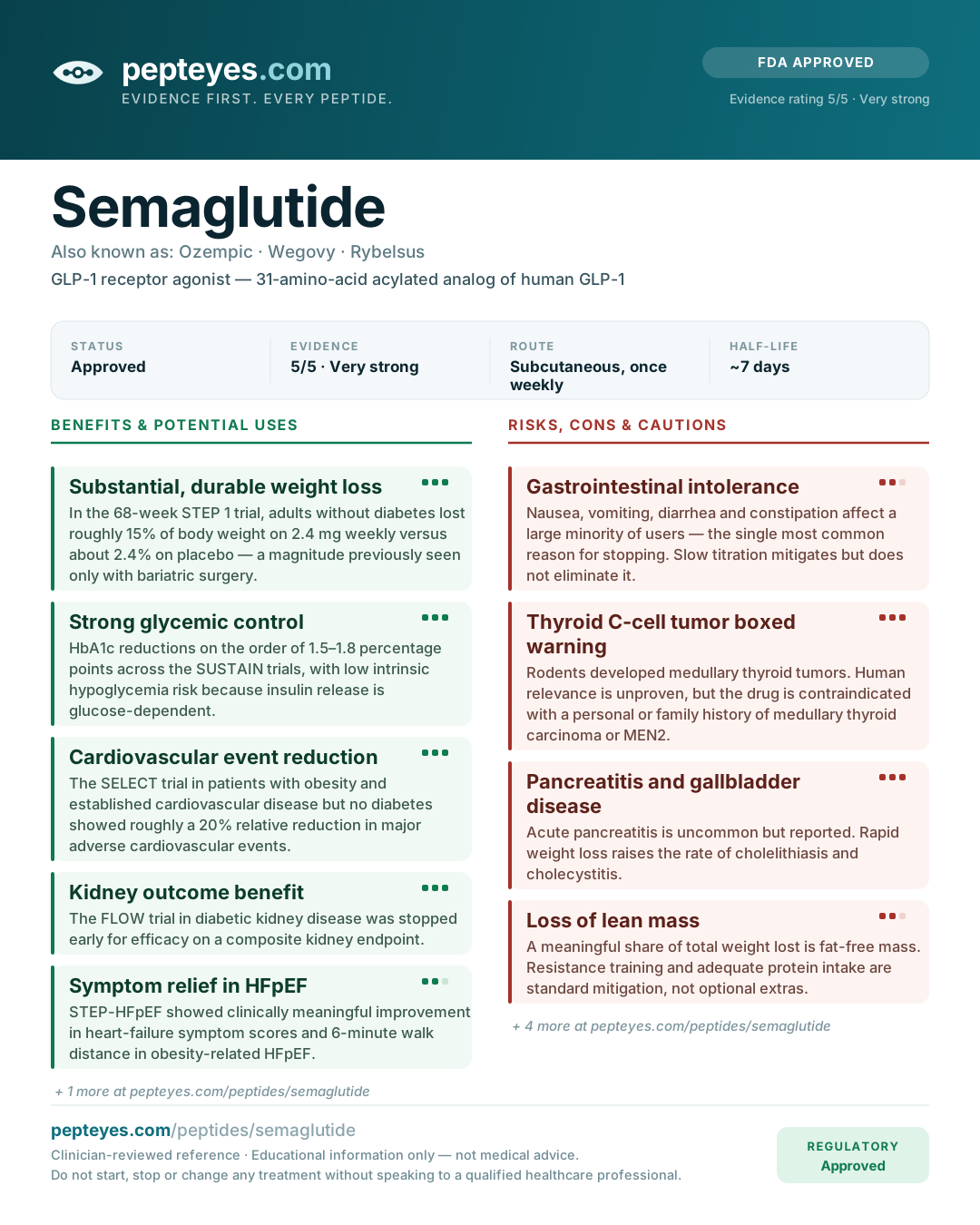
The most heavily studied peptide in modern medicine. Semaglutide mimics the gut hormone GLP-1, slowing gastric emptying, amplifying glucose-dependent insulin release, and acting on hypothalamic appetite circuits. Phase 3 programs enrolling tens of thousands of patients support both glycemic and weight outcomes.
Half-life ~7 days (fatty-acid acylation drives albumin binding) — Documented
~7 days (fatty-acid acylation drives albumin binding)
Typical studied dose Set on the approved label, which states the starting dose, how it is… — On the label
Set on the approved label, which states the starting dose, how it is increased and the maximum. Read it there rather than anywhere else — including here.
How often it is used The label schedule is once weekly. Dosing intervals follow the half-life… — On the label
The label schedule is once weekly. Dosing intervals follow the half-life above, and the prescribing information is what sets them.
How it is taken Subcutaneous, once weekly (oral tablet daily formulation also marketed) — Documented
Subcutaneous, once weekly (oral tablet daily formulation also marketed)
Main side effects Thyroid C-cell tumor boxed warning · Pancreatitis and gallbladder disease · Compounded and counterfeit supply — Carries serious risk
Thyroid C-cell tumor boxed warning — Rodents developed medullary thyroid tumors. Human relevance is unproven, but the drug is contraindicated with a personal or family history of medullary thyroid carcinoma or MEN2.
Pancreatitis and gallbladder disease — Acute pancreatitis is uncommon but reported. Rapid weight loss raises the rate of cholelithiasis and cholecystitis.
Compounded and counterfeit supply — FDA has repeatedly warned about compounded "semaglutide salts" and counterfeit pens with incorrect content, unsafe dosing instructions, and non-sterile preparation.
Storage before mixing Supplied already in solution and kept refrigerated, not frozen. Freezing…
Supplied already in solution and kept refrigerated, not frozen. Freezing a protein solution can aggregate it, which is not always visible.
Shelf life after mixing Nothing to mix — it is not supplied as a powder. The relevant date is…
Nothing to mix — it is not supplied as a powder. The relevant date is the one printed on the product.
Evidence level 5/5 · Very strong — Documented
Multiple phase 3 randomized trials plus regulatory approval in a major market.
Regulatory status FDA Approved — Documented
FDA-approved for type 2 diabetes, chronic weight management, and cardiovascular risk reduction in obesity Prescription drug. Compounded versions are permitted only under specific FDA conditions, which have narrowed as shortages resolved. Peptides sold online as "research semaglutide" are unapproved and unverified.
Overview
The most heavily studied peptide in modern medicine. Semaglutide mimics the gut hormone GLP-1, slowing gastric emptying, amplifying glucose-dependent insulin release, and acting on hypothalamic appetite circuits. Phase 3 programs enrolling tens of thousands of patients support both glycemic and weight outcomes.
FDA ApprovedFDA-approved for type 2 diabetes, chronic weight management, and cardiovascular risk reduction in obesity
| Regulatory status | FDA-approved for type 2 diabetes, chronic weight management, and cardiovascular risk reduction in obesity |
|---|---|
| Drug class | GLP-1 receptor agonist — 31-amino-acid acylated analog of human GLP-1 |
| Route | Subcutaneous, once weekly (oral tablet daily formulation also marketed) |
| Half-life | ~7 days (fatty-acid acylation drives albumin binding) |
| Evidence rating |
5/5 Very strong
Evidence rating 5 out of 5: Very strong
Multiple phase 3 randomized trials plus regulatory approval in a major market. |
| Studied in | STEP program (obesity), SUSTAIN program (type 2 diabetes), SELECT (cardiovascular outcomes), STEP-HFpEF (heart failure with preserved ejection fraction), FLOW (diabetic kidney disease). |
Semaglutide sequence & structure
Semaglutide is a 31-residue linear peptide with a free C-terminal acid, carrying a fatty-acid side chain, non-standard residues; molecular weight 4,113.58 Da.
* K: γGlu-2×OEG-C18 diacid
[bracketed] = non-standard residue* = side-chain modification
| Three-letter | H-His-Aib-Glu-Gly-Thr-Phe-Thr-Ser-Asp-Val-Ser-Ser-Tyr-Leu-Glu-Gly-Gln-Ala-Ala-Lys(γGlu-2×OEG-C18 diacid)-Glu-Phe-Ile-Ala-Trp-Leu-Val-Arg-Gly-Arg-Gly-OH |
|---|---|
| Length | 31 amino acid residues |
| Modifications |
|
| Molecular formula | C187H291N45O59 |
| Molecular weight | 4,113.58 Da (average, free base) |
| Identifiers | CAS 910463-68-2 · PubChem CID 56843331 · UniProt P01275 |
| Sources | KEGG DRUG D10025 – Semaglutide (formula, exact mass, MW 4113.58, CAS, backbone sequence HXEGTFTSDV SSYLEGQAAK EFIAWLVRGR G)FDA – OZEMPIC (semaglutide) prescribing information, section 11 Description (Aib8, Lys26 C18 fatty diacid + hydrophilic spacer, Arg34, formula, MW)PubChem CID 56843331 – Semaglutide (formula, MW, CAS 910463-68-2)EMA – Ozempic SmPC (GLP-1 analogue, 94% sequence homology to human GLP-1, DPP-4-stabilised, fatty-acid side chain)UniProt P01275 – Pro-glucagon (GCG), GLP-1(7-37) = residues 98–128 |
Positions are usually quoted in GLP-1(7-37) numbering (Aib8, Lys26, Arg34), which correspond to residues 2, 20 and 28 of the 31-mer; KEGG writes the Aib as X. Formula and MW are for the free acid (exact mass 4111.12). Rybelsus (oral) is the same molecule co-formulated with SNAC; Wegovy is the same molecule at a higher dose.
Record confidence: high — two independent authoritative sources agree on the sequence and modifications. Every sequence on the site is listed with its sources on the peptide sequences index.
How it works
Binds the GLP-1 receptor on pancreatic beta cells, gastric smooth muscle, and hypothalamic/hindbrain neurons. The result is glucose-dependent insulin secretion, suppressed glucagon, delayed gastric emptying, and reduced hunger and food reward signalling. Acylation with a C18 diacid chain gives albumin binding and a one-week half-life.
Evidence base
Rated 5 of 5 — Very strong. Multiple phase 3 randomized trials plus regulatory approval in a major market.
- More than 15 phase 3 trials with hard clinical endpoints, not just surrogate markers.
- Cardiovascular and kidney benefits are event-driven — the strongest evidence class available.
Benefits and risks, weighed against the evidence
Every entry below carries the strength of the evidence behind it — three bars for strong human data, two for moderate, one for preliminary or preclinical work. The two columns are not equal by design: where a compound has more documented risk than demonstrated benefit, the lists say so.
Reported benefits
6 entries · 4 on strong human evidence
-
Substantial, durable weight loss
In the 68-week STEP 1 trial, adults without diabetes lost roughly 15% of body weight on 2.4 mg weekly versus about 2.4% on placebo — a magnitude previously seen only with bariatric surgery.
Evidence: Strong evidence -
Strong glycemic control
HbA1c reductions on the order of 1.5–1.8 percentage points across the SUSTAIN trials, with low intrinsic hypoglycemia risk because insulin release is glucose-dependent.
Evidence: Strong evidence -
Cardiovascular event reduction
The SELECT trial in patients with obesity and established cardiovascular disease but no diabetes showed roughly a 20% relative reduction in major adverse cardiovascular events.
Evidence: Strong evidence -
Kidney outcome benefit
The FLOW trial in diabetic kidney disease was stopped early for efficacy on a composite kidney endpoint.
Evidence: Strong evidence -
Symptom relief in HFpEF
STEP-HFpEF showed clinically meaningful improvement in heart-failure symptom scores and 6-minute walk distance in obesity-related HFpEF.
Evidence: Moderate evidence -
Reduction in liver fat
Trials in metabolic dysfunction-associated steatohepatitis show improved steatosis and inflammation, though fibrosis benefit has been harder to demonstrate.
Evidence: Moderate evidence
Risks and cautions
8 entries · 3 serious or common
-
Gastrointestinal intolerance
Nausea, vomiting, diarrhea and constipation affect a large minority of users — the single most common reason for stopping. Slow titration mitigates but does not eliminate it.
Evidence: Moderate evidence -
Thyroid C-cell tumor boxed warning
Rodents developed medullary thyroid tumors. Human relevance is unproven, but the drug is contraindicated with a personal or family history of medullary thyroid carcinoma or MEN2.
Evidence: Serious -
Pancreatitis and gallbladder disease
Acute pancreatitis is uncommon but reported. Rapid weight loss raises the rate of cholelithiasis and cholecystitis.
Evidence: Serious -
Loss of lean mass
A meaningful share of total weight lost is fat-free mass. Resistance training and adequate protein intake are standard mitigation, not optional extras.
Evidence: Moderate evidence -
Delayed gastric emptying and anesthesia risk
Retained gastric contents have prompted anesthesia societies to issue pre-procedural fasting and withholding guidance because of aspiration risk.
Evidence: Moderate evidence -
Retinopathy worsening with rapid glycemic drop
Observed in SUSTAIN-6 in patients with pre-existing diabetic retinopathy on insulin; requires ophthalmologic monitoring in that group.
Evidence: Moderate evidence -
Compounded and counterfeit supply
FDA has repeatedly warned about compounded "semaglutide salts" and counterfeit pens with incorrect content, unsafe dosing instructions, and non-sterile preparation.
Evidence: Serious -
Weight regain on discontinuation
The STEP 1 extension found most lost weight returned within a year of stopping. It is a maintenance therapy, not a course of treatment.
Evidence: Moderate evidence
Counts are not a score. A single serious risk can outweigh several well-supported benefits, and a long benefit list built on preclinical work outweighs nothing at all.
Opinion — what people actually report
8 themes · 1 reported benefit · 5 reported problems
This is the weakest tier on this site. These are themes drawn from public discussion — forums, subreddits and patient threads — not from trials. There is no control group, no denominator, and no way to confirm that what someone injected matched its label. People post when a result is dramatic and when something goes wrong, and rarely when nothing happens, so treat everything below as a description of the conversation rather than of the compound. The bars count how often a thing is said, not how well it is supported.
-
"Food noise" going quiet Reported benefit. Dominant theme: Comes up in most discussions of this compound.
The single most repeated report, and the one people say they were least prepared for. Not reduced appetite so much as the disappearance of intrusive, looping thoughts about food. Many describe it as the first quiet their head has been in for years, and a substantial number say that effect matters more to them than the weight.
-
Titration weeks are where people quit Reported problem. Dominant theme: Comes up in most discussions of this compound.
Nausea, reflux, sulphurous burps and constipation cluster in the days after each dose increase. The prevailing community view is that most people who stop do so during escalation rather than at maintenance, and that the ones who persist usually find the effects fade.
-
Constipation is underestimated Reported problem. Recurring: Raised regularly, though not by everyone.
Discussed far more than the nausea that gets the headlines, and reported as more persistent. It shows up as the thing people are still managing months in, long after the queasiness has gone.
-
Muscle loss and looking "deflated" Reported problem. Recurring: Raised regularly, though not by everyone.
A widespread anxiety, often expressed as looking older or gaunt in the face rather than as a lab finding. Resistance training and protein intake are the near-universal community answer, and the more experienced posters push it hard on newcomers.
-
Compounded versus branded is a permanent argument Practical note. Dominant theme: Comes up in most discussions of this compound.
Cost drives enormous discussion of compounded sources, grey-market vials and dose-splitting. The recurring cautions are that potency varies between batches and that salt forms sold as semaglutide are not the same molecule.
-
Regain after stopping is treated as expected Practical note. Recurring: Raised regularly, though not by everyone.
Long-term posters generally describe it as a chronic medication rather than a course, and frame stopping as a decision with a predictable consequence rather than a graduation.
-
Alcohol and other appetites dimming too Reported problem. Occasional: Reported by a minority, or in specific contexts.
A recurring anecdote that interest in alcohol, nicotine and sometimes compulsive shopping drops alongside food. Usually reported as welcome, occasionally as a flattening of enjoyment generally.
-
Hair shedding a few months in Reported problem. Occasional: Reported by a minority, or in specific contexts.
Raised often enough to be a known theme. The common reading is that it tracks rapid weight loss rather than the drug itself, and that it settles.
Where the reports and the evidence part ways
On the whole this is one of the compounds where community report and trial data agree — GI effects, the magnitude of weight loss and regain after discontinuation all match the STEP programme closely. Two things diverge. Trials measure appetite with rating scales that never captured "food noise", so the effect people describe as most important is barely present in the literature; that is a gap in the instruments, not evidence against the reports. In the other direction, forums substantially overstate how much of the loss is muscle: DEXA data from trials show lean mass falls roughly in the proportion expected for any weight loss of that size, not disproportionately. The gastroparesis discussions also run ahead of the evidence, which shows delayed gastric emptying is near-universal and usually adapts, while persistent severe cases are rare.
Cheat sheet
The full sheet, all 77 compounds →The community reference numbers for this compound — reconstitution, working dose, cycle and bloodwork. Research and education only, not medical advice, and not part of the evidence-rated monograph above. Doses assume a 1mL / 100-unit insulin syringe — the calculator does the units for you.
Protocol overview
Dosing & reconstitution 10 mg vial
| WEEK | WEEKLY DOSE | UNITS PER INJECTION |
|---|---|---|
| Weeks 1 to 4 | 250 mcg (0.25 mg) | 2.5 units (0.02 mL) |
| Weeks 5 to 8 | 500 mcg (0.5 mg) | 5 units (0.05 mL) |
| Weeks 9 to 12 | 1,000 mcg (1.0 mg) | 10 units (0.10 mL) |
| Weeks 13 to 16 | 1,700 mcg (1.7 mg) | 17 units (0.17 mL) |
| Weeks 17+ (Maintenance) | 2,400 mcg (2.4 mg) | 24 units (0.24 mL) |
Frequency: Inject once weekly subcutaneously. This gradual titration improves tolerability and is consistent with FDA-approved dosing strategies for weight management. Administer on the same day each week at any time, with or without meals.
On the master sheet
- Vial
- 10mg
- BAC
- 2mL
- Dose
- 0.25–2.4mg weekly (titrate)
- Route
- SubQ
- Cycle
- 12–16+ wks
- Time Off
- None fixed
- Bloodwork
- Glucose, HbA1c, lipids, amylase/lipase
Storage note: Very stable. 4–6 weeks reconstituted. Full storage guide →
Side-effect family — GLP-1s (Sema, Tirz, Reta): Nausea and vomiting · Constipation or diarrhea · Muscle loss · Injection site redness or a lump. What helps, and the red flags →
Readers on Semaglutide
Questions and answers from readers, under generated names. Nothing here has been checked or reviewed by the site and none of it is medical advice. It is the least verified thing on this page — and it is here because people ask each other these things anyway, and most of the other places they can ask are run by sellers.
1 question · 2 answers
-
Ember Wolf desk — written by the site's editorial desk asked
How long did the nausea last for people starting semaglutide, and did anything make the first weeks easier?
Reply
Show 2 answersCollapse 2 answers
- Early Quill desk — written by the site's editorial desk answered
The near-universal report is that the rough patch clusters in the days after each dose step and eases once a level is held, which matches the STEP trial data: gastrointestinal effects were mostly mild to moderate and faded for most people. What the threads add is that constipation outlasts the nausea and is the thing people are still managing months in.
The practical advice that recurs is smaller meals, less fat, and not eating late. None of it has been studied; all of it is harmless.
- Jade Aspen desk — written by the site's editorial desk answered
One more pattern worth knowing: a lot of the people who stop do so during escalation, not at maintenance. That is worth having in mind before concluding at week three that the drug does not agree with you.
How names work, and the house rules
Names. Every verified address is given one generated name — two ordinary words — and keeps it. Nobody chooses a name and nobody can take another's. Posts marked desk were written by the site's own editorial desk, usually to open a thread; they carry a generated name like everyone else's and are held to the site's rules, which means they never state an amount.
What is not allowed. Selling, sourcing, vendor names, coupon codes and "message me" — posts that read that way are held and usually removed. Personal medical details you would not want public. Abuse. Instructions framed as what someone else should do.
What this is not. A reader's report of what happened to them is a report, not a finding, and an answer here is one person's view. Nothing in this section changes the evidence rating above it. If something you read here would change what you take, take it to a pharmacist or physician first.
Your data. Delete any post of yours at any time, or remove everything you have written together with your name. Details in the privacy notice.
Who should avoid it
- Personal or family history of medullary thyroid carcinoma or MEN2
- Prior pancreatitis (relative)
- Pregnancy and breastfeeding
- Type 1 diabetes as monotherapy
- Active gastroparesis
If used under medical supervision, monitor
- HbA1c and fasting glucose
- Weight and body composition
- Renal function during vomiting/diarrhea
- Dilated eye exam in pre-existing retinopathy
- Lipase only if symptomatic
Interactions
Not exhaustive. Always have a pharmacist or physician review your full medication list — including supplements.
- Insulin and sulfonylureas — dose reduction usually required to avoid hypoglycemia
- Oral medications — the injected form's own interaction studies found no clinically relevant change in the absorption of the drugs tested, warfarin among them, and the label says so; the caution for narrow-therapeutic-index drugs is precautionary rather than measured. The one measured effect sits with the tablet form, where levothyroxine exposure rose by about a third — more thyroid hormone absorbed, not less
- Anesthesia — societies advise withholding before elective procedures because of retained gastric contents and aspiration risk
- Alcohol — compounds nausea and hypoglycemia risk
- Thiamine - the nutrient failure with the worst ceiling. A pharmacovigilance analysis found fifteen reported cases of Wernicke encephalopathy on GLP-1 drugs, most on semaglutide, reported disproportionately against other medicines, with lasting neurological damage in most of those followed up. Nearly all had prolonged vomiting, appetite loss or marked weight loss first - a very ordinary prodrome.
- Micronutrient status generally - in a claims analysis of over four hundred thousand adults starting a GLP-1 drug, a nutritional deficiency was recorded in about an eighth within six months and over a fifth within a year, vitamin D most often. Claims capture diagnoses rather than biochemistry, and people who saw a dietitian were diagnosed more, so detection effort is part of the signal.
- Protein intake - lean soft tissue accounted for roughly a quarter to two fifths of the weight lost in the recent trials, and a dietary survey of people using these drugs found most fell short of the protein intakes associated with preserving it. Whether supplementing protein, with or without resistance training, changes that is being tested in a randomised trial that has not yet reported.
- Anything swallowed alongside the tablet form - oral semaglutide is absorbed only under strict conditions: fasting, with a small amount of plain water, and nothing else swallowed for a set interval afterwards. Supplements taken at the same time reduce how much of it is absorbed. This is a labelled administration requirement for the tablet and does not apply to the injected form.
- Creatine - raises serum creatinine by adding to the pool that turns over into it, with no matching change in directly measured filtration; a meta-analysis of randomised trials found the rise and no significant change in filtration rate. Renal function is what gets watched when vomiting or diarrhoea causes dehydration here, and a supplement can make that number look worse than the kidney is.
- Berberine - marketed as a natural equivalent of these drugs. Meta-analyses put its weight effect around a kilogram, beside double-digit percentages for the drug, and it does not act on appetite the same way. Its real hazard is pharmacological: repeated berberine reduced CYP2D6, CYP2C9 and CYP3A4 activity in a controlled human study, so it interacts with whatever else is being taken.
Commonly confused with
These mix-ups cause real harm — two products sold under one name, or two molecules whose effects run in opposite directions.
Both weekly injections for weight and glucose, and frequently swapped between. Tirzepatide adds GIP agonism and produces larger average weight loss; semaglutide has the stronger cardiovascular and kidney outcome evidence.
Compare side by sideSame drug class from the same manufacturer. Liraglutide is daily with roughly half the weight effect, and is now available as a generic.
Compare side by sideRegulatory & legal status
Prescription drug. Compounded versions are permitted only under specific FDA conditions, which have narrowed as shortages resolved. Peptides sold online as "research semaglutide" are unapproved and unverified.
Infographic
What this entry was checked against
The specific records this monograph was verified against on its last research pass. We link live literature searches below as well, because these are a snapshot and the literature is not.
- OZEMPIC (semaglutide) injection, FDA prescribing information, revised October 2025 - section 7.2 and the drug interaction figure: no clinically relevant effect on the absorption of warfarin, digoxin, metformin, atorvastatin or an oral contraceptive
- RYBELSUS (oral semaglutide) tablets, FDA prescribing information, revised December 2024 - administration on an empty stomach with a waiting period before anything else is swallowed, and levothyroxine exposure increased 33% in an interaction study
- Lev D et al. Glucagon-like peptide-1 receptor agonists and Wernicke encephalopathy: a pharmacovigilance study and literature review. Clin Nutr 2026;57:106571 - fifteen cases, disproportionate reporting, long-term neurological sequelae in most with follow-up
- Bidesie J et al. Wernicke's encephalopathy following semaglutide treatment for obesity: a systematic PRISMA review of case-based evidence. Obesity 2026 - six cases, all preceded by prolonged gastrointestinal symptoms and substantial weight loss
- Nutritional deficiencies and muscle loss in adults with type 2 diabetes using GLP-1 receptor agonists: a retrospective observational claims study of 461,382 adults - deficiencies recorded in 12.7% by six months and 22.4% by twelve, vitamin D most common
- Investigating nutrient intake during use of glucagon-like peptide-1 receptor agonist: a cross-sectional study. Front Nutr 2025 - three-day food records; most participants below protein intakes associated with lean mass preservation, and wide shortfalls in vitamin D, potassium, calcium, magnesium, iron and fibre
- Preservation of lean soft tissue during weight loss induced by GLP-1 and GLP-1/GIP receptor agonists: a case series - states that lean soft tissue loss comprised 26-40% of weight loss in recent trials
- LEAN-PREP: lean mass preservation with resistance exercise and protein during semaglutide and tirzepatide therapy - published protocol for a randomised controlled trial; results not yet reported
- Naeini EK et al. Effect of creatine supplementation on kidney function: a systematic review and meta-analysis. BMC Nephrol 2025;26:622 - small significant rise in serum creatinine, no significant change in glomerular filtration rate
- Guo Y et al. Repeated administration of berberine inhibits cytochromes P450 in humans. Eur J Clin Pharmacol 2012;68:213-7 - randomised crossover in healthy men; CYP2D6, CYP2C9 and CYP3A4 activity all reduced
Where to read further
We link to live literature searches rather than a frozen citation list, so you always see current results — including anything published after our last review.
- PubMed — all published literature on Semaglutide
- PubMed — randomized controlled trials only
- ClinicalTrials.gov — registered human trials
- DailyMed — official FDA prescribing information
Related peptides in Metabolic & Weight
Terms used on this page
- Hypothalamic Appetite Circuits
- The hypothalamic appetite circuits are arcuate nucleus neuron populations that read circulating energy signals and set hunger, satiety and energy expenditure through the melanocortin pathway.
- Glucose-Dependent Insulin Secretion
- Glucose-dependent insulin secretion is beta-cell insulin release that scales with ambient glucose, so incretin amplification fades as concentrations approach the normal range.
- Gastric Emptying
- Gastric emptying is the rate at which stomach contents pass into the duodenum, a major determinant of postprandial glucose and of incretin therapy tolerability.
- Phase 3 Trial
- A Phase 3 trial is the large confirmatory study, powered for a prespecified clinical endpoint, on which a marketing application and the resulting product label are built.
- Glucagon-Like Peptide-1 (GLP-1)
- Glucagon-like peptide-1 is an incretin hormone released by intestinal L-cells after a meal that stimulates glucose-dependent insulin secretion and suppresses appetite.
- Plasma Protein Binding
- Plasma protein binding is the reversible association of drug with albumin and other plasma proteins, leaving only the unbound fraction free to distribute, act on receptors, and be cleared.
This page is educational information, not medical advice. It cannot account for your medical history, medications, or risk factors. Do not start, stop or change any treatment based on it. Speak to a qualified healthcare professional who knows your case.