Supplied ready in solution
Metabolic & Weight
At a glance
Ten answers, each one line. Open any row for the detail behind it.
What it does The first-generation weekly-to-daily GLP-1.
The first-generation weekly-to-daily GLP-1. Superseded on efficacy by semaglutide and tirzepatide, but it has the longest real-world safety record, daily dosing that is easier to stop quickly, and is now the cheapest option in the class.
Half-life ~13 hours — Documented
~13 hours
Typical studied dose Set on the approved label, which states the starting dose, how it is… — On the label
Set on the approved label, which states the starting dose, how it is increased and the maximum. Read it there rather than anywhere else — including here.
How often it is used The label schedule is once daily. Dosing intervals follow the half-life… — On the label
The label schedule is once daily. Dosing intervals follow the half-life above, and the prescribing information is what sets them.
How it is taken Subcutaneous, once daily — Documented
Subcutaneous, once daily
Main side effects Thyroid C-cell boxed warning · Pancreatitis and gallbladder disease · GI intolerance — Carries serious risk
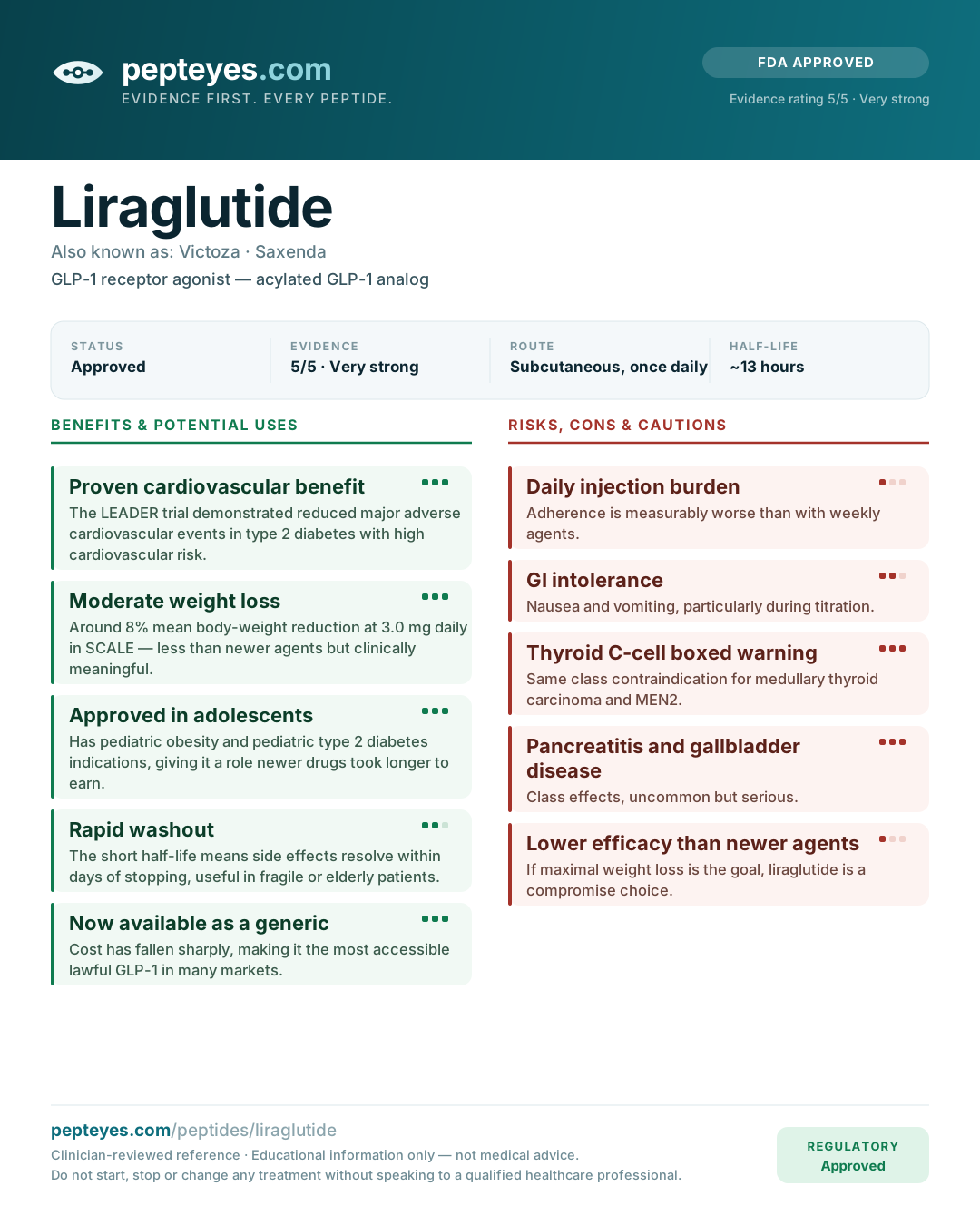
Thyroid C-cell boxed warning — Same class contraindication for medullary thyroid carcinoma and MEN2.
Pancreatitis and gallbladder disease — Class effects, uncommon but serious.
GI intolerance — Nausea and vomiting, particularly during titration.
Storage before mixing Supplied already in solution and kept refrigerated, not frozen. Freezing…
Supplied already in solution and kept refrigerated, not frozen. Freezing a protein solution can aggregate it, which is not always visible.
Shelf life after mixing Nothing to mix — it is not supplied as a powder. The relevant date is…
Nothing to mix — it is not supplied as a powder. The relevant date is the one printed on the product.
Evidence level 5/5 · Very strong — Documented
Multiple phase 3 randomized trials plus regulatory approval in a major market.
Regulatory status FDA Approved — Documented
FDA-approved for type 2 diabetes (2010) and chronic weight management (2014); generic versions now available Prescription drug, now including generic formulations.
Overview
The first-generation weekly-to-daily GLP-1. Superseded on efficacy by semaglutide and tirzepatide, but it has the longest real-world safety record, daily dosing that is easier to stop quickly, and is now the cheapest option in the class.
FDA ApprovedFDA-approved for type 2 diabetes (2010) and chronic weight management (2014); generic versions now available
| Regulatory status | FDA-approved for type 2 diabetes (2010) and chronic weight management (2014); generic versions now available |
|---|---|
| Drug class | GLP-1 receptor agonist — acylated GLP-1 analog |
| Route | Subcutaneous, once daily |
| Half-life | ~13 hours |
| Evidence rating |
5/5 Very strong
Evidence rating 5 out of 5: Very strong
Multiple phase 3 randomized trials plus regulatory approval in a major market. |
| Studied in | LEAD program (diabetes), SCALE program (obesity), LEADER (cardiovascular outcomes). |
Liraglutide sequence & structure
Liraglutide is a 31-residue linear peptide with a free C-terminal acid, carrying a fatty-acid side chain; molecular weight 3,751.2 Da.
* K: γGlu-C16 palmitoyl
* = side-chain modification
| Three-letter | H-His-Ala-Glu-Gly-Thr-Phe-Thr-Ser-Asp-Val-Ser-Ser-Tyr-Leu-Glu-Gly-Gln-Ala-Ala-Lys(γGlu-C16 palmitoyl)-Glu-Phe-Ile-Ala-Trp-Leu-Val-Arg-Gly-Arg-Gly-OH |
|---|---|
| Length | 31 amino acid residues |
| Modifications |
|
| Molecular formula | C172H265N43O51 |
| Molecular weight | 3,751.2 Da (average, free base) |
| SMILES | CCCCCCCCCCCCCCCC(=O)N[C@@H](CCC(=O)NCCCC[C@@H](C(=O)N[C@@H](CCC(=O)O)C(=O)N[C@@H](CC1=CC=CC=C1)C(=O)N[C@@H]([C@@H](C)CC)C(=O)N[C@@H](C)C(=O)N[C@@H](CC2=CNC3=CC=CC=C32)C(=O)N[C@@H](CC(C)C)C(=O)N[C@@H](C(C)C)C(=O)N[C@@H](CCCNC(=N)N)C(=O)NCC(=O)N[C@@H](CCCNC(=N)N)C(=O)NCC(=O)O)NC(=O)[C@H](C)NC(=O)[C@H](C)NC(=O)[C@H](CCC(=O)N)NC(=O)CNC(=O)[C@H](CCC(=O)O)NC(=O)[C@H](CC(C)C)NC(=O)[C@H](CC4=CC=C(C=C4)O)NC(=O)[C@H](CO)NC(=O)[C@H](CO)NC(=O)[C@H](C(C)C)NC(=O)[C@H](CC(=O)O)NC(=O)[C@H](CO)NC(=O)[C@H]([C@@H](C)O)NC(=O)[C@H](CC5=CC=CC=C5)NC(=O)[C@H]([C@@H](C)O)NC(=O)CNC(=O)[C@H](CCC(=O)O)NC(=O)[C@H](C)NC(=O)[C@H](CC6=CN=CN6)N)C(=O)O |
| Identifiers | CAS 204656-20-2 · PubChem CID 16134956 · DrugBank DB06655 · UniProt P01275 |
| Sources | DailyMed — Victoza (liraglutide) injection label, Novo Nordisk (section 11 Description)KEGG DRUG D06404 — liraglutide (sequence, formula, MW, CAS)PubChem CID 16134956 (PUG REST properties: formula, MW, isomeric SMILES)EMA — Victoza EPAR product information (SmPC)UniProt P01275 — human proglucagon (GLP-1(7-37) = residues 98–128) |
Positions 26 and 34 use GLP-1(7-37) numbering; the 31-mer sequence is given verbatim by KEGG D06404 and the Lys34→Arg / Lys26 γGlu-palmitoyl modifications by the FDA (DailyMed) label. Formula C172H265N43O51 and MW 3751.2 Da (label, KEGG; RDKit from the PubChem SMILES gives 3751.26) refer to the free acid; the peptide backbone is expressed recombinantly in Saccharomyces cerevisiae and acylated chemically. DrugBank DB06655 is the ID commonly cited for liraglutide but the DrugBank page could not be opened (403) and remains unverified against DrugBank itself.
Record confidence: high — two independent authoritative sources agree on the sequence and modifications. Every sequence on the site is listed with its sources on the peptide sequences index.
How it works
Same GLP-1 receptor pharmacology as semaglutide with a shorter C16 fatty-acid chain, giving a daily rather than weekly dosing interval.
Evidence base
Rated 5 of 5 — Very strong. Multiple phase 3 randomized trials plus regulatory approval in a major market.
- Over a decade of post-marketing surveillance.
- Dedicated cardiovascular outcome trial with positive result.
Benefits and risks, weighed against the evidence
Every entry below carries the strength of the evidence behind it — three bars for strong human data, two for moderate, one for preliminary or preclinical work. The two columns are not equal by design: where a compound has more documented risk than demonstrated benefit, the lists say so.
Reported benefits
5 entries · 4 on strong human evidence
-
Proven cardiovascular benefit
The LEADER trial demonstrated reduced major adverse cardiovascular events in type 2 diabetes with high cardiovascular risk.
Evidence: Strong evidence -
Moderate weight loss
Around 8% mean body-weight reduction at 3.0 mg daily in SCALE — less than newer agents but clinically meaningful.
Evidence: Strong evidence -
Approved in adolescents
Has pediatric obesity and pediatric type 2 diabetes indications, giving it a role newer drugs took longer to earn.
Evidence: Strong evidence -
Rapid washout
The short half-life means side effects resolve within days of stopping, useful in fragile or elderly patients.
Evidence: Moderate evidence -
Now available as a generic
Cost has fallen sharply, making it the most accessible lawful GLP-1 in many markets.
Evidence: Strong evidence
Risks and cautions
5 entries · 2 serious or common
-
Daily injection burden
Adherence is measurably worse than with weekly agents.
Evidence: Minor -
GI intolerance
Nausea and vomiting, particularly during titration.
Evidence: Moderate evidence -
Thyroid C-cell boxed warning
Same class contraindication for medullary thyroid carcinoma and MEN2.
Evidence: Serious -
Pancreatitis and gallbladder disease
Class effects, uncommon but serious.
Evidence: Serious -
Lower efficacy than newer agents
If maximal weight loss is the goal, liraglutide is a compromise choice.
Evidence: Minor
Counts are not a score. A single serious risk can outweigh several well-supported benefits, and a long benefit list built on preclinical work outweighs nothing at all.
Opinion — what people actually report
5 themes · 1 reported benefit · 2 reported problems
This is the weakest tier on this site. These are themes drawn from public discussion — forums, subreddits and patient threads — not from trials. There is no control group, no denominator, and no way to confirm that what someone injected matched its label. People post when a result is dramatic and when something goes wrong, and rarely when nothing happens, so treat everything below as a description of the conversation rather than of the compound. The bars count how often a thing is said, not how well it is supported.
-
Daily injection is the main complaint Reported problem. Dominant theme: Comes up in most discussions of this compound.
The defining theme now that weekly agents exist. Most discussion frames it as the older option people moved on from.
-
Nausea comparable to or worse than the weekly drugs Reported problem. Dominant theme: Comes up in most discussions of this compound.
Widely reported, with the added frustration that it recurs daily rather than settling into a weekly rhythm.
-
Still works, and is often cheaper or available Reported benefit. Recurring: Raised regularly, though not by everyone.
A recurring practical point — generic liraglutide and better insurance coverage make it the accessible option for many.
-
Weight loss described as smaller than tirzepatide or semaglutide Practical note. Recurring: Raised regularly, though not by everyone.
Consistent with how people rank the class, and rarely disputed.
-
Used in adolescents and discussed by parents Practical note. Occasional: Reported by a minority, or in specific contexts.
A distinct strand of the conversation with a noticeably more cautious tone.
Where the reports and the evidence part ways
The community ranking is correct and matches head-to-head trials: SUSTAIN-10 showed semaglutide outperforming liraglutide on weight and HbA1c, and the weight loss in SCALE was smaller than what the newer agents achieve. The LEADER trial's cardiovascular benefit, which is a genuine and well-evidenced reason to choose it for some patients, barely features in weight-loss forums — the discussion is almost entirely about pounds and injection frequency, and largely ignores the outcome evidence that distinguishes this drug clinically.
Readers on Liraglutide
Questions and answers from readers, under generated names. Nothing here has been checked or reviewed by the site and none of it is medical advice. It is the least verified thing on this page — and it is here because people ask each other these things anyway, and most of the other places they can ask are run by sellers.
0 questions · 0 answers
No questions yet. Ask the first one above — it takes one box and an email address.
How names work, and the house rules
Names. Every verified address is given one generated name — two ordinary words — and keeps it. Nobody chooses a name and nobody can take another's. Posts marked desk were written by the site's own editorial desk, usually to open a thread; they carry a generated name like everyone else's and are held to the site's rules, which means they never state an amount.
What is not allowed. Selling, sourcing, vendor names, coupon codes and "message me" — posts that read that way are held and usually removed. Personal medical details you would not want public. Abuse. Instructions framed as what someone else should do.
What this is not. A reader's report of what happened to them is a report, not a finding, and an answer here is one person's view. Nothing in this section changes the evidence rating above it. If something you read here would change what you take, take it to a pharmacist or physician first.
Your data. Delete any post of yours at any time, or remove everything you have written together with your name. Details in the privacy notice.
Who should avoid it
- Medullary thyroid carcinoma or MEN2 history
- Pregnancy
- Prior pancreatitis (relative)
If used under medical supervision, monitor
- HbA1c, weight
- Renal function during GI illness
Interactions
Not exhaustive. Always have a pharmacist or physician review your full medication list — including supplements.
- Insulin and sulfonylureas — hypoglycemia risk; dose reduction usually needed
- Oral medications — delayed gastric emptying affects absorption
- Warfarin — monitor INR
Regulatory & legal status
Prescription drug, now including generic formulations.
Infographic
Where to read further
We link to live literature searches rather than a frozen citation list, so you always see current results — including anything published after our last review.
- PubMed — all published literature on Liraglutide
- PubMed — randomized controlled trials only
- ClinicalTrials.gov — registered human trials
- DailyMed — official FDA prescribing information
Related peptides in Metabolic & Weight
Terms used on this page
- Glucagon-Like Peptide-1 (GLP-1)
- Glucagon-like peptide-1 is an incretin hormone released by intestinal L-cells after a meal that stimulates glucose-dependent insulin secretion and suppresses appetite.
- Dosing Interval
- The dosing interval is the time between successive doses, and its ratio to the half-life determines how far concentrations swing and how much drug accumulates.
- Post-Marketing Surveillance
- Post-marketing surveillance is the structured collection of safety and effectiveness data after approval, spanning spontaneous reports, mandated registries and phase 4 studies.
- Hard Clinical Endpoint
- A hard clinical endpoint is an outcome that matters directly to a patient and is objectively ascertainable, such as death, stroke or fracture, rather than a laboratory value standing in for one.
- Statistical vs Clinical Significance
- Statistical significance says a difference is unlikely to be chance alone, clinical significance says it is large enough to matter to a patient, and a result can satisfy one without the other.
- Adverse Drug Reaction (ADR)
- An adverse drug reaction is a noxious, unintended response to a medicine given at normal doses, and unlike an adverse event the term carries a causal judgement inside it.
This page is educational information, not medical advice. It cannot account for your medical history, medications, or risk factors. Do not start, stop or change any treatment based on it. Speak to a qualified healthcare professional who knows your case.