Supplied as capsules or tablets
Cognitive & Neurological
At a glance
Ten answers, each one line. Open any row for the detail behind it.
What it does Widely sold in the West as a nootropic supplement despite being a prescription drug in its…
Widely sold in the West as a nootropic supplement despite being a prescription drug in its country of origin and explicitly excluded from the US supplement category. Its Russian trial record is more substantial than most nootropics and still falls well short of Western standards.
Half-life Rat: ~7 min oral, ~11 min IV. Human elimination is slower and… — Documented
Rat: ~7 min oral, ~11 min IV. Human elimination is slower and highly variable, with no published figure; cycloprolylglycine lasts longer.
Typical studied dose Set by the label of the regulator that approved it, which is not an FDA… — On the label
Set by the label of the regulator that approved it, which is not an FDA label and may not be in English. The approving country decides the dose, and it is not always the same as the dose studied elsewhere.
How often it is used Set on the approved label. The interval follows the half-life above… — On the label
Set on the approved label. The interval follows the half-life above, which is why some of these are weekly and others daily.
How it is taken Oral or sublingual — Documented
Oral or sublingual
Main side effects Not a lawful supplement in the US · Evidence base not independently replicated · Irritability, headache and sleep disruption — Carries serious risk
Not a lawful supplement in the US — FDA has stated it does not meet the dietary ingredient definition, making its sale as a supplement unlawful — a fact most vendors omit.
Evidence base not independently replicated — No Western randomized trials exist. Methodological standards in the source literature are inconsistent.
Irritability, headache and sleep disruption — Commonly reported, particularly at higher doses or later in the day.
Storage before mixing Kept dry, sealed and at room temperature unless the label says…
Kept dry, sealed and at room temperature unless the label says otherwise. Moisture is what shortens the life of a capsule or tablet.
Shelf life after mixing Nothing to mix — it is not supplied as a powder. The relevant date is…
Nothing to mix — it is not supplied as a powder. The relevant date is the one printed on the product.
Evidence level 2/5 · Limited — Nothing established
Preclinical work plus scattered human reports, uncontrolled use, or negative trials.
Regulatory status Limited Approval — Documented
Registered as a prescription medicine in Russia. In the US, FDA has determined it is not a lawful dietary ingredient. Not approved in the EU or UK. Prescription medicine in Russia. Not a lawful dietary supplement in the US. Unapproved in the EU and UK.
Overview
Widely sold in the West as a nootropic supplement despite being a prescription drug in its country of origin and explicitly excluded from the US supplement category. Its Russian trial record is more substantial than most nootropics and still falls well short of Western standards.
Limited or non-US approvalPrescription medicine in Russia. Not a lawful dietary supplement in the US. Unapproved in the EU and UK.
| Regulatory status | Registered as a prescription medicine in Russia. In the US, FDA has determined it is not a lawful dietary ingredient. Not approved in the EU or UK. |
|---|---|
| Drug class | Dipeptide-derived nootropic — a proline-containing dipeptide ethyl ester |
| Route | Oral or sublingual |
| Half-life | Rat: ~7 min oral, ~11 min IV. Human elimination is slower and highly variable, with no published figure; cycloprolylglycine lasts longer. |
| Evidence rating |
2/5 Limited
Evidence rating 2 out of 5: Limited
Preclinical work plus scattered human reports, uncontrolled use, or negative trials. |
| Studied in | Russian randomized trials in mild cognitive impairment of vascular and post-traumatic origin; extensive Russian preclinical work. |
Noopept sequence & structure
Noopept is a peptide-derived small molecule rather than a peptide: a 2-residue core with both ends chemically capped, molecular weight 318.37 Da. Chemical databases classify it as a small molecule, and so does this record.
| Three-letter | PhAc-Pro-Gly-OEt |
|---|---|
| Length | 2 amino acid residues |
| Molecular formula | C17H22N2O4 |
| Molecular weight | 318.37 Da (average, free base) |
| SMILES | CCOC(=O)CNC(=O)[C@@H]1CCCN1C(=O)Cc1ccccc1 |
| Identifiers | CAS 157115-85-0 · PubChem CID 180496 |
| Which molecule | Noopept, Omberacetam (INN 10682), GVS-111, DVD-111 and SGS-111 all denote the same single molecule, N-phenylacetyl-L-prolylglycine ethyl ester (ethyl 2-[[(2S)-1-(2-phenylacetyl)pyrrolidine-2-carbonyl]amino]acetate); only the L-proline (2S) stereoisomer is the drug substance, and the pepteyes monograph describes that molecule. |
| Sources | PubChem CID 180496 (properties)PubChem CID 180496 (synonyms)ChEMBL CHEMBL4303687NCATS Inxight Drugs / GSRS UNII 4QBJ98683M (Omberacetam)Wikipedia: Omberacetam (cross-check) |
Registered in PubChem, ChEMBL and NCATS GSRS/Inxight as a small molecule (substance class 'chemical', absolute stereochemistry) rather than a peptide; it is a fully protected dipeptide (phenylacetyl-L-prolyl-glycine ethyl ester, InChIKey PJNSMUBMSNAEEN-AWEZNQCLSA-N, EPA CompTox DTXSID80166214), so the sequence fields are given for reference and no free N- or C-terminus exists. GSRS lists no DrugBank accession (PubChem's 'DB-371006' is a vendor catalogue code, not a DrugBank id). CAS 157115-85-0 check digit verified; MW 318.37 matches ChEMBL 318.37, GSRS 318.3676 and the formula-derived 318.373. In vivo it is hydrolysed to cycloprolylglycine, its proposed active metabolite.
Record confidence: high — two independent authoritative sources agree on the sequence and modifications. Every sequence on the site is listed with its sources on the peptide sequences index.
How it works
Rapidly metabolised to cycloprolylglycine, an endogenous neuropeptide. Reported effects include increased BDNF and NGF expression in the hippocampus, modulation of AMPA and NMDA receptor function, and antioxidant activity. Structurally related to the racetam family but active at far lower doses.
Evidence base
Rated 2 of 5 — Limited. Preclinical work plus scattered human reports, uncontrolled use, or negative trials.
- More Russian trial data than most nootropics, and no independent Western replication.
Benefits and risks, weighed against the evidence
Every entry below carries the strength of the evidence behind it — three bars for strong human data, two for moderate, one for preliminary or preclinical work. The two columns are not equal by design: where a compound has more documented risk than demonstrated benefit, the lists say so.
Reported benefits
4 entries
-
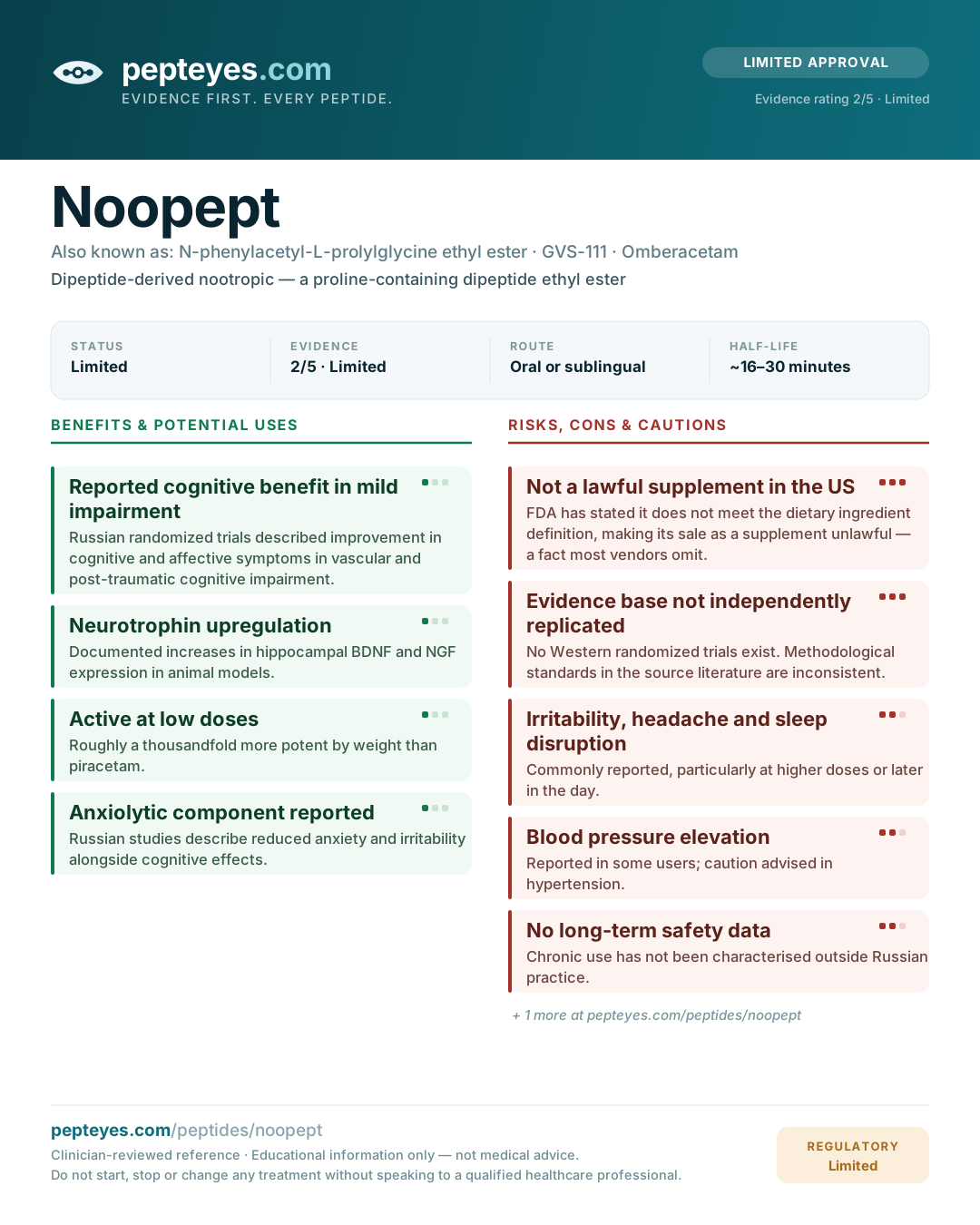
Reported cognitive benefit in mild impairment
Russian randomized trials described improvement in cognitive and affective symptoms in vascular and post-traumatic cognitive impairment.
Evidence: Preliminary -
Neurotrophin upregulation
Documented increases in hippocampal BDNF and NGF expression in animal models.
Evidence: Preliminary -
Active at low doses
Roughly a thousandfold more potent by weight than piracetam.
Evidence: Preliminary -
Anxiolytic component reported
Russian studies describe reduced anxiety and irritability alongside cognitive effects.
Evidence: Preliminary
Risks and cautions
6 entries · 2 serious or common
-
Not a lawful supplement in the US
FDA has stated it does not meet the dietary ingredient definition, making its sale as a supplement unlawful — a fact most vendors omit.
Evidence: Serious -
Evidence base not independently replicated
No Western randomized trials exist. Methodological standards in the source literature are inconsistent.
Evidence: Serious -
Irritability, headache and sleep disruption
Commonly reported, particularly at higher doses or later in the day.
Evidence: Moderate evidence -
Blood pressure elevation
Reported in some users; caution advised in hypertension.
Evidence: Moderate evidence -
No long-term safety data
Chronic use has not been characterised outside Russian practice.
Evidence: Moderate evidence -
Product quality varies widely
Sold by supplement vendors with inconsistent purity and labelling.
Evidence: Moderate evidence
Counts are not a score. A single serious risk can outweigh several well-supported benefits, and a long benefit list built on preclinical work outweighs nothing at all.
Opinion — what people actually report
5 themes · 1 reported benefit · 3 reported problems
This is the weakest tier on this site. These are themes drawn from public discussion — forums, subreddits and patient threads — not from trials. There is no control group, no denominator, and no way to confirm that what someone injected matched its label. People post when a result is dramatic and when something goes wrong, and rarely when nothing happens, so treat everything below as a description of the conversation rather than of the compound. The bars count how often a thing is said, not how well it is supported.
-
Noticeable within the first hour Reported benefit. Dominant theme: Comes up in most discussions of this compound.
Distinguishes it from racetams in discussion. People report a clear onset rather than a slow build.
-
Headaches are the common complaint Reported problem. Dominant theme: Comes up in most discussions of this compound.
Frequent enough that choline co-supplementation is standard forum advice, though the rationale is contested.
-
Tolerance builds quickly Reported problem. Dominant theme: Comes up in most discussions of this compound.
Reported within one to two weeks of daily use, driving cycling.
-
Irritability and brain fog on stopping Reported problem. Recurring: Raised regularly, though not by everyone.
Irritability and a period of duller thinking after stopping are described following extended daily use, resolving over days.
-
Not actually a peptide in the usual sense Practical note. Recurring: Raised regularly, though not by everyone.
Regularly clarified in threads — it is a dipeptide-derived compound, and the "peptide" framing misleads people about what it is.
Where the reports and the evidence part ways
Noopept follows the Semax and Selank pattern: developed and approved in Russia, supported by a domestic literature that is small, largely unreplicated and rarely blinded to Western standards, and with essentially no controlled evidence for cognitive enhancement in healthy people. The subjective acuteness people report is interesting precisely because it is unusual for this class, but a fast-onset subjective effect is also the easiest kind to generate through expectation. The choline advice is inherited from racetam culture and does not have a clear mechanistic basis for this compound.
Cheat sheet
The full sheet, all 77 compounds →The community reference numbers for this compound — reconstitution, working dose, cycle and bloodwork. Research and education only, not medical advice, and not part of the evidence-rated monograph above. Doses assume a 1mL / 100-unit insulin syringe — the calculator does the units for you.
Protocol overview
No injection schedule — oral capsules.
- Capsule: Noopept 10mg — Focus, memory, fast-acting nootropic
Readers on Noopept
Questions and answers from readers, under generated names. Nothing here has been checked or reviewed by the site and none of it is medical advice. It is the least verified thing on this page — and it is here because people ask each other these things anyway, and most of the other places they can ask are run by sellers.
0 questions · 0 answers
No questions yet. Ask the first one above — it takes one box and an email address.
How names work, and the house rules
Names. Every verified address is given one generated name — two ordinary words — and keeps it. Nobody chooses a name and nobody can take another's. Posts marked desk were written by the site's own editorial desk, usually to open a thread; they carry a generated name like everyone else's and are held to the site's rules, which means they never state an amount.
What is not allowed. Selling, sourcing, vendor names, coupon codes and "message me" — posts that read that way are held and usually removed. Personal medical details you would not want public. Abuse. Instructions framed as what someone else should do.
What this is not. A reader's report of what happened to them is a report, not a finding, and an answer here is one person's view. Nothing in this section changes the evidence rating above it. If something you read here would change what you take, take it to a pharmacist or physician first.
Your data. Delete any post of yours at any time, or remove everything you have written together with your name. Details in the privacy notice.
Who should avoid it
- Pregnancy and breastfeeding
- Uncontrolled hypertension
- Severe hepatic or renal impairment
- Concurrent stimulants without medical supervision
If used under medical supervision, monitor
- Blood pressure
- Sleep quality and mood
- Cognitive assessment if used for impairment
Commonly confused with
These mix-ups cause real harm — two products sold under one name, or two molecules whose effects run in opposite directions.
Both are Russian-developed neuropeptides sold as nootropics in the West. Semax is a seven-residue ACTH fragment given intranasally; noopept is an orally active dipeptide ester. Neither has Western regulatory review.
Compare side by sideRegulatory & legal status
Prescription medicine in Russia. Not a lawful dietary supplement in the US. Unapproved in the EU and UK.
Infographic
Where to read further
We link to live literature searches rather than a frozen citation list, so you always see current results — including anything published after our last review.
- PubMed — all published literature on Noopept
- PubMed — randomized controlled trials only
- ClinicalTrials.gov — registered human trials
Related peptides in Cognitive & Neurological
Terms used on this page
- Nootropic
- A nootropic is any substance claimed to improve cognition, a term coined for a specific pharmacological profile that has since become a marketing category with no regulatory meaning.
- Nerve Growth Factor (NGF)
- Nerve growth factor is the founding neurotrophin, supporting sympathetic and sensory neurons and basal forebrain cholinergic neurons while also acting as a potent peripheral pain mediator.
- Brain-Derived Neurotrophic Factor (BDNF)
- BDNF is a neurotrophin that signals through the TrkB receptor to support neuronal survival, dendritic growth and the late, protein-synthesis-dependent phase of synaptic potentiation.
- Preclinical Study and Animal Model
- Preclinical studies are the laboratory, cell and animal experiments done before any human exposure, establishing mechanism, target engagement and the toxicology package that permits a first trial.
- Potency vs Efficacy
- Potency is the concentration a drug needs to produce a given effect, while efficacy is the largest effect it can produce at any concentration; the two are independent properties.
This page is educational information, not medical advice. It cannot account for your medical history, medications, or risk factors. Do not start, stop or change any treatment based on it. Speak to a qualified healthcare professional who knows your case.