Supplied as a lyophilised powder to reconstitute
Cognitive & Neurological
At a glance
Ten answers, each one line. Open any row for the detail behind it.
What it does A seven-residue fragment of spadin, which is itself cut from the propeptide of the…
A seven-residue fragment of spadin, which is itself cut from the propeptide of the sortilin receptor. It blocks the TREK-1 potassium channel a few hundred times more potently than spadin does, and produced fast antidepressant-like effects in mice along with hippocampal neurogenesis. The entire record is rodent behaviour and cell-culture electrophysiology from essentially one French laboratory; nothing has been measured in a human being.
Half-life Not characterised in humans. In mice the antidepressant-like… — Nothing established
Not characterised in humans. In mice the antidepressant-like effect of one injection lasted about 23 hours, against roughly 7 for spadin.
Typical studied dose None established. No dose has ever been set for a human being, because… — Nothing established
None established. No dose has ever been set for a human being, because the studies that would set one have not been done. Any figure circulating for this compound was chosen by somebody selling it or by somebody guessing.
How often it is used No schedule exists. Cycles and intervals quoted for this compound come… — Nothing established
No schedule exists. Cycles and intervals quoted for this compound come from forums rather than from any study, and they vary because nothing anchors them.
How it is taken Intraperitoneal injection and oral gavage in mice; not established in… — Documented
Intraperitoneal injection and oral gavage in mice; not established in humans.
Main side effects No human data of any kind · Unapproved, unregulated grey-market material · Depression is a dangerous condition to self-treat — Carries serious risk
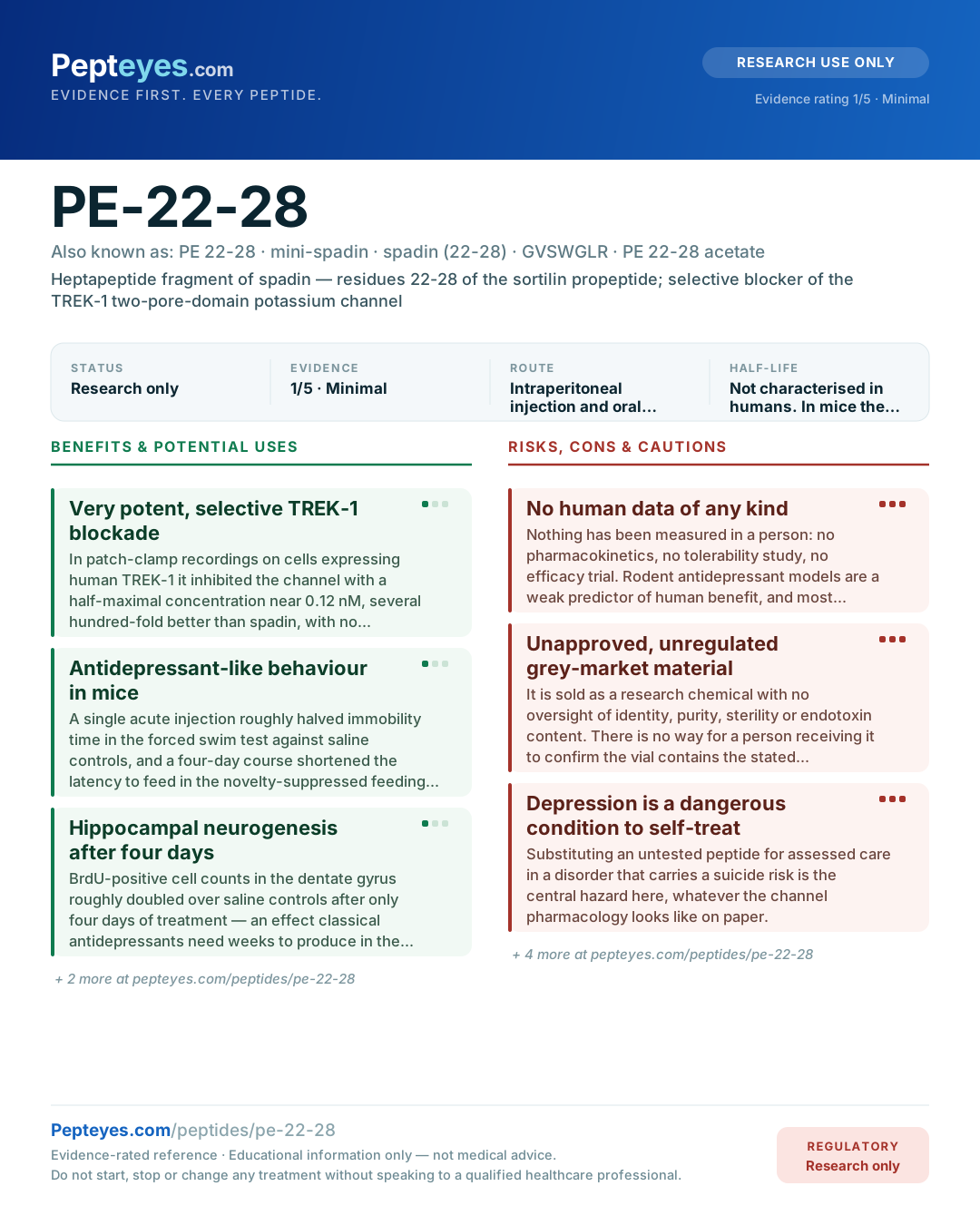
No human data of any kind — Nothing has been measured in a person: no pharmacokinetics, no tolerability study, no efficacy trial. Rodent antidepressant models are a weak predictor of human benefit, and most compounds that pass them fail later.
Unapproved, unregulated grey-market material — It is sold as a research chemical with no oversight of identity, purity, sterility or endotoxin content. There is no way for a person receiving it to confirm the vial contains the stated heptapeptide at all.
Depression is a dangerous condition to self-treat — Substituting an untested peptide for assessed care in a disorder that carries a suicide risk is the central hazard here, whatever the channel pharmacology looks like on paper.
Storage before mixing As a sealed lyophilised powder, refrigerated is typical and a freezer…
As a sealed lyophilised powder, refrigerated is typical and a freezer suits long storage; both should be dark and dry. A dry powder tolerates a few days out of the cold far better than anything in solution — which is why it ships that way.
Shelf life after mixing Once mixed it is refrigerated and treated as short-lived. Bacteriostatic…
Once mixed it is refrigerated and treated as short-lived. Bacteriostatic water contains a preservative and buys the longer window; sterile water contains none and buys a much shorter one. Peptides in solution also degrade on their own, so the container is only half the question.
Evidence level 1/5 · Minimal — Nothing established
Animal or laboratory data only. No human efficacy evidence.
Regulatory status Research Use Only — Nothing established
Not approved by any regulator and not in any registered human trial as of September 2026; it circulates under a research-use-only label. PE-22-28 has no marketing authorisation in the United States, the European Union or the United Kingdom, and is not a licensed medicine anywhere in the world. It is not a controlled substance; it moves under a research-use-only label, which is a labelling convention rather than any legal permission to give it to a person. It is not named individually on the WADA Prohibited List, but the S0 non-approved-substances clause covers pharmacological agents with no current approval by any government health authority, which includes this one. There is no compounding pathway for it in the US.
Overview
A seven-residue fragment of spadin, which is itself cut from the propeptide of the sortilin receptor. It blocks the TREK-1 potassium channel a few hundred times more potently than spadin does, and produced fast antidepressant-like effects in mice along with hippocampal neurogenesis. The entire record is rodent behaviour and cell-culture electrophysiology from essentially one French laboratory; nothing has been measured in a human being.
Not approved for human use anywhereNo approval anywhere for human use. Sold under research-use labelling. PE-22-28 has no marketing authorisation in the United States, the European Union or the United Kingdom, and is not a licensed medicine anywhere in the world. It is not a controlled substance; it moves under a research-use-only label, which is a labelling convention rather than any legal permission to give it to a person. It is not named individually on the WADA Prohibited List, but the S0 non-approved-substances clause covers pharmacological agents with no current approval by any government health authority, which includes this one. There is no compounding pathway for it in the US.
| Regulatory status | Not approved by any regulator and not in any registered human trial as of September 2026; it circulates under a research-use-only label. |
|---|---|
| Drug class | Heptapeptide fragment of spadin — residues 22-28 of the sortilin propeptide; selective blocker of the TREK-1 two-pore-domain potassium channel |
| Route | Intraperitoneal injection and oral gavage in mice; not established in humans. |
| Half-life | Not characterised in humans. In mice the antidepressant-like effect of one injection lasted about 23 hours, against roughly 7 for spadin. |
| Evidence rating |
1/5 Minimal
Evidence rating 1 out of 5: Minimal
Animal or laboratory data only. No human efficacy evidence. |
| Studied in | Patch-clamp work on cell lines expressing human TREK-1, plus mouse forced swim, learned helplessness and novelty-suppressed feeding models with hippocampal BrdU counts, reported by the Heurteaux and Borsotto group in 2017. No registered human trial exists. |
PE-22-28 sequence & structure
PE-22-28 is a 7-residue linear peptide with a free C-terminal acid; molecular weight 773.89 Da.
| Three-letter | H-Gly-Val-Ser-Trp-Gly-Leu-Arg-OH |
|---|---|
| Length | 7 amino acid residues |
| Modifications | None — an unmodified chain of standard L-amino acids |
| Molecular formula | C35H55N11O9 |
| Molecular weight | 773.89 Da (average, free base) |
| SMILES | CC(C)C[C@@H](C(=O)N[C@@H](CCCN=C(N)N)C(=O)O)NC(=O)CNC(=O)[C@H](CC1=CNC2=CC=CC=C21)NC(=O)[C@H](CO)NC(=O)[C@H](C(C)C)NC(=O)CN |
| Identifiers | CAS 1801959-12-5 · PubChem CID 165437303 · UniProt Q99523 |
| Which molecule | This record is the parent heptapeptide PE 22-28, the free-acid all-L peptide GVSWGLR described in 2017. It is not spadin (PE 12-28, the 17-residue APLPRWSGPIGVSWGLR, which carries this sequence at its C-terminus), and it is not the Gly22-to-Ala analogue G/A-PE 22-28 (AVSWGLR) or the biotinylated form, both of which were reported alongside it with their own potencies. Nor is it one of the retro-inverso spadin analogues of 2014-2015 (analogues 3 and 8), which are all-D peptides built on a reversed spadin sequence and are separate molecules; retro-inverso design was a parallel stabilisation strategy, not the route to this peptide, which was instead picked out of spadin's blood degradation products. |
| Sources | UniProt Q99523 — Sortilin (SORT1), Homo sapiens: full precursor sequence, propeptide 34-77PubChem CID 165437303 — PE 22-28: formula, weight, CAS synonym, isomeric SMILESDjillani et al., Front. Pharmacol. 2017 — Shortened Spadin Analogs Display Better TREK-1 Inhibition, In Vivo Stability and Antidepressant ActivityDjillani et al., Front. Pharmacol. 2018 — The Origin of Spadin in Depression (gives the 22-28 sequence and the G/A analogue)Mazella et al., PLOS Biology 2010 — Spadin, a Sortilin-Derived Peptide, Targeting Rodent TREK-1 Channels (spadin sequence and propeptide numbering) |
Numbering follows the 44-residue sortilin propeptide, not the precursor: propeptide residues 22-28 correspond to Gly55-Arg61 of the SORT1 precursor Q99523, where the sequence GVSWGLR was checked directly. The peptide is normally handled as an acetate salt, so a certificate of analysis may quote a mass above the 773.89 free-peptide figure given here.
Record confidence: high — two independent authoritative sources agree on the sequence and modifications. Every sequence on the site is listed with its sources on the peptide sequences index.
How it works
TREK-1 is a two-pore-domain potassium channel that hyperpolarises neurons and damps serotonergic firing in the dorsal raphe nucleus; mice lacking it behave like animals already on an antidepressant. In patch-clamp recordings on cells expressing human TREK-1, PE-22-28 inhibited the channel with a half-maximal concentration near 0.12 nM, against 40-60 nM for the parent peptide spadin, and left TREK-2, TRAAK, TRESK, TASK-1 and the cardiac hERG channel unaffected. Lifting that potassium conductance is thought to raise dorsal raphe firing rate and drive the hippocampal cell proliferation and synaptic changes conventional antidepressants take weeks to produce. The sequence was picked out of spadin's own blood degradation products, which is why it resists proteolysis better than the parent. The common claim that it acts on dopamine is an extrapolation; the published pharmacology is potassium-channel blockade with a serotonergic readout.
Evidence base
Rated 1 of 5 — Minimal. Animal or laboratory data only. No human efficacy evidence.
- Animal and in-vitro data only: patch-clamp electrophysiology on cell lines expressing human TREK-1, plus mouse behaviour and hippocampal histology. No human study of any kind has been performed or registered.
- The primary evidence is a single 2017 Frontiers in Pharmacology report, supported by spadin work from the same laboratory going back to 2010.
- A ClinicalTrials.gov registry search returns no study of PE-22-28 or of spadin.
- Rodent antidepressant paradigms such as forced swim and novelty-suppressed feeding have a poor record of predicting human efficacy, so the behavioural findings carry little weight for a person.
Benefits and risks, weighed against the evidence
Every entry below carries the strength of the evidence behind it — three bars for strong human data, two for moderate, one for preliminary or preclinical work. The two columns are not equal by design: where a compound has more documented risk than demonstrated benefit, the lists say so.
Reported benefits
5 entries
-
Very potent, selective TREK-1 blockade
In patch-clamp recordings on cells expressing human TREK-1 it inhibited the channel with a half-maximal concentration near 0.12 nM, several hundred-fold better than spadin, with no measurable effect on TREK-2, TRAAK, TRESK, TASK-1 or the cardiac hERG channel.
Evidence: Preliminary -
Antidepressant-like behaviour in mice
A single acute injection roughly halved immobility time in the forced swim test against saline controls, and a four-day course shortened the latency to feed in the novelty-suppressed feeding test in a corticosterone model of depression.
Evidence: Preliminary -
Hippocampal neurogenesis after four days
BrdU-positive cell counts in the dentate gyrus roughly doubled over saline controls after only four days of treatment — an effect classical antidepressants need weeks to produce in the same models.
Evidence: Preliminary -
Longer duration of action than spadin
In mice the antidepressant-like effect in the forced swim test persisted up to about 23 hours after one injection, against roughly 7 hours for spadin, which the authors attribute to the shortened sequence resisting the proteases that clear the parent peptide.
Evidence: Preliminary -
Synaptic marker increase in cortical neurons
PSD-95 expression in cultured mouse cortical neurons roughly doubled by 36 hours after exposure. This is a marker of synaptogenesis in a dish, not a behavioural or clinical outcome.
Evidence: Preliminary
Risks and cautions
7 entries · 3 serious or common
-
No human data of any kind
Nothing has been measured in a person: no pharmacokinetics, no tolerability study, no efficacy trial. Rodent antidepressant models are a weak predictor of human benefit, and most compounds that pass them fail later.
Evidence: Serious -
Unapproved, unregulated grey-market material
It is sold as a research chemical with no oversight of identity, purity, sterility or endotoxin content. There is no way for a person receiving it to confirm the vial contains the stated heptapeptide at all.
Evidence: Serious -
Depression is a dangerous condition to self-treat
Substituting an untested peptide for assessed care in a disorder that carries a suicide risk is the central hazard here, whatever the channel pharmacology looks like on paper.
Evidence: Serious -
Single-laboratory evidence base
Almost all of the published work traces to one group in France. The potency, selectivity and duration figures have not been independently replicated by another laboratory.
Evidence: Moderate evidence -
Chronic channel blockade is unstudied
TREK-1 sits in the heart, gut and sensory neurons as well as the brain. The 2017 work screened the hERG channel in a dish and ran behavioural studies over days; nothing has examined the months of exposure a mood treatment would involve.
Evidence: Moderate evidence -
Marketing claims outrun the pharmacology
Grey-market listings attach dopamine, addiction-recovery and general nootropic claims to it. The published mechanism is TREK-1 blockade with a serotonergic downstream readout; the rest is inference from other literature.
Evidence: Moderate evidence -
Injection hazards independent of the molecule
Reconstituting and injecting an unregulated lyophilised powder outside sterile conditions risks local infection, abscess and bloodstream infection regardless of what the peptide itself does.
Evidence: Moderate evidence
Counts are not a score. A single serious risk can outweigh several well-supported benefits, and a long benefit list built on preclinical work outweighs nothing at all.
Opinion — what people actually report
7 themes · 1 reported benefit · 3 reported problems
This is the weakest tier on this site. These are themes drawn from public discussion — forums, subreddits and patient threads — not from trials. There is no control group, no denominator, and no way to confirm that what someone injected matched its label. People post when a result is dramatic and when something goes wrong, and rarely when nothing happens, so treat everything below as a description of the conversation rather than of the compound. The bars count how often a thing is said, not how well it is supported.
-
Almost all the visible discussion was written by sellers Practical note. Dominant theme: Comes up in most discussions of this compound.
Search for it and what comes back is vendor pages, affiliate guides and protocol wikis, recycling the same rodent paper and each other. Genuine first-hand accounts are scarce by comparison, and that ratio is the most important fact about this conversation.
-
A lift in mood and motivation within days Reported benefit. Recurring: Raised regularly, though not by everyone.
The claim that draws people to it. Reports describe feeling emotionally normal rather than elevated, and the speed — days rather than the weeks an SSRI takes — is the whole of the appeal.
-
Flatness and sedation at the upper end Reported problem. Recurring: Raised regularly, though not by everyone.
The complaint that recurs most often, and it is generally attributed to taking too much rather than to the compound itself. The standing community answer is a protocol adjustment, which is not repeated here.
-
Plenty of accounts describe nothing happening Reported problem. Recurring: Raised regularly, though not by everyone.
Among the reports that are clearly first-hand, a fair share report no effect, often from someone who did not persist for long. Null results are underposted everywhere and this compound is no exception.
-
The nasal-versus-injection argument is guesswork Practical note. Recurring: Raised regularly, though not by everyone.
Whether a heptapeptide of this size crosses the nasal mucosa usefully is argued from molecular weight alone, by analogy with Semax and Selank. Nobody has measured it in a person, and the more careful threads acknowledge that.
-
It is stacked with other peptides, so nothing is attributable Practical note. Recurring: Raised regularly, though not by everyone.
Accounts frequently involve several cognitive peptides running at once. Any effect described in those is unassignable, and the compound's reputation is partly borrowed from whatever it was taken beside.
-
People are self-treating depression with it Reported problem. Occasional: Reported by a minority, or in specific contexts.
The most serious thing this discussion surfaces. A grey-market powder with no human data is being used instead of, or alongside, treatment for a condition that can be fatal, and the cautions raised in reply are not always welcome.
Where the reports and the evidence part ways
The preclinical pharmacology here is unusually clean — half-maximal TREK-1 block near 0.12 nM against 40 to 60 nM for the parent peptide spadin, with TREK-2, TRAAK, TRESK, TASK-1 and cardiac hERG left alone — and the rodent behaviour is consistent across the standard antidepressant assays. What does not exist is a single measurement in a human being: no pharmacokinetics, no registered trial, no evidence that an injected or sprayed heptapeptide reaches a channel in the dorsal raphe at all. So the reports of a mood lift in days describe something the evidence can neither corroborate nor refute, and the widely repeated community claim that it acts on dopamine appears nowhere in the literature — the published pharmacology is potassium-channel blockade read out through serotonergic firing. The sceptics who point out that most of what has been written about this compound was written in order to sell it are correct, and they are the most useful voice in the conversation.
Cheat sheet
The full sheet, all 77 compounds →The community reference numbers for this compound — reconstitution, working dose, cycle and bloodwork. Research and education only, not medical advice, and not part of the evidence-rated monograph above. Doses assume a 1mL / 100-unit insulin syringe — the calculator does the units for you.
Protocol overview
Dosing & reconstitution 10 mg vial
| WEEK | DAILY DOSE | UNITS PER INJECTION |
|---|---|---|
| Weeks 1 to 2 | 50 mcg | 0.5 units (0.00 mL) |
| Weeks 3 to 4 | 100 mcg | 1 units (0.01 mL) |
| Weeks 5 to 8 | 100 mcg | 1 units (0.01 mL) |
| Weeks 9 to 12 (Optional) | 150 mcg | 1.5 units (0.01 mL) |
| Weeks 13 to 16 (Optional) | 200 mcg | 2 units (0.02 mL) |
Frequency: Inject once daily subcutaneously. For 10 unit (0.10 mL) or smaller administrations, consider 30- or
On the master sheet
- Vial
- 10mg
- BAC
- 3mL
- Dose
- 50–200mcg daily
- Route
- SubQ
- Cycle
- 12–16 wks
- Time Off
- Equal break
Readers on PE-22-28
Questions and answers from readers, under generated names. Nothing here has been checked or reviewed by the site and none of it is medical advice. It is the least verified thing on this page — and it is here because people ask each other these things anyway, and most of the other places they can ask are run by sellers.
0 questions · 0 answers
No questions yet. Ask the first one above — it takes one box and an email address.
How names work, and the house rules
Names. Every verified address is given one generated name — two ordinary words — and keeps it. Nobody chooses a name and nobody can take another's. Posts marked desk were written by the site's own editorial desk, usually to open a thread; they carry a generated name like everyone else's and are held to the site's rules, which means they never state an amount.
What is not allowed. Selling, sourcing, vendor names, coupon codes and "message me" — posts that read that way are held and usually removed. Personal medical details you would not want public. Abuse. Instructions framed as what someone else should do.
What this is not. A reader's report of what happened to them is a report, not a finding, and an answer here is one person's view. Nothing in this section changes the evidence rating above it. If something you read here would change what you take, take it to a pharmacist or physician first.
Your data. Delete any post of yours at any time, or remove everything you have written together with your name. Details in the privacy notice.
Who should avoid it
- Use outside a registered clinical trial
- Anyone with depression, bipolar disorder or suicidal thoughts, in place of assessed treatment
- Pregnancy and breastfeeding
- Children and adolescents
- Anyone on serotonergic medication, where the overlap has never been tested
If used under medical supervision, monitor
- Not applicable outside a registered trial
- A trial would track validated depression rating scales and suicidality
- Cardiac rhythm, given TREK-1 expression in the heart
Interactions
Not exhaustive. Always have a pharmacist or physician review your full medication list — including supplements.
- Fluoxetine and other SSRIs — fluoxetine is itself a TREK-1 blocker, so the mechanisms overlap directly and untested
- Any serotonergic agent — shared effect on dorsal raphe firing, never studied in combination
- Antiarrhythmic and other cardiac ion-channel drugs — no interaction data, and TREK-1 is expressed in the heart
Regulatory & legal status
PE-22-28 has no marketing authorisation in the United States, the European Union or the United Kingdom, and is not a licensed medicine anywhere in the world. It is not a controlled substance; it moves under a research-use-only label, which is a labelling convention rather than any legal permission to give it to a person. It is not named individually on the WADA Prohibited List, but the S0 non-approved-substances clause covers pharmacological agents with no current approval by any government health authority, which includes this one. There is no compounding pathway for it in the US.
Infographic
What this entry was checked against
The specific records this monograph was verified against on its last research pass. We link live literature searches below as well, because these are a snapshot and the literature is not.
- Djillani et al., Front. Pharmacol. 2017;8:643 — Shortened Spadin Analogs Display Better TREK-1 Inhibition, In Vivo Stability and Antidepressant Activity
- PubMed 28955242 — record and abstract for the 2017 shortened-spadin-analogs paper
- Djillani et al., Pharmacol. Ther. 2019;194:185-198 — Fighting against depression with TREK-1 blockers: past and future. A focus on spadin (PubMed record)
- Djillani et al., Front. Pharmacol. 2018;9:1541 — The Origin of Spadin in Depression
- Mazella et al., PLOS Biology 2010;8:e1000355 — Spadin, a Sortilin-Derived Peptide, Targeting Rodent TREK-1 Channels
- PubChem CID 165437303 — PE 22-28 compound record
- UniProt Q99523 — Sortilin (SORT1) precursor, signal peptide, propeptide and chain boundaries
- ClinicalTrials.gov — registry search for spadin and PE 22-28 (no studies returned)
Where to read further
We link to live literature searches rather than a frozen citation list, so you always see current results — including anything published after our last review.
- PubMed — all published literature on PE-22-28
- PubMed — randomized controlled trials only
- ClinicalTrials.gov — registered human trials
Related peptides in Cognitive & Neurological
Terms used on this page
- Neurogenesis
- Neurogenesis is the generation of new neurons from neural stem and progenitor cells, which in the adult mammalian brain is confined to a small number of restricted niches.
- Serotonergic Signalling
- Serotonergic signalling is neurotransmission using 5-hydroxytryptamine, acting through fourteen receptor subtypes with divergent and sometimes opposing effects on mood, sleep, appetite and vascular tone.
- Enzymatic Degradation
- Enzymatic degradation is the breakdown of a peptide by proteases and peptidases in gut, blood, tissue and kidney, and it is the main reason unmodified peptides act only briefly.
- Trial Registration and Prospective Protocol
- Trial registration is the public deposit of a study's design and prespecified outcomes before enrolment begins, creating a dated record against which the eventual publication can be checked.
- Synaptogenesis
- Synaptogenesis is the formation of new synaptic connections between neurons, requiring coordinated assembly of a presynaptic release site and a matching postsynaptic density.
- Research Chemical Market
- The research chemical market is the trade in compounds sold as laboratory reagents under research-use disclaimers, in practice supplying individuals with substances that have no approved human use.
This page is educational information, not medical advice. It cannot account for your medical history, medications, or risk factors. Do not start, stop or change any treatment based on it. Speak to a qualified healthcare professional who knows your case.