Supplied as a lyophilised powder to reconstitute
Cognitive & Neurological
At a glance
Ten answers, each one line. Open any row for the detail behind it.
What it does Reported in rodent work to be orders of magnitude more potent than BDNF at forming new…
Reported in rodent work to be orders of magnitude more potent than BDNF at forming new synapses. That potency is the reason it attracts attention and the reason it should be treated with unusual caution — a molecule that powerful in the brain with zero human data is not a supplement.
Half-life Not established in humans — no published human trial. Only… — Nothing established
Not established in humans — no published human trial. Only rodent data exist, and the key 2013 rodent paper carries an editorial expression of concern.
Typical studied dose None established. No dose has ever been set for a human being, because… — Nothing established
None established. No dose has ever been set for a human being, because the studies that would set one have not been done. Any figure circulating for this compound was chosen by somebody selling it or by somebody guessing.
How often it is used No schedule exists. Cycles and intervals quoted for this compound come… — Nothing established
No schedule exists. Cycles and intervals quoted for this compound come from forums rather than from any study, and they vary because nothing anchors them.
How it is taken Oral or subcutaneous (research) — Documented
Oral or subcutaneous (research)
Main side effects No human data of any kind · c-Met is an oncogene pathway · Uncontrolled synaptic remodelling — Carries serious risk
No human data of any kind — Not a single human trial. There is no known safe dose, no known adverse-event profile, and no known interaction set.
c-Met is an oncogene pathway — HGF/c-Met signalling is a well-established driver in multiple cancers and a target of oncology drugs designed to block it. Chronically potentiating it is the opposite intervention.
Uncontrolled synaptic remodelling — Non-specific synaptogenesis throughout the brain is not obviously desirable and has no precedent in human therapeutics.
Storage before mixing As a sealed lyophilised powder, refrigerated is typical and a freezer…
As a sealed lyophilised powder, refrigerated is typical and a freezer suits long storage; both should be dark and dry. A dry powder tolerates a few days out of the cold far better than anything in solution — which is why it ships that way.
Shelf life after mixing Once mixed it is refrigerated and treated as short-lived. Bacteriostatic…
Once mixed it is refrigerated and treated as short-lived. Bacteriostatic water contains a preservative and buys the longer window; sterile water contains none and buys a much shorter one. Peptides in solution also degrade on their own, so the container is only half the question.
Evidence level 1/5 · Minimal — Nothing established
Animal or laboratory data only. No human efficacy evidence.
Regulatory status Research Use Only — Nothing established
Preclinical only. No human trials have been conducted. Not approved anywhere. Not approved anywhere. Sold under research-use-only labelling.
Overview
Reported in rodent work to be orders of magnitude more potent than BDNF at forming new synapses. That potency is the reason it attracts attention and the reason it should be treated with unusual caution — a molecule that powerful in the brain with zero human data is not a supplement.
Not approved for human use anywhereNo approval anywhere for human use. Sold under research-use labelling. Not approved anywhere. Sold under research-use-only labelling.
| Regulatory status | Preclinical only. No human trials have been conducted. Not approved anywhere. |
|---|---|
| Drug class | Angiotensin IV analog — small oligopeptide HGF/c-Met potentiator |
| Route | Oral or subcutaneous (research) |
| Half-life | Not established in humans — no published human trial. Only rodent data exist, and the key 2013 rodent paper carries an editorial expression of concern. |
| Evidence rating |
1/5 Minimal
Evidence rating 1 out of 5: Minimal
Animal or laboratory data only. No human efficacy evidence. |
| Studied in | Rodent models of cognitive impairment, including scopolamine-induced deficits and Parkinson models. No human studies at all. |
Dihexa sequence & structure
Dihexa is a 3-residue linear peptide with a C-terminal amide, carrying a fatty-acid side chain, non-standard residues; molecular weight 504.67 Da.
[bracketed] = non-standard residue
| Three-letter | Hexanoyl-Tyr-Ile-Ahx-NH2 |
|---|---|
| Length | 3 amino acid residues |
| Modifications |
|
| Molecular formula | C27H44N4O5 |
| Molecular weight | 504.67 Da (average, free base) |
| SMILES | CCCCCC(=O)N[C@@H](Cc1ccc(O)cc1)C(=O)N[C@@H]([C@@H](C)CC)C(=O)NCCCCCC(N)=O |
| Identifiers | CAS 1401708-83-5 · PubChem CID 129010512 |
| Which molecule | Dihexa, PNB-0408 and ATH-1001 are three names for one and the same compound (UNII 9WYX65A5C2, CAS 1401708-83-5), and that single compound is what this record describes. It is a metabolically stabilised peptidomimetic derived from the Nle1-angiotensin IV / Norleual line of angiotensin IV analogues, not angiotensin IV itself (the AngIV hexapeptide is VYIHPF) and not Norleual. Distinguish it also from fosgonimeton (ATH-1017), the injectable prodrug that has been through human trials and releases dihexa/ATH-1001 as its active moiety; dihexa itself has not been trialled in humans. |
| Sources | PubChem CID 129010512 (Dihexa) - PUG REST properties and synonymsNCATS Inxight Drugs substance record DIHEXA (names, codes, structure)FDA/NCATS GSRS substance record, UNII 9WYX65A5C2McCoy AT et al., J Pharmacol Exp Ther 2013 (primary paper, PMID 23055539) |
Built from only three residues (Tyr-Ile-Ahx) with an N-hexanoyl cap and a C-terminal amide, so it is a peptidomimetic tripeptide rather than a conventional peptide; stereochemistry is L-Tyr and L-Ile ((2S,3S)), confirmed by the InChIKey XEUVNVNAVKZSPT-JTJYXVOQSA-N. Average MW of the free base is 504.67 Da (PubChem 504.7, NCATS 504.66); CAS 1401708-83-5 passes its check-digit test. It is an unapproved research compound (Harding lab, Washington State University; later M3 Biotechnology/Athira) and the primary 2013 JPET paper carries a 2021 Expression of Concern, so efficacy claims should be cited cautiously. No DrugBank entry could be confirmed, and no NovoPro Labs page exists for a vendor cross-check.
Record confidence: high — two independent authoritative sources agree on the sequence and modifications. Every sequence on the site is listed with its sources on the peptide sequences index.
How it works
Potentiates hepatocyte growth factor signalling at the c-Met receptor, driving dendritic spine formation and synaptogenesis in hippocampal neurons. Designed for blood-brain barrier penetration and metabolic stability relative to the parent angiotensin IV peptide.
Evidence base
Rated 1 of 5 — Minimal. Animal or laboratory data only. No human efficacy evidence.
- Preclinical only. The gap between the marketing and the evidence here is among the widest on this site.
- In April 2025 the Journal of Pharmacology and Experimental Therapeutics retracted the 2014 paper that supplied the HGF/c-Met mechanism, and a companion dimerization-domain paper, after a Washington State University investigation found falsified and fabricated figures. The foundational literature is thinner than the citation count suggests.
Benefits and risks, weighed against the evidence
Every entry below carries the strength of the evidence behind it — three bars for strong human data, two for moderate, one for preliminary or preclinical work. The two columns are not equal by design: where a compound has more documented risk than demonstrated benefit, the lists say so.
Reported benefits
3 entries
-
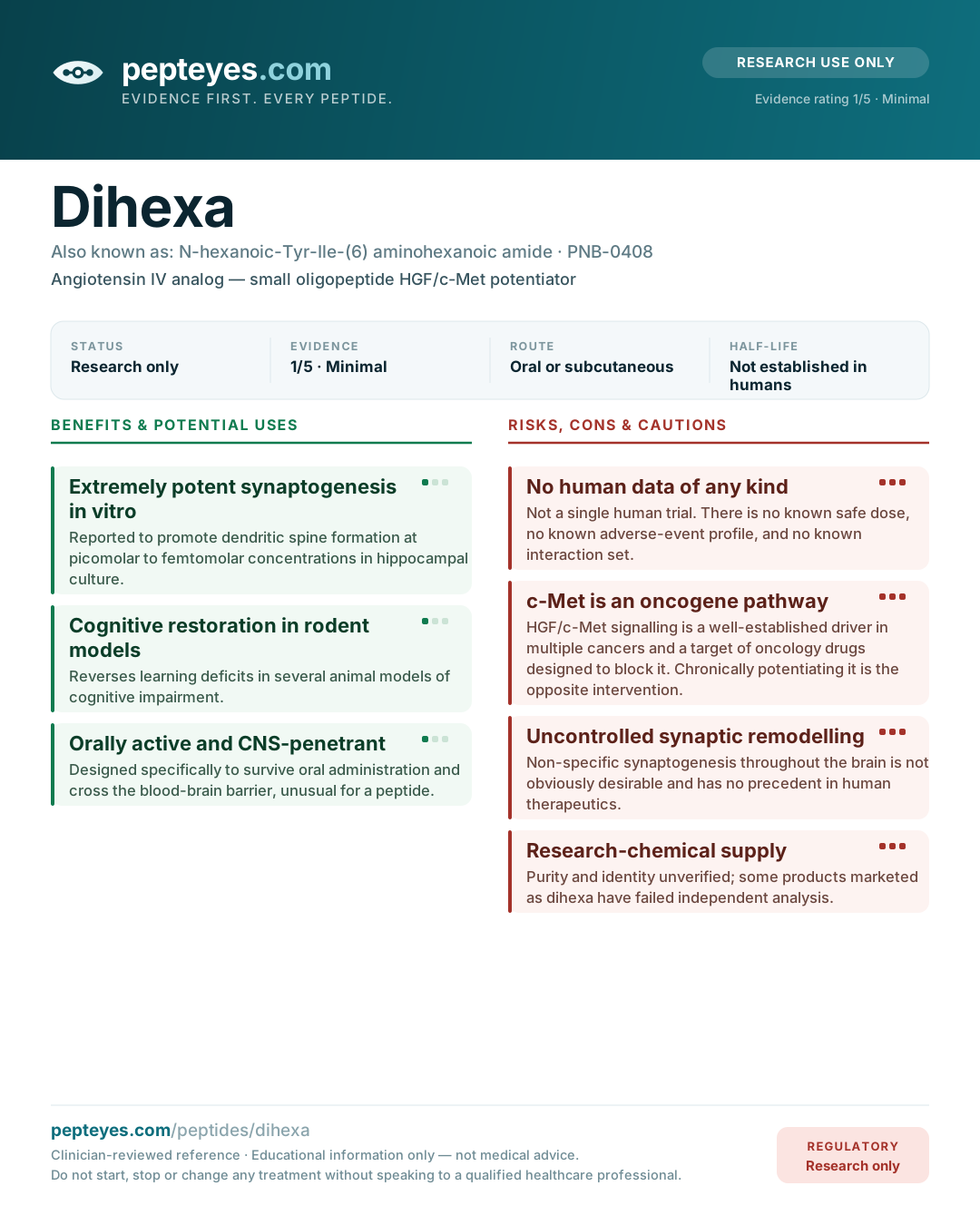
Extremely potent synaptogenesis in vitro
Reported to promote dendritic spine formation at picomolar to femtomolar concentrations in hippocampal culture.
Evidence: Preliminary -
Cognitive restoration in rodent models
Reverses learning deficits in several animal models of cognitive impairment.
Evidence: Preliminary -
Orally active and CNS-penetrant
Designed specifically to survive oral administration and cross the blood-brain barrier, unusual for a peptide.
Evidence: Preliminary
Risks and cautions
5 entries · 5 serious or common
-
No human data of any kind
Not a single human trial. There is no known safe dose, no known adverse-event profile, and no known interaction set.
Evidence: Serious -
c-Met is an oncogene pathway
HGF/c-Met signalling is a well-established driver in multiple cancers and a target of oncology drugs designed to block it. Chronically potentiating it is the opposite intervention.
Evidence: Serious -
Uncontrolled synaptic remodelling
Non-specific synaptogenesis throughout the brain is not obviously desirable and has no precedent in human therapeutics.
Evidence: Serious -
Retracted foundational papers
Two of the core dihexa papers from the originating laboratory were retracted in 2025 for data falsification, so the mechanism and cognition claims rest on a compromised evidence base.
Evidence: Serious -
Research-chemical supply
Purity and identity unverified; some products marketed as dihexa have failed independent analysis.
Evidence: Serious
Counts are not a score. A single serious risk can outweigh several well-supported benefits, and a long benefit list built on preclinical work outweighs nothing at all.
Opinion — what people actually report
4 themes · 1 reported benefit · 2 reported problems
This is the weakest tier on this site. These are themes drawn from public discussion — forums, subreddits and patient threads — not from trials. There is no control group, no denominator, and no way to confirm that what someone injected matched its label. People post when a result is dramatic and when something goes wrong, and rarely when nothing happens, so treat everything below as a description of the conversation rather than of the compound. The bars count how often a thing is said, not how well it is supported.
-
Strong subjective cognitive reports from a few people Reported benefit. Recurring: Raised regularly, though not by everyone.
The accounts that exist are unusually enthusiastic, describing marked changes in memory and verbal fluency.
-
Serious unease about uncontrolled synaptogenesis Reported problem. Dominant theme: Comes up in most discussions of this compound.
The most-raised concern, and it is raised by proponents as often as by critics — a compound promoting new synapse formation with no human data is widely treated as genuinely risky.
-
Almost no human data and few users Reported problem. Dominant theme: Comes up in most discussions of this compound.
Non-trivial numbers of people research it and decide against it, which is unusual in nootropic communities.
-
Solubility and dosing are improvised Practical note. Recurring: Raised regularly, though not by everyone.
Practical handling advice varies wildly, reflecting that nobody has established anything.
Where the reports and the evidence part ways
The preclinical work is real and the potency claims relative to BDNF come from published rodent studies. There has never been a human trial. The community's own concern is the right one and deserves stating plainly: a compound whose proposed mechanism is promoting new synaptic connections, taken by healthy people with no dose-finding, no toxicology and no monitoring, is not a low-stakes experiment. The enthusiastic individual reports are exactly the kind of uncontrolled subjective account that is least reliable and most persuasive.
Cheat sheet
The full sheet, all 77 compounds →The community reference numbers for this compound — reconstitution, working dose, cycle and bloodwork. Research and education only, not medical advice, and not part of the evidence-rated monograph above. Doses assume a 1mL / 100-unit insulin syringe — the calculator does the units for you.
Protocol overview
No injection schedule — this compound is dosed orally or topically.
On the master sheet
- Vial
- N/A
- BAC
- N/A
- Dose
- Oral 10–30mg / topical 3–5mg daily
- Route
- Oral/topical
- Cycle
- 2–6 wks
- Time Off
- 2–4 wks
Readers on Dihexa
Questions and answers from readers, under generated names. Nothing here has been checked or reviewed by the site and none of it is medical advice. It is the least verified thing on this page — and it is here because people ask each other these things anyway, and most of the other places they can ask are run by sellers.
0 questions · 0 answers
No questions yet. Ask the first one above — it takes one box and an email address.
How names work, and the house rules
Names. Every verified address is given one generated name — two ordinary words — and keeps it. Nobody chooses a name and nobody can take another's. Posts marked desk were written by the site's own editorial desk, usually to open a thread; they carry a generated name like everyone else's and are held to the site's rules, which means they never state an amount.
What is not allowed. Selling, sourcing, vendor names, coupon codes and "message me" — posts that read that way are held and usually removed. Personal medical details you would not want public. Abuse. Instructions framed as what someone else should do.
What this is not. A reader's report of what happened to them is a report, not a finding, and an answer here is one person's view. Nothing in this section changes the evidence rating above it. If something you read here would change what you take, take it to a pharmacist or physician first.
Your data. Delete any post of yours at any time, or remove everything you have written together with your name. Details in the privacy notice.
Who should avoid it
- All human use outside a formal clinical trial
If used under medical supervision, monitor
- Not applicable
Commonly confused with
These mix-ups cause real harm — two products sold under one name, or two molecules whose effects run in opposite directions.
Both neuroactive peptides marketed on synaptic mechanisms. Davunetide actually ran a properly powered phase 3 trial and failed. Dihexa has never been given to a human in a published study.
Compare side by sideRegulatory & legal status
Not approved anywhere. Sold under research-use-only labelling.
Off Category 2 since April 2026 with no committee vote yet: neither prohibited as a significant safety risk nor authorised for compounding.
- Removed from Category 2
- 22 April 2026
- Approved as a drug?
- No. Compounding status and drug approval are separate questions; this compound has no approval for the uses it is sold for.
The full dated record, with sources, and every affected peptide →
Infographic
Where to read further
We link to live literature searches rather than a frozen citation list, so you always see current results — including anything published after our last review.
- PubMed — all published literature on Dihexa
- PubMed — randomized controlled trials only
- ClinicalTrials.gov — registered human trials
Related peptides in Cognitive & Neurological
Terms used on this page
- Potency vs Efficacy
- Potency is the concentration a drug needs to produce a given effect, while efficacy is the largest effect it can produce at any concentration; the two are independent properties.
- Brain-Derived Neurotrophic Factor (BDNF)
- BDNF is a neurotrophin that signals through the TrkB receptor to support neuronal survival, dendritic growth and the late, protein-synthesis-dependent phase of synaptic potentiation.
- Blood-Brain Barrier (BBB)
- The blood-brain barrier is the tight-junctioned endothelial lining of brain capillaries whose seals and efflux pumps exclude nearly all peptides from brain tissue.
- Synaptogenesis
- Synaptogenesis is the formation of new synaptic connections between neurons, requiring coordinated assembly of a presynaptic release site and a matching postsynaptic density.
- Preclinical Study and Animal Model
- Preclinical studies are the laboratory, cell and animal experiments done before any human exposure, establishing mechanism, target engagement and the toxicology package that permits a first trial.
- Oral Peptide Delivery
- Oral peptide delivery is the formulation of a peptide into a swallowed dosage form, a route that fights gastric acid, gut proteases and an epithelium built to exclude large molecules.
This page is educational information, not medical advice. It cannot account for your medical history, medications, or risk factors. Do not start, stop or change any treatment based on it. Speak to a qualified healthcare professional who knows your case.