Supplied as a lyophilised powder to reconstitute
Longevity & Mitochondrial
At a glance
Ten answers, each one line. Open any row for the detail behind it.
What it does The flagship "longevity peptide", built on decades of work by a single Russian research…
The flagship "longevity peptide", built on decades of work by a single Russian research group reporting telomerase activation and reduced mortality. The claims are extraordinary; the independent replication is absent.
Half-life Never measured. No pharmacokinetic study of Epitalon has been… — Documented
Never measured. No pharmacokinetic study of Epitalon has been published in any species; reviews only note that short peptides like it degrade fast in vivo.
Typical studied dose None established. No dose has ever been set for a human being, because… — Nothing established
None established. No dose has ever been set for a human being, because the studies that would set one have not been done. Any figure circulating for this compound was chosen by somebody selling it or by somebody guessing.
How often it is used No schedule exists. Cycles and intervals quoted for this compound come… — Nothing established
No schedule exists. Cycles and intervals quoted for this compound come from forums rather than from any study, and they vary because nothing anchors them.
How it is taken Subcutaneous or intranasal (research) — Documented
Subcutaneous or intranasal (research)
Main side effects No independent replication · Telomerase activation and cancer · No Western trials — Carries serious risk
No independent replication — Nearly all supporting work traces to one research group. Extraordinary claims with a single source are not established findings.
Telomerase activation and cancer — Telomerase reactivation is a hallmark of most cancers. A drug designed to switch it on systemically has an obvious and unstudied oncologic concern.
No Western trials — No FDA or EMA review; no registered trials with contemporary methodology.
Storage before mixing As a sealed lyophilised powder, refrigerated is typical and a freezer…
As a sealed lyophilised powder, refrigerated is typical and a freezer suits long storage; both should be dark and dry. A dry powder tolerates a few days out of the cold far better than anything in solution — which is why it ships that way.
Shelf life after mixing Once mixed it is refrigerated and treated as short-lived. Bacteriostatic…
Once mixed it is refrigerated and treated as short-lived. Bacteriostatic water contains a preservative and buys the longer window; sterile water contains none and buys a much shorter one. Peptides in solution also degrade on their own, so the container is only half the question.
Evidence level 2/5 · Limited — Nothing established
Preclinical work plus scattered human reports, uncontrolled use, or negative trials.
Regulatory status Research Use Only — Nothing established
Not approved in the US, EU or UK. Used in Russian gerontology practice. Widely sold as an anti-aging research peptide. Not approved for human use in the US, EU or UK.
Overview
The flagship "longevity peptide", built on decades of work by a single Russian research group reporting telomerase activation and reduced mortality. The claims are extraordinary; the independent replication is absent.
Not approved for human use anywhereNo approval anywhere for human use. Sold under research-use labelling. Not approved for human use in the US, EU or UK.
| Regulatory status | Not approved in the US, EU or UK. Used in Russian gerontology practice. Widely sold as an anti-aging research peptide. |
|---|---|
| Drug class | Synthetic tetrapeptide modelled on the pineal extract epithalamin |
| Route | Subcutaneous or intranasal (research) |
| Half-life | Never measured. No pharmacokinetic study of Epitalon has been published in any species; reviews only note that short peptides like it degrade fast in vivo. |
| Evidence rating |
2/5 Limited
Evidence rating 2 out of 5: Limited
Preclinical work plus scattered human reports, uncontrolled use, or negative trials. |
| Studied in | Russian studies in elderly cohorts reporting reduced mortality over multi-year follow-up; cell culture telomerase work; rodent lifespan studies. |
Epitalon sequence & structure
Epitalon is a 4-residue linear peptide with a free C-terminal acid; molecular weight 390.35 Da.
Unmodified all-L linear tetrapeptide with free amine and free acid termini (UNII O65P17785G, InChIKey HGHOBRRUMWJWCU-FXQIFTODSA-N, MeSH C421253, DSSTox DTXSID80952957); PubChem also cross-references older CAS numbers 64082-79-7 and 35561-07-0 for the same sequence, but 307297-39-8 is the primary CAS in GSRS. Research vendors commonly sell it as the TFA or acetate salt, so vendor-quoted weights may differ from the 390.35 Da free base; a DrugBank entry DB17882 is cited by Wikidata but DrugBank could not be opened for verification, so it is left null.
Record confidence: high — two independent authoritative sources agree on the sequence and modifications. Every sequence on the site is listed with its sources on the peptide sequences index.
How it works
Proposed to induce telomerase reverse transcriptase expression, lengthening telomeres in cultured cells, and to normalise pineal melatonin rhythm and neuroendocrine function. Some work suggests direct interaction with promoter regions of specific genes.
Evidence base
Rated 2 of 5 — Limited. Preclinical work plus scattered human reports, uncontrolled use, or negative trials.
- Single-group evidence base with high-stakes unreplicated claims.
Benefits and risks, weighed against the evidence
Every entry below carries the strength of the evidence behind it — three bars for strong human data, two for moderate, one for preliminary or preclinical work. The two columns are not equal by design: where a compound has more documented risk than demonstrated benefit, the lists say so.
Reported benefits
4 entries
-
Telomerase activation in cell culture
Reported induction of telomerase and telomere elongation in human somatic cell cultures — the core scientific claim.
Evidence: Preliminary -
Melatonin rhythm normalisation
Studies report restored nocturnal melatonin secretion in older subjects, with corresponding sleep improvements.
Evidence: Preliminary -
Reduced mortality in Russian cohort studies
Long-term follow-up studies reported lower mortality in treated elderly groups. Methodology and independence are significant caveats.
Evidence: Preliminary -
Antioxidant effects in animal models
Reduced lipid peroxidation and improved antioxidant enzyme activity in rodents.
Evidence: Preliminary
Risks and cautions
5 entries · 4 serious or common
-
No independent replication
Nearly all supporting work traces to one research group. Extraordinary claims with a single source are not established findings.
Evidence: Serious -
Telomerase activation and cancer
Telomerase reactivation is a hallmark of most cancers. A drug designed to switch it on systemically has an obvious and unstudied oncologic concern.
Evidence: Serious -
No Western trials
No FDA or EMA review; no registered trials with contemporary methodology.
Evidence: Serious -
Unregulated supply
Sold as a research chemical with no purity assurance.
Evidence: Serious -
No established safe dosing
Protocols circulating online have no clinical validation.
Evidence: Moderate evidence
Counts are not a score. A single serious risk can outweigh several well-supported benefits, and a long benefit list built on preclinical work outweighs nothing at all.
Opinion — what people actually report
5 themes · 2 reported benefits · 1 reported problem
This is the weakest tier on this site. These are themes drawn from public discussion — forums, subreddits and patient threads — not from trials. There is no control group, no denominator, and no way to confirm that what someone injected matched its label. People post when a result is dramatic and when something goes wrong, and rarely when nothing happens, so treat everything below as a description of the conversation rather than of the compound. The bars count how often a thing is said, not how well it is supported.
-
Sleep is the only concrete effect most people name Reported benefit. Dominant theme: Comes up in most discussions of this compound.
Almost every account that reports something specific reports better sleep. Everything else is described in general terms.
-
Used on faith, and people say so Practical note. Dominant theme: Comes up in most discussions of this compound.
The defining feature of this discussion: the claimed benefit is telomere length, which nobody can feel, so most posters acknowledge they have no way to know whether it is working.
-
The telomerase claims are widely challenged Reported problem. Recurring: Raised regularly, though not by everyone.
A strong sceptical strand points out that the evidence is old Russian work and that telomere lengthening would be as plausible a cancer risk as a longevity benefit.
-
Short annual courses are convention Practical note. Recurring: Raised regularly, though not by everyone.
Ten-to-twenty-day courses once or twice a year are near-universal, and trace to the original Russian protocols rather than to any dose-finding study.
-
Vague reports of energy or wellbeing Reported benefit. Occasional: Reported by a minority, or in specific contexts.
Non-specific and acknowledged as such by most who report them.
Where the reports and the evidence part ways
The claims here rest almost entirely on work from one St Petersburg research group, published over decades largely in Russian, reporting mortality and telomere effects that no independent laboratory has reproduced. That is the weakest evidentiary position in this library — not merely untested, but tested only by the parties who developed it. The sceptics in the community are right about the direction of the concern, too: telomerase activation is a recognised feature of cancer biology, so if the compound did what is claimed, the safety implication would need answering rather than assuming. The sleep reports are the one thing here that people can actually observe, and they have no controlled evidence either.
Cheat sheet
The full sheet, all 77 compounds →The community reference numbers for this compound — reconstitution, working dose, cycle and bloodwork. Research and education only, not medical advice, and not part of the evidence-rated monograph above. Doses assume a 1mL / 100-unit insulin syringe — the calculator does the units for you.
Protocol overview
Dosing & reconstitution 10 mg vial
| PHASE | DAILY DOSE | UNITS PER INJECTION |
|---|---|---|
| Days 1 to 20 (Cycle On) | 5,000 mcg (5 mg) | 50 units (0.50 mL) |
| Weeks 4 to 26 (Cycle Off) | 0 mcg |
Frequency: Inject once daily subcutaneously, preferably in the evening or at bedtime to synergize with natural melatonin rhythms. Complete 20 consecutive days, then observe a 4 to 6 month off-cycle before repeating (typically 2 cycles per year). Alternative: 10 mg/day for 10 days (same total cycle dose of 100 mg).
On the master sheet
- Vial
- 10mg
- BAC
- 2mL
- Dose
- 5–10mg daily x10 days
- Route
- SubQ
- Cycle
- 1–2x/year
- Time Off
- 3–6 mo
- Bloodwork
- Optional telomere
Storage note: Very stable. Freeze dry between annual cycles. Full storage guide →
Readers on Epitalon
Questions and answers from readers, under generated names. Nothing here has been checked or reviewed by the site and none of it is medical advice. It is the least verified thing on this page — and it is here because people ask each other these things anyway, and most of the other places they can ask are run by sellers.
0 questions · 0 answers
No questions yet. Ask the first one above — it takes one box and an email address.
How names work, and the house rules
Names. Every verified address is given one generated name — two ordinary words — and keeps it. Nobody chooses a name and nobody can take another's. Posts marked desk were written by the site's own editorial desk, usually to open a thread; they carry a generated name like everyone else's and are held to the site's rules, which means they never state an amount.
What is not allowed. Selling, sourcing, vendor names, coupon codes and "message me" — posts that read that way are held and usually removed. Personal medical details you would not want public. Abuse. Instructions framed as what someone else should do.
What this is not. A reader's report of what happened to them is a report, not a finding, and an answer here is one person's view. Nothing in this section changes the evidence rating above it. If something you read here would change what you take, take it to a pharmacist or physician first.
Your data. Delete any post of yours at any time, or remove everything you have written together with your name. Details in the privacy notice.
Who should avoid it
- Any cancer history or active malignancy
- Pregnancy
- Anyone unwilling to accept entirely unquantified long-term risk
If used under medical supervision, monitor
- No validated monitoring; age-appropriate cancer screening is prudent for anyone considering it
Commonly confused with
These mix-ups cause real harm — two products sold under one name, or two molecules whose effects run in opposite directions.
Both come from the same Russian gerontology research tradition and are sold together as an anti-aging pair. Neither has independent replication outside that tradition.
Compare side by sideStudied side by side in the same chromatin and enkephalinase papers and sold as a pair. Epitalon is AEDG and pitched at the pineal gland and telomeres; Livagen is KEDA and pitched at the liver. In a hepatocyte assay Epitalon did nothing, and neither inherits the other's evidence.
Compare side by sideRegulatory & legal status
Not approved for human use in the US, EU or UK.
Off Category 2 since April 2026 and recommended by the FDA’s advisory committee in July 2026 — but not yet on the 503A bulks list, so not yet lawfully compoundable.
- Removed from Category 2
- 22 April 2026
- Advisory committee vote
- 7–5, one abstention on 23–24 July 2026, considered for insomnia
- Approved as a drug?
- No. Compounding status and drug approval are separate questions; this compound has no approval for the uses it is sold for.
The full dated record, with sources, and every affected peptide →
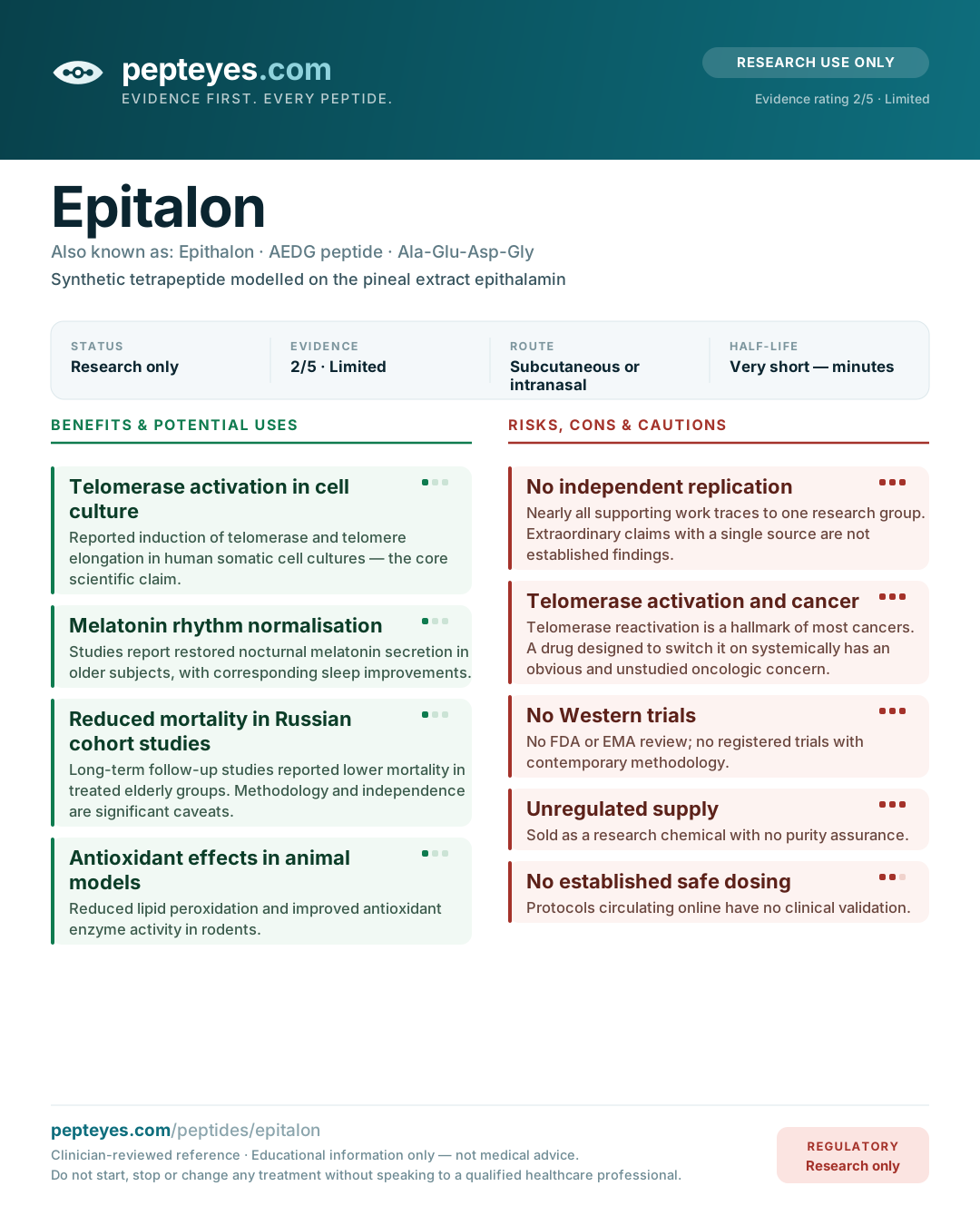
Infographic
Where to read further
We link to live literature searches rather than a frozen citation list, so you always see current results — including anything published after our last review.
- PubMed — all published literature on Epitalon
- PubMed — randomized controlled trials only
- ClinicalTrials.gov — registered human trials
Related peptides in Longevity & Mitochondrial
Terms used on this page
- Reproducibility and Replication
- Reproducibility is obtaining the same result from the same data and analysis, while replication is obtaining a consistent result from new data, and only the second shows the finding is real.
- Research Chemical Market
- The research chemical market is the trade in compounds sold as laboratory reagents under research-use disclaimers, in practice supplying individuals with substances that have no approved human use.
This page is educational information, not medical advice. It cannot account for your medical history, medications, or risk factors. Do not start, stop or change any treatment based on it. Speak to a qualified healthcare professional who knows your case.