Supplied as a lyophilised powder to reconstitute
Longevity & Mitochondrial
At a glance
Ten answers, each one line. Open any row for the detail behind it.
What it does A designed senolytic that kills senescent cells by disrupting the protein interaction…
A designed senolytic that kills senescent cells by disrupting the protein interaction keeping them alive. The mouse results — restored fur density, improved renal function, recovered fitness in aged animals — are among the most visually striking in aging research. There is no human data.
Half-life Never measured. No half-life has been published for FOXO4-DRI… — Documented
Never measured. No half-life has been published for FOXO4-DRI in any species; the retro-inverso D-peptide design resists proteases but no figure exists.
Typical studied dose None established. No dose has ever been set for a human being, because… — Nothing established
None established. No dose has ever been set for a human being, because the studies that would set one have not been done. Any figure circulating for this compound was chosen by somebody selling it or by somebody guessing.
How often it is used No schedule exists. Cycles and intervals quoted for this compound come… — Nothing established
No schedule exists. Cycles and intervals quoted for this compound come from forums rather than from any study, and they vary because nothing anchors them.
How it is taken Intravenous or intraperitoneal (research) — Documented
Intravenous or intraperitoneal (research)
Main side effects No human data at all · p53 activation is a blunt instrument · Senescent cells have useful functions — Carries serious risk
No human data at all — Not one human has been dosed in a published trial. Nothing is known about human safety.
p53 activation is a blunt instrument — Releasing p53 broadly can trigger apoptosis in stressed but healthy cells; the selectivity margin in humans is unknown.
Senescent cells have useful functions — They participate in wound healing and tumour suppression; indiscriminate clearance is not automatically beneficial.
Storage before mixing As a sealed lyophilised powder, refrigerated is typical and a freezer…
As a sealed lyophilised powder, refrigerated is typical and a freezer suits long storage; both should be dark and dry. A dry powder tolerates a few days out of the cold far better than anything in solution — which is why it ships that way.
Shelf life after mixing Once mixed it is refrigerated and treated as short-lived. Bacteriostatic…
Once mixed it is refrigerated and treated as short-lived. Bacteriostatic water contains a preservative and buys the longer window; sterile water contains none and buys a much shorter one. Peptides in solution also degrade on their own, so the container is only half the question.
Evidence level 1/5 · Minimal — Nothing established
Animal or laboratory data only. No human efficacy evidence.
Regulatory status Research Use Only — Nothing established
Preclinical senolytic research compound. No human trials. Not approved. Not approved anywhere.
Overview
A designed senolytic that kills senescent cells by disrupting the protein interaction keeping them alive. The mouse results — restored fur density, improved renal function, recovered fitness in aged animals — are among the most visually striking in aging research. There is no human data.
Not approved for human use anywhereNo approval anywhere for human use. Sold under research-use labelling. Not approved anywhere.
| Regulatory status | Preclinical senolytic research compound. No human trials. Not approved. |
|---|---|
| Drug class | Retro-inverso D-amino acid peptide targeting the FOXO4-p53 interaction |
| Route | Intravenous or intraperitoneal (research) |
| Half-life | Never measured. No half-life has been published for FOXO4-DRI in any species; the retro-inverso D-peptide design resists proteases but no figure exists. |
| Evidence rating |
1/5 Minimal
Evidence rating 1 out of 5: Minimal
Animal or laboratory data only. No human efficacy evidence. |
| Studied in | Mouse studies in naturally aged, fast-aging (Xpd) and chemotherapy-treated animals. No human studies. |
FOXO4-DRI sequence & structure
FOXO4-DRI is a 46-residue linear peptide with a free C-terminal acid, carrying D-amino acid substitutions; molecular weight 5,358.05 Da.
lowercase = D-amino acid
| Three-letter | H-D-Leu-D-Thr-D-Leu-D-Arg-D-Lys-D-Glu-D-Pro-D-Ala-D-Ser-D-Glu-D-Ile-D-Ala-D-Gln-D-Ser-D-Ile-D-Leu-D-Glu-D-Ala-D-Tyr-D-Ser-D-Gln-D-Asn-Gly-D-Trp-D-Ala-D-Asn-D-Arg-D-Arg-D-Ser-Gly-Gly-D-Lys-D-Arg-D-Pro-D-Pro-D-Pro-D-Arg-D-Arg-D-Arg-D-Gln-D-Arg-D-Arg-D-Lys-D-Lys-D-Arg-Gly-OH |
|---|---|
| Length | 46 amino acid residues |
| Modifications |
|
| Molecular formula | C228H388N86O64 |
| Molecular weight | 5,358.05 Da (average, free base) |
| Identifiers | CAS 2460055-10-9 · PubChem CID 167312269 · UniProt P98177 |
| Which molecule | This record describes the 46-residue all-D free base used in the senolytic literature, not the all-L FOXO4 p53-interfering peptide. It also differs from the salt entries catalogued alongside it: PubChem gives the acetate as CID 167312268 (C250H432N86O86, ~6019 Da, i.e. 11 acetates) and titles CID 167312269 itself 'FOXO4-DRI TFA salt form' even though the structure and formula deposited there are the free base. Ignore the unrelated record CID 72233564, also titled 'FOXO4-DRI acetate', which is a different, much smaller compound (C36H64N14O14S, 949 Da). |
| Sources | PubChem CID 167312269 (PUG REST) - formula, MW, CAS synonym, and the full all-D IUPAC stereo-name from which every residue was read backUniProt P98177 (FOXO4_HUMAN) FASTA - parent segment located at residues 92-124; Forkhead DNA-binding domain annotated 100-188Wu et al., Commun Biol 2025 (PMC11850796) - methods give the D-isoform sequence verbatim and MW 5358.05Nat Commun 2025 (PMC12216184), 'The disordered p53 transactivation domain is the target of FOXO4 and the senolytic compound FOXO4-DRI' - independent confirmation of the D-retro-inverso design and that the parent segment is the N-terminal disordered region plus helix 1 of the FOXO4 FH domain fused to HIV-TATNovoPro Labs, FOXO4 D-Retro-Inverso peptide cat. 318716 - vendor cross-check of sequence, length, formula, MW and CAS |
Sequence verified three ways: read residue-by-residue off PubChem's all-D IUPAC name (42 alpha-carbons all R, 4 achiral Gly), matched to the exact reverse of UniProt P98177 residues 92-124 fused to TAT(48-57)+PPP, and matched to the string published in the Commun Biol 2025 methods; the composition-derived formula reproduces PubChem's C228H388N86O64 exactly. MW 5358.05 is the figure quoted by the paper and the catalogue; recomputing from the formula with current IUPAC atomic weights gives 5358.15, so treat anything in that range as the same free base. Vendors ship acetate (~6019 Da) or TFA salt, so gravimetric dosing from a vial understates peptide content - the net peptide content on the CoA matters. Research-grade only: no INN, no DrugBank entry and no human trials; the original mouse work is Baar et al., Cell 2017;169(1):132-147.e16 (PMID 28340339).
Record confidence: high — two independent authoritative sources agree on the sequence and modifications. Every sequence on the site is listed with its sources on the peptide sequences index.
How it works
Senescent cells sequester p53 in the nucleus via FOXO4 to avoid apoptosis. This retro-inverso peptide competitively disrupts that interaction, releasing p53 and triggering apoptosis selectively in senescent cells while sparing healthy ones.
Evidence base
Rated 1 of 5 — Minimal. Animal or laboratory data only. No human efficacy evidence.
- Landmark mouse study; no clinical translation.
Benefits and risks, weighed against the evidence
Every entry below carries the strength of the evidence behind it — three bars for strong human data, two for moderate, one for preliminary or preclinical work. The two columns are not equal by design: where a compound has more documented risk than demonstrated benefit, the lists say so.
Reported benefits
3 entries
-
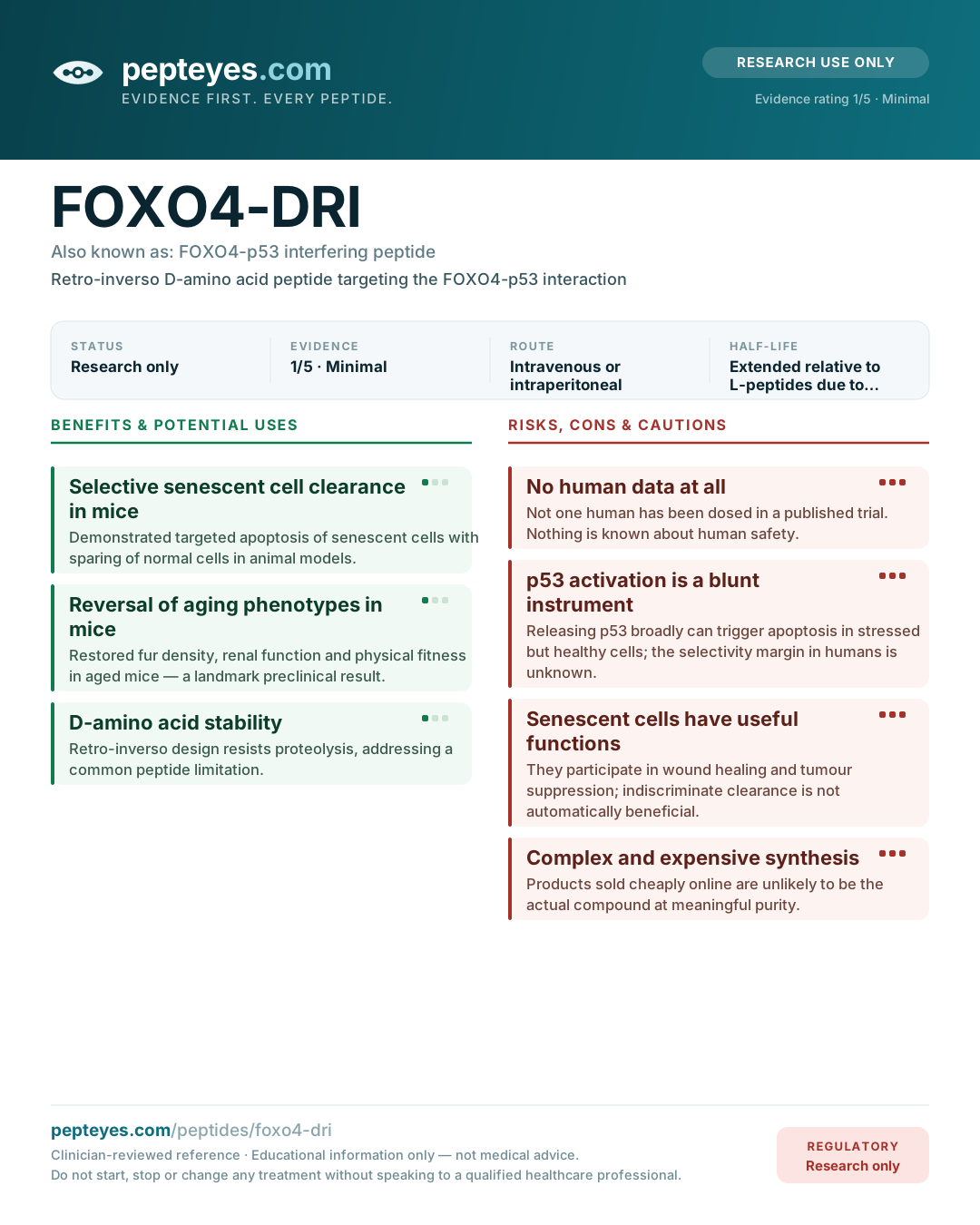
Selective senescent cell clearance in mice
Demonstrated targeted apoptosis of senescent cells with sparing of normal cells in animal models.
Evidence: Preliminary -
Reversal of aging phenotypes in mice
Restored fur density, renal function and physical fitness in aged mice — a landmark preclinical result.
Evidence: Preliminary -
D-amino acid stability
Retro-inverso design resists proteolysis, addressing a common peptide limitation.
Evidence: Preliminary
Risks and cautions
4 entries · 4 serious or common
-
No human data at all
Not one human has been dosed in a published trial. Nothing is known about human safety.
Evidence: Serious -
p53 activation is a blunt instrument
Releasing p53 broadly can trigger apoptosis in stressed but healthy cells; the selectivity margin in humans is unknown.
Evidence: Serious -
Senescent cells have useful functions
They participate in wound healing and tumour suppression; indiscriminate clearance is not automatically beneficial.
Evidence: Serious -
Complex and expensive synthesis
Products sold cheaply online are unlikely to be the actual compound at meaningful purity.
Evidence: Serious
Counts are not a score. A single serious risk can outweigh several well-supported benefits, and a long benefit list built on preclinical work outweighs nothing at all.
Opinion — what people actually report
4 themes · 1 reported benefit · 2 reported problems
This is the weakest tier on this site. These are themes drawn from public discussion — forums, subreddits and patient threads — not from trials. There is no control group, no denominator, and no way to confirm that what someone injected matched its label. People post when a result is dramatic and when something goes wrong, and rarely when nothing happens, so treat everything below as a description of the conversation rather than of the compound. The bars count how often a thing is said, not how well it is supported.
-
The mouse photographs drive everything Practical note. Dominant theme: Comes up in most discussions of this compound.
Interest traces almost entirely to one 2017 study and its widely circulated images of restored fur in aged mice.
-
Extremely few people report using it Reported problem. Dominant theme: Comes up in most discussions of this compound.
Cost, difficulty of synthesis and genuine unease keep this near-theoretical. Most threads are discussion rather than experience.
-
Serious safety concern about killing senescent cells indiscriminately Reported problem. Recurring: Raised regularly, though not by everyone.
Better-informed posters raise that senescent cells have physiological roles in wound healing and tumour suppression, and that removing them is not self-evidently good.
-
Isolated anecdotes of energy or skin changes Reported benefit. Occasional: Reported by a minority, or in specific contexts.
Very few, uncontrolled, and treated sceptically in the threads themselves.
Where the reports and the evidence part ways
The 2017 mouse work is real and was genuinely striking, but it is one study in one species, and there has been no human trial of FOXO4-DRI for anything. The senolytic field as a whole is early — the human trials that exist involve other agents, mostly dasatinib with quercetin, in small numbers. Community caution here is appropriate and the safety concern raised is the right one: senescent cell clearance is a plausible therapeutic strategy and also a plausible way to impair wound healing and tumour suppression, and nobody has established which happens in people.
Cheat sheet
The full sheet, all 77 compounds →The community reference numbers for this compound — reconstitution, working dose, cycle and bloodwork. Research and education only, not medical advice, and not part of the evidence-rated monograph above. Doses assume a 1mL / 100-unit insulin syringe — the calculator does the units for you.
Protocol overview
Dosing & reconstitution 10 mg vial
| WEEK | DAILY DOSE | UNITS PER INJECTION |
|---|---|---|
| Weeks 1 to 4 | 250 mcg | 2.5 units (0.02 mL) |
| Weeks 5 to 8 | 375 mcg | 3.7 units (0.04 mL) |
| Weeks 9 to 12 | 500 mcg | 5 units (0.05 mL) |
| Weeks 13 to 16 | 500 mcg | 5 units (0.05 mL) |
Frequency: Inject once daily subcutaneously. For 10 unit (0.10 mL) or smaller administrations, consider 30- or
On the master sheet
- Vial
- 10mg
- BAC
- 3mL
- Dose
- 250–500mcg daily (titrate)
- Route
- SubQ
- Cycle
- 8–16 wks
- Notes
- Senolytic, preclinical only
Readers on FOXO4-DRI
Questions and answers from readers, under generated names. Nothing here has been checked or reviewed by the site and none of it is medical advice. It is the least verified thing on this page — and it is here because people ask each other these things anyway, and most of the other places they can ask are run by sellers.
0 questions · 0 answers
No questions yet. Ask the first one above — it takes one box and an email address.
How names work, and the house rules
Names. Every verified address is given one generated name — two ordinary words — and keeps it. Nobody chooses a name and nobody can take another's. Posts marked desk were written by the site's own editorial desk, usually to open a thread; they carry a generated name like everyone else's and are held to the site's rules, which means they never state an amount.
What is not allowed. Selling, sourcing, vendor names, coupon codes and "message me" — posts that read that way are held and usually removed. Personal medical details you would not want public. Abuse. Instructions framed as what someone else should do.
What this is not. A reader's report of what happened to them is a report, not a finding, and an answer here is one person's view. Nothing in this section changes the evidence rating above it. If something you read here would change what you take, take it to a pharmacist or physician first.
Your data. Delete any post of yours at any time, or remove everything you have written together with your name. Details in the privacy notice.
Who should avoid it
- All human use outside a formal clinical trial
If used under medical supervision, monitor
- Not applicable
Regulatory & legal status
Not approved anywhere.
Infographic
Where to read further
We link to live literature searches rather than a frozen citation list, so you always see current results — including anything published after our last review.
- PubMed — all published literature on FOXO4-DRI
- PubMed — randomized controlled trials only
- ClinicalTrials.gov — registered human trials
Related peptides in Longevity & Mitochondrial
Terms used on this page
- Retro-Inverso Peptide
- A retro-inverso peptide reverses the parent's sequence and builds it from D-amino acids, keeping the side chains in roughly the same places while making the backbone invisible to proteases.
- Preclinical Study and Animal Model
- Preclinical studies are the laboratory, cell and animal experiments done before any human exposure, establishing mechanism, target engagement and the toxicology package that permits a first trial.
- Enzymatic Degradation
- Enzymatic degradation is the breakdown of a peptide by proteases and peptidases in gut, blood, tissue and kidney, and it is the main reason unmodified peptides act only briefly.
- Receptor Selectivity
- Receptor selectivity is the degree to which a ligand acts on its intended receptor rather than related ones, expressed as the ratio between its potency at the target and at each off-target.
This page is educational information, not medical advice. It cannot account for your medical history, medications, or risk factors. Do not start, stop or change any treatment based on it. Speak to a qualified healthcare professional who knows your case.