Supplied as a lyophilised powder to reconstitute
Longevity & Mitochondrial
At a glance
Ten answers, each one line. Open any row for the detail behind it.
What it does Discovered in surviving neurons of Alzheimer brains, which is a striking origin story.
Discovered in surviving neurons of Alzheimer brains, which is a striking origin story. It is cytoprotective in a wide range of stress models, and plasma levels decline with age. None of that has yet been tested as a treatment in humans.
Half-life Not characterised in humans; rodent data only, where the HNG… — Nothing established
Not characterised in humans; rodent data only, where the HNG analogue clears faster in mice than in rats.
Typical studied dose None established. No dose has ever been set for a human being, because… — Nothing established
None established. No dose has ever been set for a human being, because the studies that would set one have not been done. Any figure circulating for this compound was chosen by somebody selling it or by somebody guessing.
How often it is used No schedule exists. Cycles and intervals quoted for this compound come… — Nothing established
No schedule exists. Cycles and intervals quoted for this compound come from forums rather than from any study, and they vary because nothing anchors them.
How it is taken Subcutaneous or intracerebroventricular (research) — Documented
Subcutaneous or intracerebroventricular (research)
Main side effects No human trials · Anti-apoptotic effects are double-edged · Unregulated supply — Carries serious risk
No human trials — No interventional human data exists.
Anti-apoptotic effects are double-edged — Blocking programmed cell death systemically is exactly the mechanism by which damaged and pre-cancerous cells survive.
Unregulated supply — Research-chemical market.
Storage before mixing As a sealed lyophilised powder, refrigerated is typical and a freezer…
As a sealed lyophilised powder, refrigerated is typical and a freezer suits long storage; both should be dark and dry. A dry powder tolerates a few days out of the cold far better than anything in solution — which is why it ships that way.
Shelf life after mixing Once mixed it is refrigerated and treated as short-lived. Bacteriostatic…
Once mixed it is refrigerated and treated as short-lived. Bacteriostatic water contains a preservative and buys the longer window; sterile water contains none and buys a much shorter one. Peptides in solution also degrade on their own, so the container is only half the question.
Evidence level 1/5 · Minimal — Nothing established
Animal or laboratory data only. No human efficacy evidence.
Regulatory status Research Use Only — Nothing established
Not approved. Preclinical neuroprotection and metabolic research compound. Not approved for human use.
Overview
Discovered in surviving neurons of Alzheimer brains, which is a striking origin story. It is cytoprotective in a wide range of stress models, and plasma levels decline with age. None of that has yet been tested as a treatment in humans.
Not approved for human use anywhereNo approval anywhere for human use. Sold under research-use labelling. Not approved for human use.
| Regulatory status | Not approved. Preclinical neuroprotection and metabolic research compound. |
|---|---|
| Drug class | Mitochondrial-derived peptide — 24 amino acids |
| Route | Subcutaneous or intracerebroventricular (research) |
| Half-life | Not characterised in humans; rodent data only, where the HNG analogue clears faster in mice than in rats. |
| Evidence rating |
1/5 Minimal
Evidence rating 1 out of 5: Minimal
Animal or laboratory data only. No human efficacy evidence. |
| Studied in | Rodent models of Alzheimer disease, stroke, myocardial infarction, and metabolic disease; human observational studies of circulating levels versus age and disease. |
Humanin sequence & structure
Humanin is a 24-residue linear peptide with a free C-terminal acid; molecular weight 2,687.28 Da.
| Three-letter | H-Met-Ala-Pro-Arg-Gly-Phe-Ser-Cys-Leu-Leu-Leu-Leu-Thr-Ser-Glu-Ile-Asp-Leu-Pro-Val-Lys-Arg-Arg-Ala-OH |
|---|---|
| Length | 24 amino acid residues |
| Modifications | None — an unmodified chain of standard L-amino acids |
| Molecular formula | C119H204N34O32S2 |
| Molecular weight | 2,687.28 Da (average, free base) |
| Identifiers | CAS 330936-69-1 · PubChem CID 16131438 · UniProt Q8IVG9 |
| Which molecule | Describes the 24-residue humanin (HN) read from the MT-RNR2 16S rRNA open reading frame with the standard cytoplasmic genetic code — the form that is synthesised, sold and used in essentially all research. Translation of the same ORF inside the mitochondrion, where AGA/AGG are stop codons, would terminate after Lys21 and give a 21-residue peptide (MAPRGFSCLLLLTSEIDLPVK); which reading frame is used in vivo is still unsettled. The nuclear-encoded humanin-like paralogs (MTRNR2L1-13) and the potency-enhanced analogs [Gly14]-HN (HNG, S14G) and [Ala8]-HN (C8A) are distinct molecules not covered by this record. |
| Sources | UniProt Q8IVG9 (HUNIN_HUMAN)NCBI Protein GenPept Q8IVG9.1 (Humanin, 24 aa)PubChem CID 16131438 (Humanin — title, formula, MW)ChEMBL CHEMBL4447799 (formula, MW, isomeric SMILES)NCI/CADD Chemical Identifier Resolver — CAS 330936-69-1 names (CAS index name for 1-24 humanin) |
Unmodified linear all-L peptide with a free N-terminal amine and a free C-terminal acid; the single Cys8 is reduced, so there is no disulfide. The CAS index name for 330936-69-1 (L-Alanine, L-methionyl-L-alanyl-L-prolyl-L-arginylglycyl-...-L-arginyl-L-arginyl-) reproduces this sequence residue for residue and confirms the free-acid C-terminus. Usually supplied as a TFA or acetate salt, so vendor MW figures may exceed the free-base value of 2687.28 Da. ChEMBL ID CHEMBL4447799.
Record confidence: high — two independent authoritative sources agree on the sequence and modifications. Every sequence on the site is listed with its sources on the peptide sequences index.
How it works
Binds a trimeric receptor complex and interacts with pro-apoptotic Bcl-2 family proteins, inhibiting Bax-mediated apoptosis. Also activates STAT3 signalling and improves insulin sensitivity in animal models.
Evidence base
Rated 1 of 5 — Minimal. Animal or laboratory data only. No human efficacy evidence.
- Active academic research area; no clinical translation to date.
Benefits and risks, weighed against the evidence
Every entry below carries the strength of the evidence behind it — three bars for strong human data, two for moderate, one for preliminary or preclinical work. The two columns are not equal by design: where a compound has more documented risk than demonstrated benefit, the lists say so.
Reported benefits
4 entries
-
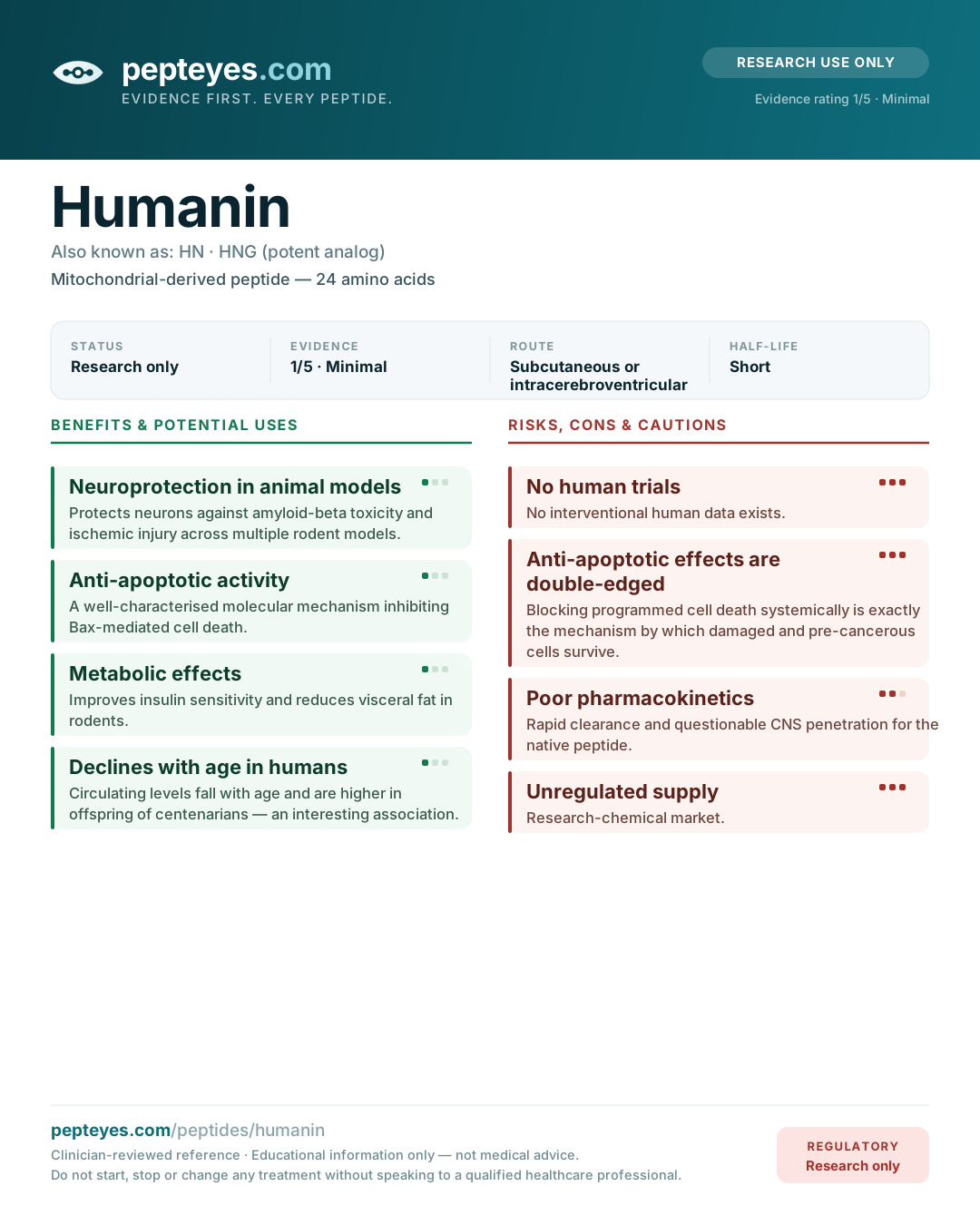
Neuroprotection in animal models
Protects neurons against amyloid-beta toxicity and ischemic injury across multiple rodent models.
Evidence: Preliminary -
Anti-apoptotic activity
A well-characterised molecular mechanism inhibiting Bax-mediated cell death.
Evidence: Preliminary -
Metabolic effects
Improves insulin sensitivity and reduces visceral fat in rodents.
Evidence: Preliminary -
Declines with age in humans
Circulating levels fall with age and are higher in offspring of centenarians — an interesting association.
Evidence: Preliminary
Risks and cautions
4 entries · 3 serious or common
-
No human trials
No interventional human data exists.
Evidence: Serious -
Anti-apoptotic effects are double-edged
Blocking programmed cell death systemically is exactly the mechanism by which damaged and pre-cancerous cells survive.
Evidence: Serious -
Poor pharmacokinetics
Rapid clearance and questionable CNS penetration for the native peptide.
Evidence: Moderate evidence -
Unregulated supply
Research-chemical market.
Evidence: Serious
Counts are not a score. A single serious risk can outweigh several well-supported benefits, and a long benefit list built on preclinical work outweighs nothing at all.
Opinion — what people actually report
3 themes · 1 reported problem
This is the weakest tier on this site. These are themes drawn from public discussion — forums, subreddits and patient threads — not from trials. There is no control group, no denominator, and no way to confirm that what someone injected matched its label. People post when a result is dramatic and when something goes wrong, and rarely when nothing happens, so treat everything below as a description of the conversation rather than of the compound. The bars count how often a thing is said, not how well it is supported.
-
Almost purely theoretical interest Practical note. Dominant theme: Comes up in most discussions of this compound.
Discussion is about mitochondrial-derived peptide biology and the epidemiology linking higher levels to longevity, not about use.
-
Practically nobody reports using it Reported problem. Dominant theme: Comes up in most discussions of this compound.
Availability is poor and the effects, if any, are not the sort a person could perceive.
-
Often mentioned alongside MOTS-c Practical note. Recurring: Raised regularly, though not by everyone.
The two are usually discussed together as the mitochondrial-derived peptide category.
Where the reports and the evidence part ways
The biology is genuine and interesting — humanin is a real mitochondrial-derived peptide with cytoprotective activity in cell and animal models, and its levels do correlate with longevity in some human observational work. Correlation with longevity is not evidence that administering it extends life, and no human trial has tested that. The community is honest that this is a subject of interest rather than a usable intervention, which is the correct position.
Readers on Humanin
Questions and answers from readers, under generated names. Nothing here has been checked or reviewed by the site and none of it is medical advice. It is the least verified thing on this page — and it is here because people ask each other these things anyway, and most of the other places they can ask are run by sellers.
0 questions · 0 answers
No questions yet. Ask the first one above — it takes one box and an email address.
How names work, and the house rules
Names. Every verified address is given one generated name — two ordinary words — and keeps it. Nobody chooses a name and nobody can take another's. Posts marked desk were written by the site's own editorial desk, usually to open a thread; they carry a generated name like everyone else's and are held to the site's rules, which means they never state an amount.
What is not allowed. Selling, sourcing, vendor names, coupon codes and "message me" — posts that read that way are held and usually removed. Personal medical details you would not want public. Abuse. Instructions framed as what someone else should do.
What this is not. A reader's report of what happened to them is a report, not a finding, and an answer here is one person's view. Nothing in this section changes the evidence rating above it. If something you read here would change what you take, take it to a pharmacist or physician first.
Your data. Delete any post of yours at any time, or remove everything you have written together with your name. Details in the privacy notice.
Who should avoid it
- Human use outside research settings
- Any cancer history
If used under medical supervision, monitor
- No validated monitoring exists
Regulatory & legal status
Not approved for human use.
Infographic
Where to read further
We link to live literature searches rather than a frozen citation list, so you always see current results — including anything published after our last review.
- PubMed — all published literature on Humanin
- PubMed — randomized controlled trials only
- ClinicalTrials.gov — registered human trials
Related peptides in Longevity & Mitochondrial
Terms used on this page
- Insulin Resistance
- Insulin resistance is a state in which a given insulin concentration produces less than the expected effect on glucose uptake, hepatic glucose output or lipolysis.
- Preclinical Study and Animal Model
- Preclinical studies are the laboratory, cell and animal experiments done before any human exposure, establishing mechanism, target engagement and the toxicology package that permits a first trial.
- Visceral Adipose Tissue (VAT)
- Visceral adipose tissue is the intra-abdominal fat surrounding the organs, metabolically distinct from subcutaneous fat and more closely linked to cardiometabolic risk.
- Central Nervous System (CNS) Penetration
- CNS penetration is the extent to which unbound drug in plasma reaches brain interstitial fluid, expressed formally as the unbound brain-to-plasma partition coefficient.
This page is educational information, not medical advice. It cannot account for your medical history, medications, or risk factors. Do not start, stop or change any treatment based on it. Speak to a qualified healthcare professional who knows your case.