Supplied ready in solution
Immune & Anti-inflammatory
At a glance
Ten answers, each one line. Open any row for the detail behind it.
What it does A calf thymus extract used in Russian clinical practice for decades, and heavily promoted…
A calf thymus extract used in Russian clinical practice for decades, and heavily promoted in Western longevity circles on the strength of a long-term study reporting reduced mortality in elderly subjects. Independent replication does not exist.
Half-life Not applicable — heterogeneous mixture — Documented
Not applicable — heterogeneous mixture
Typical studied dose Set by the label of the regulator that approved it, which is not an FDA… — On the label
Set by the label of the regulator that approved it, which is not an FDA label and may not be in English. The approving country decides the dose, and it is not always the same as the dose studied elsewhere.
How often it is used Set on the approved label. The interval follows the half-life above… — On the label
Set on the approved label. The interval follows the half-life above, which is why some of these are weekly and others daily.
How it is taken Intramuscular — Documented
Intramuscular
Main side effects Undefined composition · No independent replication · Autoimmune and transplant contraindications — Carries serious risk
Undefined composition — An extract rather than a defined molecule, so batch consistency and mechanism attribution are both uncertain.
No independent replication — The evidence base traces almost entirely to one research tradition and has not been reproduced elsewhere.
Autoimmune and transplant contraindications — Immune stimulation is inappropriate in autoimmune disease and after transplant.
Storage before mixing Supplied already in solution and kept refrigerated, not frozen. Freezing…
Supplied already in solution and kept refrigerated, not frozen. Freezing a protein solution can aggregate it, which is not always visible.
Shelf life after mixing Nothing to mix — it is not supplied as a powder. The relevant date is…
Nothing to mix — it is not supplied as a powder. The relevant date is the one printed on the product.
Evidence level 2/5 · Limited — Nothing established
Preclinical work plus scattered human reports, uncontrolled use, or negative trials.
Regulatory status Limited Approval — Documented
Registered in Russia as an immunomodulator. Not approved in the US, EU or UK. Registered in Russia; unapproved elsewhere.
Overview
A calf thymus extract used in Russian clinical practice for decades, and heavily promoted in Western longevity circles on the strength of a long-term study reporting reduced mortality in elderly subjects. Independent replication does not exist.
Limited or non-US approvalRegistered in Russia; unapproved elsewhere.
| Regulatory status | Registered in Russia as an immunomodulator. Not approved in the US, EU or UK. |
|---|---|
| Drug class | Polypeptide complex extracted from calf thymus — a mixture, not a single molecule |
| Route | Intramuscular |
| Half-life | Not applicable — heterogeneous mixture |
| Evidence rating |
2/5 Limited
Evidence rating 2 out of 5: Limited
Preclinical work plus scattered human reports, uncontrolled use, or negative trials. |
| Studied in | Russian clinical studies in immunodeficiency and post-surgical infection; a long-term gerontology cohort study reporting mortality reduction in elderly participants. |
Thymalin sequence & structure
Thymalin is a mixture rather than a single molecule, so it has no sequence to state; Thymalin is a mixture with no single sequence, formula or molecular weight. Per US 5,070,076 it is made by extracting cleaned calf (or sheep/pig/horse) thymus with 1–10% aqueous acetic acid containing 0.2–2 g/L zinc chloride (pH 2.5–4, 5–15 °C, 24–72 h) and precipitating with acetone, chloroform or ethanol; the product is polypeptides of about 600–6,000 Da in three fractions (I: 600–1,000 Da, pI 3.5–5.0; II: 5,000–6,000 Da, pI 5.5–6.7; III: 2,000–4,000 Da, pI 7.0–9.0) with an overall amino-acid composition (mole %) of Ala 10.7, Pro 10.1, Val 8.8, Gly 8.6, Arg 8.5, Lys 7.0, Leu 6.7, Glu 6.2, Asp 5.8, Thr 5.7, Ser 5.7, Ile 3.9, cystine 3.4, Phe 3.2, His 2.9, Tyr 2.4, Met and Trp trace (the patent itself never uses the trade name). The 1997 paper describes it as natural peptides isolated from calf thymus by mild acid extraction, and Linkova/Khavinson 2023 name the dipeptides Lys-Glu (KE) and Glu-Trp (EW) as its active constituents; EP0346501A1 describes the marketed form as a 600–6,000 Da polypeptide complex in glycine at 10 mg per dose (the exact glycine content per vial was not confirmed and is omitted). CAS 79621-14-0 (check digit valid) denotes the extract; any vendor listing a sequence, CAS 63958-90-7 or MW ~859 Da for 'Thymalin' is describing thymulin. Confidence is medium because the composition data rest on a single primary patent, corroborated only qualitatively by later papers.
| Identifiers | CAS 79621-14-0 |
|---|---|
| Which molecule | This record describes Thymalin (Russian: Тималин; also spelled Thymarin), the Morozov/Khavinson acetic-acid polypeptide extract of calf thymus registered in Russia (Samson-Med) as a 10 mg lyophilisate for intramuscular injection, ATC L03AX, active substance 'thymus extract'. It is not thymulin/nonathymulin (the zinc-binding nonapeptide pGlu-Ala-Lys-Ser-Gln-Gly-Gly-Ser-Asn, CAS 63958-90-7, UNII 9H198D04WL, C33H54N12O15, MW 858.9), not Thymogen (synthetic L-Glu-L-Trp, originally identified as a Thymalin constituent), and not thymosin alpha-1. PubChem lists 'Thymalin' as a synonym of CID 3085284, which is thymulin; that CID is therefore deliberately omitted here. No DrugBank, UniProt or GSRS/UNII record exists for Thymalin. |
| Sources | US Patent 5,070,076 — Thymus-gland preparation and method for producing same (Morozov & Khavinson, 1991): extraction method, 600–6,000 Da range, fraction pI values and amino-acid composition tableMorozov & Khavinson, Natural and synthetic thymic peptides as therapeutics for immune dysfunction. Int J Immunopharmacol 1997;19:501-505 (PubMed 9637345)Linkova N, Khavinson V, et al. The influence of KE and EW dipeptides in the composition of the Thymalin drug... Int J Mol Sci 2023;24:13377 (PubMed 37686182, PMC10488166)PubChem Substance SID 135339424 (ChemIDplus deposit for Thymalin, CAS 79621-14-0, classed under Adjuvants, Immunologic)RLS (Russian drug registry) — Тималин, лиофилизат для приготовления раствора для в/м введения 10 мг, Самсон-Мед, ATC L03AX |
Record confidence: medium — one authoritative source, or sources agree on the sequence but not on every identifier. Every sequence on the site is listed with its sources on the peptide sequences index.
How it works
Proposed to restore T-lymphocyte differentiation and normalise the CD4/CD8 ratio in immunodeficient states. As an undefined extract, the active constituents are not fully characterised, which limits mechanistic reasoning.
Evidence base
Rated 2 of 5 — Limited. Preclinical work plus scattered human reports, uncontrolled use, or negative trials.
- Single-tradition evidence base with extraordinary longevity claims and no external replication.
Benefits and risks, weighed against the evidence
Every entry below carries the strength of the evidence behind it — three bars for strong human data, two for moderate, one for preliminary or preclinical work. The two columns are not equal by design: where a compound has more documented risk than demonstrated benefit, the lists say so.
Reported benefits
3 entries
-
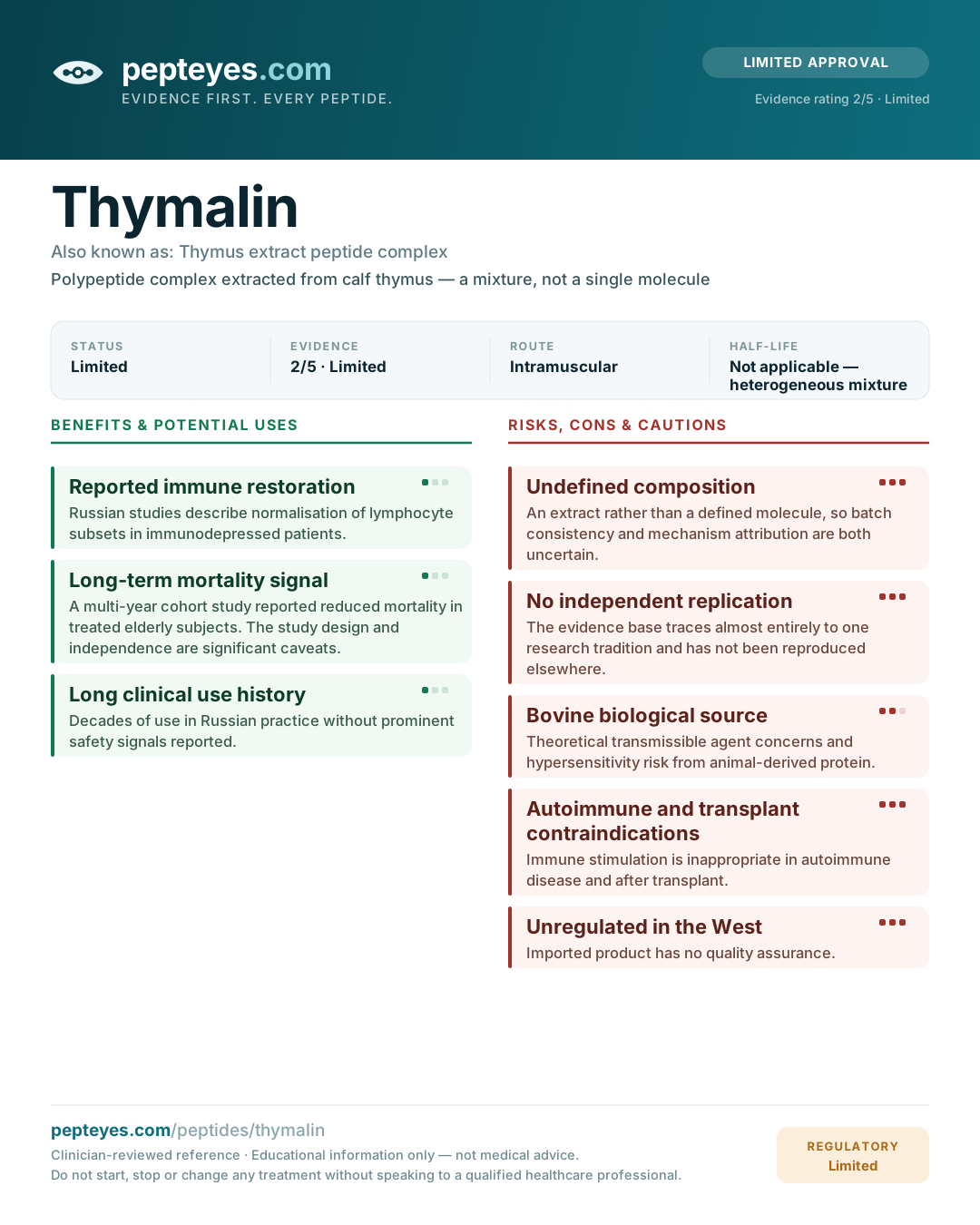
Reported immune restoration
Russian studies describe normalisation of lymphocyte subsets in immunodepressed patients.
Evidence: Preliminary -
Long-term mortality signal
A multi-year cohort study reported reduced mortality in treated elderly subjects. The study design and independence are significant caveats.
Evidence: Preliminary -
Long clinical use history
Decades of use in Russian practice without prominent safety signals reported.
Evidence: Preliminary
Risks and cautions
5 entries · 4 serious or common
-
Undefined composition
An extract rather than a defined molecule, so batch consistency and mechanism attribution are both uncertain.
Evidence: Serious -
No independent replication
The evidence base traces almost entirely to one research tradition and has not been reproduced elsewhere.
Evidence: Serious -
Bovine biological source
Theoretical transmissible agent concerns and hypersensitivity risk from animal-derived protein.
Evidence: Moderate evidence -
Autoimmune and transplant contraindications
Immune stimulation is inappropriate in autoimmune disease and after transplant.
Evidence: Serious -
Unregulated in the West
Imported product has no quality assurance.
Evidence: Serious
Counts are not a score. A single serious risk can outweigh several well-supported benefits, and a long benefit list built on preclinical work outweighs nothing at all.
Opinion — what people actually report
4 themes · 1 reported benefit · 1 reported problem
This is the weakest tier on this site. These are themes drawn from public discussion — forums, subreddits and patient threads — not from trials. There is no control group, no denominator, and no way to confirm that what someone injected matched its label. People post when a result is dramatic and when something goes wrong, and rarely when nothing happens, so treat everything below as a description of the conversation rather than of the compound. The bars count how often a thing is said, not how well it is supported.
-
Discussed alongside Epitalon and from the same source Practical note. Dominant theme: Comes up in most discussions of this compound.
The two are almost always mentioned together, both originating from the same Russian research programme.
-
Vague reports of resilience and fewer illnesses Reported benefit. Recurring: Raised regularly, though not by everyone.
Non-specific and acknowledged as difficult to evaluate.
-
Composition is undefined Reported problem. Dominant theme: Comes up in most discussions of this compound.
A thymic extract rather than a defined peptide, which better-informed posters point out makes batch consistency and any replication problematic.
-
Short annual courses by convention Practical note. Recurring: Raised regularly, though not by everyone.
Inherited from the original protocols rather than derived from any dose-finding work.
Where the reports and the evidence part ways
The situation mirrors Epitalon closely. The claims rest on a Russian literature from one research programme, including long-running mortality claims, that no independent group has reproduced. Thymalin is additionally not a single defined molecule but a polypeptide extract of variable composition, which makes both quality control and independent replication substantially harder. There is no Western regulatory approval and no independent randomized evidence.
Readers on Thymalin
Questions and answers from readers, under generated names. Nothing here has been checked or reviewed by the site and none of it is medical advice. It is the least verified thing on this page — and it is here because people ask each other these things anyway, and most of the other places they can ask are run by sellers.
0 questions · 0 answers
No questions yet. Ask the first one above — it takes one box and an email address.
How names work, and the house rules
Names. Every verified address is given one generated name — two ordinary words — and keeps it. Nobody chooses a name and nobody can take another's. Posts marked desk were written by the site's own editorial desk, usually to open a thread; they carry a generated name like everyone else's and are held to the site's rules, which means they never state an amount.
What is not allowed. Selling, sourcing, vendor names, coupon codes and "message me" — posts that read that way are held and usually removed. Personal medical details you would not want public. Abuse. Instructions framed as what someone else should do.
What this is not. A reader's report of what happened to them is a report, not a finding, and an answer here is one person's view. Nothing in this section changes the evidence rating above it. If something you read here would change what you take, take it to a pharmacist or physician first.
Your data. Delete any post of yours at any time, or remove everything you have written together with your name. Details in the privacy notice.
Who should avoid it
- Autoimmune disease
- Organ transplant recipients
- Pregnancy
- Known bovine protein allergy
If used under medical supervision, monitor
- CBC with differential and lymphocyte subsets if used clinically
Commonly confused with
These mix-ups cause real harm — two products sold under one name, or two molecules whose effects run in opposite directions.
Thymosin alpha-1 is a single defined 28-amino-acid peptide approved in more than 30 countries with randomized hepatitis trials behind it. Thymalin is an undefined bovine extract registered only in Russia.
Compare side by sideRegulatory & legal status
Registered in Russia; unapproved elsewhere.
Infographic
Where to read further
We link to live literature searches rather than a frozen citation list, so you always see current results — including anything published after our last review.
- PubMed — all published literature on Thymalin
- PubMed — randomized controlled trials only
- ClinicalTrials.gov — registered human trials
Related peptides in Immune & Anti-inflammatory
Terms used on this page
- Reproducibility and Replication
- Reproducibility is obtaining the same result from the same data and analysis, while replication is obtaining a consistent result from new data, and only the second shows the finding is real.
- Thymic Peptide
- Thymic peptides are small peptides originally isolated from thymus tissue and proposed as immune-regulating hormones; only thymosin alpha-1 has meaningful clinical use, and it is not FDA-approved.
- Cohort Study
- A cohort study follows groups defined by exposure forward to their outcomes, allowing incidence and risk to be estimated directly but leaving treatment assignment to the world rather than to chance.
- Safety Signal Detection
- Safety signal detection is the statistical and clinical screening of adverse event databases for drug-event pairs reported more often than the rest of the data would predict.
- Hypersensitivity Reaction
- A hypersensitivity reaction is an immune response to a drug that injures the host, classified by the Gell and Coombs types from immediate IgE-mediated events to delayed T-cell-mediated ones.
- Autoimmunity
- Autoimmunity is an adaptive immune response directed at self, arising when central or peripheral tolerance fails, and it counts as disease only when that response produces demonstrable tissue injury.
This page is educational information, not medical advice. It cannot account for your medical history, medications, or risk factors. Do not start, stop or change any treatment based on it. Speak to a qualified healthcare professional who knows your case.