Supplied ready in solution
Gut & Gastrointestinal
At a glance
Ten answers, each one line. Open any row for the detail behind it.
What it does The intestinal counterpart to the GLP-1 drugs.
The intestinal counterpart to the GLP-1 drugs. Where GLP-1 suppresses appetite, GLP-2 makes the remaining bowel physically grow — taller villi, deeper crypts, more absorptive surface. For patients living on intravenous nutrition, that is the difference between a pump every night and a life.
Half-life ~2 hours in healthy subjects, ~1.3 hours in… — Documented
~2 hours in healthy subjects, ~1.3 hours in short-bowel-syndrome patients, subcutaneously.
Typical studied dose Set on the approved label, which states the starting dose, how it is… — On the label
Set on the approved label, which states the starting dose, how it is increased and the maximum. Read it there rather than anywhere else — including here.
How often it is used The label schedule is once daily. Dosing intervals follow the half-life… — On the label
The label schedule is once daily. Dosing intervals follow the half-life above, and the prescribing information is what sets them.
How it is taken Subcutaneous, once daily — Documented
Subcutaneous, once daily
Main side effects Colorectal cancer surveillance required · Bowel obstruction · Biliary and pancreatic disease — Carries serious risk
Colorectal cancer surveillance required — A drug whose entire mechanism is intestinal growth carries a theoretical neoplasia risk. Colonoscopy is required before starting and periodically thereafter, with polyp removal.
Bowel obstruction — Mucosal growth can narrow an already compromised lumen; stoma stenosis and obstruction are recognised complications.
Biliary and pancreatic disease — Cholecystitis, cholangitis and pancreatitis are labelled risks requiring periodic laboratory assessment.
Storage before mixing Supplied already in solution and kept refrigerated, not frozen. Freezing…
Supplied already in solution and kept refrigerated, not frozen. Freezing a protein solution can aggregate it, which is not always visible.
Shelf life after mixing Nothing to mix — it is not supplied as a powder. The relevant date is…
Nothing to mix — it is not supplied as a powder. The relevant date is the one printed on the product.
Evidence level 5/5 · Very strong — Documented
Multiple phase 3 randomized trials plus regulatory approval in a major market.
Regulatory status FDA Approved — Documented
FDA-approved (2012) for short bowel syndrome in patients dependent on parenteral support. Prescription drug, typically prescribed through specialist intestinal failure centres.
Overview
The intestinal counterpart to the GLP-1 drugs. Where GLP-1 suppresses appetite, GLP-2 makes the remaining bowel physically grow — taller villi, deeper crypts, more absorptive surface. For patients living on intravenous nutrition, that is the difference between a pump every night and a life.
FDA ApprovedFDA-approved (2012) for short bowel syndrome in patients dependent on parenteral support.
| Regulatory status | FDA-approved (2012) for short bowel syndrome in patients dependent on parenteral support. |
|---|---|
| Drug class | GLP-2 receptor agonist — 33-amino-acid analog resistant to DPP-4 |
| Route | Subcutaneous, once daily |
| Half-life | ~2 hours in healthy subjects, ~1.3 hours in short-bowel-syndrome patients, subcutaneously. |
| Evidence rating |
5/5 Very strong
Evidence rating 5 out of 5: Very strong
Multiple phase 3 randomized trials plus regulatory approval in a major market. |
| Studied in | STEPS phase 3 program and long-term extension studies in short bowel syndrome with intestinal failure. |
Teduglutide sequence & structure
Teduglutide is a 33-residue linear peptide with a free C-terminal acid; molecular weight 3,752.1 Da.
| Three-letter | H-His-Gly-Asp-Gly-Ser-Phe-Ser-Asp-Glu-Met-Asn-Thr-Ile-Leu-Asp-Asn-Leu-Ala-Ala-Arg-Asp-Phe-Ile-Asn-Trp-Leu-Ile-Gln-Thr-Lys-Ile-Thr-Asp-OH |
|---|---|
| Length | 33 amino acid residues |
| Modifications |
|
| Molecular formula | C164H252N44O55S |
| Molecular weight | 3,752.1 Da (average, free base) |
| Identifiers | CAS 197922-42-2 · PubChem CID 16139605 · DrugBank DB08900 · UniProt P01275 |
| Sources | KEGG DRUG D06053 (teduglutide: sequence, formula, MW, CAS)EMA EPAR – Revestive (teduglutide) product information, section 5.1PubChem CID 16139605 (formula, MW)UniProt P01275 GLUC_HUMAN (proglucagon; native GLP-2 = residues 146–178)IUPHAR/BPS Guide to Pharmacology ligand 7049 (InChI, DrugBank/ChEMBL/PubChem links) |
Teduglutide is [Gly2]hGLP-2(1-33): native human GLP-2 (proglucagon residues 146–178, HADGSF…) with Ala2 replaced by Gly, otherwise unmodified, free N-terminus and free-acid C-terminus. Gattex/Revestive is recombinant (E. coli) lyophilized teduglutide with L-histidine, mannitol and sodium phosphate excipients. Reported average MW varies slightly by source (KEGG 3752.08, PubChem 3752.1, others up to 3752.14; the labels round to 3752); PubChem also lists a second CAS (287714-30-1) under the same CID, but 197922-42-2 is the registry number used by KEGG, vendors and the label-era literature.
Record confidence: high — two independent authoritative sources agree on the sequence and modifications. Every sequence on the site is listed with its sources on the peptide sequences index.
How it works
Agonises GLP-2 receptors on intestinal subepithelial myofibroblasts and enteric neurons, triggering mucosal growth: increased villus height and crypt depth, slowed gastric emptying and transit, and increased intestinal blood flow. A single alanine-to-glycine substitution blocks DPP-4 degradation, extending half-life from minutes to hours.
Evidence base
Rated 5 of 5 — Very strong. Multiple phase 3 randomized trials plus regulatory approval in a major market.
- Phase 3 trials with an objective, hard-to-game endpoint: litres of intravenous nutrition avoided.
Benefits and risks, weighed against the evidence
Every entry below carries the strength of the evidence behind it — three bars for strong human data, two for moderate, one for preliminary or preclinical work. The two columns are not equal by design: where a compound has more documented risk than demonstrated benefit, the lists say so.
Reported benefits
4 entries · 3 on strong human evidence
-
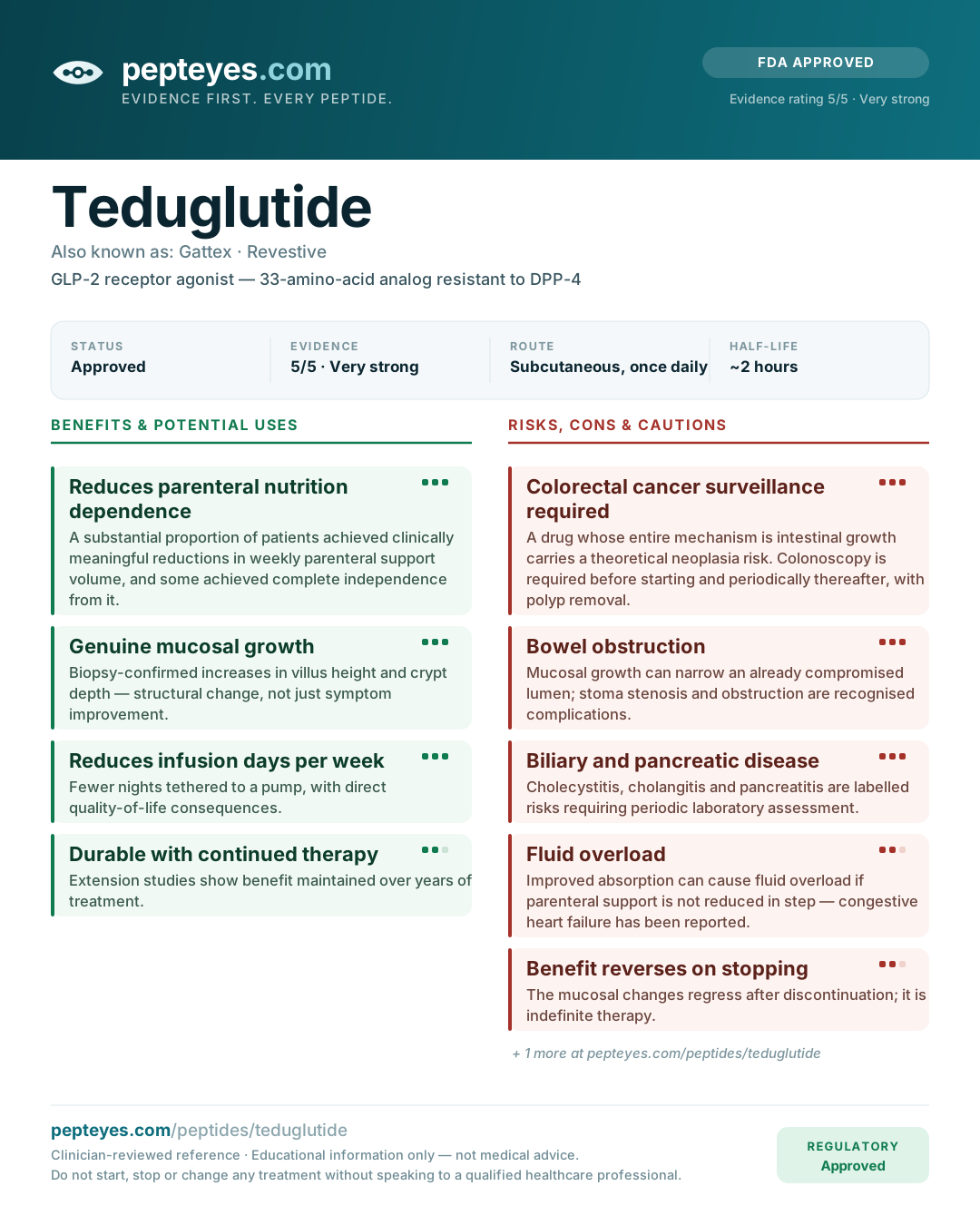
Reduces parenteral nutrition dependence
A substantial proportion of patients achieved clinically meaningful reductions in weekly parenteral support volume, and some achieved complete independence from it.
Evidence: Strong evidence -
Genuine mucosal growth
Biopsy-confirmed increases in villus height and crypt depth — structural change, not just symptom improvement.
Evidence: Strong evidence -
Reduces infusion days per week
Fewer nights tethered to a pump, with direct quality-of-life consequences.
Evidence: Strong evidence -
Durable with continued therapy
Extension studies show benefit maintained over years of treatment.
Evidence: Moderate evidence
Risks and cautions
6 entries · 3 serious or common
-
Colorectal cancer surveillance required
A drug whose entire mechanism is intestinal growth carries a theoretical neoplasia risk. Colonoscopy is required before starting and periodically thereafter, with polyp removal.
Evidence: Serious -
Bowel obstruction
Mucosal growth can narrow an already compromised lumen; stoma stenosis and obstruction are recognised complications.
Evidence: Serious -
Biliary and pancreatic disease
Cholecystitis, cholangitis and pancreatitis are labelled risks requiring periodic laboratory assessment.
Evidence: Serious -
Fluid overload
Improved absorption can cause fluid overload if parenteral support is not reduced in step — congestive heart failure has been reported.
Evidence: Moderate evidence -
Benefit reverses on stopping
The mucosal changes regress after discontinuation; it is indefinite therapy.
Evidence: Moderate evidence -
Very high cost
Among the more expensive chronic therapies in gastroenterology.
Evidence: Minor
Counts are not a score. A single serious risk can outweigh several well-supported benefits, and a long benefit list built on preclinical work outweighs nothing at all.
Opinion — what people actually report
5 themes · 1 reported benefit · 3 reported problems
This is the weakest tier on this site. These are themes drawn from public discussion — forums, subreddits and patient threads — not from trials. There is no control group, no denominator, and no way to confirm that what someone injected matched its label. People post when a result is dramatic and when something goes wrong, and rarely when nothing happens, so treat everything below as a description of the conversation rather than of the compound. The bars count how often a thing is said, not how well it is supported.
-
Reduced parenteral nutrition dependence Reported benefit. Dominant theme: Comes up in most discussions of this compound.
The benefit that matters, and reports describe it in terms of hours per night freed from an infusion pump rather than in clinical endpoints.
-
Abdominal pain and distension early on Reported problem. Dominant theme: Comes up in most discussions of this compound.
The most common adverse effect, and reported as difficult in the first weeks.
-
Colonoscopy surveillance is a source of anxiety Reported problem. Dominant theme: Comes up in most discussions of this compound.
The requirement for scopes because of polyp and neoplasia concerns comes up constantly, and patients find it unsettling.
-
Stoma changes and site complications Reported problem. Recurring: Raised regularly, though not by everyone.
Enlargement and output changes in patients with stomas are frequently discussed.
-
Cost is extraordinary and access is fought for Practical note. Dominant theme: Comes up in most discussions of this compound.
Among the most expensive drugs discussed anywhere on this site, and much of the community conversation is about obtaining it.
Where the reports and the evidence part ways
The benefit and the burden both match the trial evidence: STEPS showed reduced parenteral support requirements, and the GI effects and the neoplasia surveillance requirement are labelled and real. The intestinotrophic mechanism that produces the benefit is the same one that drives the polyp concern, which is a genuine trade-off rather than a theoretical one. Patient anxiety about surveillance is proportionate rather than excessive here.
Readers on Teduglutide
Questions and answers from readers, under generated names. Nothing here has been checked or reviewed by the site and none of it is medical advice. It is the least verified thing on this page — and it is here because people ask each other these things anyway, and most of the other places they can ask are run by sellers.
0 questions · 0 answers
No questions yet. Ask the first one above — it takes one box and an email address.
How names work, and the house rules
Names. Every verified address is given one generated name — two ordinary words — and keeps it. Nobody chooses a name and nobody can take another's. Posts marked desk were written by the site's own editorial desk, usually to open a thread; they carry a generated name like everyone else's and are held to the site's rules, which means they never state an amount.
What is not allowed. Selling, sourcing, vendor names, coupon codes and "message me" — posts that read that way are held and usually removed. Personal medical details you would not want public. Abuse. Instructions framed as what someone else should do.
What this is not. A reader's report of what happened to them is a report, not a finding, and an answer here is one person's view. Nothing in this section changes the evidence rating above it. If something you read here would change what you take, take it to a pharmacist or physician first.
Your data. Delete any post of yours at any time, or remove everything you have written together with your name. Details in the privacy notice.
Who should avoid it
- Active gastrointestinal malignancy
- Active malignancy elsewhere within the last 5 years (relative)
- Known colorectal polyps not yet removed
- Pregnancy (insufficient data)
If used under medical supervision, monitor
- Colonoscopy before initiation, at 1 year, then every 5 years
- Bilirubin, alkaline phosphatase, lipase and amylase every 6 months
- Fluid balance and parenteral support volume
- Stoma assessment where present
Interactions
Not exhaustive. Always have a pharmacist or physician review your full medication list — including supplements.
- Oral medications — increased absorption may require dose reduction of drugs with narrow therapeutic windows
- Parenteral nutrition — must be actively reduced as absorption improves
Commonly confused with
These mix-ups cause real harm — two products sold under one name, or two molecules whose effects run in opposite directions.
GLP-1 and GLP-2 are different hormones from the same precursor gene with opposite therapeutic aims: GLP-1 drugs reduce intake and slow the gut, GLP-2 drugs grow the gut to absorb more.
Compare side by sideRegulatory & legal status
Prescription drug, typically prescribed through specialist intestinal failure centres.
Infographic
Where to read further
We link to live literature searches rather than a frozen citation list, so you always see current results — including anything published after our last review.
- PubMed — all published literature on Teduglutide
- PubMed — randomized controlled trials only
- ClinicalTrials.gov — registered human trials
- DailyMed — official FDA prescribing information
Related peptides in Gut & Gastrointestinal
Terms used on this page
- Intravenous Administration (IV)
- Intravenous administration delivers drug directly into the bloodstream, giving complete bioavailability by definition and making it the reference route against which all others are measured.
- Glucagon-Like Peptide-1 (GLP-1)
- Glucagon-like peptide-1 is an incretin hormone released by intestinal L-cells after a meal that stimulates glucose-dependent insulin secretion and suppresses appetite.
- DPP-4 Cleavage
- DPP-4 cleavage is the removal of an N-terminal dipeptide by dipeptidyl peptidase-4, the enzymatic step that inactivates incretin hormones within minutes of their release.
- Gastric Emptying
- Gastric emptying is the rate at which stomach contents pass into the duodenum, a major determinant of postprandial glucose and of incretin therapy tolerability.
- Fibroblast
- A fibroblast is the mesenchymal cell that produces and maintains connective tissue matrix, and which differentiates into a contractile myofibroblast during wound repair.
- Terminal Half-Life
- Terminal half-life is the time taken for drug concentration to fall by half during the final, slowest phase of elimination, and it sets the dosing interval.
This page is educational information, not medical advice. It cannot account for your medical history, medications, or risk factors. Do not start, stop or change any treatment based on it. Speak to a qualified healthcare professional who knows your case.