Supplied as capsules or tablets
Gut & Gastrointestinal
At a glance
Ten answers, each one line. Open any row for the detail behind it.
What it does Linaclotide's younger sibling, designed around the body's own uroguanylin rather than a…
Linaclotide's younger sibling, designed around the body's own uroguanylin rather than a bacterial toxin. Its distinguishing feature is pH-dependence: it is most active in the slightly acidic proximal small intestine and loses activity further down, which is intended to limit diarrhea.
Half-life Minimally absorbed — acts locally — Documented
Minimally absorbed — acts locally
Typical studied dose Set on the approved label, which states the starting dose, how it is… — On the label
Set on the approved label, which states the starting dose, how it is increased and the maximum. Read it there rather than anywhere else — including here.
How often it is used The label schedule is once daily. Dosing intervals follow the half-life… — On the label
The label schedule is once daily. Dosing intervals follow the half-life above, and the prescribing information is what sets them.
How it is taken Oral tablet, once daily — Documented
Oral tablet, once daily
Main side effects Boxed warning: contraindicated in young children · Contraindicated in obstruction · Severe dehydration risk — Carries serious risk
Boxed warning: contraindicated in young children — Same class warning as linaclotide — contraindicated under 6 years, and not recommended between 6 and 18, due to fatal dehydration risk in juvenile animals.
Contraindicated in obstruction — Same class contraindication.
Severe dehydration risk — Stop the drug if severe diarrhea develops.
Storage before mixing Kept dry, sealed and at room temperature unless the label says…
Kept dry, sealed and at room temperature unless the label says otherwise. Moisture is what shortens the life of a capsule or tablet.
Shelf life after mixing Nothing to mix — it is not supplied as a powder. The relevant date is…
Nothing to mix — it is not supplied as a powder. The relevant date is the one printed on the product.
Evidence level 4/5 · Strong — Documented
Consistent human randomized trials, or approval outside the United States.
Regulatory status FDA Approved — Documented
FDA-approved for chronic idiopathic constipation and for irritable bowel syndrome with constipation. Prescription drug.
Overview
Linaclotide's younger sibling, designed around the body's own uroguanylin rather than a bacterial toxin. Its distinguishing feature is pH-dependence: it is most active in the slightly acidic proximal small intestine and loses activity further down, which is intended to limit diarrhea.
FDA ApprovedFDA-approved for chronic idiopathic constipation and for irritable bowel syndrome with constipation.
| Regulatory status | FDA-approved for chronic idiopathic constipation and for irritable bowel syndrome with constipation. |
|---|---|
| Drug class | Guanylate cyclase-C agonist — 16-amino-acid uroguanylin analog |
| Route | Oral tablet, once daily |
| Half-life | Minimally absorbed — acts locally |
| Evidence rating |
4/5 Strong
Evidence rating 4 out of 5: Strong
Consistent human randomized trials, or approval outside the United States. |
| Studied in | Phase 3 trials in chronic idiopathic constipation and in IBS-C. |
Plecanatide sequence & structure
Plecanatide is a 16-residue disulfide-bridged peptide with a free C-terminal acid; molecular weight 1,681.9 Da.
| Three-letter | H-Asn-Asp-Glu-Cys-Glu-Leu-Cys-Val-Asn-Val-Ala-Cys-Thr-Gly-Cys-Leu-OH |
|---|---|
| Length | 16 amino acid residues |
| Modifications |
|
| Molecular formula | C65H104N18O26S4 |
| Molecular weight | 1,681.9 Da (average, free base) |
| Identifiers | CAS 467426-54-6 · PubChem CID 70693500 · DrugBank DB13170 |
| Sources | FDA approved label, TRULANCE (plecanatide) tablets, NDA 208745 — Section 11 DESCRIPTIONDailyMed – Trulance (plecanatide) tablets label, Description sectionPubChem CID 70693500 (plecanatide) – formula, MW, CAS and DrugBank cross-referenceUniProt Q16661 – human GUCA2B (uroguanylin precursor), for the parent-sequence comparison |
All-L, unmodified 16-mer with a free N-terminus and free C-terminal acid; the only structural feature is the uroguanylin-type bis-disulfide, given on the FDA label as cyclic (4→12),(7→15)-bis(disulfide). It differs from mature human uroguanylin (GUCA2B, UniProt Q16661 residues 97–112, NDDCELCVNVACTGCL) solely by Asp3→Glu, so no UniProt accession describes plecanatide itself and the uniprot field is deliberately null. The label rounds the molecular weight to 1682 Da; 1681.9 is the PubChem value and matches calculation from the formula.
Record confidence: high — two independent authoritative sources agree on the sequence and modifications. Every sequence on the site is listed with its sources on the peptide sequences index.
How it works
Agonises guanylate cyclase-C, increasing cyclic GMP and driving chloride and bicarbonate secretion into the lumen. Unlike linaclotide, which derives from heat-stable enterotoxin, plecanatide is a near-copy of endogenous uroguanylin and retains its pH-sensitivity, binding maximally around pH 5.
Evidence base
Rated 4 of 5 — Strong. Consistent human randomized trials, or approval outside the United States.
- Solid phase 3 evidence; the tolerability advantage over linaclotide is inferred, not demonstrated head-to-head.
Benefits and risks, weighed against the evidence
Every entry below carries the strength of the evidence behind it — three bars for strong human data, two for moderate, one for preliminary or preclinical work. The two columns are not equal by design: where a compound has more documented risk than demonstrated benefit, the lists say so.
Reported benefits
4 entries · 2 on strong human evidence
-
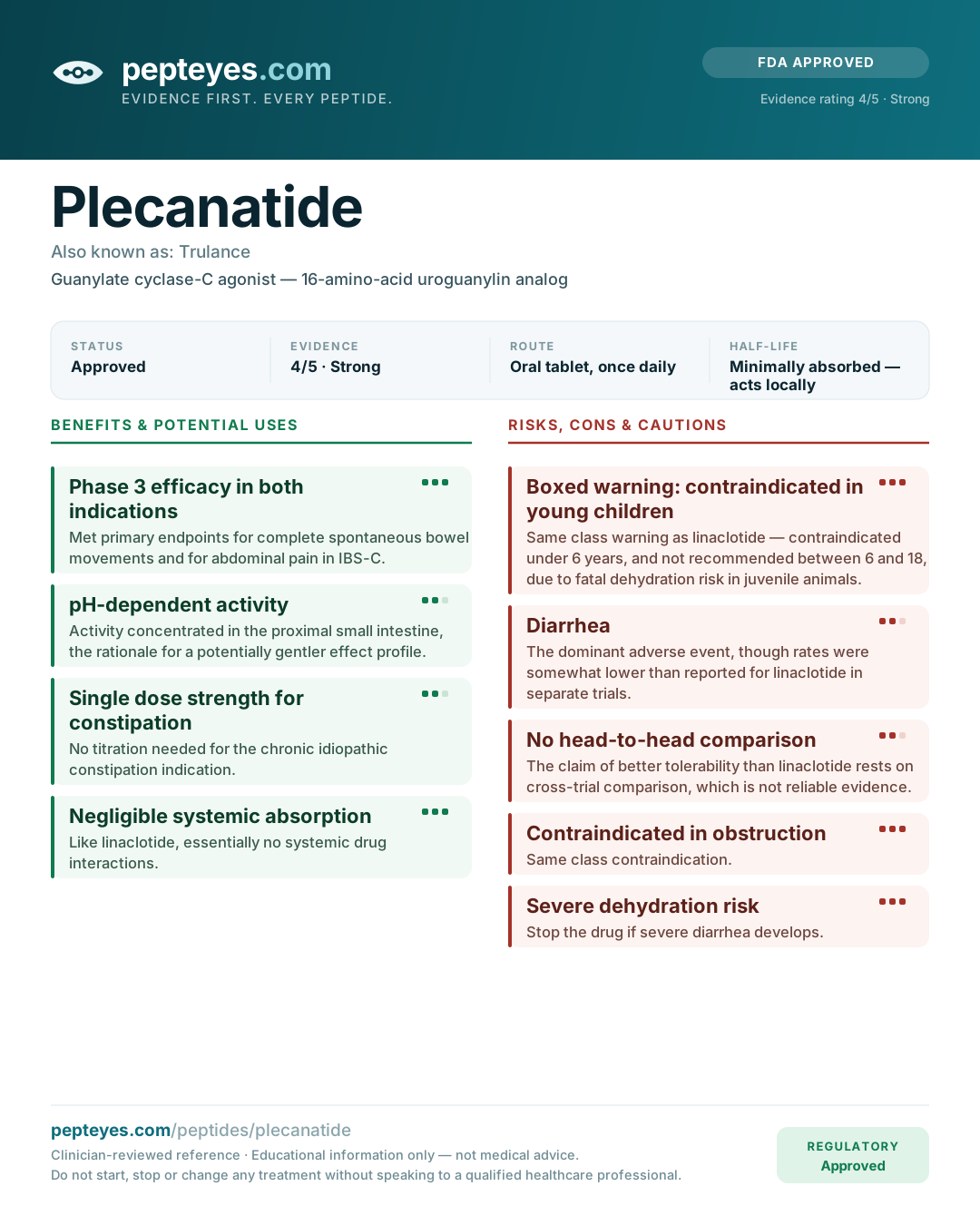
Phase 3 efficacy in both indications
Met primary endpoints for complete spontaneous bowel movements and for abdominal pain in IBS-C.
Evidence: Strong evidence -
pH-dependent activity
Activity concentrated in the proximal small intestine, the rationale for a potentially gentler effect profile.
Evidence: Moderate evidence -
Single dose strength for constipation
No titration needed for the chronic idiopathic constipation indication.
Evidence: Moderate evidence -
Negligible systemic absorption
Like linaclotide, essentially no systemic drug interactions.
Evidence: Strong evidence
Risks and cautions
5 entries · 3 serious or common
-
Boxed warning: contraindicated in young children
Same class warning as linaclotide — contraindicated under 6 years, and not recommended between 6 and 18, due to fatal dehydration risk in juvenile animals.
Evidence: Serious -
Diarrhea
The dominant adverse event, though rates were somewhat lower than reported for linaclotide in separate trials.
Evidence: Moderate evidence -
No head-to-head comparison
The claim of better tolerability than linaclotide rests on cross-trial comparison, which is not reliable evidence.
Evidence: Moderate evidence -
Contraindicated in obstruction
Same class contraindication.
Evidence: Serious -
Severe dehydration risk
Stop the drug if severe diarrhea develops.
Evidence: Serious
Counts are not a score. A single serious risk can outweigh several well-supported benefits, and a long benefit list built on preclinical work outweighs nothing at all.
Opinion — what people actually report
4 themes · 1 reported benefit · 2 reported problems
This is the weakest tier on this site. These are themes drawn from public discussion — forums, subreddits and patient threads — not from trials. There is no control group, no denominator, and no way to confirm that what someone injected matched its label. People post when a result is dramatic and when something goes wrong, and rarely when nothing happens, so treat everything below as a description of the conversation rather than of the compound. The bars count how often a thing is said, not how well it is supported.
-
Gentler than linaclotide Reported benefit. Dominant theme: Comes up in most discussions of this compound.
The central claim in almost every comparison, with less urgent diarrhoea the specific difference people name.
-
Diarrhoea still happens Reported problem. Recurring: Raised regularly, though not by everyone.
Less often and less severely by report, but it remains the main adverse effect and the main reason for stopping.
-
Often the second thing tried Practical note. Recurring: Raised regularly, though not by everyone.
A large share of reports come from people who could not tolerate linaclotide.
-
Insurance coverage is the practical obstacle Reported problem. Recurring: Raised regularly, though not by everyone.
Frequently reported as requiring failure on cheaper options first.
Where the reports and the evidence part ways
The "gentler" reputation has a plausible mechanistic basis — plecanatide is engineered to be pH-sensitive and act preferentially in the proximal small intestine — and diarrhoea rates in its trials were lower than those reported for linaclotide. But those are separate trial programmes in different populations, not a head-to-head comparison, and no randomized trial has directly established that one is better tolerated than the other. The community consensus here is probably right and is nonetheless resting on an indirect comparison.
Readers on Plecanatide
Questions and answers from readers, under generated names. Nothing here has been checked or reviewed by the site and none of it is medical advice. It is the least verified thing on this page — and it is here because people ask each other these things anyway, and most of the other places they can ask are run by sellers.
0 questions · 0 answers
No questions yet. Ask the first one above — it takes one box and an email address.
How names work, and the house rules
Names. Every verified address is given one generated name — two ordinary words — and keeps it. Nobody chooses a name and nobody can take another's. Posts marked desk were written by the site's own editorial desk, usually to open a thread; they carry a generated name like everyone else's and are held to the site's rules, which means they never state an amount.
What is not allowed. Selling, sourcing, vendor names, coupon codes and "message me" — posts that read that way are held and usually removed. Personal medical details you would not want public. Abuse. Instructions framed as what someone else should do.
What this is not. A reader's report of what happened to them is a report, not a finding, and an answer here is one person's view. Nothing in this section changes the evidence rating above it. If something you read here would change what you take, take it to a pharmacist or physician first.
Your data. Delete any post of yours at any time, or remove everything you have written together with your name. Details in the privacy notice.
Who should avoid it
- Children under 6 years — boxed warning
- Patients aged 6 to 18 (not recommended)
- Known or suspected mechanical obstruction
If used under medical supervision, monitor
- Stool frequency and consistency
- Hydration status
- Symptom response over 4–12 weeks
Interactions
Not exhaustive. Always have a pharmacist or physician review your full medication list — including supplements.
- Minimal systemic interactions
- Other laxatives — additive diarrhea risk
Commonly confused with
These mix-ups cause real harm — two products sold under one name, or two molecules whose effects run in opposite directions.
Same receptor and indications. The differences are the parent molecule (uroguanylin vs bacterial enterotoxin), pH-sensitivity, and the pediatric age cut-off in the boxed warning.
Compare side by sideRegulatory & legal status
Prescription drug.
Infographic
Where to read further
We link to live literature searches rather than a frozen citation list, so you always see current results — including anything published after our last review.
- PubMed — all published literature on Plecanatide
- PubMed — randomized controlled trials only
- ClinicalTrials.gov — registered human trials
- DailyMed — official FDA prescribing information
Related peptides in Gut & Gastrointestinal
Terms used on this page
- Phase 3 Trial
- A Phase 3 trial is the large confirmatory study, powered for a prespecified clinical endpoint, on which a marketing application and the resulting product label are built.
- Primary vs Secondary Endpoint
- The primary endpoint is the single prespecified outcome a trial is powered and statistically budgeted for, while secondary endpoints are additional measures that support interpretation but cannot replace it.
- Drug-Drug Interaction (DDI)
- A drug-drug interaction is a change in one medicine's exposure or effect caused by another, arising pharmacokinetically through absorption or metabolism, or pharmacodynamically at the effect site.
- Contraindication vs Precaution
- A contraindication marks a situation where a drug must not be used at all, while a precaution flags a risk that calls for caution, monitoring or a modified plan rather than avoidance.
- Adverse Event (AE)
- An adverse event is any untoward medical occurrence in someone receiving a medicine, recorded whether or not the drug caused it, which is why an event table is not a harm table.
- Randomised Controlled Trial (RCT)
- A randomised controlled trial assigns participants to intervention or control by chance and follows them prospectively, which is what allows an outcome difference to be attributed to the treatment itself.
This page is educational information, not medical advice. It cannot account for your medical history, medications, or risk factors. Do not start, stop or change any treatment based on it. Speak to a qualified healthcare professional who knows your case.