Supplied as capsules or tablets
Gut & Gastrointestinal
At a glance
Ten answers, each one line. Open any row for the detail behind it.
What it does The furthest any "leaky gut" therapy has progressed through formal drug development — all…
The furthest any "leaky gut" therapy has progressed through formal drug development — all the way to phase 3, where it failed. That result is important context for the intestinal-permeability claims made across the supplement industry.
Half-life Minimal systemic absorption — acts locally in the gut lumen — Documented
Minimal systemic absorption — acts locally in the gut lumen
Typical studied dose No established dose. Each trial protocol fixes its own and publishes it… — Depends on the study
No established dose. Each trial protocol fixes its own and publishes it in the registry entry, under medical supervision that is part of the dose. There is no approved amount for use outside a study.
How often it is used Whatever the protocol specifies. The registry entry for a given study… — Depends on the study
Whatever the protocol specifies. The registry entry for a given study states its interval; nothing establishes one outside a study.
How it is taken Oral — Documented
Oral
Main side effects Failed phase 3 · Not available · Headache and gastrointestinal symptoms — Carries serious risk
Failed phase 3 — The definitive trial stopped for futility. This is the most important thing to know about it.
Not available — No approved product; no lawful supply.
Headache and gastrointestinal symptoms — The most commonly reported events, generally mild.
Storage before mixing Kept dry, sealed and at room temperature unless the label says…
Kept dry, sealed and at room temperature unless the label says otherwise. Moisture is what shortens the life of a capsule or tablet.
Shelf life after mixing Nothing to mix — it is not supplied as a powder. The relevant date is…
Nothing to mix — it is not supplied as a powder. The relevant date is the one printed on the product.
Evidence level 3/5 · Moderate — Depends on the study
Small or early-phase human trials, or good controlled topical human data.
Regulatory status In Clinical Trials — Depends on the study
Reached phase 3 for celiac disease; the trial did not meet its primary endpoint and was discontinued in 2022. Not approved. Investigational; development discontinued.
Overview
The furthest any "leaky gut" therapy has progressed through formal drug development — all the way to phase 3, where it failed. That result is important context for the intestinal-permeability claims made across the supplement industry.
Investigational — not approvedInvestigational; development discontinued.
| Regulatory status | Reached phase 3 for celiac disease; the trial did not meet its primary endpoint and was discontinued in 2022. Not approved. |
|---|---|
| Drug class | Octapeptide tight-junction regulator (zonulin antagonist) |
| Route | Oral |
| Half-life | Minimal systemic absorption — acts locally in the gut lumen |
| Evidence rating |
3/5 Moderate
Evidence rating 3 out of 5: Moderate
Small or early-phase human trials, or good controlled topical human data. |
| Studied in | Multiple phase 2 trials in celiac disease showing symptom benefit; the CeDLara phase 3 trial, stopped for futility at interim analysis. |
Larazotide Acetate sequence & structure
Larazotide Acetate is a 8-residue linear peptide with a free C-terminal acid; molecular weight 725.85 Da.
| Three-letter | H-Gly-Gly-Val-Leu-Val-Gln-Pro-Gly-OH |
|---|---|
| Length | 8 amino acid residues |
| Modifications | None — an unmodified chain of standard L-amino acids |
| Molecular formula | C32H55N9O10 |
| Molecular weight | 725.85 Da (average, free base) |
| SMILES | CC(C)C[C@H](NC(=O)[C@@H](NC(=O)CNC(=O)CN)C(C)C)C(=O)N[C@H](C(=O)N[C@@H](CCC(N)=O)C(=O)N1CCC[C@H]1C(=O)NCC(=O)O)C(C)C |
| Identifiers | CAS 258818-34-7 · PubChem CID 9810532 · DrugBank DB05645 |
| Sources | PubChem CID 9810532 (formula, MW, SMILES)ChEMBL CHEMBL2105646 (INN/USAN, HELM sequence)FDA GSRS UNII ZN3R5560ZV (subunit sequence GGVLVQPG)KEGG DRUG D09351 (USAN/INN, formula, CAS)ChEBI 177799 (formula, average mass, SMILES, CAS, DrugBank link) |
Unmodified linear octapeptide of all-L standard residues (free amine, free acid); clinical material is larazotide acetate (CAS 881851-50-9), whereas 258818-34-7 and the formula/MW here refer to the free base. Research codes AT-1001 and AT-2347 both map to this molecule; INN-202 is a later development code for the same drug. UNII ZN3R5560ZV; DrugBank DB05645 confirmed via the ChEBI cross-reference (go.drugbank.com refuses automated fetches).
Record confidence: high — two independent authoritative sources agree on the sequence and modifications. Every sequence on the site is listed with its sources on the peptide sequences index.
How it works
Antagonises zonulin signalling to tighten intestinal epithelial tight junctions, reducing paracellular passage of gliadin peptides. It is designed to act locally in the gut lumen with negligible systemic absorption.
Evidence base
Rated 3 of 5 — Moderate. Small or early-phase human trials, or good controlled topical human data.
- A well-run program with a negative definitive result — genuinely useful evidence.
Benefits and risks, weighed against the evidence
Every entry below carries the strength of the evidence behind it — three bars for strong human data, two for moderate, one for preliminary or preclinical work. The two columns are not equal by design: where a compound has more documented risk than demonstrated benefit, the lists say so.
Reported benefits
3 entries · 1 on strong human evidence
-
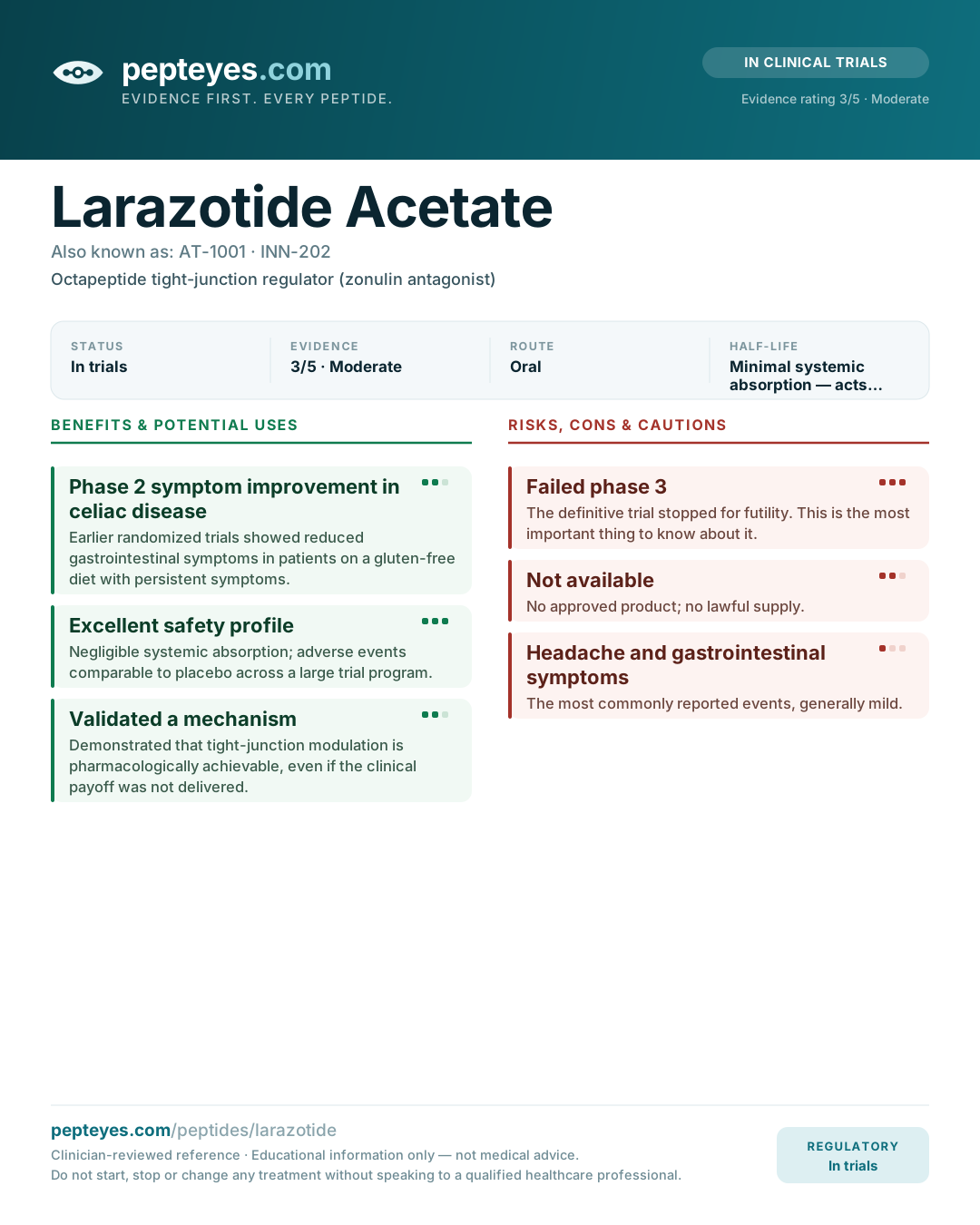
Phase 2 symptom improvement in celiac disease
Earlier randomized trials showed reduced gastrointestinal symptoms in patients on a gluten-free diet with persistent symptoms.
Evidence: Moderate evidence -
Excellent safety profile
Negligible systemic absorption; adverse events comparable to placebo across a large trial program.
Evidence: Strong evidence -
Validated a mechanism
Demonstrated that tight-junction modulation is pharmacologically achievable, even if the clinical payoff was not delivered.
Evidence: Moderate evidence
Risks and cautions
3 entries · 1 serious or common
-
Failed phase 3
The definitive trial stopped for futility. This is the most important thing to know about it.
Evidence: Serious -
Not available
No approved product; no lawful supply.
Evidence: Moderate evidence -
Headache and gastrointestinal symptoms
The most commonly reported events, generally mild.
Evidence: Minor
Counts are not a score. A single serious risk can outweigh several well-supported benefits, and a long benefit list built on preclinical work outweighs nothing at all.
Opinion — what people actually report
4 themes · 1 reported benefit · 1 reported problem
This is the weakest tier on this site. These are themes drawn from public discussion — forums, subreddits and patient threads — not from trials. There is no control group, no denominator, and no way to confirm that what someone injected matched its label. People post when a result is dramatic and when something goes wrong, and rarely when nothing happens, so treat everything below as a description of the conversation rather than of the compound. The bars count how often a thing is said, not how well it is supported.
-
Hope followed by disappointment Practical note. Dominant theme: Comes up in most discussions of this compound.
The dominant arc in coeliac communities. Years of anticipation as the leading candidate, then the phase 3 failure, and the discussion has largely gone quiet since.
-
Some reported fewer symptoms after accidental gluten exposure Reported benefit. Recurring: Raised regularly, though not by everyone.
From trial participants and from people using research-chemical versions, and hard to separate from variability in exposure.
-
Many reported no difference Reported problem. Recurring: Raised regularly, though not by everyone.
Prominent, and consistent with how the trial ended.
-
The tight-junction idea remains attractive Practical note. Recurring: Raised regularly, though not by everyone.
Interest in the zonulin and intestinal permeability mechanism persists well beyond this specific compound, including in communities discussing conditions where the concept is much less established.
Where the reports and the evidence part ways
The community's trajectory tracked the evidence honestly: enthusiasm during promising phase 2 results, then acceptance when the phase 3 trial did not meet its endpoint and development was discontinued. What outlived the drug is the "leaky gut" framing it popularised, which now circulates in wellness contexts far beyond coeliac disease and with far less support than it had here. The mechanism was plausible and specific; its afterlife has been neither.
Readers on Larazotide Acetate
Questions and answers from readers, under generated names. Nothing here has been checked or reviewed by the site and none of it is medical advice. It is the least verified thing on this page — and it is here because people ask each other these things anyway, and most of the other places they can ask are run by sellers.
0 questions · 0 answers
No questions yet. Ask the first one above — it takes one box and an email address.
How names work, and the house rules
Names. Every verified address is given one generated name — two ordinary words — and keeps it. Nobody chooses a name and nobody can take another's. Posts marked desk were written by the site's own editorial desk, usually to open a thread; they carry a generated name like everyone else's and are held to the site's rules, which means they never state an amount.
What is not allowed. Selling, sourcing, vendor names, coupon codes and "message me" — posts that read that way are held and usually removed. Personal medical details you would not want public. Abuse. Instructions framed as what someone else should do.
What this is not. A reader's report of what happened to them is a report, not a finding, and an answer here is one person's view. Nothing in this section changes the evidence rating above it. If something you read here would change what you take, take it to a pharmacist or physician first.
Your data. Delete any post of yours at any time, or remove everything you have written together with your name. Details in the privacy notice.
Who should avoid it
- Not applicable — no lawful supply exists
If used under medical supervision, monitor
- Not applicable
Commonly confused with
These mix-ups cause real harm — two products sold under one name, or two molecules whose effects run in opposite directions.
Both marketed for "leaky gut". Larazotide is the only tight-junction drug to reach phase 3 — where it failed. BPC-157 has never had a published randomized human trial at all.
Compare side by sideRegulatory & legal status
Investigational; development discontinued.
Infographic
Where to read further
We link to live literature searches rather than a frozen citation list, so you always see current results — including anything published after our last review.
- PubMed — all published literature on Larazotide Acetate
- PubMed — randomized controlled trials only
- ClinicalTrials.gov — registered human trials
Related peptides in Gut & Gastrointestinal
Terms used on this page
- Phase 3 Trial
- A Phase 3 trial is the large confirmatory study, powered for a prespecified clinical endpoint, on which a marketing application and the resulting product label are built.
- Adverse Event (AE)
- An adverse event is any untoward medical occurrence in someone receiving a medicine, recorded whether or not the drug caused it, which is why an event table is not a harm table.
- Placebo and Placebo Control
- A placebo is an inactive intervention matched to the real one in appearance and route, used as a control arm so that improvement caused by the drug can be separated from improvement that would occur anyway.
- Phase 2 Trial
- A Phase 2 trial is the first test of a compound in the target patient population, sized to find a workable dose and an early efficacy signal rather than to prove clinical benefit.
This page is educational information, not medical advice. It cannot account for your medical history, medications, or risk factors. Do not start, stop or change any treatment based on it. Speak to a qualified healthcare professional who knows your case.