Supplied as a nasal solution
Cognitive & Neurological
At a glance
Ten answers, each one line. Open any row for the detail behind it.
What it does Semax's anxiolytic sibling, developed at the same Russian institute.
Semax's anxiolytic sibling, developed at the same Russian institute. It is framed as a benzodiazepine alternative without sedation, tolerance or dependence — a claim supported by Russian trials and untested elsewhere.
Half-life Intranasal: in plasma within 30 seconds and cleared over about… — Documented
Intranasal: in plasma within 30 seconds and cleared over about 5 minutes (Russian label); central effects outlast plasma levels.
Typical studied dose Set by the label of the regulator that approved it, which is not an FDA… — On the label
Set by the label of the regulator that approved it, which is not an FDA label and may not be in English. The approving country decides the dose, and it is not always the same as the dose studied elsewhere.
How often it is used Set on the approved label. The interval follows the half-life above… — On the label
Set on the approved label. The interval follows the half-life above, which is why some of these are weekly and others daily.
How it is taken Intranasal (primary) — Documented
Intranasal (primary)
Main side effects No Western trials · Not a substitute for treated anxiety disorder · Grey-market quality — Carries serious risk
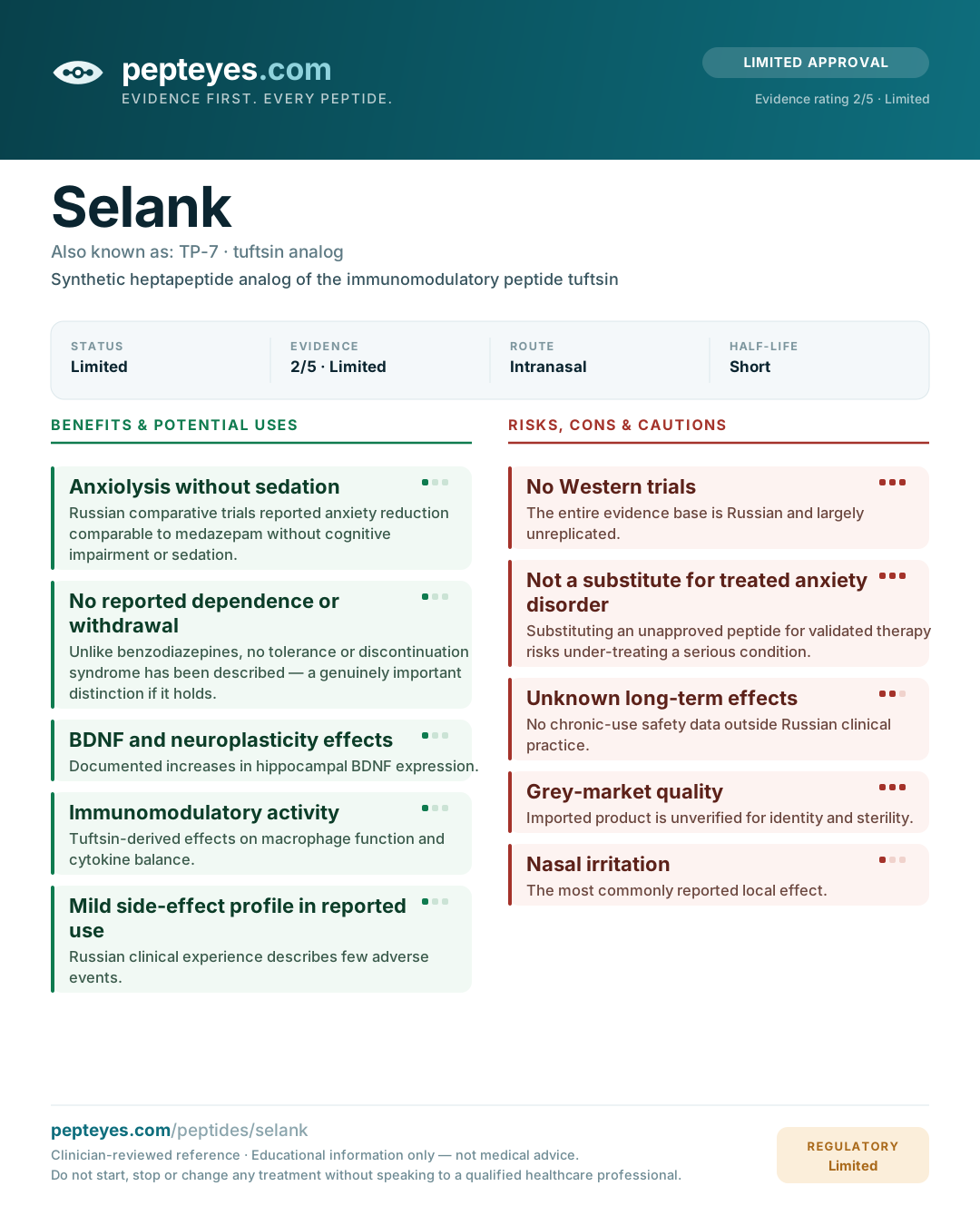
No Western trials — The entire evidence base is Russian and largely unreplicated.
Not a substitute for treated anxiety disorder — Substituting an unapproved peptide for validated therapy risks under-treating a serious condition.
Grey-market quality — Imported product is unverified for identity and sterility.
Storage before mixing Refrigerated, upright and sealed. A nasal solution is usually preserved…
Refrigerated, upright and sealed. A nasal solution is usually preserved, but it is still a solution and the same rules on heat and light apply.
Shelf life after mixing Nothing to mix — it is not supplied as a powder. The relevant date is…
Nothing to mix — it is not supplied as a powder. The relevant date is the one printed on the product.
Evidence level 2/5 · Limited — Nothing established
Preclinical work plus scattered human reports, uncontrolled use, or negative trials.
Regulatory status Limited Approval — Documented
Registered in Russia as an anxiolytic. Not approved in the US, EU or UK. Prescription medicine in Russia; unapproved elsewhere.
Overview
Semax's anxiolytic sibling, developed at the same Russian institute. It is framed as a benzodiazepine alternative without sedation, tolerance or dependence — a claim supported by Russian trials and untested elsewhere.
Limited or non-US approvalPrescription medicine in Russia; unapproved elsewhere.
| Regulatory status | Registered in Russia as an anxiolytic. Not approved in the US, EU or UK. |
|---|---|
| Drug class | Synthetic heptapeptide analog of the immunomodulatory peptide tuftsin |
| Route | Intranasal (primary) |
| Half-life | Intranasal: in plasma within 30 seconds and cleared over about 5 minutes (Russian label); central effects outlast plasma levels. |
| Evidence rating |
2/5 Limited
Evidence rating 2 out of 5: Limited
Preclinical work plus scattered human reports, uncontrolled use, or negative trials. |
| Studied in | Russian randomized comparisons against benzodiazepines in generalized anxiety disorder; preclinical anxiolytic and antidepressant models. |
Selank sequence & structure
Selank is a 7-residue linear peptide with a free C-terminal acid; molecular weight 751.89 Da.
| Three-letter | H-Thr-Lys-Pro-Arg-Pro-Gly-Pro-OH |
|---|---|
| Length | 7 amino acid residues |
| Modifications | None — an unmodified chain of standard L-amino acids |
| Molecular formula | C33H57N11O9 |
| Molecular weight | 751.89 Da (average, free base) |
| SMILES | C[C@H]([C@@H](C(=O)N[C@@H](CCCCN)C(=O)N1CCC[C@H]1C(=O)N[C@@H](CCCN=C(N)N)C(=O)N2CCC[C@H]2C(=O)NCC(=O)N3CCC[C@H]3C(=O)O)N)O |
| Identifiers | CAS 129954-34-3 · PubChem CID 11765600 |
| Sources | PubChem CID 11765600 (formula, MW, isomeric SMILES, synonyms incl. CAS and UNII)FDA UNII search, UNII TS9JR8EP1G SELANK (CAS 129954-34-3; threonyl-lysyl-prolyl-arginyl-prolyl-glycyl-proline; synonym TP 7)PubMed: Kolomin et al. 2013, tuftsin analog Selank (Thr-Lys-Pro-Arg-Pro-Gly-Pro), PMID 24450168Europe PMC: Kost et al. 2001, Semax and Selank (Thr-Lys-Pro-Arg-Pro-Gly-Pro) inhibit enkephalin-degrading enzymes, PMID 11443939NovoPro Labs Selank product page (cross-check) |
Synthetic all-L heptapeptide: the tuftsin tetrapeptide Thr-Lys-Pro-Arg (IgG heavy-chain fragment) extended C-terminally with Pro-Gly-Pro; both termini unmodified, no other modifications. CAS 129954-34-3 (check digit valid; confirmed at PubChem and FDA UNII TS9JR8EP1G) and the formula/MW are for the free peptide (PubChem 751.9; 751.89 from standard atomic weights); vendors commonly sell the acetate salt (PubChem synonym 'TP-7 diacetate'), which has a higher formula weight. Also known as TP-7. No ChEMBL entry found by name search and no DrugBank entry could be confirmed.
Record confidence: high — two independent authoritative sources agree on the sequence and modifications. Every sequence on the site is listed with its sources on the peptide sequences index.
How it works
Modulates GABA-A receptor expression indirectly, influences serotonin and noradrenaline turnover, and increases BDNF. Also inhibits enkephalin degradation, extending endogenous opioid signalling. The tuftsin backbone confers immunomodulatory activity independent of the CNS effects.
Evidence base
Rated 2 of 5 — Limited. Preclinical work plus scattered human reports, uncontrolled use, or negative trials.
- Plausible mechanism, encouraging domestic trials, no independent confirmation.
Benefits and risks, weighed against the evidence
Every entry below carries the strength of the evidence behind it — three bars for strong human data, two for moderate, one for preliminary or preclinical work. The two columns are not equal by design: where a compound has more documented risk than demonstrated benefit, the lists say so.
Reported benefits
5 entries
-
Anxiolysis without sedation
Russian comparative trials reported anxiety reduction comparable to medazepam without cognitive impairment or sedation.
Evidence: Preliminary -
No reported dependence or withdrawal
Unlike benzodiazepines, no tolerance or discontinuation syndrome has been described — a genuinely important distinction if it holds.
Evidence: Preliminary -
BDNF and neuroplasticity effects
Documented increases in hippocampal BDNF expression.
Evidence: Preliminary -
Immunomodulatory activity
Tuftsin-derived effects on macrophage function and cytokine balance.
Evidence: Preliminary -
Mild side-effect profile in reported use
Russian clinical experience describes few adverse events.
Evidence: Preliminary
Risks and cautions
5 entries · 3 serious or common
-
No Western trials
The entire evidence base is Russian and largely unreplicated.
Evidence: Serious -
Not a substitute for treated anxiety disorder
Substituting an unapproved peptide for validated therapy risks under-treating a serious condition.
Evidence: Serious -
Unknown long-term effects
No chronic-use safety data outside Russian clinical practice.
Evidence: Moderate evidence -
Grey-market quality
Imported product is unverified for identity and sterility.
Evidence: Serious -
Nasal irritation
The most commonly reported local effect.
Evidence: Minor
Counts are not a score. A single serious risk can outweigh several well-supported benefits, and a long benefit list built on preclinical work outweighs nothing at all.
Opinion — what people actually report
5 themes · 2 reported benefits · 3 reported problems
This is the weakest tier on this site. These are themes drawn from public discussion — forums, subreddits and patient threads — not from trials. There is no control group, no denominator, and no way to confirm that what someone injected matched its label. People post when a result is dramatic and when something goes wrong, and rarely when nothing happens, so treat everything below as a description of the conversation rather than of the compound. The bars count how often a thing is said, not how well it is supported.
-
Anxiety reduction without sedation Reported benefit. Dominant theme: Comes up in most discussions of this compound.
The defining claim, and the reason it is used. Repeatedly described as taking the edge off without the fog, dependence or memory effects of benzodiazepines.
-
Often paired with Semax Reported benefit. Recurring: Raised regularly, though not by everyone.
A very common stack, with Selank framed as smoothing the edge off Semax's stimulation.
-
Subtle enough that people doubt it Reported problem. Dominant theme: Comes up in most discussions of this compound.
The most common complaint is uncertainty about whether anything happened, which makes placebo unusually hard to rule out here.
-
Nasal irritation Reported problem. Recurring: Raised regularly, though not by everyone.
The standard delivery complaint for this class.
-
Occasional fatigue or flatness Reported problem. Occasional: Reported by a minority, or in specific contexts.
A minority report of blunted affect rather than calm.
Where the reports and the evidence part ways
The mechanism people cite — that Selank is a tuftsin analogue modulating GABAergic and monoamine systems without benzodiazepine-type receptor binding — is a reasonable reading of the preclinical work, and it does explain why sedation and dependence are not reported. The problem is the same as with Semax: the human evidence is a small Russian literature in anxiety disorders, not enhancement in healthy people, and it has not been independently replicated. The community's own most common observation — that the effect is subtle enough to be indistinguishable from nothing — is a more honest appraisal than most of what is written about it.
Cheat sheet
The full sheet, all 77 compounds →The community reference numbers for this compound — reconstitution, working dose, cycle and bloodwork. Research and education only, not medical advice, and not part of the evidence-rated monograph above. Doses assume a 1mL / 100-unit insulin syringe — the calculator does the units for you.
Protocol overview
Dosing & reconstitution 5 mg vial
| WEEK | DAILY DOSE | UNITS PER INJECTION |
|---|---|---|
| Weeks 1 to 2 | 300 mcg | 3 units (0.03 mL) |
| Weeks 3 to 4 | 500 mcg | 5 units (0.05 mL) |
Frequency: Inject once daily subcutaneously. A common cycling pattern is 4 weeks on, 4 weeks off to prevent tachyphylaxis, though continuous daily use has been studied in clinical trials for up to 14 days with good tolerability. Some practitioners recommend administering 5 days per week with 2-day breaks.
On the master sheet
- Vial
- 5mg
- BAC
- 2mL
- Dose
- Inj 250–500mcg / IN 125–250mcg per nostril 1–3x
- Route
- IN preferred
- Cycle
- 2–4 wks
- Time Off
- 1–2 wks
- Pre-mixed nasal spray: Selank 10mg — Anxiety, calm focus
Storage note: More fragile. 3–4 weeks reconstituted. Full storage guide →
Readers on Selank
Questions and answers from readers, under generated names. Nothing here has been checked or reviewed by the site and none of it is medical advice. It is the least verified thing on this page — and it is here because people ask each other these things anyway, and most of the other places they can ask are run by sellers.
0 questions · 0 answers
No questions yet. Ask the first one above — it takes one box and an email address.
How names work, and the house rules
Names. Every verified address is given one generated name — two ordinary words — and keeps it. Nobody chooses a name and nobody can take another's. Posts marked desk were written by the site's own editorial desk, usually to open a thread; they carry a generated name like everyone else's and are held to the site's rules, which means they never state an amount.
What is not allowed. Selling, sourcing, vendor names, coupon codes and "message me" — posts that read that way are held and usually removed. Personal medical details you would not want public. Abuse. Instructions framed as what someone else should do.
What this is not. A reader's report of what happened to them is a report, not a finding, and an answer here is one person's view. Nothing in this section changes the evidence rating above it. If something you read here would change what you take, take it to a pharmacist or physician first.
Your data. Delete any post of yours at any time, or remove everything you have written together with your name. Details in the privacy notice.
Who should avoid it
- Pregnancy
- Serious psychiatric illness without specialist care
- Use as a replacement for evidence-based anxiety treatment
If used under medical supervision, monitor
- Validated anxiety scales if used clinically
- Mood and sleep tracking
Interactions
Not exhaustive. Always have a pharmacist or physician review your full medication list — including supplements.
- Nothing is established with any supplement or nutrient. No combination study exists with a vitamin, mineral, amino acid or herbal product, and the peptide has no published human pharmacokinetic profile against which one could be interpreted.
- The only documented combination is with a prescription benzodiazepine, not a supplement - Russian work reports the peptide alongside phenazepam, and the registration trial compared it against medazepam in generalised anxiety disorder and neurasthenia. That literature is small, reported in Russian and not independently replicated, which sets the ceiling on what can be said about combinations.
- Sedating supplements taken for the same purpose - valerian, kava, melatonin - have no interaction data here in either direction, and the proposed mechanism runs through GABA-A subunit expression rather than direct receptor binding, which is no basis for predicting additive sedation. Phenibut is different: FDA states it is not a lawful dietary ingredient, and it causes dependence and withdrawal.
Regulatory & legal status
Prescription medicine in Russia; unapproved elsewhere.
Infographic
What this entry was checked against
The specific records this monograph was verified against on its last research pass. We link live literature searches below as well, because these are a snapshot and the literature is not.
- Zozulia AA et al. Efficacy and possible mechanisms of action of a new peptide anxiolytic selank in the therapy of generalized anxiety disorders and neurasthenia. Zh Nevrol Psikhiatr 2008;108:38-48 - sixty-two patients, compared against medazepam, reported in Russian
- FDA, Phenibut in dietary supplements - phenibut does not meet the statutory definition of a dietary ingredient, supplements declaring it are misbranded, and FDA has issued warning letters and obtained a permanent injunction
- Poison Control, Phenibut: a recreational drug with abuse potential - tolerance and physical dependence develop quickly and abrupt cessation can cause a dangerous withdrawal
Where to read further
We link to live literature searches rather than a frozen citation list, so you always see current results — including anything published after our last review.
- PubMed — all published literature on Selank
- PubMed — randomized controlled trials only
- ClinicalTrials.gov — registered human trials
Related peptides in Cognitive & Neurological
Terms used on this page
- Immunomodulation
- Immunomodulation is the deliberate shifting of immune activity in either direction, a category covering suppression, stimulation and restored regulation, often used precisely to avoid naming which is meant.
- Brain-Derived Neurotrophic Factor (BDNF)
- BDNF is a neurotrophin that signals through the TrkB receptor to support neuronal survival, dendritic growth and the late, protein-synthesis-dependent phase of synaptic potentiation.
- Withdrawal and Rebound
- Withdrawal and rebound describe what follows stopping a drug, ranging from a simple return of the underlying condition to an overshoot past the untreated baseline or a dependence syndrome.
- Cytokine
- Cytokines are small secreted signalling proteins acting at picomolar concentrations over short distances to coordinate immune cells, characterised by pleiotropy and extensive functional redundancy.
- Adverse Event (AE)
- An adverse event is any untoward medical occurrence in someone receiving a medicine, recorded whether or not the drug caused it, which is why an event table is not a harm table.
- Placebo and Placebo Control
- A placebo is an inactive intervention matched to the real one in appearance and route, used as a control arm so that improvement caused by the drug can be separated from improvement that would occur anyway.
This page is educational information, not medical advice. It cannot account for your medical history, medications, or risk factors. Do not start, stop or change any treatment based on it. Speak to a qualified healthcare professional who knows your case.