Supplied as a lyophilised powder to reconstitute
Metabolic & Weight
At a glance
Ten answers, each one line. Open any row for the detail behind it.
What it does Adds glucagon-receptor agonism to the incretin pair, which raises energy expenditure on…
Adds glucagon-receptor agonism to the incretin pair, which raises energy expenditure on top of appetite suppression. Phase 2 weight-loss results are the largest yet reported for a pharmacological agent, but long-term safety is genuinely unknown.
Half-life ~6 days — Documented
~6 days
Typical studied dose No established dose. Each trial protocol fixes its own and publishes it… — Depends on the study
No established dose. Each trial protocol fixes its own and publishes it in the registry entry, under medical supervision that is part of the dose. There is no approved amount for use outside a study.
How often it is used Whatever the protocol specifies. The registry entry for a given study… — Depends on the study
Whatever the protocol specifies. The registry entry for a given study states its interval; nothing establishes one outside a study.
How it is taken Subcutaneous, once weekly (investigational) — Documented
Subcutaneous, once weekly (investigational)
Main side effects No phase 3 safety data yet · Dose-dependent heart-rate increase · Entirely unregulated supply — Carries serious risk
No phase 3 safety data yet — Every claim about long-term safety is extrapolation. Approval is not guaranteed and prior obesity drugs have failed at exactly this stage.
Dose-dependent heart-rate increase — Phase 2 showed increases in heart rate that peaked mid-trial. Cardiovascular outcome data do not yet exist.
Entirely unregulated supply — All retatrutide sold to consumers is illicit. There is no verified identity, purity, sterility, or dose accuracy, and no recourse if harmed.
Storage before mixing As a sealed lyophilised powder, refrigerated is typical and a freezer…
As a sealed lyophilised powder, refrigerated is typical and a freezer suits long storage; both should be dark and dry. A dry powder tolerates a few days out of the cold far better than anything in solution — which is why it ships that way.
Shelf life after mixing Once mixed it is refrigerated and treated as short-lived. Bacteriostatic…
Once mixed it is refrigerated and treated as short-lived. Bacteriostatic water contains a preservative and buys the longer window; sterile water contains none and buys a much shorter one. Peptides in solution also degrade on their own, so the container is only half the question.
Evidence level 3/5 · Moderate — Depends on the study
Small or early-phase human trials, or good controlled topical human data.
Regulatory status In Clinical Trials — Depends on the study
Phase 3 (TRIUMPH program). Not approved anywhere. Widely and illegally sold grey-market. Investigational. Not approved by FDA, EMA, or any comparable regulator. Sale for human use is unlawful; "research chemical" labelling does not change that.
Overview
Adds glucagon-receptor agonism to the incretin pair, which raises energy expenditure on top of appetite suppression. Phase 2 weight-loss results are the largest yet reported for a pharmacological agent, but long-term safety is genuinely unknown.
Investigational — not approvedInvestigational. Not approved by FDA, EMA, or any comparable regulator. Sale for human use is unlawful; "research chemical" labelling does not change that.
| Regulatory status | Phase 3 (TRIUMPH program). Not approved anywhere. Widely and illegally sold grey-market. |
|---|---|
| Drug class | Triple GLP-1 / GIP / glucagon receptor agonist |
| Route | Subcutaneous, once weekly (investigational) |
| Half-life | ~6 days |
| Evidence rating |
3/5 Moderate
Evidence rating 3 out of 5: Moderate
Small or early-phase human trials, or good controlled topical human data. |
| Studied in | Phase 2 obesity and type 2 diabetes trials; phase 3 TRIUMPH trials ongoing across obesity, diabetes, knee osteoarthritis and sleep apnea. |
Retatrutide sequence & structure
Retatrutide is a 39-residue linear peptide with a C-terminal amide, carrying a fatty-acid side chain, non-standard residues; molecular weight 4,731.42 Da.
* K: OEG-γGlu-C20diacid
[bracketed] = non-standard residue* = side-chain modification
| Three-letter | H-Tyr-Aib-Gln-Gly-Thr-Phe-Thr-Ser-Asp-Tyr-Ser-Ile-αMeLeu-Leu-Asp-Lys-Lys(OEG-γGlu-C20 diacid)-Ala-Gln-Aib-Ala-Phe-Ile-Glu-Tyr-Leu-Leu-Glu-Gly-Gly-Pro-Ser-Ser-Gly-Ala-Pro-Pro-Pro-Ser-NH2 |
|---|---|
| Length | 39 amino acid residues |
| Modifications |
|
| Molecular formula | C221H342N46O68 |
| Molecular weight | 4,731.42 Da (average, free base) |
| Identifiers | CAS 2381089-83-2 · PubChem CID 171934787 |
| Sources | WHO Recommended INN List 90 (WHO Drug Information Vol. 37 No. 3, 2023) – retatrutidum entry, full chemical name and C221H342N46O68KEGG DRUG D12430 Retatrutide (USAN): sequence, C221H342N46O68, MW 4731.34, CAS 2381089-83-2ChEMBL CHEMBL5590721 (full structure record, C221H342N46O68, 4731.42)PubChem CID 171934787NCATS GSRS UNII NOP2Y096GV (39-residue backbone sequence) |
Eli Lilly LY3437943; a fully synthetic 39-residue glucagon-scaffold analogue (no endogenous precursor, so no UniProt accession). Lys16 is free; only Lys17 carries the side chain, which per the INN is Lys-Nε–(single OEG/AEEA)–γGlu–C20 diacid (not the 2×OEG of semaglutide/tirzepatide), and the C-terminus is an amide. Formula and MW (4731.42, free base; KEGG rounds to 4731.34) were recomputed from the sequence and match ChEMBL/KEGG; PubChem's CID is titled 'sodium salt' but lists the free-base formula. ChEMBL has two records: CHEMBL5095485 (named, no structure) and CHEMBL5590721 (structure). Some vendor pages misstate the acyl chain as C18 or omit the C-terminal amide. The DrugBank id (reported as DB18993) could not be verified against DrugBank itself and is omitted.
Record confidence: high — two independent authoritative sources agree on the sequence and modifications. Every sequence on the site is listed with its sources on the peptide sequences index.
How it works
Simultaneous agonism at three receptors. GLP-1 and GIP reduce intake and improve insulin dynamics; glucagon-receptor activation increases hepatic fat oxidation and resting energy expenditure — the same axis that makes glucagon a stress hormone, which is why cardiac and glycemic effects need close scrutiny.
Evidence base
Rated 3 of 5 — Moderate. Small or early-phase human trials, or good controlled topical human data.
- Phase 2 only, in the public domain. Phase 3 results pending.
- Peer-reviewed publication exists for phase 2 obesity data.
Benefits and risks, weighed against the evidence
Every entry below carries the strength of the evidence behind it — three bars for strong human data, two for moderate, one for preliminary or preclinical work. The two columns are not equal by design: where a compound has more documented risk than demonstrated benefit, the lists say so.
Reported benefits
3 entries
-
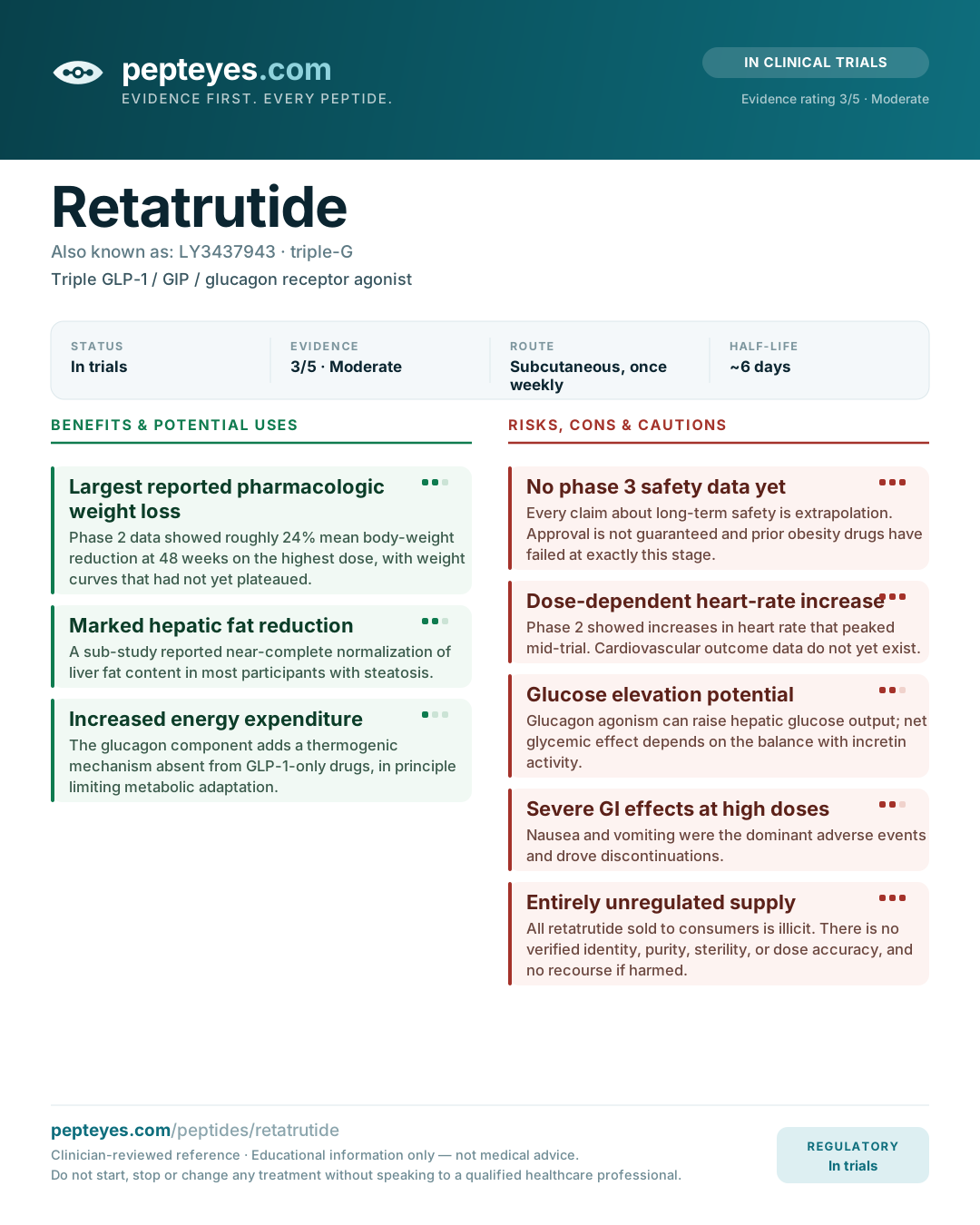
Largest reported pharmacologic weight loss
Phase 2 data showed roughly 24% mean body-weight reduction at 48 weeks on the highest dose, with weight curves that had not yet plateaued.
Evidence: Moderate evidence -
Marked hepatic fat reduction
A sub-study reported near-complete normalization of liver fat content in most participants with steatosis.
Evidence: Moderate evidence -
Increased energy expenditure
The glucagon component adds a thermogenic mechanism absent from GLP-1-only drugs, in principle limiting metabolic adaptation.
Evidence: Preliminary
Risks and cautions
5 entries · 3 serious or common
-
No phase 3 safety data yet
Every claim about long-term safety is extrapolation. Approval is not guaranteed and prior obesity drugs have failed at exactly this stage.
Evidence: Serious -
Dose-dependent heart-rate increase
Phase 2 showed increases in heart rate that peaked mid-trial. Cardiovascular outcome data do not yet exist.
Evidence: Serious -
Glucose elevation potential
Glucagon agonism can raise hepatic glucose output; net glycemic effect depends on the balance with incretin activity.
Evidence: Moderate evidence -
Severe GI effects at high doses
Nausea and vomiting were the dominant adverse events and drove discontinuations.
Evidence: Moderate evidence -
Entirely unregulated supply
All retatrutide sold to consumers is illicit. There is no verified identity, purity, sterility, or dose accuracy, and no recourse if harmed.
Evidence: Serious
Counts are not a score. A single serious risk can outweigh several well-supported benefits, and a long benefit list built on preclinical work outweighs nothing at all.
Opinion — what people actually report
6 themes · 1 reported benefit · 3 reported problems
This is the weakest tier on this site. These are themes drawn from public discussion — forums, subreddits and patient threads — not from trials. There is no control group, no denominator, and no way to confirm that what someone injected matched its label. People post when a result is dramatic and when something goes wrong, and rarely when nothing happens, so treat everything below as a description of the conversation rather than of the compound. The bars count how often a thing is said, not how well it is supported.
-
Described as another step up again Reported benefit. Dominant theme: Comes up in most discussions of this compound.
People who have used semaglutide and tirzepatide routinely rank this above both for rate of loss. It is the compound most often described as working faster than the user wanted.
-
Heart rate rising noticeably Reported problem. Dominant theme: Comes up in most discussions of this compound.
The most distinctive complaint, and the one that separates it from the earlier drugs in discussion. Reported as resting heart rate up by a visible margin, sometimes with palpitations.
-
Heat, flushing and sweating Reported problem. Recurring: Raised regularly, though not by everyone.
Frequently linked by posters to the glucagon component and increased energy expenditure. Usually described as uncomfortable rather than alarming.
-
Almost all use is grey-market Practical note. Dominant theme: Comes up in most discussions of this compound.
This is an investigational drug with no approved product, so essentially every account comes from research-chemical vials of unverified identity and purity. Experienced posters are unusually blunt about this.
-
Losing weight too fast to be comfortable Reported problem. Recurring: Raised regularly, though not by everyone.
A recurring theme of people deliberately reducing their own doses. Loose skin, weakness and appearance changes come up more here than with the approved drugs.
-
Nobody knows the long-term picture Practical note. Occasional: Reported by a minority, or in specific contexts.
The more careful voices point out that phase 3 has not reported and that they are effectively running an uncontrolled trial on themselves.
Where the reports and the evidence part ways
The efficacy reports are broadly in line with the published phase 2 results, which showed weight loss beyond anything the dual agonists achieved. The heart rate signal people describe is real and appears in the trial data too. The divergence is not about effects but about context: every community account comes from unregulated vials, without the medical screening, dose titration and monitoring that trial participants received, and without any phase 3 safety readout to sit behind it. Forum discussion treats the trial results as validation of what people are doing at home. They are not the same thing, and the gap between them is the entire safety margin.
Cheat sheet
The full sheet, all 77 compounds →The community reference numbers for this compound — reconstitution, working dose, cycle and bloodwork. Research and education only, not medical advice, and not part of the evidence-rated monograph above. Doses assume a 1mL / 100-unit insulin syringe — the calculator does the units for you.
Protocol overview
Dosing & reconstitution 10 mg vial
| PHASE | WEEKLY DOSE | UNITS PER INJECTION | VIALS NEEDED |
|---|---|---|---|
| Weeks 1 to 4 | 2 mg | 20 units (0.20 mL) | 1 vial per dose |
| Weeks 5 to 8 | 4 mg | 40 units (0.40 mL) | 1 vial per dose |
| Weeks 9 to 12 | 6 mg | 60 units (0.60 mL) | 1 vial per dose |
| Weeks 13+ | 8 mg | 80 units (0.80 mL) | 1 vial per dose |
Frequency: Inject once weekly subcutaneously. All doses at or under 10 mg can be drawn from one reconstituted
On the master sheet
- Vial
- 10mg
- BAC
- 2mL
- Dose
- 0.5–12mg weekly escalation
- Route
- SubQ
- Cycle
- 24–48+ wks
- Time Off
- None standard
- Bloodwork
- Glucose, HbA1c, lipids, watch dysesthesia
Side-effect family — GLP-1s (Sema, Tirz, Reta): Nausea and vomiting · Constipation or diarrhea · Muscle loss · Injection site redness or a lump. What helps, and the red flags →
Readers on Retatrutide
Questions and answers from readers, under generated names. Nothing here has been checked or reviewed by the site and none of it is medical advice. It is the least verified thing on this page — and it is here because people ask each other these things anyway, and most of the other places they can ask are run by sellers.
2 questions · 3 answers
-
Plain Willet desk — written by the site's editorial desk asked
Resting heart rate up on retatrutide — is this as common as the threads make it sound, and does it settle?
Reply
Show 1 answerCollapse 1 answer
- Ashen Harbour desk — written by the site's editorial desk answered
It is the most distinctive complaint in the threads and it is also in the phase 2 data, so this one is not forum imagination. People describe a visible jump in resting rate, occasionally palpitations, and most say it eased over the following weeks rather than disappearing outright.
The difference is context: trial participants who reported it were being monitored; the people posting about it are not. If it comes with chest discomfort, breathlessness or fainting, that is an emergency-room question, not a forum one.
-
Yellow Finch desk — written by the site's editorial desk asked
Has anyone had bad skin tingling or burning — the dysesthesia people describe — on retatrutide? It comes up often enough in the threads that it seems worth asking what people actually did about it, and whether it faded on its own.
Reply
Show 2 answersCollapse 2 answers
- Sage Vale desk — written by the site's editorial desk answered
Zinc picolinate is the fix that gets passed around most in the reta threads, and a fair number of people say the tingling eased within a week or two of adding it. Treat that as forum lore rather than evidence: nobody has studied it, and there is no way to tell it apart from the symptom fading on its own, which some people also report.
One caution that does have evidence behind it: long-term high-dose zinc depletes copper, and copper deficiency causes its own nerve symptoms, which is the last thing you want when the complaint is tingling. Worth running past a pharmacist before adding anything alongside an investigational drug.
- Clear Dune desk — written by the site's editorial desk answered
The other pattern in the reports is that it tracked dose increases rather than the drug itself, and faded once people stopped escalating. Also worth ruling out the boring causes with a blood test — B12 and thyroid — because eating very little for weeks can produce tingling with no drug involved at all.
How names work, and the house rules
Names. Every verified address is given one generated name — two ordinary words — and keeps it. Nobody chooses a name and nobody can take another's. Posts marked desk were written by the site's own editorial desk, usually to open a thread; they carry a generated name like everyone else's and are held to the site's rules, which means they never state an amount.
What is not allowed. Selling, sourcing, vendor names, coupon codes and "message me" — posts that read that way are held and usually removed. Personal medical details you would not want public. Abuse. Instructions framed as what someone else should do.
What this is not. A reader's report of what happened to them is a report, not a finding, and an answer here is one person's view. Nothing in this section changes the evidence rating above it. If something you read here would change what you take, take it to a pharmacist or physician first.
Your data. Delete any post of yours at any time, or remove everything you have written together with your name. Details in the privacy notice.
Who should avoid it
- Everyone outside a registered clinical trial — there is no lawful or quality-assured route to this compound
If used under medical supervision, monitor
- Not applicable outside trial settings
Interactions
Not exhaustive. Always have a pharmacist or physician review your full medication list — including supplements.
- No interaction study of any kind has been published for this molecule - not with a drug, not with a supplement, not with a nutrient. Everything written about what it combines with is carried across from semaglutide and tirzepatide, and it is a triple agonist rather than either of those, so the transfer is an assumption and not a finding.
- Thiamine, protein and micronutrient intake - the nutrient questions that matter on the approved incretin drugs arise here by inference only. Appetite suppression and weight loss in the trials were larger than for either approved drug, which is a reason to expect the nutrition questions to be at least as pressing, not a reason to think they have been answered for this compound.
- Anything taken by mouth - gastric emptying delay is a class property and has been measured for the approved incretin drugs, not for this one. Where the delay sits in magnitude or how fast it attenuates with repeated dosing is unpublished for retatrutide, so no direction or size can be stated.
Commonly confused with
These mix-ups cause real harm — two products sold under one name, or two molecules whose effects run in opposite directions.
Retatrutide adds glucagon-receptor agonism on top of tirzepatide's two targets. It shows larger phase 2 weight loss but has no phase 3 safety data and no approval anywhere.
Compare side by sideBoth add glucagon agonism. Survodutide is a dual agonist with a biopsy-confirmed liver endpoint in phase 2; retatrutide is a triple agonist with the larger weight-loss numbers.
Compare side by sideRegulatory & legal status
Investigational. Not approved by FDA, EMA, or any comparable regulator. Sale for human use is unlawful; "research chemical" labelling does not change that.
Infographic
What this entry was checked against
The specific records this monograph was verified against on its last research pass. We link live literature searches below as well, because these are a snapshot and the literature is not.
- Jastreboff AM et al. Triple-hormone-receptor agonist retatrutide for obesity - a phase 2 trial. N Engl J Med 2023 - the primary published human trial record for this compound
- TRIUMPH-Outcomes (NCT06383390) on ClinicalTrials.gov - the phase 3 programme; the compound remains investigational and unapproved in any market
- Lev D et al. Glucagon-like peptide-1 receptor agonists and Wernicke encephalopathy: a pharmacovigilance study and literature review. Clin Nutr 2026;57:106571 - the class nutrient signal, reported for semaglutide and tirzepatide and not for retatrutide
Where to read further
We link to live literature searches rather than a frozen citation list, so you always see current results — including anything published after our last review.
- PubMed — all published literature on Retatrutide
- PubMed — randomized controlled trials only
- ClinicalTrials.gov — registered human trials
Related peptides in Metabolic & Weight
Terms used on this page
- Satiety vs Satiation
- Satiation is the set of signals that ends a meal in progress, while satiety is the post-meal inhibition that determines how long it takes before eating begins again.
- Resting Energy Expenditure (REE)
- Resting energy expenditure is the energy a body uses at rest in a fasted, thermoneutral state, and it accounts for most of daily total energy expenditure.
- The Incretin Effect
- The incretin effect is the larger insulin response to oral glucose than to intravenous glucose matched for the same blood glucose profile, and it is mediated mainly by GLP-1 and GIP.
- Agonist
- An agonist is a ligand that binds a receptor and stabilises its active conformation, producing a biological response rather than merely occupying the binding site.
- Phase 2 Trial
- A Phase 2 trial is the first test of a compound in the target patient population, sized to find a workable dose and an early efficacy signal rather than to prove clinical benefit.
- Glucagon
- Glucagon is a 29-amino-acid pancreatic alpha-cell hormone that raises blood glucose by driving hepatic glycogenolysis and gluconeogenesis, and also increases energy expenditure.
This page is educational information, not medical advice. It cannot account for your medical history, medications, or risk factors. Do not start, stop or change any treatment based on it. Speak to a qualified healthcare professional who knows your case.