Supplied as a lyophilised powder to reconstitute
Sexual Health & Melanocortin
At a glance
Ten answers, each one line. Open any row for the detail behind it.
What it does Sold as the "Barbie drug" for tanning without sun exposure.
Sold as the "Barbie drug" for tanning without sun exposure. It is the clearest example on this site of a peptide where the documented harms are concrete and the regulatory position is unanimous.
Half-life No published human pharmacokinetics. The only disposition… — Documented
No published human pharmacokinetics. The only disposition study is a rat IV one showing biphasic clearance; the 1-2 h figure is not a human measurement.
Typical studied dose None established. No dose has ever been set for a human being, because… — Nothing established
None established. No dose has ever been set for a human being, because the studies that would set one have not been done. Any figure circulating for this compound was chosen by somebody selling it or by somebody guessing.
How often it is used No schedule exists. Cycles and intervals quoted for this compound come… — Nothing established
No schedule exists. Cycles and intervals quoted for this compound come from forums rather than from any study, and they vary because nothing anchors them.
How it is taken Subcutaneous (illicit) — Documented
Subcutaneous (illicit)
Main side effects Melanoma and changing moles · Rhabdomyolysis · Priapism — Carries serious risk
Melanoma and changing moles — Multiple case reports describe new or rapidly changing melanocytic lesions and melanoma diagnoses in users. It stimulates the exact cells involved.
Rhabdomyolysis — Case reports of severe rhabdomyolysis with acute kidney injury following use.
Priapism — Prolonged painful erection requiring emergency intervention has been reported; untreated priapism causes permanent damage.
Storage before mixing As a sealed lyophilised powder, refrigerated is typical and a freezer…
As a sealed lyophilised powder, refrigerated is typical and a freezer suits long storage; both should be dark and dry. A dry powder tolerates a few days out of the cold far better than anything in solution — which is why it ships that way.
Shelf life after mixing Once mixed it is refrigerated and treated as short-lived. Bacteriostatic…
Once mixed it is refrigerated and treated as short-lived. Bacteriostatic water contains a preservative and buys the longer window; sterile water contains none and buys a much shorter one. Peptides in solution also degrade on their own, so the container is only half the question.
Evidence level 1/5 · Minimal — Nothing established
Animal or laboratory data only. No human efficacy evidence.
Regulatory status Research Use Only — Nothing established
Not approved anywhere. Regulators in the US, UK, Australia and across the EU have issued explicit consumer safety warnings against it. Illegal to sell for human use in the US, UK, EU and Australia. Not approved anywhere.
Overview
Sold as the "Barbie drug" for tanning without sun exposure. It is the clearest example on this site of a peptide where the documented harms are concrete and the regulatory position is unanimous.
Not approved for human use anywhereNo approval anywhere for human use. Sold under research-use labelling. Illegal to sell for human use in the US, UK, EU and Australia. Not approved anywhere.
| Regulatory status | Not approved anywhere. Regulators in the US, UK, Australia and across the EU have issued explicit consumer safety warnings against it. |
|---|---|
| Drug class | Non-selective melanocortin receptor agonist (MC1R/MC3R/MC4R/MC5R) |
| Route | Subcutaneous (illicit) |
| Half-life | No published human pharmacokinetics. The only disposition study is a rat IV one showing biphasic clearance; the 1-2 h figure is not a human measurement. |
| Evidence rating |
1/5 Minimal
Evidence rating 1 out of 5: Minimal
Animal or laboratory data only. No human efficacy evidence. |
| Studied in | Early academic studies of tanning and sexual function in the 1990s. No completed development program; superseded by the selective and approved afamelanotide. |
Melanotan II sequence & structure
Melanotan II is a 7-residue cyclic peptide with a C-terminal amide, carrying D-amino acid substitutions, non-standard residues; molecular weight 1,024.2 Da.
lowercase = D-amino acid[bracketed] = non-standard residue
| Three-letter | Ac-Nle-Asp-His-D-Phe-Arg-Trp-Lys-NH2 |
|---|---|
| Length | 7 amino acid residues |
| Modifications |
|
| Molecular formula | C50H69N15O9 |
| Molecular weight | 1,024.2 Da (average, free base) |
| SMILES | CCCC[C@H](NC(C)=O)C(=O)N[C@H]1CC(=O)NCCCC[C@@H](C(N)=O)NC(=O)[C@H](Cc2c[nH]c3ccccc23)NC(=O)[C@H](CCCNC(=N)N)NC(=O)[C@@H](Cc2ccccc2)NC(=O)[C@H](Cc2cnc[nH]2)NC1=O |
| Identifiers | CAS 121062-08-6 · PubChem CID 92432 |
| Which molecule | Distinct from Melanotan I (afamelanotide), the linear 13-mer [Nle4,D-Phe7]-alpha-MSH. This record is the cyclic lactam heptapeptide Ac-[Nle4,Asp5,D-Phe7,Lys10]-alpha-MSH(4-10)-NH2 of Al-Obeidi/Hruby et al. (J Med Chem 1989), sold as MT-II/MT-2. Bremelanotide (PT-141) is a separate molecule: it keeps the N-acetyl-Nle and the same lactam ring but has a C-terminal free acid instead of the amide (C50H68N14O10, PubChem CID 9941379). |
| Sources | IUPHAR/BPS Guide to PHARMACOLOGY, ligand 1323 (MT-II)PubChem CID 92432 (Melanotan II)ChEMBL CHEMBL430239Wikipedia: Melanotan IINovoPro Labs product page (cross-check) |
Literature residue numbering follows alpha-MSH (Nle4...Lys10); the lactam ring spans Asp-Lys with the acetylated Nle sitting outside the ring. Usually supplied as an acetate or TFA salt, so vendor MW may exceed the 1024.2 free-base value. ChEMBL files it under the misspelt preferred name 'Melatonan'. Not approved anywhere and has no INN.
Record confidence: high — two independent authoritative sources agree on the sequence and modifications. Every sequence on the site is listed with its sources on the peptide sequences index.
How it works
Non-selective melanocortin agonism. MC1R activation drives melanogenesis (the tanning effect), MC4R activation produces the appetite suppression and sexual arousal effects, and MC5R and other receptor activity accounts for much of the unpredictable side-effect profile.
Evidence base
Rated 1 of 5 — Minimal. Animal or laboratory data only. No human efficacy evidence.
- A rare case where the harm literature is more developed than the benefit literature.
Benefits and risks, weighed against the evidence
Every entry below carries the strength of the evidence behind it — three bars for strong human data, two for moderate, one for preliminary or preclinical work. The two columns are not equal by design: where a compound has more documented risk than demonstrated benefit, the lists say so.
Reported benefits
3 entries
-
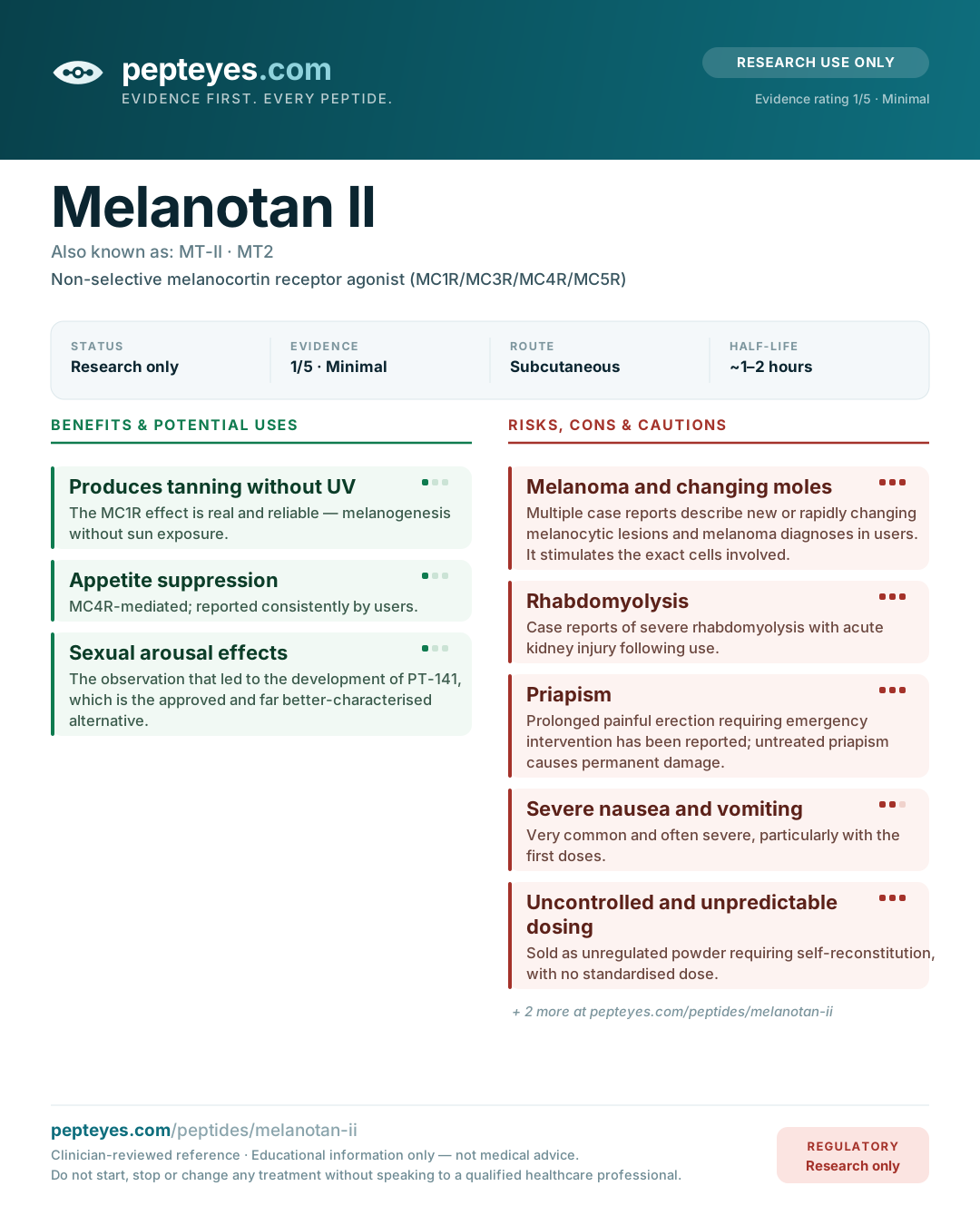
Produces tanning without UV
The MC1R effect is real and reliable — melanogenesis without sun exposure.
Evidence: Preliminary -
Appetite suppression
MC4R-mediated; reported consistently by users.
Evidence: Preliminary -
Sexual arousal effects
The observation that led to the development of PT-141, which is the approved and far better-characterised alternative.
Evidence: Preliminary
Risks and cautions
7 entries · 6 serious or common
-
Melanoma and changing moles
Multiple case reports describe new or rapidly changing melanocytic lesions and melanoma diagnoses in users. It stimulates the exact cells involved.
Evidence: Serious -
Rhabdomyolysis
Case reports of severe rhabdomyolysis with acute kidney injury following use.
Evidence: Serious -
Priapism
Prolonged painful erection requiring emergency intervention has been reported; untreated priapism causes permanent damage.
Evidence: Serious -
Severe nausea and vomiting
Very common and often severe, particularly with the first doses.
Evidence: Moderate evidence -
Uncontrolled and unpredictable dosing
Sold as unregulated powder requiring self-reconstitution, with no standardised dose.
Evidence: Serious -
Regulator warnings worldwide
FDA, MHRA, TGA and EU authorities have all warned consumers specifically against this product.
Evidence: Serious -
Injection-related infection
Non-sterile reconstitution and repeated self-injection have caused abscesses and systemic infection.
Evidence: Serious
Counts are not a score. A single serious risk can outweigh several well-supported benefits, and a long benefit list built on preclinical work outweighs nothing at all.
Opinion — what people actually report
7 themes · 1 reported benefit · 5 reported problems
This is the weakest tier on this site. These are themes drawn from public discussion — forums, subreddits and patient threads — not from trials. There is no control group, no denominator, and no way to confirm that what someone injected matched its label. People post when a result is dramatic and when something goes wrong, and rarely when nothing happens, so treat everything below as a description of the conversation rather than of the compound. The bars count how often a thing is said, not how well it is supported.
-
Tanning works, and quickly Reported benefit. Dominant theme: Comes up in most discussions of this compound.
One of the few compounds in this library where nearly everyone agrees the primary effect occurs and is unmistakable. Reports describe pigmentation developing within weeks with minimal sun exposure.
-
Nausea on dosing is close to universal Reported problem. Dominant theme: Comes up in most discussions of this compound.
The most reported side effect, worst in the first doses and after evening administration.
-
Moles darkening and new ones appearing Reported problem. Dominant theme: Comes up in most discussions of this compound.
The most serious and most frequently raised concern, and the one that produces the most dermatologist visits. It is discussed with genuine alarm rather than as a nuisance.
-
Spontaneous erections and flushing Reported problem. Recurring: Raised regularly, though not by everyone.
An off-target melanocortin effect reported often, sometimes welcomed and often described as inconvenient.
-
Uneven or patchy pigmentation Reported problem. Recurring: Raised regularly, though not by everyone.
Freckling, blotchy tanning and darkening of scars come up frequently.
-
Widely counterfeited and mislabelled Practical note. Recurring: Raised regularly, though not by everyone.
Confusion with Melanotan I and with unlabelled blends is a recurring theme.
-
Appetite suppression Reported problem. Occasional: Reported by a minority, or in specific contexts.
A commonly noticed secondary effect, occasionally the reason people continue.
Where the reports and the evidence part ways
The tanning effect is real and mechanistically clear — this is a non-selective melanocortin agonist and MC1R drives melanogenesis. The nausea and erectile effects follow from the same non-selectivity, which is exactly why the selective analogue that became bremelanotide was developed. The divergence is over risk. Melanotan II has never been approved anywhere, has no toxicology or carcinogenicity programme behind it, and multiple national regulators have issued safety warnings. Case reports document rapidly changing naevi and melanoma diagnoses in users; that is not proof of causation, but a compound that stimulates melanocytes and visibly alters moles carries an unquantified risk that the community's vigilance about mole-checking implicitly acknowledges while continuing anyway.
Cheat sheet
The full sheet, all 77 compounds →The community reference numbers for this compound — reconstitution, working dose, cycle and bloodwork. Research and education only, not medical advice, and not part of the evidence-rated monograph above. Doses assume a 1mL / 100-unit insulin syringe — the calculator does the units for you.
Protocol overview
Dosing & reconstitution 10 mg vial
| WEEK / PHASE | DAILY DOSE | UNITS PER INJECTION |
|---|---|---|
| Week 1 | 250 mcg (0.25 mg) | 2.5 units (0.02 mL) |
| Week 2 | 500 mcg (0.5 mg) | 5 units (0.05 mL) |
| Week 3 | 750 mcg (0.75 mg) | 7.5 units (0.07 mL) |
| Weeks 4 to 8 | 1,000 mcg (1 mg) | 10 units (0.10 mL) |
| Maintenance (after Week 8) | 500 to 1,000 mcg (1 to 2 times weekly) | 5 to 10 units (0.05 to 0.10 mL) |
Frequency: Inject once daily subcutaneously during the initial 8-week tanning phase; transition to 1 or 2 injections per week for maintenance dosing to sustain pigmentation. For 10 unit (0.10 mL) or smaller administrations, consider 30- or 50-unit insulin syringes for improved readability.
On the master sheet
- Vial
- 10mg
- BAC
- 2mL
- Dose
- 250mcg test, 500mcg daily load 1–4wk, then 500mcg weekly-biweekly
- Route
- SubQ
- Cycle
- 4–8 wks
- Bloodwork
- BP + mole exam
- Pre-mixed nasal spray: MT-2 10mg — Tanning, pigmentation
Side-effect family — Melanotan II and PT-141: Nausea and facial flushing · Mole darkening (MT2) · Increased blood pressure. What helps, and the red flags →
Readers on Melanotan II
Questions and answers from readers, under generated names. Nothing here has been checked or reviewed by the site and none of it is medical advice. It is the least verified thing on this page — and it is here because people ask each other these things anyway, and most of the other places they can ask are run by sellers.
0 questions · 0 answers
No questions yet. Ask the first one above — it takes one box and an email address.
How names work, and the house rules
Names. Every verified address is given one generated name — two ordinary words — and keeps it. Nobody chooses a name and nobody can take another's. Posts marked desk were written by the site's own editorial desk, usually to open a thread; they carry a generated name like everyone else's and are held to the site's rules, which means they never state an amount.
What is not allowed. Selling, sourcing, vendor names, coupon codes and "message me" — posts that read that way are held and usually removed. Personal medical details you would not want public. Abuse. Instructions framed as what someone else should do.
What this is not. A reader's report of what happened to them is a report, not a finding, and an answer here is one person's view. Nothing in this section changes the evidence rating above it. If something you read here would change what you take, take it to a pharmacist or physician first.
Your data. Delete any post of yours at any time, or remove everything you have written together with your name. Details in the privacy notice.
Who should avoid it
- Everyone — regulators globally advise against use. Anyone with atypical naevi, melanoma history or fair skin faces particularly elevated risk
If used under medical supervision, monitor
- If used despite advice: dermatologic surveillance with full-body skin examination
Commonly confused with
These mix-ups cause real harm — two products sold under one name, or two molecules whose effects run in opposite directions.
The critical distinction on this site. Afamelanotide (Melanotan I) is a selective MC1R agonist, FDA-approved, delivered as a physician-implanted device for a rare photosensitivity disease. Melanotan II is non-selective, unapproved, self-injected, and the subject of worldwide regulator warnings including melanoma case reports.
Compare side by sidePT-141 was developed from Melanotan II specifically to isolate the sexual-arousal effect without the pigmentation effect. PT-141 is FDA-approved for one indication; Melanotan II is approved nowhere.
Compare side by sideRegulatory & legal status
Illegal to sell for human use in the US, UK, EU and Australia. Not approved anywhere.
Off Category 2 since April 2026 with no committee vote yet: neither prohibited as a significant safety risk nor authorised for compounding.
- Removed from Category 2
- 22 April 2026
- Approved as a drug?
- No. Compounding status and drug approval are separate questions; this compound has no approval for the uses it is sold for.
Removal of the compounding listing changes nothing about the rest of melanotan II’s position: it remains unapproved and unlawful to sell for human use in the US, UK, EU and Australia, and the published case reports of eruptive naevi and melanoma stand.
The full dated record, with sources, and every affected peptide →
Infographic
Where to read further
We link to live literature searches rather than a frozen citation list, so you always see current results — including anything published after our last review.
- PubMed — all published literature on Melanotan II
- PubMed — randomized controlled trials only
- ClinicalTrials.gov — registered human trials
Related peptides in Sexual Health & Melanocortin
Terms used on this page
- Satiety vs Satiation
- Satiation is the set of signals that ends a meal in progress, while satiety is the post-meal inhibition that determines how long it takes before eating begins again.
- Sexual Desire vs Arousal
- Sexual desire is the motivational interest in sexual activity while arousal is the genital and subjective response to stimulation, and the two dissociate enough that trials measure them separately.
- Melanogenesis
- Melanogenesis is the enzymatic synthesis of melanin inside melanosomes and the subsequent transfer of those pigment granules to surrounding keratinocytes, where they shield nuclear DNA.
- Melanocortin System
- The melanocortin system is the POMC-derived signalling network in which alpha-MSH and ACTH act on five receptors to control pigmentation, adrenal steroid output, appetite and energy balance.
- Agonist
- An agonist is a ligand that binds a receptor and stabilises its active conformation, producing a biological response rather than merely occupying the binding site.
- Melanocortin-1 Receptor (MC1R)
- MC1R is the G protein-coupled receptor on melanocytes that, when bound by alpha-MSH or ACTH, raises cyclic AMP and switches pigment synthesis from pheomelanin toward eumelanin.
This page is educational information, not medical advice. It cannot account for your medical history, medications, or risk factors. Do not start, stop or change any treatment based on it. Speak to a qualified healthcare professional who knows your case.