Supplied as a clinic-placed implant
Sexual Health & Melanocortin
At a glance
Ten answers, each one line. Open any row for the detail behind it.
What it does The properly developed sibling of Melanotan II — selective for MC1R, delivered as a…
The properly developed sibling of Melanotan II — selective for MC1R, delivered as a controlled-release implant by a physician, and approved for a rare photosensitivity disorder. It shows what the melanocortin pigmentation mechanism looks like when taken through real drug development.
Half-life ~30 minutes (US label ~0.7 h); the implant releases most drug… — Documented
~30 minutes (US label ~0.7 h); the implant releases most drug within 48 h and over 90% by day 5, with plasma levels gone by day 10.
Typical studied dose Set on the approved label, which states the starting dose, how it is… — On the label
Set on the approved label, which states the starting dose, how it is increased and the maximum. Read it there rather than anywhere else — including here.
How often it is used Set on the approved label. The interval follows the half-life above… — On the label
Set on the approved label. The interval follows the half-life above, which is why some of these are weekly and others daily.
How it is taken Subcutaneous implant (controlled release over ~2 months) — Documented
Subcutaneous implant (controlled release over ~2 months)
Main side effects Melanocytic lesion monitoring required · Very restricted indication and access · Generalised skin darkening — Depends on the study
Melanocytic lesion monitoring required — Twice-yearly full-body skin examination is required by the label; it does not remove the need for sun protection.
Very restricted indication and access — Only for erythropoietic protoporphyria, administered in certified centres. It is not available or appropriate as a tanning product.
Generalised skin darkening — Expected and on-target, but cosmetically significant and unavoidable.
Storage before mixing Refrigerated by the clinic that places it. It is not a vial and not…
Refrigerated by the clinic that places it. It is not a vial and not something handled at home — the implant is inserted by a trained person and releases over weeks.
Shelf life after mixing Nothing to mix — it is not supplied as a powder. The relevant date is…
Nothing to mix — it is not supplied as a powder. The relevant date is the one printed on the product.
Evidence level 5/5 · Very strong — Documented
Multiple phase 3 randomized trials plus regulatory approval in a major market.
Regulatory status FDA Approved — Documented
FDA-approved (2019) and EMA-approved to increase pain-free light exposure in adults with erythropoietic protoporphyria Approved prescription implant, administered by certified healthcare professionals only.
Overview
The properly developed sibling of Melanotan II — selective for MC1R, delivered as a controlled-release implant by a physician, and approved for a rare photosensitivity disorder. It shows what the melanocortin pigmentation mechanism looks like when taken through real drug development.
FDA ApprovedFDA-approved (2019) and EMA-approved to increase pain-free light exposure in adults with erythropoietic protoporphyria
| Regulatory status | FDA-approved (2019) and EMA-approved to increase pain-free light exposure in adults with erythropoietic protoporphyria |
|---|---|
| Drug class | Selective MC1R agonist — alpha-MSH analog |
| Route | Subcutaneous implant (controlled release over ~2 months) |
| Half-life | ~30 minutes (US label ~0.7 h); the implant releases most drug within 48 h and over 90% by day 5, with plasma levels gone by day 10. |
| Evidence rating |
5/5 Very strong
Evidence rating 5 out of 5: Very strong
Multiple phase 3 randomized trials plus regulatory approval in a major market. |
| Studied in | Randomized controlled trials in erythropoietic protoporphyria in the US and Europe; long-term post-authorisation safety registries. |
Afamelanotide sequence & structure
Afamelanotide is a 13-residue linear peptide with a C-terminal amide, carrying D-amino acid substitutions, non-standard residues; molecular weight 1,646.85 Da.
lowercase = D-amino acid[bracketed] = non-standard residue
| Three-letter | Ac-Ser-Tyr-Ser-Nle-Glu-His-D-Phe-Arg-Trp-Gly-Lys-Pro-Val-NH2 |
|---|---|
| Length | 13 amino acid residues |
| Modifications |
|
| Molecular formula | C78H111N21O19 |
| Molecular weight | 1,646.85 Da (average, free base) |
| SMILES | CCCC[C@H](NC(=O)[C@H](CO)NC(=O)[C@H](Cc1ccc(O)cc1)NC(=O)[C@H](CO)NC(C)=O)C(=O)N[C@@H](CCC(=O)O)C(=O)N[C@@H](Cc1c[nH]cn1)C(=O)N[C@H](Cc1ccccc1)C(=O)N[C@@H](CCCNC(=N)N)C(=O)N[C@@H](Cc1c[nH]c2ccccc12)C(=O)NCC(=O)N[C@@H](CCCCN)C(=O)N1CCC[C@H]1C(=O)N[C@H](C(N)=O)C(C)C |
| Identifiers | CAS 75921-69-6 · PubChem CID 16197727 · DrugBank DB04931 |
| Sources | DailyMed / FDA label — SCENESSE (afamelanotide) implant, Description sectionPubChem CID 16197727 — AfamelanotideChEMBL CHEMBL441738 — Afamelanotide (HELM notation)KEGG DRUG D10511 — Afamelanotide (formula, MW, CAS)ChEBI CHEBI:136034 — Afamelanotide (formula, mass, CAS, DrugBank cross-ref) |
Also known as [Nle4,D-Phe7]-alpha-MSH (NDP-alpha-MSH), Melanotan I / CUV1647; Scenesse is the acetate salt (C78H111N21O19·xC2H4O2, 3 ≤ x ≤ 4; 16 mg afamelanotide = 18 mg afamelanotide acetate). Not to be confused with Melanotan II, a cyclic heptapeptide with a different sequence. Formula/MW are for the anhydrous free base; sources differ only in rounding (FDA label 1646.85, KEGG 1646.84, ChEBI/ChEMBL 1646.87). UNII QW68W3J66U; KEGG lists the acetate salt separately as D11334.
Record confidence: high — two independent authoritative sources agree on the sequence and modifications. Every sequence on the site is listed with its sources on the peptide sequences index.
How it works
Selective MC1R agonism increases eumelanin production in the skin, providing photoprotection. In erythropoietic protoporphyria, this reduces the excruciating phototoxic pain that follows even brief light exposure.
Evidence base
Rated 5 of 5 — Very strong. Multiple phase 3 randomized trials plus regulatory approval in a major market.
- Randomized trials plus ongoing post-authorisation safety registries.
Benefits and risks, weighed against the evidence
Every entry below carries the strength of the evidence behind it — three bars for strong human data, two for moderate, one for preliminary or preclinical work. The two columns are not equal by design: where a compound has more documented risk than demonstrated benefit, the lists say so.
Reported benefits
4 entries · 4 on strong human evidence
-
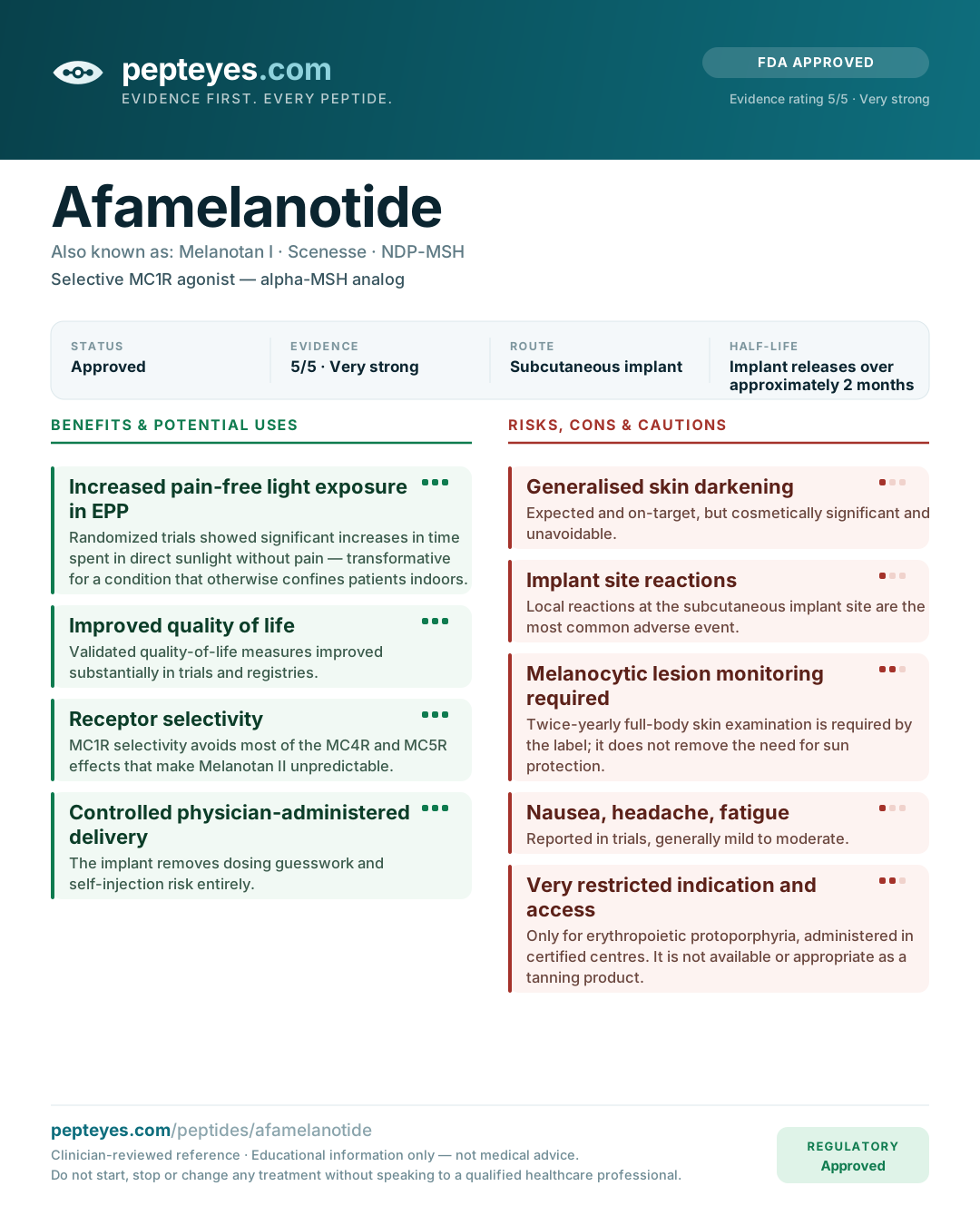
Increased pain-free light exposure in EPP
Randomized trials showed significant increases in time spent in direct sunlight without pain — transformative for a condition that otherwise confines patients indoors.
Evidence: Strong evidence -
Improved quality of life
Validated quality-of-life measures improved substantially in trials and registries.
Evidence: Strong evidence -
Receptor selectivity
MC1R selectivity avoids most of the MC4R and MC5R effects that make Melanotan II unpredictable.
Evidence: Strong evidence -
Controlled physician-administered delivery
The implant removes dosing guesswork and self-injection risk entirely.
Evidence: Strong evidence
Risks and cautions
5 entries
-
Generalised skin darkening
Expected and on-target, but cosmetically significant and unavoidable.
Evidence: Minor -
Implant site reactions
Local reactions at the subcutaneous implant site are the most common adverse event.
Evidence: Minor -
Melanocytic lesion monitoring required
Twice-yearly full-body skin examination is required by the label; it does not remove the need for sun protection.
Evidence: Moderate evidence -
Nausea, headache, fatigue
Reported in trials, generally mild to moderate.
Evidence: Minor -
Very restricted indication and access
Only for erythropoietic protoporphyria, administered in certified centres. It is not available or appropriate as a tanning product.
Evidence: Moderate evidence
Counts are not a score. A single serious risk can outweigh several well-supported benefits, and a long benefit list built on preclinical work outweighs nothing at all.
Opinion — what people actually report
5 themes · 1 reported benefit · 3 reported problems
This is the weakest tier on this site. These are themes drawn from public discussion — forums, subreddits and patient threads — not from trials. There is no control group, no denominator, and no way to confirm that what someone injected matched its label. People post when a result is dramatic and when something goes wrong, and rarely when nothing happens, so treat everything below as a description of the conversation rather than of the compound. The bars count how often a thing is said, not how well it is supported.
-
Genuinely enabling for EPP patients Reported benefit. Dominant theme: Comes up in most discussions of this compound.
Among the most positive reports in this library. People with erythropoietic protoporphyria describe being able to go outside for the first time, which is a different order of benefit from most compounds here.
-
The implant insertion itself Reported problem. Dominant theme: Comes up in most discussions of this compound.
A subdermal implant every two months is the main practical complaint, with site soreness and occasional extrusion discussed.
-
Skin darkening is expected Reported problem. Recurring: Raised regularly, though not by everyone.
A direct and universal melanocortin effect, generally accepted as part of the treatment.
-
Nausea and headache after implantation Reported problem. Recurring: Raised regularly, though not by everyone.
Nausea and headache in the days after an implant are frequently reported, and are described as settling as the course continues.
-
Access and cost are the dominant frustration Practical note. Dominant theme: Comes up in most discussions of this compound.
Availability varies enormously by country and payer, and this dominates patient group discussion.
Where the reports and the evidence part ways
Reports and evidence align closely. Trials showed increased pain-free sunlight exposure in EPP, and the approval reflects that. The important divergence is elsewhere on the internet: afamelanotide is routinely confused with Melanotan I in tanning discussions, where an approved, monitored implant for a rare photosensitivity disorder is cited as evidence for unregulated injectable tanning. They are related molecules used in unrelated ways under completely different levels of oversight.
Readers on Afamelanotide
Questions and answers from readers, under generated names. Nothing here has been checked or reviewed by the site and none of it is medical advice. It is the least verified thing on this page — and it is here because people ask each other these things anyway, and most of the other places they can ask are run by sellers.
0 questions · 0 answers
No questions yet. Ask the first one above — it takes one box and an email address.
How names work, and the house rules
Names. Every verified address is given one generated name — two ordinary words — and keeps it. Nobody chooses a name and nobody can take another's. Posts marked desk were written by the site's own editorial desk, usually to open a thread; they carry a generated name like everyone else's and are held to the site's rules, which means they never state an amount.
What is not allowed. Selling, sourcing, vendor names, coupon codes and "message me" — posts that read that way are held and usually removed. Personal medical details you would not want public. Abuse. Instructions framed as what someone else should do.
What this is not. A reader's report of what happened to them is a report, not a finding, and an answer here is one person's view. Nothing in this section changes the evidence rating above it. If something you read here would change what you take, take it to a pharmacist or physician first.
Your data. Delete any post of yours at any time, or remove everything you have written together with your name. Details in the privacy notice.
Who should avoid it
- Anyone without erythropoietic protoporphyria
- Hepatic impairment
- Pregnancy
If used under medical supervision, monitor
- Full-body skin examination twice yearly
- Liver function
- Implant site assessment
Commonly confused with
These mix-ups cause real harm — two products sold under one name, or two molecules whose effects run in opposite directions.
Afamelanotide is Melanotan I: selective, approved, physician-implanted, for a rare disease. Melanotan II is non-selective, unapproved, self-injected, and carries worldwide regulator warnings.
Compare side by sideRegulatory & legal status
Approved prescription implant, administered by certified healthcare professionals only.
Infographic
Where to read further
We link to live literature searches rather than a frozen citation list, so you always see current results — including anything published after our last review.
- PubMed — all published literature on Afamelanotide
- PubMed — randomized controlled trials only
- ClinicalTrials.gov — registered human trials
- DailyMed — official FDA prescribing information
Related peptides in Sexual Health & Melanocortin
Terms used on this page
- Melanocortin System
- The melanocortin system is the POMC-derived signalling network in which alpha-MSH and ACTH act on five receptors to control pigmentation, adrenal steroid output, appetite and energy balance.
- Subcutaneous Implant
- A subcutaneous implant is a solid depot placed under the skin by a minor procedure, releasing its drug slowly by diffusion or matrix erosion over months rather than hours.
- Melanocortin-1 Receptor (MC1R)
- MC1R is the G protein-coupled receptor on melanocytes that, when bound by alpha-MSH or ACTH, raises cyclic AMP and switches pigment synthesis from pheomelanin toward eumelanin.
- Agonist
- An agonist is a ligand that binds a receptor and stabilises its active conformation, producing a biological response rather than merely occupying the binding site.
- Receptor Selectivity
- Receptor selectivity is the degree to which a ligand acts on its intended receptor rather than related ones, expressed as the ratio between its potency at the target and at each off-target.
- MC3R vs MC4R
- MC3R and MC4R are the two central melanocortin receptors, with MC4R driving satiety and energy expenditure and MC3R tuning nutrient partitioning and the timing of puberty.
This page is educational information, not medical advice. It cannot account for your medical history, medications, or risk factors. Do not start, stop or change any treatment based on it. Speak to a qualified healthcare professional who knows your case.