Supplied as a lyophilised powder to reconstitute
Bone, Muscle & Other
At a glance
Ten answers, each one line. Open any row for the detail behind it.
What it does The body's principal intracellular antioxidant, and an entirely legitimate molecule with a…
The body's principal intracellular antioxidant, and an entirely legitimate molecule with a largely illegitimate injectable market. Oral supplementation faces a real bioavailability problem; IV skin-lightening infusions face a real safety problem.
Half-life ~14 minutes (14.1 +/- 9.2) after intravenous dosing in healthy… — Documented
~14 minutes (14.1 +/- 9.2) after intravenous dosing in healthy adults.
Typical studied dose Set by the label of the regulator that approved it, which is not an FDA… — On the label
Set by the label of the regulator that approved it, which is not an FDA label and may not be in English. The approving country decides the dose, and it is not always the same as the dose studied elsewhere.
How often it is used Set on the approved label. The interval follows the half-life above… — On the label
Set on the approved label. The interval follows the half-life above, which is why some of these are weekly and others daily.
How it is taken Oral, intravenous, liposomal, inhaled — Documented
Oral, intravenous, liposomal, inhaled
Main side effects Endotoxin in dietary-supplement-grade powder · IV skin-lightening infusions are unapproved and unsafe · Infection risk from unregulated infusion clinics — Carries serious risk
Endotoxin in dietary-supplement-grade powder — The injectable glutathione market runs on bulk powder, and twice, in 2019 and 2026, compounders used powder labelled for dietary supplements rather than for injection. Both times patients developed fever, chills, hypotension and shock-like reactions within minutes to hours, traced to bacterial endotoxin, which survives sterilisation and is not caught by a sterility test. In 2026 at least 30 patients were affected across several states and three pharmacies recalled product. A vial can be sterile and still pyrogenic; only a bacterial endotoxin test on the batch would show it, and a 503A pharmacy is not required to run one on every lot.
IV skin-lightening infusions are unapproved and unsafe — FDA and several national regulators have warned against them following reports of severe adverse events including Stevens-Johnson syndrome, renal dysfunction and thyroid effects.
Infection risk from unregulated infusion clinics — Non-sterile compounding and IV administration in non-medical settings has caused serious infections.
Storage before mixing As a sealed lyophilised powder, refrigerated is typical and a freezer…
As a sealed lyophilised powder, refrigerated is typical and a freezer suits long storage; both should be dark and dry. A dry powder tolerates a few days out of the cold far better than anything in solution — which is why it ships that way.
Shelf life after mixing Once mixed it is refrigerated and treated as short-lived. Bacteriostatic…
Once mixed it is refrigerated and treated as short-lived. Bacteriostatic water contains a preservative and buys the longer window; sterile water contains none and buys a much shorter one. Peptides in solution also degrade on their own, so the container is only half the question.
Evidence level 3/5 · Moderate — Depends on the study
Small or early-phase human trials, or good controlled topical human data.
Regulatory status Limited Approval — Documented
Lawful as an oral supplement. Injectable glutathione is approved in the Philippines only as an adjunct to cisplatin chemotherapy; no injectable is FDA-approved for any systemic use, and US compounding of it rests on interim enforcement discretion while the substance is under evaluation. Injectable use for skin lightening or wellness is unapproved everywhere. Lawful as an oral supplement. Injectable cosmetic use is unapproved and subject to import alerts.
Overview
The body's principal intracellular antioxidant, and an entirely legitimate molecule with a largely illegitimate injectable market. Oral supplementation faces a real bioavailability problem; IV skin-lightening infusions face a real safety problem.
Limited or non-US approvalLawful as an oral supplement. Injectable cosmetic use is unapproved and subject to import alerts.
| Regulatory status | Lawful as an oral supplement. Injectable glutathione is approved in the Philippines only as an adjunct to cisplatin chemotherapy; no injectable is FDA-approved for any systemic use, and US compounding of it rests on interim enforcement discretion while the substance is under evaluation. Injectable use for skin lightening or wellness is unapproved everywhere. |
|---|---|
| Drug class | Endogenous tripeptide antioxidant (glutamate-cysteine-glycine) |
| Route | Oral, intravenous, liposomal, inhaled |
| Half-life | ~14 minutes (14.1 +/- 9.2) after intravenous dosing in healthy adults. |
| Evidence rating |
3/5 Moderate
Evidence rating 3 out of 5: Moderate
Small or early-phase human trials, or good controlled topical human data. |
| Studied in | Randomised double-blind trials of pharmaceutical-grade IV glutathione given alongside cisplatin or oxaliplatin to blunt neuropathy (about 50 to 150 patients each, 1990s to 2002; a 2014 Cochrane review pooled seven such trials); a negative 21-patient randomised pilot in Parkinson disease; five small oral trials for skin tone; one non-randomised, unblinded IV skin-lightening study of 32 women with a non-significant result and frequent liver-enzyme derangement. No controlled trial of IV glutathione for fatigue, immunity or wellness in healthy adults. |
Glutathione sequence & structure
Glutathione is a 3-residue linear peptide with a free C-terminal acid; molecular weight 307.33 Da.
| Three-letter | H-γ-Glu-Cys-Gly-OH |
|---|---|
| Length | 3 amino acid residues |
| Modifications |
|
| Molecular formula | C10H17N3O6S |
| Molecular weight | 307.33 Da (average, free base) |
| SMILES | N[C@@H](CCC(=O)N[C@@H](CS)C(=O)NCC(=O)O)C(=O)O |
| Identifiers | CAS 70-18-8 · PubChem CID 124886 · DrugBank DB00143 |
| Which molecule | "Glutathione" covers both the reduced monomer (GSH, CAS 70-18-8) and the oxidised disulfide dimer (GSSG, C20H32N6O12S2, MW 612.63). This record describes reduced GSH, the form sold as an oral supplement and used in IV/liposomal/inhaled products, which is what the monograph (aka GSH, L-glutathione) describes; oxidation to GSSG links two GSH units via a Cys–Cys disulfide. |
| Sources | ChEBI CHEBI:16856 — L-γ-glutamyl-L-cysteinylglycine (formula, 307.328 Da, CAS 70-18-8, SMILES, InChIKey)PubChem CID 124886 (properties)PubChem CID 124886 (synonyms: CAS 70-18-8, DB00143, CHEMBL1543, CHEBI:16856)ChEMBL CHEMBL1543NovoPro Labs — Glutathione peptide (Glu-Cys-Gly, 96.9% HPLC) |
ChEBI, PubChem and ChEMBL independently agree on formula C10H17N3O6S, MW 307.33, stereochemistry (L-Glu, L-Cys), the γ-glutamyl linkage and InChIKey RWSXRVCMGQZWBV-WDSKDSINSA-N; CAS 70-18-8 check digit verified. The one-letter string 'ECG' understates the structure: a vendor listing 'Glu-Cys-Gly' with a normal α-peptide bond would be a different, non-natural isomer. No FDA-approved glutathione drug exists; DailyMed shows only unapproved cosmetic/OTC listings, and injectable products are compounded (FDA has warned about endotoxin in compounded glutathione). Endogenous GSH is made enzymatically (GCL then GSS), not ribosomally, so there is no UniProt precursor.
Record confidence: high — two independent authoritative sources agree on the sequence and modifications. Every sequence on the site is listed with its sources on the peptide sequences index.
How it works
Central redox buffer neutralising reactive oxygen species and supporting phase II hepatic detoxification via glutathione S-transferases. The skin-lightening claim rests on inhibition of tyrosinase and a shift from eumelanin toward pheomelanin production.
Evidence base
Rated 3 of 5 — Moderate. Small or early-phase human trials, or good controlled topical human data.
- Strong physiology, weak supplementation evidence, and a genuinely hazardous injectable market.
- The rating is carried entirely by the chemotherapy-adjunct trials of pharmaceutical-grade product given for a few doses under supervision, and by a non-US approval for that narrow use. None of it transfers to the wellness infusions sold as immunity, fatigue or detox support, which have no controlled human evidence at all.
- Two regulatory episodes bracket the injectable market: in 2019 and again in 2026, compounders injected glutathione powder sold as dietary-supplement grade, and patients developed fever, chills, hypotension and sepsis-like reactions traced to bacterial endotoxin. The failure was the ingredient grade, not the molecule.
Benefits and risks, weighed against the evidence
Every entry below carries the strength of the evidence behind it — three bars for strong human data, two for moderate, one for preliminary or preclinical work. The two columns are not equal by design: where a compound has more documented risk than demonstrated benefit, the lists say so.
Reported benefits
5 entries · 2 on strong human evidence
-
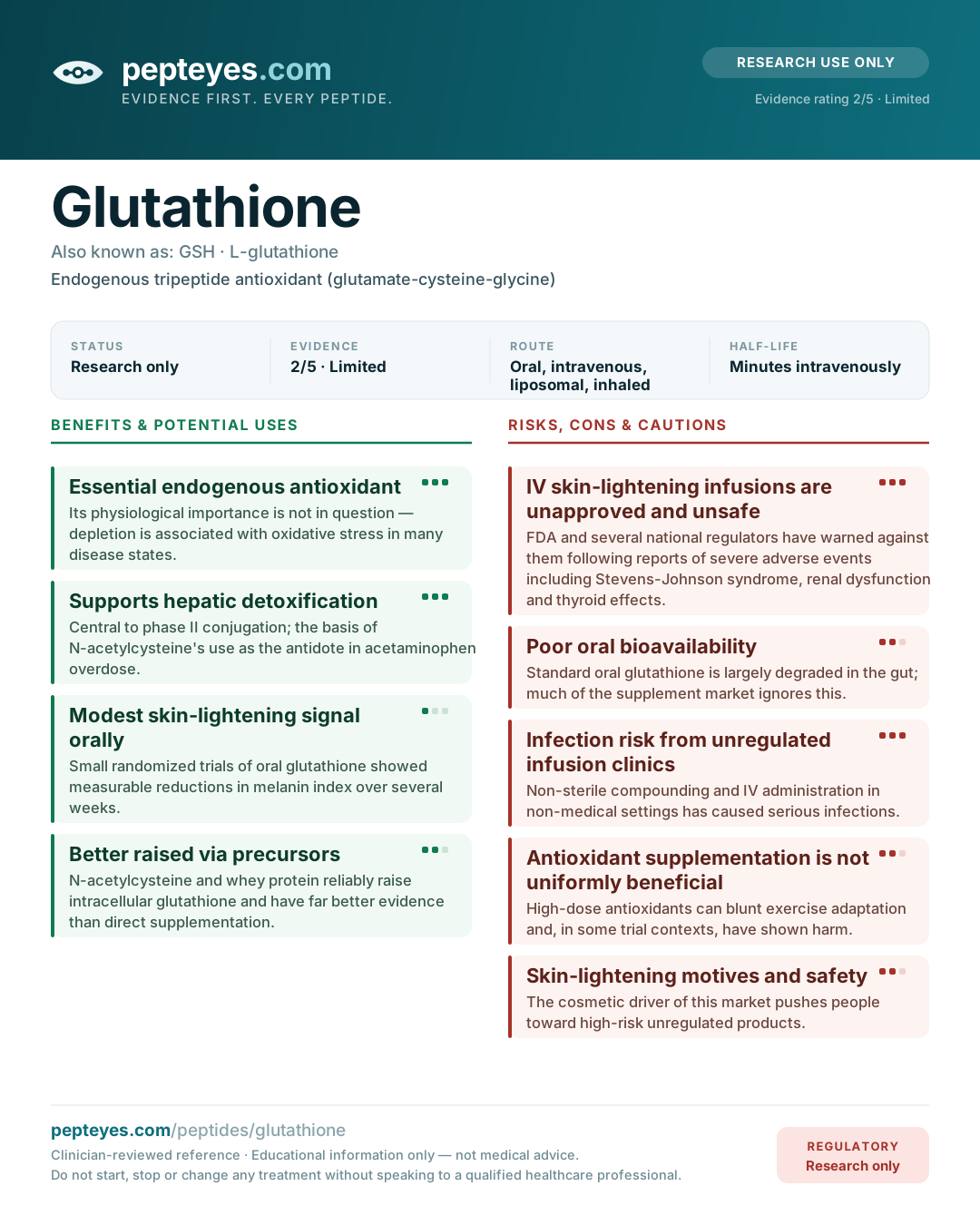
Essential endogenous antioxidant
Its physiological importance is not in question — depletion is associated with oxidative stress in many disease states.
Evidence: Strong evidence -
Supports hepatic detoxification
Central to phase II conjugation; the basis of N-acetylcysteine's use as the antidote in acetaminophen overdose.
Evidence: Strong evidence -
Modest skin-lightening signal orally
Small randomized trials of oral glutathione showed measurable reductions in melanin index over several weeks.
Evidence: Preliminary -
Reduces platinum chemotherapy neuropathy in small trials
Randomised double-blind trials in gastric, colorectal and ovarian cancer found fewer patients developing clinically significant neuropathy when pharmaceutical-grade glutathione was infused around cisplatin or oxaliplatin, without blunting tumour response; a Cochrane review pooled seven such trials. Subjective toxicity scales, small numbers, and a supervised oncology setting: this is the legitimate injectable use, and it is nothing like a wellness drip.
Evidence: Moderate evidence -
Better raised via precursors
N-acetylcysteine and whey protein reliably raise intracellular glutathione and have far better evidence than direct supplementation.
Evidence: Moderate evidence
Risks and cautions
6 entries · 3 serious or common
-
Endotoxin in dietary-supplement-grade powder
The injectable glutathione market runs on bulk powder, and twice, in 2019 and 2026, compounders used powder labelled for dietary supplements rather than for injection. Both times patients developed fever, chills, hypotension and shock-like reactions within minutes to hours, traced to bacterial endotoxin, which survives sterilisation and is not caught by a sterility test. In 2026 at least 30 patients were affected across several states and three pharmacies recalled product. A vial can be sterile and still pyrogenic; only a bacterial endotoxin test on the batch would show it, and a 503A pharmacy is not required to run one on every lot.
Evidence: Serious -
IV skin-lightening infusions are unapproved and unsafe
FDA and several national regulators have warned against them following reports of severe adverse events including Stevens-Johnson syndrome, renal dysfunction and thyroid effects.
Evidence: Serious -
Poor oral bioavailability
Standard oral glutathione is largely degraded in the gut; much of the supplement market ignores this.
Evidence: Moderate evidence -
Infection risk from unregulated infusion clinics
Non-sterile compounding and IV administration in non-medical settings has caused serious infections.
Evidence: Serious -
Antioxidant supplementation is not uniformly beneficial
High-dose antioxidants can blunt exercise adaptation and, in some trial contexts, have shown harm.
Evidence: Moderate evidence -
Skin-lightening motives and safety
The cosmetic driver of this market pushes people toward high-risk unregulated products.
Evidence: Moderate evidence
Counts are not a score. A single serious risk can outweigh several well-supported benefits, and a long benefit list built on preclinical work outweighs nothing at all.
Opinion — what people actually report
5 themes · 2 reported benefits · 2 reported problems
This is the weakest tier on this site. These are themes drawn from public discussion — forums, subreddits and patient threads — not from trials. There is no control group, no denominator, and no way to confirm that what someone injected matched its label. People post when a result is dramatic and when something goes wrong, and rarely when nothing happens, so treat everything below as a description of the conversation rather than of the compound. The bars count how often a thing is said, not how well it is supported.
-
Skin brightening is the main draw Reported benefit. Dominant theme: Comes up in most discussions of this compound.
The dominant use worldwide, particularly for intravenous infusions marketed for skin lightening.
-
Oral forms widely reported as useless Reported problem. Dominant theme: Comes up in most discussions of this compound.
A consistent theme that oral glutathione is broken down before absorption, with NAC or liposomal forms suggested instead.
-
IV infusions carry real reported harm Reported problem. Dominant theme: Comes up in most discussions of this compound.
Serious adverse events from unregulated infusion clinics are discussed, and several national regulators have issued warnings that circulate in these threads.
-
Reports of reduced hangover and general wellbeing Reported benefit. Recurring: Raised regularly, though not by everyone.
Common but non-specific and easily attributable to the fluids in an infusion.
-
Not really a peptide in the way people mean Practical note. Recurring: Raised regularly, though not by everyone.
It is a tripeptide, which is why it appears here, but it behaves like a small-molecule antioxidant rather than a signalling peptide.
Where the reports and the evidence part ways
The oral bioavailability scepticism is correct — glutathione is largely hydrolysed in the gut, which is why cysteine donors are the more sensible oral route. On skin lightening, the evidence is thin, small and mostly from a few regions, and the intravenous practice is genuinely dangerous: the FDA and other regulators have warned against injectable skin-lightening products, and serious adverse events including Stevens-Johnson syndrome and renal injury have been reported. The community is right about the oral form and considerably too relaxed about the injectable one.
Cheat sheet
The full sheet, all 77 compounds →The community reference numbers for this compound — reconstitution, working dose, cycle and bloodwork. Research and education only, not medical advice, and not part of the evidence-rated monograph above. Doses assume a 1mL / 100-unit insulin syringe — the calculator does the units for you.
Protocol overview
Dosing & reconstitution 1,500 mg vial
| WEEK | DAILY DOSE | UNITS PER INJECTION |
|---|---|---|
| Weeks 1 to 2 | 100 mg | 20 units (0.20 mL) |
| Weeks 3 to 4 | 150 mg | 30 units (0.30 mL) |
| Weeks 5 to 8 | 200 mg | 40 units (0.40 mL) |
Frequency: Inject once daily subcutaneously, or split into every-other-day dosing based on protocol goals. Some protocols utilize 200 mg 1 to 2 times weekly for maintenance.
- Pre-mixed nasal spray: Glutathione 500mg — Antioxidant, detox, skin
Readers on Glutathione
Questions and answers from readers, under generated names. Nothing here has been checked or reviewed by the site and none of it is medical advice. It is the least verified thing on this page — and it is here because people ask each other these things anyway, and most of the other places they can ask are run by sellers.
0 questions · 0 answers
No questions yet. Ask the first one above — it takes one box and an email address.
How names work, and the house rules
Names. Every verified address is given one generated name — two ordinary words — and keeps it. Nobody chooses a name and nobody can take another's. Posts marked desk were written by the site's own editorial desk, usually to open a thread; they carry a generated name like everyone else's and are held to the site's rules, which means they never state an amount.
What is not allowed. Selling, sourcing, vendor names, coupon codes and "message me" — posts that read that way are held and usually removed. Personal medical details you would not want public. Abuse. Instructions framed as what someone else should do.
What this is not. A reader's report of what happened to them is a report, not a finding, and an answer here is one person's view. Nothing in this section changes the evidence rating above it. If something you read here would change what you take, take it to a pharmacist or physician first.
Your data. Delete any post of yours at any time, or remove everything you have written together with your name. Details in the privacy notice.
Who should avoid it
- IV glutathione for cosmetic purposes
- Asthma (inhaled forms have triggered bronchospasm)
- Pregnancy for injectable use
If used under medical supervision, monitor
- Renal and hepatic function if using injectable forms
- Skin examination
Commonly confused with
These mix-ups cause real harm — two products sold under one name, or two molecules whose effects run in opposite directions.
Both marketed for skin, both frequently offered by IV infusion clinics. Neither has evidence supporting intravenous cosmetic use, and IV glutathione has specific regulator warnings against it.
Compare side by sideRegulatory & legal status
Lawful as an oral supplement. Injectable cosmetic use is unapproved and subject to import alerts.
Infographic
Where to read further
We link to live literature searches rather than a frozen citation list, so you always see current results — including anything published after our last review.
- PubMed — all published literature on Glutathione
- PubMed — randomized controlled trials only
- ClinicalTrials.gov — registered human trials
Related peptides in Bone, Muscle & Other
Terms used on this page
- Bioavailability
- Bioavailability is the fraction of an administered dose that reaches the systemic circulation chemically unchanged, measured against an intravenous dose of the same drug.
- Tyrosinase
- Tyrosinase is the copper-dependent melanosomal enzyme that catalyses the rate-limiting first steps of melanin synthesis, making it the principal target of depigmenting agents.
- Buffer and pH Adjustment
- A buffer is a weak acid and its conjugate base that holds a formulation at a chosen pH, which determines a peptide's charge, its solubility, and which degradation reactions dominate.
- Endotoxin (Lipopolysaccharide)
- Endotoxin is the lipopolysaccharide of Gram-negative outer membranes, a heat-stable TLR4 agonist that causes fever and shock at nanogram doses and that sterilisation does not remove.
- Statistical vs Clinical Significance
- Statistical significance says a difference is unlikely to be chance alone, clinical significance says it is large enough to matter to a patient, and a result can satisfy one without the other.
- Systematic Review
- A systematic review answers a defined question using a prespecified protocol, an explicit multi-database search, stated eligibility criteria and formal risk-of-bias assessment, unlike a narrative review.
This page is educational information, not medical advice. It cannot account for your medical history, medications, or risk factors. Do not start, stop or change any treatment based on it. Speak to a qualified healthcare professional who knows your case.