Supplied as a lyophilised powder to reconstitute
Bone, Muscle & Other
At a glance
Ten answers, each one line. Open any row for the detail behind it.
What it does Designed to kill the blood supply feeding fat tissue.
Designed to kill the blood supply feeding fat tissue. It worked in monkeys — and damaged their kidneys. Development stopped, and it is included here because it continues to be sold online to people unaware of why it was abandoned.
Half-life Not characterised. No pharmacokinetic data have been published… — Nothing established
Not characterised. No pharmacokinetic data have been published in any species, and the only human trial was terminated without results.
Typical studied dose None established. No dose has ever been set for a human being, because… — Nothing established
None established. No dose has ever been set for a human being, because the studies that would set one have not been done. Any figure circulating for this compound was chosen by somebody selling it or by somebody guessing.
How often it is used No schedule exists. Cycles and intervals quoted for this compound come… — Nothing established
No schedule exists. Cycles and intervals quoted for this compound come from forums rather than from any study, and they vary because nothing anchors them.
How it is taken Subcutaneous (research) — Documented
Subcutaneous (research)
Main side effects Dose-dependent nephrotoxicity · Almost no human data · Non-selective apoptosis — Carries serious risk
Dose-dependent nephrotoxicity — Kidney damage in primate studies was the reason development stopped. This is not a theoretical concern.
Almost no human data — The only human exposure on record is a four-participant phase 1 trial in advanced prostate cancer that was terminated without published results, so nothing about safety or effect in people has been characterised. Development stopped because of primate kidney toxicity.
Non-selective apoptosis — Prohibitin is expressed elsewhere; off-target vascular apoptosis is a design-level risk.
Storage before mixing As a sealed lyophilised powder, refrigerated is typical and a freezer…
As a sealed lyophilised powder, refrigerated is typical and a freezer suits long storage; both should be dark and dry. A dry powder tolerates a few days out of the cold far better than anything in solution — which is why it ships that way.
Shelf life after mixing Once mixed it is refrigerated and treated as short-lived. Bacteriostatic…
Once mixed it is refrigerated and treated as short-lived. Bacteriostatic water contains a preservative and buys the longer window; sterile water contains none and buys a much shorter one. Peptides in solution also degrade on their own, so the container is only half the question.
Evidence level 1/5 · Minimal — Nothing established
Animal or laboratory data only. No human efficacy evidence.
Regulatory status Research Use Only — Nothing established
Development halted after primate studies showed dose-dependent kidney toxicity. Not approved. Not approved. Development discontinued.
Overview
Designed to kill the blood supply feeding fat tissue. It worked in monkeys — and damaged their kidneys. Development stopped, and it is included here because it continues to be sold online to people unaware of why it was abandoned.
Not approved for human use anywhereNo approval anywhere for human use. Sold under research-use labelling. Not approved. Development discontinued.
| Regulatory status | Development halted after primate studies showed dose-dependent kidney toxicity. Not approved. |
|---|---|
| Drug class | Peptidomimetic targeting prohibitin on adipose vasculature, fused to a pro-apoptotic domain |
| Route | Subcutaneous (research) |
| Half-life | Not characterised. No pharmacokinetic data have been published in any species, and the only human trial was terminated without results. |
| Evidence rating |
1/5 Minimal
Evidence rating 1 out of 5: Minimal
Animal or laboratory data only. No human efficacy evidence. |
| Studied in | Obese rhesus monkey studies showing rapid weight loss alongside renal toxicity; rodent studies. One first-in-human phase 1 trial (NCT01262664, MD Anderson, 2012–2019) in men with metastatic prostate cancer and obesity enrolled four participants and was terminated at the investigator's request; no efficacy results were published. |
Adipotide sequence & structure
Adipotide is a 25-residue linear peptide with a free C-terminal acid, carrying D-amino acid substitutions; molecular weight 2,557.21 Da.
lowercase = D-amino acid
| Three-letter | H-Cys-Lys-Gly-Gly-Arg-Ala-Lys-Asp-Cys-Gly-Gly-D-Lys-D-Leu-D-Ala-D-Lys-D-Leu-D-Ala-D-Lys-D-Lys-D-Leu-D-Ala-D-Lys-D-Leu-D-Ala-D-Lys-OH |
|---|---|
| Length | 25 amino acid residues |
| Modifications |
|
| Molecular formula | C111H206N36O28S2 |
| Molecular weight | 2,557.21 Da (average, free base) |
| Identifiers | CAS 859216-15-2 · PubChem CID 163360068 |
| Which molecule | Adipotide, FTPP, prohibitin-TP01/TP01 and HKPao all denote the same 25-residue chimera CKGGRAKDC-GG-D(KLAKLAK)2, described in the source literature as a peptidomimetic although it is chemically an ordinary all-amide peptide. This record describes the reduced, linear, free-acid form registered under CAS 859216-15-2 and depicted at PubChem CID 163360068 (free Cys thiols, C111H206N36O28S2, 2557.21 Da) - the form research suppliers ship. The homing motif is a CX7C phage-display insert, so the Cys1-Cys9 disulfide-cyclised form (C111H204N36O28S2, 2555.20 Da) is the biologically relevant constraint and is what some secondary sources quote instead. |
| Sources | PubChem CID 163360068 (Adipotide) - formula, average mass, per-residue stereodescriptors and CAS synonymUS Patent 7,452,964 (Arap/Pasqualini/Kolonin) - targeting peptides against adipose tissue, CKGGRAKDC as SEQ ID NO:22 with the (KLAKLAK)2 pro-apoptotic agentKolonin MG et al., Reversal of obesity by targeted ablation of adipose tissue, Nat Med 2004;10:625-632 (PMID 15133506)ClinicalTrials.gov NCT01262664 - first-in-man Phase 1 of Prohibitin-TP01 in metastatic prostate cancer and obesity (terminated)Wikipedia: Prohibitin-targeting peptide 1 (cross-check for CAS and sequence) |
Formula and mass are for the free base of the reduced linear free-acid form; supplied material is normally a TFA or acetate salt, so vial mass overstates peptide content. Common vendor errors are writing the D-domain in uppercase as if L, and quoting the cyclised mass (2555.2) against the linear formula (2557.21); no INN, DrugBank, ChEMBL or NCI Thesaurus record exists, so PubChem is the only authoritative structure record.
Record confidence: medium — one authoritative source, or sources agree on the sequence but not on every identifier. Every sequence on the site is listed with its sources on the peptide sequences index.
How it works
A homing peptide targeting prohibitin, expressed on the endothelium of white adipose tissue vasculature, coupled to a pro-apoptotic peptide domain. Binding triggers apoptosis in the adipose blood supply, causing fat tissue to regress from ischemia.
Evidence base
Rated 1 of 5 — Minimal. Animal or laboratory data only. No human efficacy evidence.
- Abandoned for documented organ toxicity in primates — the clearest possible negative signal short of a human trial.
Benefits and risks, weighed against the evidence
Every entry below carries the strength of the evidence behind it — three bars for strong human data, two for moderate, one for preliminary or preclinical work. The two columns are not equal by design: where a compound has more documented risk than demonstrated benefit, the lists say so.
Reported benefits
2 entries
-
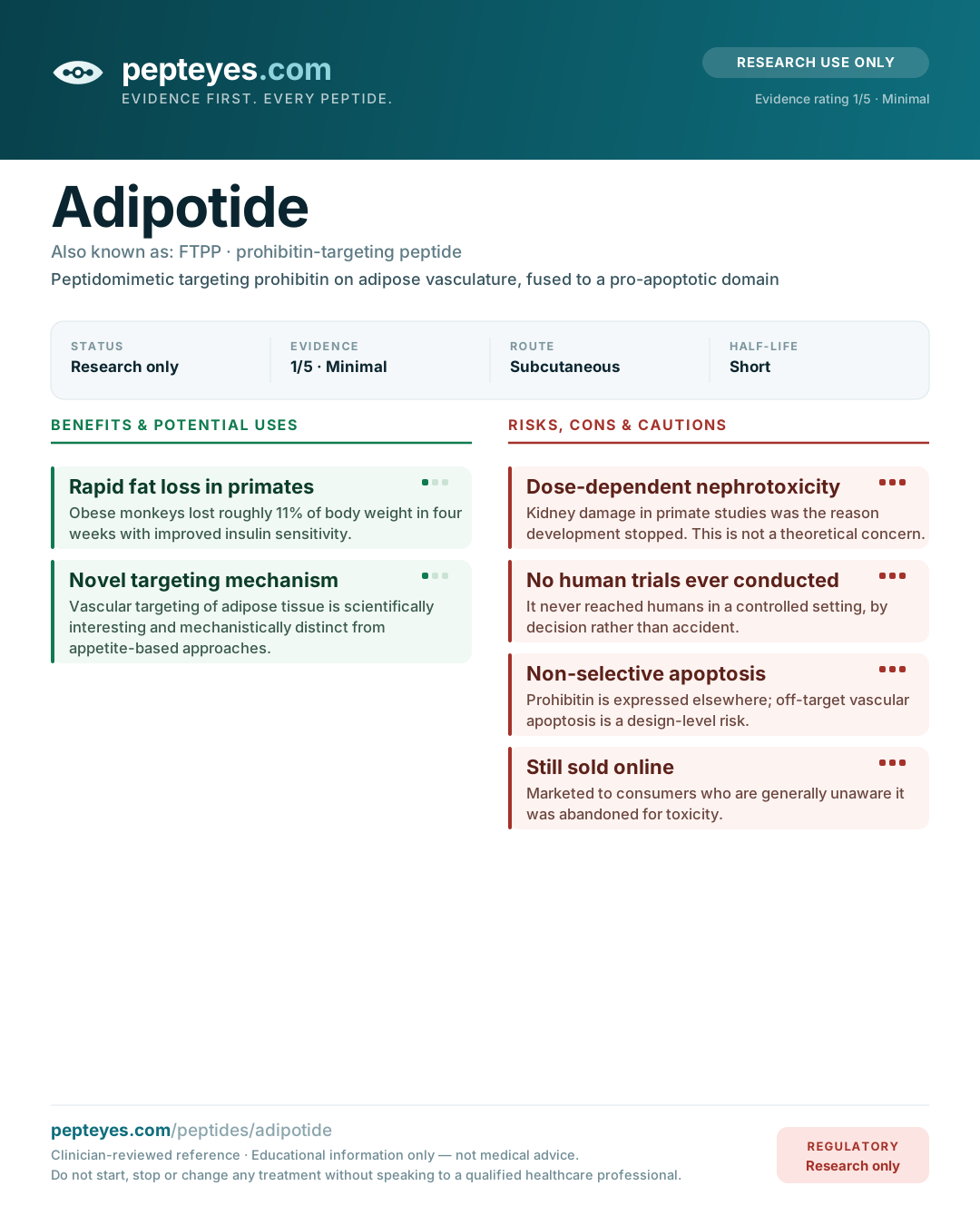
Rapid fat loss in primates
Obese monkeys lost roughly 11% of body weight in four weeks with improved insulin sensitivity.
Evidence: Preliminary -
Novel targeting mechanism
Vascular targeting of adipose tissue is scientifically interesting and mechanistically distinct from appetite-based approaches.
Evidence: Preliminary
Risks and cautions
4 entries · 4 serious or common
-
Dose-dependent nephrotoxicity
Kidney damage in primate studies was the reason development stopped. This is not a theoretical concern.
Evidence: Serious -
Almost no human data
The only human exposure on record is a four-participant phase 1 trial in advanced prostate cancer that was terminated without published results, so nothing about safety or effect in people has been characterised. Development stopped because of primate kidney toxicity.
Evidence: Serious -
Non-selective apoptosis
Prohibitin is expressed elsewhere; off-target vascular apoptosis is a design-level risk.
Evidence: Serious -
Still sold online
Marketed to consumers who are generally unaware it was abandoned for toxicity.
Evidence: Serious
Counts are not a score. A single serious risk can outweigh several well-supported benefits, and a long benefit list built on preclinical work outweighs nothing at all.
Opinion — what people actually report
4 themes · 1 reported benefit · 2 reported problems
This is the weakest tier on this site. These are themes drawn from public discussion — forums, subreddits and patient threads — not from trials. There is no control group, no denominator, and no way to confirm that what someone injected matched its label. People post when a result is dramatic and when something goes wrong, and rarely when nothing happens, so treat everything below as a description of the conversation rather than of the compound. The bars count how often a thing is said, not how well it is supported.
-
Kidney toxicity dominates the discussion Reported problem. Dominant theme: Comes up in most discussions of this compound.
Unusually, the most-repeated theme in every thread is a warning rather than a benefit. The renal findings in primate studies are cited constantly.
-
Very few people report actually using it Reported problem. Dominant theme: Comes up in most discussions of this compound.
Discussion is mostly people talking each other out of it, which is rare in this space.
-
Occasional claims of rapid fat loss Reported benefit. Occasional: Reported by a minority, or in specific contexts.
A small number of accounts, generally treated sceptically by others in the thread.
-
Development was abandoned and people know it Practical note. Recurring: Raised regularly, though not by everyone.
Better-informed posters cite the halt in development as the decisive argument.
Where the reports and the evidence part ways
The community and the evidence agree, and both counsel against use. Adipotide is a pro-apoptotic peptide designed to destroy the blood supply of white adipose tissue; primate studies showed weight loss and also renal toxicity, and development did not proceed. There are no human efficacy or safety trials. This is one of the few entries where forum caution accurately reflects a genuine and specific documented danger rather than generalised unease.
Readers on Adipotide
Questions and answers from readers, under generated names. Nothing here has been checked or reviewed by the site and none of it is medical advice. It is the least verified thing on this page — and it is here because people ask each other these things anyway, and most of the other places they can ask are run by sellers.
0 questions · 0 answers
No questions yet. Ask the first one above — it takes one box and an email address.
How names work, and the house rules
Names. Every verified address is given one generated name — two ordinary words — and keeps it. Nobody chooses a name and nobody can take another's. Posts marked desk were written by the site's own editorial desk, usually to open a thread; they carry a generated name like everyone else's and are held to the site's rules, which means they never state an amount.
What is not allowed. Selling, sourcing, vendor names, coupon codes and "message me" — posts that read that way are held and usually removed. Personal medical details you would not want public. Abuse. Instructions framed as what someone else should do.
What this is not. A reader's report of what happened to them is a report, not a finding, and an answer here is one person's view. Nothing in this section changes the evidence rating above it. If something you read here would change what you take, take it to a pharmacist or physician first.
Your data. Delete any post of yours at any time, or remove everything you have written together with your name. Details in the privacy notice.
Who should avoid it
- All human use
If used under medical supervision, monitor
- Not applicable
Regulatory & legal status
Not approved. Development discontinued.
Infographic
Where to read further
We link to live literature searches rather than a frozen citation list, so you always see current results — including anything published after our last review.
- PubMed — all published literature on Adipotide
- PubMed — randomized controlled trials only
- ClinicalTrials.gov — registered human trials
Related peptides in Bone, Muscle & Other
Terms used on this page
- Adiposity
- Adiposity is the total quantity and anatomical distribution of body fat, treated as an active endocrine tissue rather than as inert storage.
- Tissue Perfusion
- Tissue perfusion is the volume of blood delivered through the capillary bed per unit of tissue mass per minute, the quantity that determines local oxygen and drug delivery.
- Insulin Resistance
- Insulin resistance is a state in which a given insulin concentration produces less than the expected effect on glucose uptake, hepatic glucose output or lipolysis.
- Phase 1 Trial
- A Phase 1 trial is the first administration of a compound to humans, designed to characterise safety, tolerability and pharmacokinetics rather than to demonstrate that the drug works.
- Off-Target Activity
- Off-target activity is any interaction a compound has with proteins other than its intended target, and it is a matter of degree rather than a property a drug either has or lacks.
This page is educational information, not medical advice. It cannot account for your medical history, medications, or risk factors. Do not start, stop or change any treatment based on it. Speak to a qualified healthcare professional who knows your case.