Supplied as a lyophilised powder to reconstitute
Healing & Tissue Repair
At a glance
Ten answers, each one line. Open any row for the detail behind it.
What it does A three-residue peptide — alanine, glutamate, aspartate — from the Khavinson family of…
A three-residue peptide — alanine, glutamate, aspartate — from the Khavinson family of Russian peptide bioregulators, sold for joints and cartilage. What has actually been published is small: gene-expression and immunostaining readouts in cultured human stem cells, chondrocytes and skin fibroblasts, nearly all of it from one St Petersburg institute, and the cartilage papers are Russian-language with only English abstracts reachable. Nothing has been measured in a person. The marketing promises cartilage repair; the published evidence is transcripts and stains in a dish.
Half-life Never measured. No pharmacokinetic study of this sequence has… — Documented
Never measured. No pharmacokinetic study of this sequence has been published in any species, so nothing is known about how long it persists or where it goes.
Typical studied dose None established. No dose has ever been set for a human being, because… — Nothing established
None established. No dose has ever been set for a human being, because the studies that would set one have not been done. Any figure circulating for this compound was chosen by somebody selling it or by somebody guessing.
How often it is used No schedule exists. Cycles and intervals quoted for this compound come… — Nothing established
No schedule exists. Cycles and intervals quoted for this compound come from forums rather than from any study, and they vary because nothing anchors them.
How it is taken Marketed in Russia as an oral capsule and on the grey market as a… — Documented
Marketed in Russia as an oral capsule and on the grey market as a lyophilised powder for injection; neither route has been studied in a person.
Main side effects No human data of any kind · Unapproved grey-market material of unverifiable identity · The entire evidence base comes from one research group — Carries serious risk
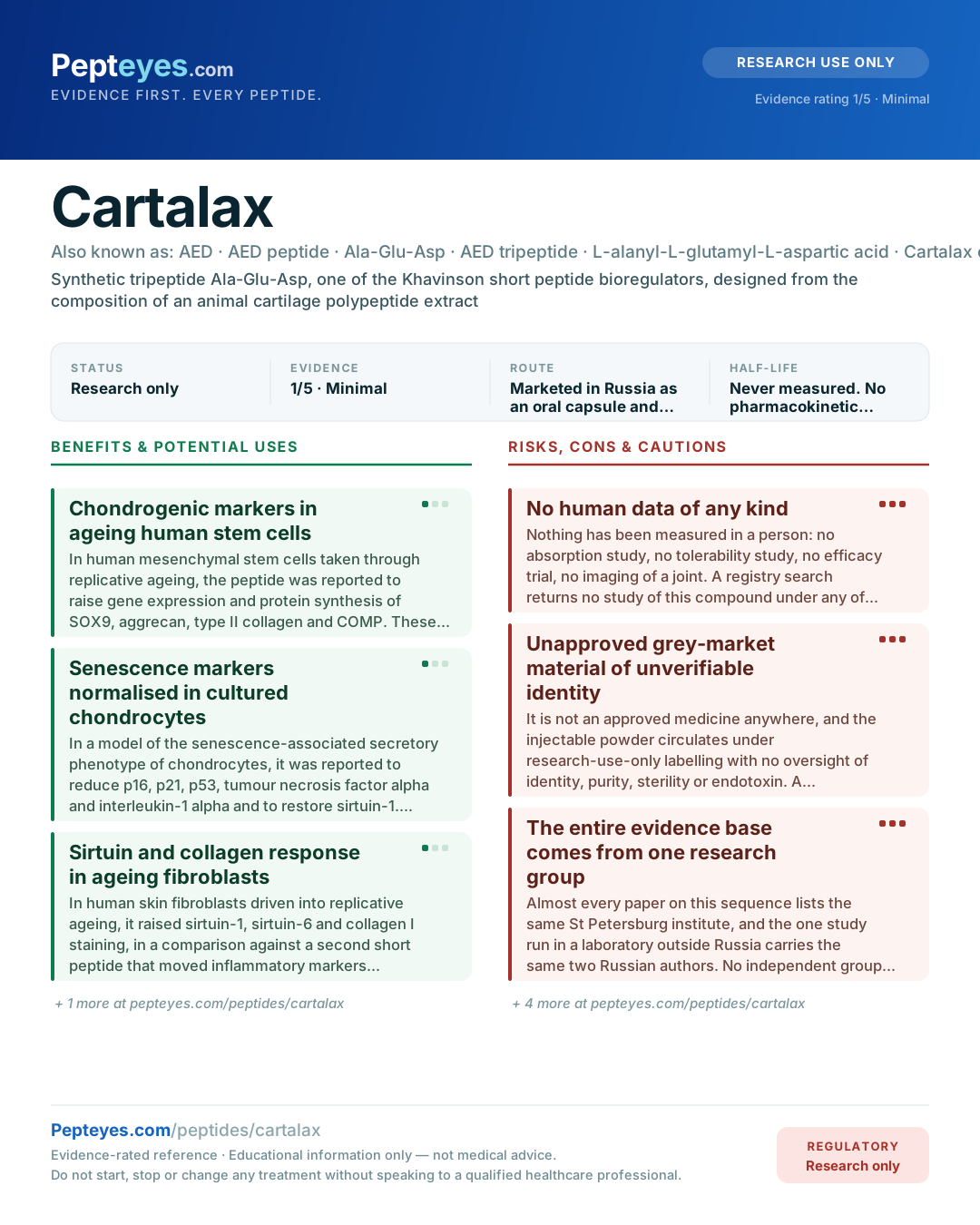
No human data of any kind — Nothing has been measured in a person: no absorption study, no tolerability study, no efficacy trial, no imaging of a joint. A registry search returns no study of this compound under any of its names. Everything claimed for it in people is extrapolation from cultured cells.
Unapproved grey-market material of unverifiable identity — It is not an approved medicine anywhere, and the injectable powder circulates under research-use-only labelling with no oversight of identity, purity, sterility or endotoxin. A three-residue peptide is cheap to fake and impossible to tell apart from filler by eye.
The entire evidence base comes from one research group — Almost every paper on this sequence lists the same St Petersburg institute, and the one study run in a laboratory outside Russia carries the same two Russian authors. No independent group has reproduced any of it, which is a different and weaker position than simply being untested.
Storage before mixing As a sealed lyophilised powder, refrigerated is typical and a freezer…
As a sealed lyophilised powder, refrigerated is typical and a freezer suits long storage; both should be dark and dry. A dry powder tolerates a few days out of the cold far better than anything in solution — which is why it ships that way.
Shelf life after mixing Once mixed it is refrigerated and treated as short-lived. Bacteriostatic…
Once mixed it is refrigerated and treated as short-lived. Bacteriostatic water contains a preservative and buys the longer window; sterile water contains none and buys a much shorter one. Peptides in solution also degrade on their own, so the container is only half the question.
Evidence level 1/5 · Minimal — Nothing established
Animal or laboratory data only. No human efficacy evidence.
Regulatory status Research Use Only — Nothing established
Not an approved medicine anywhere. In Russia it is sold as a capsule food supplement rather than as a registered drug; elsewhere it moves under research-use-only labelling. No registered human trial exists as of September 2026. Cartalax has no marketing authorisation in the United States, the European Union or the United Kingdom, and is not a licensed medicine in any of them. It is not a controlled substance. In Russia it is marketed as a capsule food supplement rather than as a registered medicine, and the originating group's own review of this peptide family flags only one member as a medicinal product, which is not this one. There is no FDA substance-registry record for it at all, while its close relative Epitalon has one. It is not named on the WADA Prohibited List, but its clause for agents with no approval from any health authority reaches it.
Overview
A three-residue peptide — alanine, glutamate, aspartate — from the Khavinson family of Russian peptide bioregulators, sold for joints and cartilage. What has actually been published is small: gene-expression and immunostaining readouts in cultured human stem cells, chondrocytes and skin fibroblasts, nearly all of it from one St Petersburg institute, and the cartilage papers are Russian-language with only English abstracts reachable. Nothing has been measured in a person. The marketing promises cartilage repair; the published evidence is transcripts and stains in a dish.
Not approved for human use anywhereNo approval anywhere for human use. Sold under research-use labelling. Cartalax has no marketing authorisation in the United States, the European Union or the United Kingdom, and is not a licensed medicine in any of them. It is not a controlled substance. In Russia it is marketed as a capsule food supplement rather than as a registered medicine, and the originating group's own review of this peptide family flags only one member as a medicinal product, which is not this one. There is no FDA substance-registry record for it at all, while its close relative Epitalon has one. It is not named on the WADA Prohibited List, but its clause for agents with no approval from any health authority reaches it.
| Regulatory status | Not an approved medicine anywhere. In Russia it is sold as a capsule food supplement rather than as a registered drug; elsewhere it moves under research-use-only labelling. No registered human trial exists as of September 2026. |
|---|---|
| Drug class | Synthetic tripeptide Ala-Glu-Asp, one of the Khavinson short peptide bioregulators, designed from the composition of an animal cartilage polypeptide extract |
| Route | Marketed in Russia as an oral capsule and on the grey market as a lyophilised powder for injection; neither route has been studied in a person. |
| Half-life | Never measured. No pharmacokinetic study of this sequence has been published in any species, so nothing is known about how long it persists or where it goes. |
| Evidence rating |
1/5 Minimal
Evidence rating 1 out of 5: Minimal
Animal or laboratory data only. No human efficacy evidence. |
| Studied in | Cell culture almost exclusively: human mesenchymal stem cells and chondrocytes in replicative-ageing models, human and rat skin fibroblasts, and human periodontal ligament stem cells. One rat study of cisplatin kidney injury included it among several peptides. No human study of any design has been published or registered. |
Cartalax sequence & structure
Cartalax is a 3-residue linear peptide with a free C-terminal acid; molecular weight 333.29 Da.
Unmodified linear all-L tripeptide with a free amine and a free carboxyl terminus; monoisotopic mass 333.11721, average 333.29, InChIKey KXEVYGKATAMXJJ-ACZMJKKPSA-N. CAS 85806-95-7 comes from the PubChem synonym set and its check digit is valid, and querying PubChem by that number returns the same CID. There is no FDA GSRS substance record or UNII for Cartalax, so no regulator-curated name or weight exists to cross-check against, which is why the record rests on PubChem plus the originating group's own published tables. PubChem's synonym list for this CID also contains the string H-Asp-Glu-Asp-OH, which is a different sequence and appears to be a deposit error; the structure, formula and SMILES on the record are Ala-Glu-Asp. Material is usually handled as an acetate or trifluoroacetate salt, so a certificate of analysis may quote a mass above the 333.29 free-peptide figure.
Record confidence: high — two independent authoritative sources agree on the sequence and modifications. Every sequence on the site is listed with its sources on the peptide sequences index.
How it works
The governing hypothesis belongs to the group that made the peptide: that sequences two to four residues long cross the cell and nuclear membranes and bind promoter regions of DNA directly, switching tissue-specific genes on or off, with each sequence assigned a target tissue and this one assigned cartilage. What has actually been measured is downstream of that. In human mesenchymal stem cells carried through replicative ageing it was reported to raise expression of SOX9, aggrecan, type II collagen and COMP, the standard chondrogenic markers. In a chondrocyte senescence model it reportedly lowered p16, p21, p53 and two inflammatory cytokines while raising sirtuin-1. In a bone-marrow stem cell line it raised IGF1 and also NF-kappa-B, a driver of inflammatory ageing that sits awkwardly with a chondroprotective story. The claim that carriers such as PEPT1 and LAT1 ferry it into cells rests on docking scores, not measured transport.
Evidence base
Rated 1 of 5 — Minimal. Animal or laboratory data only. No human efficacy evidence.
- Cell culture and gene expression only. No human study of any design has been performed or registered: searches of ClinicalTrials.gov for Cartalax, for Ala-Glu-Asp and for AED peptide return no study of this compound.
- The whole literature traces to the Saint Petersburg Institute of Bioregulation and Gerontology. A Europe PMC search for Cartalax returns two records, both reviews by that group; a search for AED peptide returns nine, six of them from the same authors, and the one paper based in a laboratory outside Russia lists two of them as co-authors. This site caps a rating whenever an entire evidence base traces to a single research group, however many papers it contains.
- The cartilage-specific work is published in a Russian-language gerontology journal, with only English abstracts reachable. The claims about chondrogenic markers cannot be checked against methods or figures from outside Russia.
- The phase 2 programme in Russia that marketing copy attaches to this peptide is of a polypeptide complex extracted from animal cartilage, a mixture of many peptides, and not of the tripeptide. The originating group's own review makes that distinction; the reprints of it generally do not.
- That short peptides survive the gut and reach cartilage intact after a capsule is an assumption, not a finding. Digestive and brush-border peptidases degrade small peptides, the carrier that moves di- and tripeptides across the intestinal wall favours neutral hydrophobic sequences rather than a doubly acidic one like this, and no absorption study of this peptide exists.
Benefits and risks, weighed against the evidence
Every entry below carries the strength of the evidence behind it — three bars for strong human data, two for moderate, one for preliminary or preclinical work. The two columns are not equal by design: where a compound has more documented risk than demonstrated benefit, the lists say so.
Reported benefits
4 entries
-
Chondrogenic markers in ageing human stem cells
In human mesenchymal stem cells taken through replicative ageing, the peptide was reported to raise gene expression and protein synthesis of SOX9, aggrecan, type II collagen and COMP. These are the markers a cell moving toward a cartilage phenotype should show, measured in culture rather than in cartilage.
Evidence: Preliminary -
Senescence markers normalised in cultured chondrocytes
In a model of the senescence-associated secretory phenotype of chondrocytes, it was reported to reduce p16, p21, p53, tumour necrosis factor alpha and interleukin-1 alpha and to restore sirtuin-1. The readouts are immunostains of cells in a dish, not joint tissue or joint function.
Evidence: Preliminary -
Sirtuin and collagen response in ageing fibroblasts
In human skin fibroblasts driven into replicative ageing, it raised sirtuin-1, sirtuin-6 and collagen I staining, in a comparison against a second short peptide that moved inflammatory markers instead. It is the most direct evidence that the sequence does something to a human cell.
Evidence: Preliminary -
One whole-animal signal, in kidneys rather than joints
In rats with cisplatin-induced acute renal failure it reduced urinary protein and electrolyte excretion, though a different short peptide in the same experiment carried the protective effect. It is the only in-vivo result of note, and it has nothing to do with cartilage.
Evidence: Preliminary
Risks and cautions
7 entries · 4 serious or common
-
No human data of any kind
Nothing has been measured in a person: no absorption study, no tolerability study, no efficacy trial, no imaging of a joint. A registry search returns no study of this compound under any of its names. Everything claimed for it in people is extrapolation from cultured cells.
Evidence: Serious -
Unapproved grey-market material of unverifiable identity
It is not an approved medicine anywhere, and the injectable powder circulates under research-use-only labelling with no oversight of identity, purity, sterility or endotoxin. A three-residue peptide is cheap to fake and impossible to tell apart from filler by eye.
Evidence: Serious -
The entire evidence base comes from one research group
Almost every paper on this sequence lists the same St Petersburg institute, and the one study run in a laboratory outside Russia carries the same two Russian authors. No independent group has reproduced any of it, which is a different and weaker position than simply being untested.
Evidence: Serious -
Delaying real osteoarthritis care
Osteoarthritis has treatments with actual trial evidence behind them, including exercise therapy, weight management, established analgesia and, at the end of the road, joint replacement. Substituting an untested peptide for assessment of a painful joint is the practical harm most likely to occur here.
Evidence: Serious -
Gene-expression effects are not benign by default
The reported actions include raising IGF1, NF-kappa-B and a tankyrase gene tied to telomere maintenance, and altering sirtuins and p53. Those are growth, inflammation and senescence pathways. Nobody has looked at what sustained exposure does, and the oncologic question has not been asked at all.
Evidence: Moderate evidence -
Injection hazards independent of the molecule
Reconstituting and injecting an unregulated lyophilised powder outside sterile conditions risks local infection, abscess and bloodstream infection whatever the peptide itself does or fails to do.
Evidence: Moderate evidence -
Marketing claims far outrun the record
Listings describe it as restoring cartilage, treating osteoarthritis and being clinically proven. None of those is supported. The one clinical programme the originating group describes is of an animal cartilage extract, a different substance, and it is described as ongoing rather than reported.
Evidence: Moderate evidence
Counts are not a score. A single serious risk can outweigh several well-supported benefits, and a long benefit list built on preclinical work outweighs nothing at all.
Opinion — what people actually report
6 themes · 1 reported benefit · 2 reported problems
This is the weakest tier on this site. These are themes drawn from public discussion — forums, subreddits and patient threads — not from trials. There is no control group, no denominator, and no way to confirm that what someone injected matched its label. People post when a result is dramatic and when something goes wrong, and rarely when nothing happens, so treat everything below as a description of the conversation rather than of the compound. The bars count how often a thing is said, not how well it is supported.
-
Barely discussed at all Practical note. Dominant theme: Comes up in most discussions of this compound.
The defining feature of this one. Threads are rare and usually a single question with a handful of replies, and most of what circulates online is reprinted seller copy rather than an account of anyone actually taking it.
-
Routinely mixed up with the cartilage extract Practical note. Dominant theme: Comes up in most discussions of this compound.
It and the older animal-tissue cartilage preparation are talked about almost interchangeably, and people frequently end up on both without being able to say which one is the defined tripeptide and which is the extract.
-
The usual account is of feeling nothing Reported problem. Recurring: Raised regularly, though not by everyone.
Reports that describe finishing a course tend to end with no perceptible change, at which point the framing shifts from improvement to maintenance and hoping to hold ground.
-
Capsules versus injection is the live argument Practical note. Recurring: Raised regularly, though not by everyone.
A recurring disagreement over whether the oral capsule form does anything at all, with the injecting side assuming absorption is the whole difference and neither side having anything measured to point at.
-
Scepticism about the single Russian source Reported problem. Recurring: Raised regularly, though not by everyone.
Better-informed posters point out that the whole literature traces to one institute and that nothing has been tested in a person. This strand of the discussion is usually the most accurate part of it.
-
Occasional reports of easier joints Reported benefit. Occasional: Reported by a minority, or in specific contexts.
A minority describe less morning stiffness or easier movement, almost always while taking several other things for the same joint, and usually acknowledged by the person reporting it as impossible to attribute.
Where the reports and the evidence part ways
The community here is unusually small, and that is itself the finding: a compound with a decades-long research programme behind it has generated almost no first-hand accounts. What discussion does exist tracks the evidence better than most, because the reports of feeling nothing sit comfortably with a record that contains no human study at all. Where it parts company is the persistent confusion between the tripeptide and the animal cartilage extract it was identified in. Those are different substances with different standing: the extract is the one with a Russian clinical programme attached to it, and the peptide inherits none of that. The capsule-versus-injection argument likewise assumes an absorption question that nobody has measured in either direction.
Cheat sheet
The full sheet, all 77 compounds →The community reference numbers for this compound — reconstitution, working dose, cycle and bloodwork. Research and education only, not medical advice, and not part of the evidence-rated monograph above. Doses assume a 1mL / 100-unit insulin syringe — the calculator does the units for you.
Protocol overview
Dosing & reconstitution 20 mg vial
| WEEK | DAILY DOSE | UNITS PER INJECTION |
|---|---|---|
| Weeks 1 to 2 | 2.0 mg | 20 units (0.20 mL) |
| Weeks 3 to 4 | 3.0 mg | 30 units (0.30 mL) |
| Weeks 5 to 8 | 4.0 mg | 40 units (0.40 mL) |
| Weeks 9 to 12 | 5.0 mg | 50 units (0.50 mL) |
Frequency: Subcutaneous, once daily. Evidence note: specific human RCT posology for SC Cartalax is limited; this schedule references preclinical fibroblast/chondrocyte studies and general SC technique guidance. This schedule uses the largest practical dilution (3.0 mL) to keep per-injection volumes within typical SC tolerability parameters.
On the master sheet
- Vial
- 20mg
- BAC
- 3mL
- Dose
- 2–5mg daily (titrate)
- Route
- SubQ
- Cycle
- 8–12 wks
- Bloodwork
- Optional
Readers on Cartalax
Questions and answers from readers, under generated names. Nothing here has been checked or reviewed by the site and none of it is medical advice. It is the least verified thing on this page — and it is here because people ask each other these things anyway, and most of the other places they can ask are run by sellers.
0 questions · 0 answers
No questions yet. Ask the first one above — it takes one box and an email address.
How names work, and the house rules
Names. Every verified address is given one generated name — two ordinary words — and keeps it. Nobody chooses a name and nobody can take another's. Posts marked desk were written by the site's own editorial desk, usually to open a thread; they carry a generated name like everyone else's and are held to the site's rules, which means they never state an amount.
What is not allowed. Selling, sourcing, vendor names, coupon codes and "message me" — posts that read that way are held and usually removed. Personal medical details you would not want public. Abuse. Instructions framed as what someone else should do.
What this is not. A reader's report of what happened to them is a report, not a finding, and an answer here is one person's view. Nothing in this section changes the evidence rating above it. If something you read here would change what you take, take it to a pharmacist or physician first.
Your data. Delete any post of yours at any time, or remove everything you have written together with your name. Details in the privacy notice.
Who should avoid it
- Use outside a registered clinical trial
- Anyone using it in place of assessment for a painful or swollen joint
- Any cancer history, given the unstudied growth and telomere-related signalling
- Pregnancy and breastfeeding
- Children and adolescents
If used under medical supervision, monitor
- Not applicable outside a registered trial
- A trial would need validated pain and function scales with cartilage imaging, not marker panels
- Injection sites, for anyone injecting an unregulated powder
Interactions
Not exhaustive. Always have a pharmacist or physician review your full medication list — including supplements.
- No interaction study of any kind exists for this peptide
- Analgesics and disease-modifying drugs used in joint disease — never studied in combination, and nothing here substitutes for them
- Other short peptides of the same family, which are commonly stacked together with no combination data at all
Commonly confused with
These mix-ups cause real harm — two products sold under one name, or two molecules whose effects run in opposite directions.
One residue apart and from the same laboratory: Epitalon is AEDG, this is AED without the terminal glycine. They are sold side by side and their claims get swapped freely, but Epitalon's pitch is telomerase and lifespan while this one is assigned cartilage, and neither inherits the other's evidence — which in both cases is thin and from the same source.
Compare side by sideSame Russian research tradition, and often sold together, but a different kind of thing. Thymalin is an undefined bovine thymus extract registered as a medicine in Russia; Cartalax is a single defined tripeptide that is not a registered medicine anywhere. The cartilage equivalent of Thymalin is the animal cartilage extract this peptide was derived from, which is also not the same substance.
Compare side by sideSame laboratory and the same shape of evidence with a different assigned organ: Livagen is the four-residue KEDA sold for the liver, Cartalax the three-residue AED sold for cartilage. They are sold side by side as 'bioregulators' and neither has a published human trial; Livagen's only human record is an example in an expired patent.
Compare side by sideRegulatory & legal status
Cartalax has no marketing authorisation in the United States, the European Union or the United Kingdom, and is not a licensed medicine in any of them. It is not a controlled substance. In Russia it is marketed as a capsule food supplement rather than as a registered medicine, and the originating group's own review of this peptide family flags only one member as a medicinal product, which is not this one. There is no FDA substance-registry record for it at all, while its close relative Epitalon has one. It is not named on the WADA Prohibited List, but its clause for agents with no approval from any health authority reaches it.
Infographic
What this entry was checked against
The specific records this monograph was verified against on its last research pass. We link live literature searches below as well, because these are a snapshot and the literature is not.
- Linkova N, Khavinson V, Diatlova A, Myakisheva S, Ryzhak G. Peptide Regulation of Chondrogenic Stem Cell Differentiation. Int J Mol Sci 2023;24:8415 — the group's own English-language review; describes AED and states that the cartilage polypeptide complex, not the tripeptide, is in phase 2 trials in Russia
- Myakisheva SN et al. The influence of peptides on the chondrogenic differentiation of human mesenchymal stem cells during replicative aging. Adv Gerontol 2023 (PubMed 37782646) — Russian-language, English abstract only: the source of the SOX9, aggrecan, type II collagen and COMP claims
- Myakisheva SN et al. Peptides prevent the forming of secretory phenotype of chondrocytes associated with the aging. Adv Gerontol 2023 (PubMed 37356100) — Russian-language, English abstract only: the source of the p16, p21, p53, TNF-alpha, interleukin-1 alpha and sirtuin-1 claims
- Ashapkin V, Khavinson V, Shilovsky G, Linkova N, Vanuyshin B. Gene expression in human mesenchymal stem cell aging cultures: modulation by short peptides. Mol Biol Rep 2020;47:4323-4329 (PubMed record, abstract reachable) — IGF1, FOXO1, TERT, TNKS2 and NF-kappa-B readouts in the FetMSC line
- Fridman NV, Linkova NS, Kozhevnikova EO, Gutop EO, Khavinson VK. Comparison of the Effects of KE and AED Peptides on Functional Activity of Human Skin Fibroblasts during Their Replicative Aging. Bull Exp Biol Med 2020 (PubMed record, abstract reachable) — sirtuin-1, sirtuin-6 and collagen I
- Zamorskii II et al. Peptides Restore Functional State of the Kidneys During Cisplatin-Induced Acute Renal Failure. Bull Exp Biol Med 2015 (PubMed record, abstract reachable) — the only whole-animal experiment that includes this peptide, and it is a kidney model
- Caputi S, Trubiani O, Sinjari B, Trofimova S, Diomede F, Linkova N, Diatlova A, Khavinson V. Effect of short peptides on neuronal differentiation of stem cells. Int J Immunopathol Pharmacol 2019 — the one study run in a laboratory outside Russia, and it lists Linkova and Khavinson as co-authors
- Khavinson V, Linkova N, Kozhevnikova E, Dyatlova A, Petukhov M. Transport of Biologically Active Ultrashort Peptides Using POT and LAT Carriers. Int J Mol Sci 2022;23:7733 — the docking-score basis for the claim that these peptides are carried into cells, and the table that names Cartalax as AED
- Amigo L, Hernandez-Ledesma B. Current Evidence on the Bioavailability of Food Bioactive Peptides. Molecules 2020;25:4479 — independent review of why orally taken short peptides rarely reach tissue intact, and of the carrier preference for neutral hydrophobic di- and tripeptides
- PubChem CID 87815447 — Ala-Glu-Asp compound record, listing Cartalax as a synonym
Where to read further
We link to live literature searches rather than a frozen citation list, so you always see current results — including anything published after our last review.
- PubMed — all published literature on Cartalax
- PubMed — randomized controlled trials only
- ClinicalTrials.gov — registered human trials
Related peptides in Healing & Tissue Repair
Terms used on this page
- Human Dermal Fibroblast (HDF)
- Human dermal fibroblasts are the connective tissue cells that build and remodel the dermal matrix, and their cultured form is the standard test system for cosmetic ingredient screening.
- Chondrocyte
- A chondrocyte is the sole resident cell type of cartilage, responsible for producing and maintaining the type II collagen and aggrecan matrix that gives the tissue its mechanical properties.
- Cytokine
- Cytokines are small secreted signalling proteins acting at picomolar concentrations over short distances to coordinate immune cells, characterised by pleiotropy and extensive functional redundancy.
- Amino Acid Residue
- An amino acid residue is what remains of an amino acid once it has been joined into a chain and a molecule of water has been lost, and residue count is how peptide length is stated.
- Insulin-Like Growth Factor 1 (IGF-1)
- IGF-1 is a 70-amino-acid, proinsulin-like peptide produced mainly by the liver under growth hormone control, and it mediates most of the anabolic effects attributed to growth hormone.
- Trial Registration and Prospective Protocol
- Trial registration is the public deposit of a study's design and prespecified outcomes before enrolment begins, creating a dated record against which the eventual publication can be checked.
This page is educational information, not medical advice. It cannot account for your medical history, medications, or risk factors. Do not start, stop or change any treatment based on it. Speak to a qualified healthcare professional who knows your case.