Supplied as a lyophilised powder to reconstitute
Healing & Tissue Repair
At a glance
Ten answers, each one line. Open any row for the detail behind it.
What it does An elegant piece of drug design: it takes the tissue-protective part of erythropoietin and…
An elegant piece of drug design: it takes the tissue-protective part of erythropoietin and discards the part that makes red blood cells. That separation removes the thrombotic risk that makes EPO dangerous, leaving only the repair signalling.
Half-life ~2 minutes (tissue effects far outlast plasma levels) — Documented
~2 minutes (tissue effects far outlast plasma levels)
Typical studied dose No established dose. Each trial protocol fixes its own and publishes it… — Depends on the study
No established dose. Each trial protocol fixes its own and publishes it in the registry entry, under medical supervision that is part of the dose. There is no approved amount for use outside a study.
How often it is used Whatever the protocol specifies. The registry entry for a given study… — Depends on the study
Whatever the protocol specifies. The registry entry for a given study states its interval; nothing establishes one outside a study.
How it is taken Subcutaneous (investigational) — Documented
Subcutaneous (investigational)
Main side effects Not approved; development slow · Grey-market availability · Small trials — Carries serious risk
Not approved; development slow — Despite encouraging phase 2 data across several years, it has not reached approval.
Grey-market availability — Sold as a research peptide well outside the neuropathy contexts studied.
Small trials — Phase 2 populations were modest in size, in a condition with substantial placebo response.
Storage before mixing As a sealed lyophilised powder, refrigerated is typical and a freezer…
As a sealed lyophilised powder, refrigerated is typical and a freezer suits long storage; both should be dark and dry. A dry powder tolerates a few days out of the cold far better than anything in solution — which is why it ships that way.
Shelf life after mixing Once mixed it is refrigerated and treated as short-lived. Bacteriostatic…
Once mixed it is refrigerated and treated as short-lived. Bacteriostatic water contains a preservative and buys the longer window; sterile water contains none and buys a much shorter one. Peptides in solution also degrade on their own, so the container is only half the question.
Evidence level 3/5 · Moderate — Depends on the study
Small or early-phase human trials, or good controlled topical human data.
Regulatory status In Clinical Trials — Depends on the study
Investigational. Phase 2 trials in sarcoidosis-associated small fibre neuropathy. Not approved. Investigational; not approved in any market.
Overview
An elegant piece of drug design: it takes the tissue-protective part of erythropoietin and discards the part that makes red blood cells. That separation removes the thrombotic risk that makes EPO dangerous, leaving only the repair signalling.
Investigational — not approvedInvestigational; not approved in any market.
| Regulatory status | Investigational. Phase 2 trials in sarcoidosis-associated small fibre neuropathy. Not approved. |
|---|---|
| Drug class | 11-amino-acid peptide derived from the helix B region of erythropoietin |
| Route | Subcutaneous (investigational) |
| Half-life | ~2 minutes (tissue effects far outlast plasma levels) |
| Evidence rating |
3/5 Moderate
Evidence rating 3 out of 5: Moderate
Small or early-phase human trials, or good controlled topical human data. |
| Studied in | Phase 2 randomized trials in sarcoidosis-associated small fibre neuropathy and in type 2 diabetes with neuropathic pain; preclinical work across neuropathy, wound and ischemia models. |
ARA-290 (Cibinetide) sequence & structure
ARA-290 (Cibinetide) is a 11-residue linear peptide with a free C-terminal acid; molecular weight 1,257.32 Da.
[bracketed] = non-standard residue
| Three-letter | pGlu-Glu-Gln-Leu-Glu-Arg-Ala-Leu-Asn-Ser-Ser-OH |
|---|---|
| Length | 11 amino acid residues |
| Modifications |
|
| Molecular formula | C51H84N16O21 |
| Molecular weight | 1,257.32 Da (average, free base) |
| SMILES | CC(C)C[C@H](NC(=O)[C@H](C)NC(=O)[C@H](CCCNC(=N)N)NC(=O)[C@H](CCC(=O)O)NC(=O)[C@H](CC(C)C)NC(=O)[C@H](CCC(N)=O)NC(=O)[C@H](CCC(=O)O)NC(=O)[C@@H]1CCC(=O)N1)C(=O)N[C@@H](CC(N)=O)C(=O)N[C@@H](CO)C(=O)N[C@@H](CO)C(=O)O |
| Identifiers | CAS 1208243-50-8 · PubChem CID 91810664 · DrugBank DB13006 · UniProt P01588 |
| Which molecule | ARA-290 is the INN drug cibinetide, also called pHBSP (pyroglutamate helix B surface peptide). It is the N-terminally cyclised form of the earlier 11-mer HBSP (H-Gln-Glu-Gln-Leu-Glu-Arg-Ala-Leu-Asn-Ser-Ser-OH, C51H87N17O21, MW 1274.36); the pyroglutamate replaces the free N-terminal Gln, so the peptide cannot cyclise spontaneously and is more stable. This record describes cibinetide (the pGlu form), which is what clinical trials and vendors supply as ARA-290. |
| Sources | WHO Proposed INN List 114 (cibinetide) — definitive chemical name, C51H84N16O21, CAS 1208243-50-8ChEMBL CHEMBL3545305 (HELM: PEPTIDE1{[Glp].E.Q.L.E.R.A.L.N.S.S})PubChem CID 91810664 (Cibinetide)FDA GSRS / UNII 9W5677JKDA (Cibinetide)UniProt P01588 (EPO_HUMAN) — parent erythropoietin sequence |
WHO INN chemical name: 5-oxo-L-prolyl-L-alpha-glutamyl-L-glutaminyl-L-leucyl-L-alpha-glutamyl-L-arginyl-L-alanyl-L-leucyl-L-asparaginyl-L-seryl-L-serine; UNII 9W5677JKDA, KEGG D11218, monoisotopic mass 1256.60. The sequence is a designed linear peptide mimicking the solvent-exposed face of erythropoietin helix B (UniProt P01588) and is NOT a contiguous EPO fragment — the longest exact match to mature EPO is only three residues — so the UniProt accession identifies the parent protein, not a source fragment. Usually supplied as the acetate salt; some vendor listings quote an incorrect formula/MW (e.g. C55H82N18O18, 1259.34) that matches none of the authoritative records.
Record confidence: high — two independent authoritative sources agree on the sequence and modifications. Every sequence on the site is listed with its sources on the peptide sequences index.
How it works
Binds the innate repair receptor — a heterocomplex of the EPO receptor beta-common chain — rather than the classical homodimeric EPO receptor. This triggers anti-inflammatory and tissue-protective signalling without stimulating erythropoiesis.
Evidence base
Rated 3 of 5 — Moderate. Small or early-phase human trials, or good controlled topical human data.
- Genuine randomized phase 2 data with an objective corneal nerve imaging endpoint — better than most compounds in this category.
Benefits and risks, weighed against the evidence
Every entry below carries the strength of the evidence behind it — three bars for strong human data, two for moderate, one for preliminary or preclinical work. The two columns are not equal by design: where a compound has more documented risk than demonstrated benefit, the lists say so.
Reported benefits
4 entries · 1 on strong human evidence
-
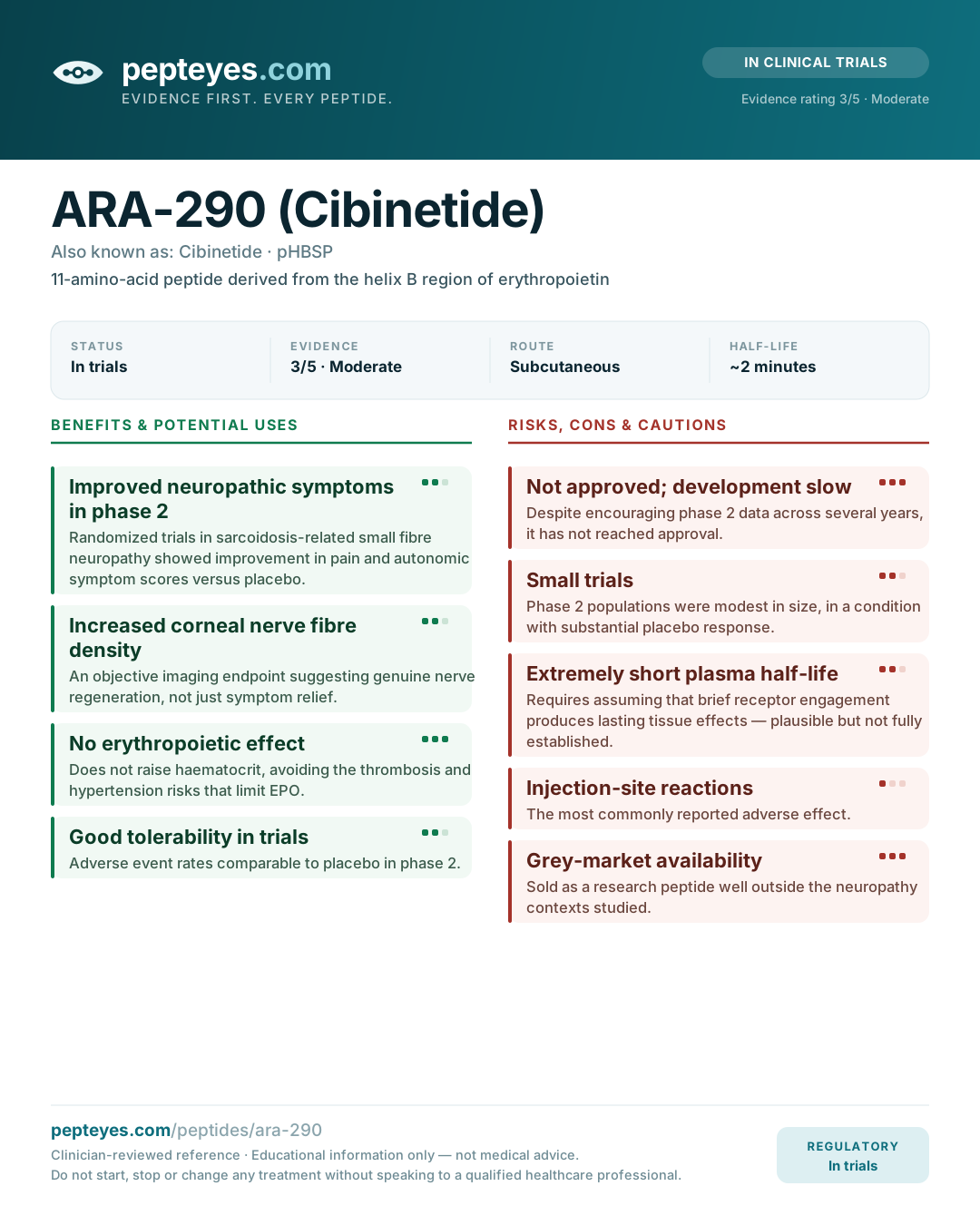
Improved neuropathic symptoms in phase 2
Randomized trials in sarcoidosis-related small fibre neuropathy showed improvement in pain and autonomic symptom scores versus placebo.
Evidence: Moderate evidence -
Increased corneal nerve fibre density
An objective imaging endpoint suggesting genuine nerve regeneration, not just symptom relief.
Evidence: Moderate evidence -
No erythropoietic effect
Does not raise haematocrit, avoiding the thrombosis and hypertension risks that limit EPO.
Evidence: Strong evidence -
Good tolerability in trials
Adverse event rates comparable to placebo in phase 2.
Evidence: Moderate evidence
Risks and cautions
5 entries · 2 serious or common
-
Not approved; development slow
Despite encouraging phase 2 data across several years, it has not reached approval.
Evidence: Serious -
Small trials
Phase 2 populations were modest in size, in a condition with substantial placebo response.
Evidence: Moderate evidence -
Extremely short plasma half-life
Requires assuming that brief receptor engagement produces lasting tissue effects — plausible but not fully established.
Evidence: Moderate evidence -
Injection-site reactions
The most commonly reported adverse effect.
Evidence: Minor -
Grey-market availability
Sold as a research peptide well outside the neuropathy contexts studied.
Evidence: Serious
Counts are not a score. A single serious risk can outweigh several well-supported benefits, and a long benefit list built on preclinical work outweighs nothing at all.
Opinion — what people actually report
4 themes · 1 reported benefit · 1 reported problem
This is the weakest tier on this site. These are themes drawn from public discussion — forums, subreddits and patient threads — not from trials. There is no control group, no denominator, and no way to confirm that what someone injected matched its label. People post when a result is dramatic and when something goes wrong, and rarely when nothing happens, so treat everything below as a description of the conversation rather than of the compound. The bars count how often a thing is said, not how well it is supported.
-
Neuropathic pain reports from small-fibre neuropathy patients Reported benefit. Recurring: Raised regularly, though not by everyone.
A distinct patient community, mostly people with sarcoidosis-related neuropathy who followed the trials.
-
Interest driven by trial results, not by broad use Practical note. Dominant theme: Comes up in most discussions of this compound.
Few casual users; most accounts come from people with a specific condition.
-
Availability is the main obstacle Reported problem. Recurring: Raised regularly, though not by everyone.
Development stalled, so obtaining it is difficult and quality is unverifiable.
-
The no-erythropoiesis point is well understood Practical note. Occasional: Reported by a minority, or in specific contexts.
Posters generally know it is designed to avoid EPO's red-cell effects, which distinguishes it from EPO misuse.
Where the reports and the evidence part ways
ARA-290 has better human evidence than most things in this category — a randomized trial in sarcoidosis-related small fibre neuropathy reported improvements in corneal nerve fibre measures and symptom scores. That is genuine phase 2 evidence, not preclinical extrapolation. What has not happened is confirmation in a larger trial or any approval, and development has not progressed. The patient reports are consistent with the trial data; the problem is that the trial data stopped where it did.
Cheat sheet
The full sheet, all 77 compounds →The community reference numbers for this compound — reconstitution, working dose, cycle and bloodwork. Research and education only, not medical advice, and not part of the evidence-rated monograph above. Doses assume a 1mL / 100-unit insulin syringe — the calculator does the units for you.
Protocol overview
Dosing & reconstitution 16 mg vial
| WEEK | DAILY DOSE | UNITS PER INJECTION |
|---|---|---|
| Week 1 | 2 mg (2,000 mcg) | 20 units (0.20 mL) |
| Weeks 2 to 8 (or up to 16) | 4 mg (4,000 mcg) | 40 units (0.40 mL) |
Frequency: Inject once daily subcutaneously. Clinical studies used 4 mg/day as the target therapeutic dose, with no additional benefit observed at 8 mg. Starting at 2 mg for the first week allows assessment of individual tolerance before reaching the maintenance dose.
On the master sheet
- Vial
- 16mg
- BAC
- 5mL
- Dose
- 4mg daily
- Route
- SubQ
- Cycle
- 28 days-12 wks
- Notes
- Nerve repair; Phase 2 data, FDA Fast Track
Readers on ARA-290 (Cibinetide)
Questions and answers from readers, under generated names. Nothing here has been checked or reviewed by the site and none of it is medical advice. It is the least verified thing on this page — and it is here because people ask each other these things anyway, and most of the other places they can ask are run by sellers.
0 questions · 0 answers
No questions yet. Ask the first one above — it takes one box and an email address.
How names work, and the house rules
Names. Every verified address is given one generated name — two ordinary words — and keeps it. Nobody chooses a name and nobody can take another's. Posts marked desk were written by the site's own editorial desk, usually to open a thread; they carry a generated name like everyone else's and are held to the site's rules, which means they never state an amount.
What is not allowed. Selling, sourcing, vendor names, coupon codes and "message me" — posts that read that way are held and usually removed. Personal medical details you would not want public. Abuse. Instructions framed as what someone else should do.
What this is not. A reader's report of what happened to them is a report, not a finding, and an answer here is one person's view. Nothing in this section changes the evidence rating above it. If something you read here would change what you take, take it to a pharmacist or physician first.
Your data. Delete any post of yours at any time, or remove everything you have written together with your name. Details in the privacy notice.
Who should avoid it
- Use outside clinical trials
- Pregnancy
If used under medical supervision, monitor
- Not applicable outside trials
Regulatory & legal status
Investigational; not approved in any market.
Infographic
Where to read further
We link to live literature searches rather than a frozen citation list, so you always see current results — including anything published after our last review.
- PubMed — all published literature on ARA-290 (Cibinetide)
- PubMed — randomized controlled trials only
- ClinicalTrials.gov — registered human trials
Related peptides in Healing & Tissue Repair
Terms used on this page
- Phase 2 Trial
- A Phase 2 trial is the first test of a compound in the target patient population, sized to find a workable dose and an early efficacy signal rather than to prove clinical benefit.
- Placebo and Placebo Control
- A placebo is an inactive intervention matched to the real one in appearance and route, used as a control arm so that improvement caused by the drug can be separated from improvement that would occur anyway.
- Adverse Event (AE)
- An adverse event is any untoward medical occurrence in someone receiving a medicine, recorded whether or not the drug caused it, which is why an event table is not a harm table.
- Randomised Controlled Trial (RCT)
- A randomised controlled trial assigns participants to intervention or control by chance and follows them prospectively, which is what allows an outcome difference to be attributed to the treatment itself.
- Preclinical Study and Animal Model
- Preclinical studies are the laboratory, cell and animal experiments done before any human exposure, establishing mechanism, target engagement and the toxicology package that permits a first trial.
This page is educational information, not medical advice. It cannot account for your medical history, medications, or risk factors. Do not start, stop or change any treatment based on it. Speak to a qualified healthcare professional who knows your case.