Supplied ready in solution
Bone, Muscle & Other
At a glance
Ten answers, each one line. Open any row for the detail behind it.
What it does A peptide that genuinely builds bone rather than merely slowing its loss — the first…
A peptide that genuinely builds bone rather than merely slowing its loss — the first anabolic osteoporosis therapy. It is also a clean example of pulsatile versus continuous hormone exposure producing opposite biological effects.
Half-life ~1 hour after subcutaneous injection; serum levels fall below… — Documented
~1 hour after subcutaneous injection; serum levels fall below quantification within about 3 hours.
Typical studied dose Set on the approved label, which states the starting dose, how it is… — On the label
Set on the approved label, which states the starting dose, how it is increased and the maximum. Read it there rather than anywhere else — including here.
How often it is used The label schedule is once daily. Dosing intervals follow the half-life… — On the label
The label schedule is once daily. Dosing intervals follow the half-life above, and the prescribing information is what sets them.
How it is taken Subcutaneous, once daily — Documented
Subcutaneous, once daily
Main side effects Bone density loss after stopping · Contraindicated with prior skeletal radiation · Historic osteosarcoma signal — Carries serious risk
Bone density loss after stopping — Gains are lost unless followed by an antiresorptive agent. Sequencing is essential, not optional.
Contraindicated with prior skeletal radiation — Along with Paget disease, unexplained alkaline phosphatase elevation, and bone metastases.
Historic osteosarcoma signal — Rats given high lifetime doses developed osteosarcoma. Long-term human surveillance did not confirm the risk, and the boxed warning was removed — but caution persists in patients with pre-existing bone malignancy risk.
Storage before mixing Supplied already in solution and kept refrigerated, not frozen. Freezing…
Supplied already in solution and kept refrigerated, not frozen. Freezing a protein solution can aggregate it, which is not always visible.
Shelf life after mixing Nothing to mix — it is not supplied as a powder. The relevant date is…
Nothing to mix — it is not supplied as a powder. The relevant date is the one printed on the product.
Evidence level 5/5 · Very strong — Documented
Multiple phase 3 randomized trials plus regulatory approval in a major market.
Regulatory status FDA Approved — Documented
FDA-approved for severe osteoporosis at high fracture risk. The osteosarcoma boxed warning and 2-year lifetime limit were removed in 2020–21 following long-term surveillance data. Prescription drug; biosimilar and generic versions are now available.
Overview
A peptide that genuinely builds bone rather than merely slowing its loss — the first anabolic osteoporosis therapy. It is also a clean example of pulsatile versus continuous hormone exposure producing opposite biological effects.
FDA ApprovedFDA-approved for severe osteoporosis at high fracture risk. The osteosarcoma boxed warning and 2-year lifetime limit were removed in 2020–21 following long-term surveillance data.
| Regulatory status | FDA-approved for severe osteoporosis at high fracture risk. The osteosarcoma boxed warning and 2-year lifetime limit were removed in 2020–21 following long-term surveillance data. |
|---|---|
| Drug class | Recombinant human parathyroid hormone fragment — first 34 amino acids |
| Route | Subcutaneous, once daily |
| Half-life | ~1 hour after subcutaneous injection; serum levels fall below quantification within about 3 hours. |
| Evidence rating |
5/5 Very strong
Evidence rating 5 out of 5: Very strong
Multiple phase 3 randomized trials plus regulatory approval in a major market. |
| Studied in | Fracture Prevention Trial and numerous subsequent randomized trials, including head-to-head comparisons against bisphosphonates. |
Teriparatide sequence & structure
Teriparatide is a 34-residue linear peptide with a free C-terminal acid; molecular weight 4,117.8 Da.
| Three-letter | H-Ser-Val-Ser-Glu-Ile-Gln-Leu-Met-His-Asn-Leu-Gly-Lys-His-Leu-Asn-Ser-Met-Glu-Arg-Val-Glu-Trp-Leu-Arg-Lys-Lys-Leu-Gln-Asp-Val-His-Asn-Phe-OH |
|---|---|
| Length | 34 amino acid residues |
| Modifications | None — an unmodified chain of standard L-amino acids |
| Molecular formula | C181H291N55O51S2 |
| Molecular weight | 4,117.8 Da (average, free base) |
| Identifiers | CAS 52232-67-4 · PubChem CID 16133850 · DrugBank DB06285 · UniProt P01270 |
| Which molecule | Teriparatide is human PTH(1-34), the unmodified N-terminal 34 residues of mature parathyroid hormone (UniProt P01270 residues 32-65; the precursor carries a 25-residue signal peptide and a 6-residue propeptide, mature PTH(1-84) is residues 32-115). It is distinct from abaloparatide (a PTHrP(1-34) analogue) and from full-length recombinant PTH(1-84) (Natpara/Preotact). |
| Sources | FDA label - FORTEO (teriparatide) injection, section 11 Description (MW 4117.8 Da, PTH 1-34 sequence)UniProt P01270 (PTHY_HUMAN) flat file: precursor sequence, SIGNAL 1-25 / PROPEP 26-31 / CHAIN 32-115, DrugBank DB06285 cross-referenceChEMBL CHEMBL525610 (HELM notation, formula C181H291N55O51S2, MW 4117.79)PubChem CID 16133850 (formula, MW, CAS 52232-67-4, UNII 10T9CSU89I)KEGG DRUG D06078 Teriparatide (three-letter sequence, formula, MW 4117.72, CAS 52232-67-4) |
Fully native sequence with free N-terminal amine and free C-terminal acid; no non-natural residues, amidation or lipidation. Forteo is produced recombinantly in E. coli, while research-grade material is usually synthetic and supplied as an acetate or TFA salt, so vendor MWs (e.g. NovoPro 4117.98) differ slightly from the 4117.8 Da free-base value on the FDA label (ChEMBL 4117.79, KEGG 4117.72). Both Met8 and Met18 are oxidation-prone, a known stability liability.
Record confidence: high — two independent authoritative sources agree on the sequence and modifications. Every sequence on the site is listed with its sources on the peptide sequences index.
How it works
Intermittent daily PTH receptor activation preferentially stimulates osteoblast activity over osteoclast activity, producing net bone formation. Continuous PTH elevation, as in hyperparathyroidism, does the reverse and causes bone loss. The dosing interval is the whole mechanism.
Evidence base
Rated 5 of 5 — Very strong. Multiple phase 3 randomized trials plus regulatory approval in a major market.
- Fracture-endpoint randomized trials — the strongest evidence class in osteoporosis.
Benefits and risks, weighed against the evidence
Every entry below carries the strength of the evidence behind it — three bars for strong human data, two for moderate, one for preliminary or preclinical work. The two columns are not equal by design: where a compound has more documented risk than demonstrated benefit, the lists say so.
Reported benefits
5 entries · 4 on strong human evidence
-
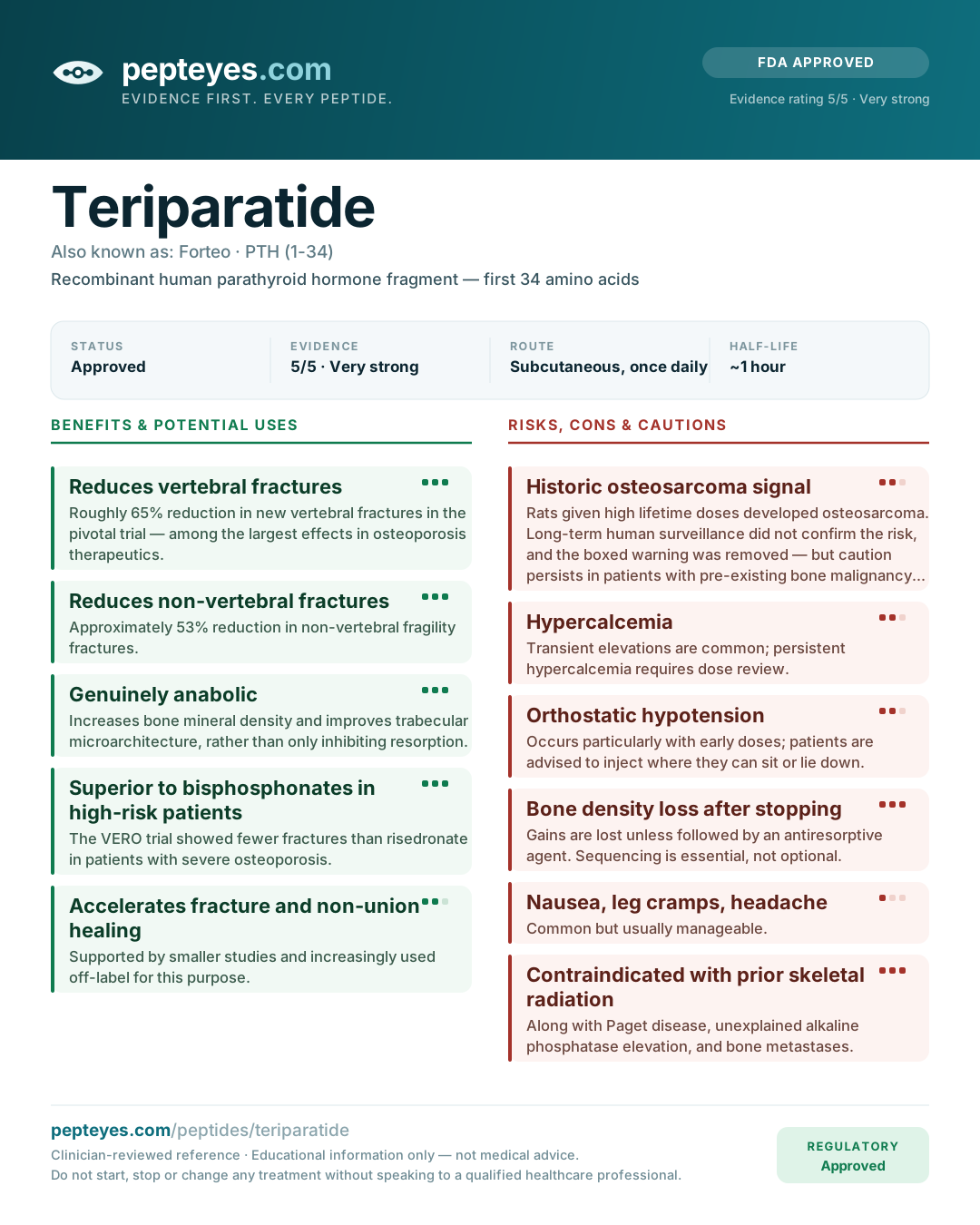
Reduces vertebral fractures
Roughly 65% reduction in new vertebral fractures in the pivotal trial — among the largest effects in osteoporosis therapeutics.
Evidence: Strong evidence -
Reduces non-vertebral fractures
Approximately 53% reduction in non-vertebral fragility fractures.
Evidence: Strong evidence -
Genuinely anabolic
Increases bone mineral density and improves trabecular microarchitecture, rather than only inhibiting resorption.
Evidence: Strong evidence -
Superior to bisphosphonates in high-risk patients
The VERO trial showed fewer fractures than risedronate in patients with severe osteoporosis.
Evidence: Strong evidence -
Accelerates fracture and non-union healing
Supported by smaller studies and increasingly used off-label for this purpose.
Evidence: Moderate evidence
Risks and cautions
6 entries · 2 serious or common
-
Historic osteosarcoma signal
Rats given high lifetime doses developed osteosarcoma. Long-term human surveillance did not confirm the risk, and the boxed warning was removed — but caution persists in patients with pre-existing bone malignancy risk.
Evidence: Moderate evidence -
Hypercalcemia
Transient elevations are common; persistent hypercalcemia requires dose review.
Evidence: Moderate evidence -
Orthostatic hypotension
Occurs particularly with early doses; patients are advised to inject where they can sit or lie down.
Evidence: Moderate evidence -
Bone density loss after stopping
Gains are lost unless followed by an antiresorptive agent. Sequencing is essential, not optional.
Evidence: Serious -
Nausea, leg cramps, headache
Common but usually manageable.
Evidence: Minor -
Contraindicated with prior skeletal radiation
Along with Paget disease, unexplained alkaline phosphatase elevation, and bone metastases.
Evidence: Serious
Counts are not a score. A single serious risk can outweigh several well-supported benefits, and a long benefit list built on preclinical work outweighs nothing at all.
Opinion — what people actually report
6 themes · 1 reported benefit · 3 reported problems
This is the weakest tier on this site. These are themes drawn from public discussion — forums, subreddits and patient threads — not from trials. There is no control group, no denominator, and no way to confirm that what someone injected matched its label. People post when a result is dramatic and when something goes wrong, and rarely when nothing happens, so treat everything below as a description of the conversation rather than of the compound. The bars count how often a thing is said, not how well it is supported.
-
Daily injection for up to two years is hard to sustain Reported problem. Dominant theme: Comes up in most discussions of this compound.
The dominant practical theme, and the most common reason people describe stopping early.
-
The osteosarcoma warning frightens people Reported problem. Dominant theme: Comes up in most discussions of this compound.
Raised constantly, often years after the boxed warning was removed. Patients report being told about rat studies and finding it difficult to weigh.
-
Bone density gains people can see on scans Reported benefit. Recurring: Raised regularly, though not by everyone.
A concrete, verifiable result that patients report as motivating, unlike most treatments where nothing is visible.
-
Dizziness and nausea after early doses Reported problem. Recurring: Raised regularly, though not by everyone.
Common at the start and usually reported to settle.
-
Cost and prior authorisation Practical note. Dominant theme: Comes up in most discussions of this compound.
A large share of the discussion, since it is generally reserved for patients who have already failed other therapy.
-
The follow-on drug matters and people are not always told Practical note. Recurring: Raised regularly, though not by everyone.
A recurring frustration among better-informed patients, who report discovering only late that stopping without an antiresorptive gives the gains back.
Where the reports and the evidence part ways
Patient reports track the evidence well on efficacy and tolerability. The two places they part company are both about risk communication. The osteosarcoma fear substantially exceeds what the evidence now supports — the signal came from rats given high lifetime doses, human surveillance has not reproduced it, and both the boxed warning and the cumulative lifetime limit were removed. In the other direction, the community underweights the thing that actually determines outcome: bone built during treatment is rapidly lost without follow-on antiresorptive therapy, which is a far more consequential and far better established risk than the one people worry about.
Readers on Teriparatide
Questions and answers from readers, under generated names. Nothing here has been checked or reviewed by the site and none of it is medical advice. It is the least verified thing on this page — and it is here because people ask each other these things anyway, and most of the other places they can ask are run by sellers.
0 questions · 0 answers
No questions yet. Ask the first one above — it takes one box and an email address.
How names work, and the house rules
Names. Every verified address is given one generated name — two ordinary words — and keeps it. Nobody chooses a name and nobody can take another's. Posts marked desk were written by the site's own editorial desk, usually to open a thread; they carry a generated name like everyone else's and are held to the site's rules, which means they never state an amount.
What is not allowed. Selling, sourcing, vendor names, coupon codes and "message me" — posts that read that way are held and usually removed. Personal medical details you would not want public. Abuse. Instructions framed as what someone else should do.
What this is not. A reader's report of what happened to them is a report, not a finding, and an answer here is one person's view. Nothing in this section changes the evidence rating above it. If something you read here would change what you take, take it to a pharmacist or physician first.
Your data. Delete any post of yours at any time, or remove everything you have written together with your name. Details in the privacy notice.
Who should avoid it
- Prior external beam or implant radiation to the skeleton
- Paget disease of bone
- Bone metastases or skeletal malignancy
- Pre-existing hypercalcemia
- Pregnancy
If used under medical supervision, monitor
- Serum calcium
- Bone mineral density by DXA
- Renal function
- Plan for sequential antiresorptive therapy before stopping
Interactions
Not exhaustive. Always have a pharmacist or physician review your full medication list — including supplements.
- Digoxin — hypercalcemia may predispose to digoxin toxicity
- Calcium and vitamin D supplements — needed for efficacy but contribute to hypercalcemia risk
- Thiazide diuretics — additive hypercalcemia
- Bisphosphonates — concurrent use may blunt the anabolic effect; sequential use after teriparatide is standard
Regulatory & legal status
Prescription drug; biosimilar and generic versions are now available.
Infographic
Where to read further
We link to live literature searches rather than a frozen citation list, so you always see current results — including anything published after our last review.
- PubMed — all published literature on Teriparatide
- PubMed — randomized controlled trials only
- ClinicalTrials.gov — registered human trials
- DailyMed — official FDA prescribing information
Related peptides in Bone, Muscle & Other
Terms used on this page
- Osteoblast
- An osteoblast is the mesenchymal-lineage cell that lays down and mineralises bone matrix, and its activity sets the formation half of the bone remodelling cycle.
- Dosing Interval
- The dosing interval is the time between successive doses, and its ratio to the half-life determines how far concentrations swing and how much drug accumulates.
- Bone Remodelling
- Bone remodelling is the lifelong coupled cycle in which osteoclasts resorb a packet of bone and osteoblasts refill it, continuously renewing the skeleton without changing its shape.
- Osteoclast
- An osteoclast is a large multinucleated cell of haematopoietic origin that dissolves bone mineral and digests its collagen, providing the resorption half of bone remodelling.
- Phase 3 Trial
- A Phase 3 trial is the large confirmatory study, powered for a prespecified clinical endpoint, on which a marketing application and the resulting product label are built.
- Bone Mineral Density (BMD)
- Bone mineral density is the mineral content of bone per unit of projected area measured by DXA, expressed as grams per square centimetre and reported clinically as a T-score.
This page is educational information, not medical advice. It cannot account for your medical history, medications, or risk factors. Do not start, stop or change any treatment based on it. Speak to a qualified healthcare professional who knows your case.