Supplied ready in solution
Growth Hormone Axis
At a glance
Ten answers, each one line. Open any row for the detail behind it.
What it does The reference point every growth hormone secretagogue is implicitly compared against.
The reference point every growth hormone secretagogue is implicitly compared against. Including it makes the comparison honest: rhGH is what actually happens when you raise growth hormone substantially, side effects included — and US law bans distributing it for anti-aging.
Half-life ~3–4 hours subcutaneously — Documented
~3–4 hours subcutaneously
Typical studied dose Set on the approved label, which states the starting dose, how it is… — On the label
Set on the approved label, which states the starting dose, how it is increased and the maximum. Read it there rather than anywhere else — including here.
How often it is used The label schedule is daily. Dosing intervals follow the half-life above… — On the label
The label schedule is daily. Dosing intervals follow the half-life above, and the prescribing information is what sets them.
How it is taken Subcutaneous, daily (or weekly for long-acting analogs) — Documented
Subcutaneous, daily (or weekly for long-acting analogs)
Main side effects Distributing it for anti-aging is a federal crime in the US · Insulin resistance and diabetes · Intracranial hypertension — Carries serious risk
Distributing it for anti-aging is a federal crime in the US — GH is unusual: federal law restricts distribution to approved indications specifically, and prosecutions of anti-aging clinics have followed. This is not a grey area.
Insulin resistance and diabetes — GH is directly counter-regulatory to insulin. New-onset type 2 diabetes is a recognised consequence of sustained therapy.
Intracranial hypertension — Uncommon but serious; presents with headache and visual change and requires prompt assessment.
Storage before mixing Supplied already in solution and kept refrigerated, not frozen. Freezing…
Supplied already in solution and kept refrigerated, not frozen. Freezing a protein solution can aggregate it, which is not always visible.
Shelf life after mixing Nothing to mix — it is not supplied as a powder. The relevant date is…
Nothing to mix — it is not supplied as a powder. The relevant date is the one printed on the product.
Evidence level 5/5 · Very strong — Documented
Multiple phase 3 randomized trials plus regulatory approval in a major market.
Regulatory status FDA Approved — Documented
FDA-approved for growth hormone deficiency, Turner syndrome, Prader-Willi syndrome, short bowel syndrome and several other indications. Distribution for anti-aging use is specifically prohibited by US federal law. Prescription drug. US federal law (21 U.S.C. § 333(e)) prohibits distribution for any use other than approved indications, making anti-aging distribution a criminal offence.
Overview
The reference point every growth hormone secretagogue is implicitly compared against. Including it makes the comparison honest: rhGH is what actually happens when you raise growth hormone substantially, side effects included — and US law bans distributing it for anti-aging.
FDA ApprovedFDA-approved for growth hormone deficiency, Turner syndrome, Prader-Willi syndrome, short bowel syndrome and several other indications. Distribution for anti-aging use is specifically prohibited by US federal law.
| Regulatory status | FDA-approved for growth hormone deficiency, Turner syndrome, Prader-Willi syndrome, short bowel syndrome and several other indications. Distribution for anti-aging use is specifically prohibited by US federal law. |
|---|---|
| Drug class | 191-amino-acid recombinant human growth hormone — a protein, not a short peptide |
| Route | Subcutaneous, daily (or weekly for long-acting analogs) |
| Half-life | ~3–4 hours subcutaneously |
| Evidence rating |
5/5 Very strong
Evidence rating 5 out of 5: Very strong
Multiple phase 3 randomized trials plus regulatory approval in a major market. |
| Studied in | Decades of randomized trials across pediatric and adult deficiency states; large post-marketing safety registries such as KIGS and NordiNet. |
Somatropin (recombinant hGH) sequence & structure
Somatropin (recombinant hGH) is a 191-residue protein of about 22,124.77 Da, catalogued under UniProt P01241. The full sequence is shown below.
| Three-letter | H-Phe-Pro-Thr-Ile-Pro-Leu-Ser-Arg-Leu-Phe-Asp-Asn-Ala-Met-Leu-Arg-Ala-His-Arg-Leu-His-Gln-Leu-Ala-Phe-Asp-Thr-Tyr-Gln-Glu-Phe-Glu-Glu-Ala-Tyr-Ile-Pro-Lys-Glu-Gln-Lys-Tyr-Ser-Phe-Leu-Gln-Asn-Pro-Gln-Thr-Ser-Leu-Cys-Phe-Ser-Glu-Ser-Ile-Pro-Thr-Pro-Ser-Asn-Arg-Glu-Glu-Thr-Gln-Gln-Lys-Ser-Asn-Leu-Glu-Leu-Leu-Arg-Ile-Ser-Leu-Leu-Leu-Ile-Gln-Ser-Trp-Leu-Glu-Pro-Val-Gln-Phe-Leu-Arg-Ser-Val-Phe-Ala-Asn-Ser-Leu-Val-Tyr-Gly-Ala-Ser-Asp-Ser-Asn-Val-Tyr-Asp-Leu-Leu-Lys-Asp-Leu-Glu-Glu-Gly-Ile-Gln-Thr-Leu-Met-Gly-Arg-Leu-Glu-Asp-Gly-Ser-Pro-Arg-Thr-Gly-Gln-Ile-Phe-Lys-Gln-Thr-Tyr-Ser-Lys-Phe-Asp-Thr-Asn-Ser-His-Asn-Asp-Asp-Ala-Leu-Leu-Lys-Asn-Tyr-Gly-Leu-Leu-Tyr-Cys-Phe-Arg-Lys-Asp-Met-Asp-Lys-Val-Glu-Thr-Phe-Leu-Arg-Ile-Val-Gln-Cys-Arg-Ser-Val-Glu-Gly-Ser-Cys-Gly-Phe-OH |
|---|---|
| Length | 191 amino acid residues |
| Modifications |
|
| Molecular formula | C990H1528N262O300S7 |
| Molecular weight | 22,124.77 Da (average, free base) |
| Identifiers | CAS 12629-01-5 · DrugBank DB00052 · UniProt P01241 |
| Which molecule | Somatropin is the INN for recombinant human growth hormone with the exact 191-residue sequence of pituitary 22 kDa hGH (UniProt P01241 residues 27–217, signal peptide removed), which is what Genotropin, Norditropin, Humatrope, Omnitrope, Nutropin, Saizen and Serostim all contain. It is distinct from somatrem (192 residues, extra N-terminal Met, e.g. Protropin), from the 20 kDa splice variant of pituitary GH, and from the long-acting derivatives somapacitan, lonapegsomatropin and somatrogon. |
| Sources | UniProt P01241 (SOMA_HUMAN) — sequence, signal peptide 1–26, mature chain 27–217, disulfides 79–191 and 208–215KEGG DRUG D02691 (Somatropin USP/INN) — sequence, disulfides 53–165 and 182–189, formula C990H1528N262O300S7, MW 22124.77, CAS 12629-01-5ChEMBL CHEMBL1201621 (Somatropin) — biotherapeutic sequence, INN/USANDailyMed — HUMATROPE (somatropin) label, Description: 191 residues, ~22,125 Da, sequence identical to pituitary hGH, E. coliDailyMed — GENOTROPIN (somatropin) label, Description section |
Single-chain 191-residue protein with two disulfides and no glycosylation or other post-translational modification; the mature sequence was confirmed identical in UniProt P01241 (residues 27–217), ChEMBL and KEGG D02691, and KEGG independently gives the same formula C990H1528N262O300S7, MW 22124.77 (labels state about 22,125 Da) and CAS 12629-01-5 (check digit valid). CAS 9002-72-6 is the older entry for pituitary-derived growth hormone; DrugBank DB00052 could not be opened (HTTP 403) so its formula was not cross-checked, and somatropin has no PubChem compound CID (KEGG links only substance SID 17396860). Vendor 'HGH 191AA' listings refer to this same molecule.
Record confidence: high — two independent authoritative sources agree on the sequence and modifications. Every sequence on the site is listed with its sources on the peptide sequences index.
How it works
Directly replaces growth hormone, binding the GH receptor to drive hepatic IGF-1 production, lipolysis, and protein anabolism. Unlike secretagogues it bypasses the pituitary entirely, producing sustained supraphysiological levels and suppressing endogenous secretion.
Evidence base
Rated 5 of 5 — Very strong. Multiple phase 3 randomized trials plus regulatory approval in a major market.
- One of the best-characterised hormone therapies in medicine, including a landmark trial showing harm in critical illness.
Benefits and risks, weighed against the evidence
Every entry below carries the strength of the evidence behind it — three bars for strong human data, two for moderate, one for preliminary or preclinical work. The two columns are not equal by design: where a compound has more documented risk than demonstrated benefit, the lists say so.
Reported benefits
4 entries · 3 on strong human evidence
-
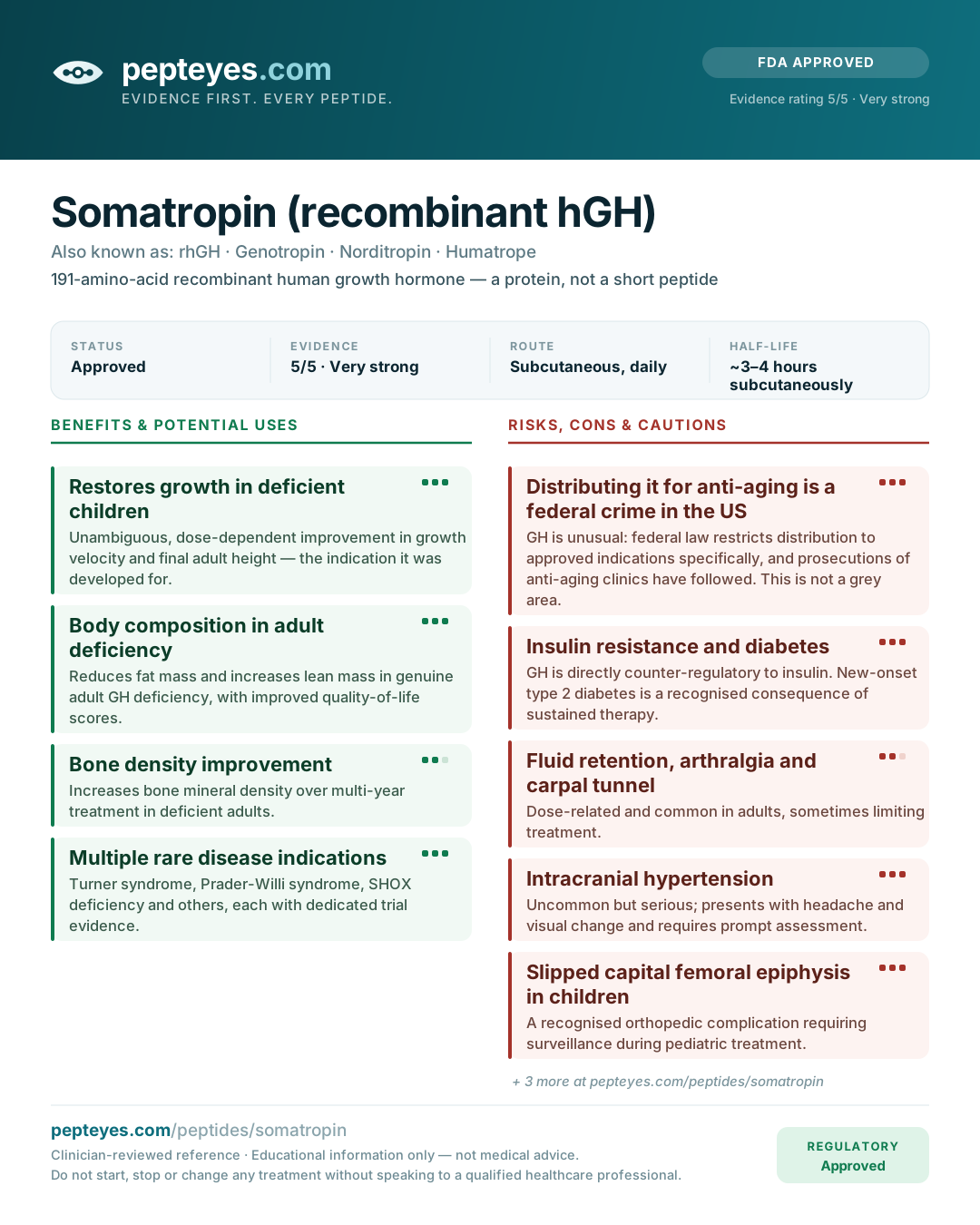
Restores growth in deficient children
Unambiguous, dose-dependent improvement in growth velocity and final adult height — the indication it was developed for.
Evidence: Strong evidence -
Body composition in adult deficiency
Reduces fat mass and increases lean mass in genuine adult GH deficiency, with improved quality-of-life scores.
Evidence: Strong evidence -
Bone density improvement
Increases bone mineral density over multi-year treatment in deficient adults.
Evidence: Moderate evidence -
Multiple rare disease indications
Turner syndrome, Prader-Willi syndrome, SHOX deficiency and others, each with dedicated trial evidence.
Evidence: Strong evidence
Risks and cautions
8 entries · 6 serious or common
-
Distributing it for anti-aging is a federal crime in the US
GH is unusual: federal law restricts distribution to approved indications specifically, and prosecutions of anti-aging clinics have followed. This is not a grey area.
Evidence: Serious -
Insulin resistance and diabetes
GH is directly counter-regulatory to insulin. New-onset type 2 diabetes is a recognised consequence of sustained therapy.
Evidence: Serious -
Fluid retention, arthralgia and carpal tunnel
Dose-related and common in adults, sometimes limiting treatment.
Evidence: Moderate evidence -
Intracranial hypertension
Uncommon but serious; presents with headache and visual change and requires prompt assessment.
Evidence: Serious -
Slipped capital femoral epiphysis in children
A recognised orthopedic complication requiring surveillance during pediatric treatment.
Evidence: Serious -
Malignancy caution
Contraindicated in active malignancy. Long-term registry data are broadly reassuring in deficiency, but not in healthy adults taking it to feel younger.
Evidence: Serious -
Suppresses the endogenous axis
Unlike secretagogues, exogenous GH shuts down natural pituitary secretion.
Evidence: Moderate evidence -
Counterfeit market
Widely counterfeited; seized products have contained no active ingredient or unidentified substances.
Evidence: Serious
Counts are not a score. A single serious risk can outweigh several well-supported benefits, and a long benefit list built on preclinical work outweighs nothing at all.
Opinion — what people actually report
7 themes · 1 reported benefit · 4 reported problems
This is the weakest tier on this site. These are themes drawn from public discussion — forums, subreddits and patient threads — not from trials. There is no control group, no denominator, and no way to confirm that what someone injected matched its label. People post when a result is dramatic and when something goes wrong, and rarely when nothing happens, so treat everything below as a description of the conversation rather than of the compound. The bars count how often a thing is said, not how well it is supported.
-
Water retention and carpal tunnel Reported problem. Dominant theme: Comes up in most discussions of this compound.
The defining side effect cluster, reported as dose-related and as the practical ceiling on how much people can take.
-
Sleep, skin and recovery Reported benefit. Dominant theme: Comes up in most discussions of this compound.
The consistently reported subjective benefits, usually noticed before anything measurable.
-
Insulin resistance and rising glucose Reported problem. Dominant theme: Comes up in most discussions of this compound.
The most-cited serious concern among long-term users, often with self-reported labs attached.
-
Deficiency treatment and physique use are separate worlds Practical note. Dominant theme: Comes up in most discussions of this compound.
Patients on prescribed replacement and people using it for body composition discuss it in almost entirely different terms and rarely overlap.
-
Cost and counterfeits Reported problem. Recurring: Raised regularly, though not by everyone.
Generic and grey-market products are widely discussed, along with the difficulty of verifying them.
-
Joint pain and stiffness Reported problem. Recurring: Raised regularly, though not by everyone.
Aching joints and morning stiffness are common in the first weeks and are consistently described as easing when the dose is reduced.
-
Organ and tissue growth concerns Practical note. Occasional: Reported by a minority, or in specific contexts.
Raised by longer-term users, usually as a reason for conservative dosing.
Where the reports and the evidence part ways
Somatropin has a large and solid evidence base — in genuine growth hormone deficiency, and in specific paediatric conditions. That evidence is the source of its credibility and it is not evidence for the use most forum discussion concerns. In healthy adults, controlled trials show modest increases in lean mass and decreases in fat mass with no demonstrated improvement in strength or function, alongside consistent increases in oedema, arthralgia, carpal tunnel syndrome and insulin resistance. The anti-ageing case rests substantially on a small 1990 study whose own authors later cautioned against the conclusions drawn from it. The community reports the side effects accurately; it overstates what the drug does for people who are not deficient.
Readers on Somatropin (recombinant hGH)
Questions and answers from readers, under generated names. Nothing here has been checked or reviewed by the site and none of it is medical advice. It is the least verified thing on this page — and it is here because people ask each other these things anyway, and most of the other places they can ask are run by sellers.
0 questions · 0 answers
No questions yet. Ask the first one above — it takes one box and an email address.
How names work, and the house rules
Names. Every verified address is given one generated name — two ordinary words — and keeps it. Nobody chooses a name and nobody can take another's. Posts marked desk were written by the site's own editorial desk, usually to open a thread; they carry a generated name like everyone else's and are held to the site's rules, which means they never state an amount.
What is not allowed. Selling, sourcing, vendor names, coupon codes and "message me" — posts that read that way are held and usually removed. Personal medical details you would not want public. Abuse. Instructions framed as what someone else should do.
What this is not. A reader's report of what happened to them is a report, not a finding, and an answer here is one person's view. Nothing in this section changes the evidence rating above it. If something you read here would change what you take, take it to a pharmacist or physician first.
Your data. Delete any post of yours at any time, or remove everything you have written together with your name. Details in the privacy notice.
Who should avoid it
- Active malignancy
- Acute critical illness — a trial in ICU patients found increased mortality
- Proliferative diabetic retinopathy
- Closed epiphyses when used for height
- Anti-aging or performance use
If used under medical supervision, monitor
- IGF-1 targeted to age-adjusted reference range
- Fasting glucose and HbA1c
- Thyroid function
- Fundoscopy if headache or visual symptoms
- Growth velocity and hip examination in children
Interactions
Not exhaustive. Always have a pharmacist or physician review your full medication list — including supplements.
- Corticosteroids — mutually antagonistic; both doses may need adjustment
- Insulin and oral hypoglycemics — requirements typically increase
- Oral estrogen — reduces GH responsiveness, higher doses often needed
- CYP450 substrates — GH can alter clearance
Commonly confused with
These mix-ups cause real harm — two products sold under one name, or two molecules whose effects run in opposite directions.
Sermorelin stimulates your pituitary to release its own GH and preserves feedback control. Somatropin replaces GH directly, suppresses endogenous secretion, and carries the full acromegaly-like side effect profile.
Compare side by sideMarketing often implies these are equivalent. CJC-1295 has phase 1 data only; somatropin has decades of trials and a specific federal law governing its distribution.
Compare side by sideRegulatory & legal status
Prescription drug. US federal law (21 U.S.C. § 333(e)) prohibits distribution for any use other than approved indications, making anti-aging distribution a criminal offence.
Infographic
Where to read further
We link to live literature searches rather than a frozen citation list, so you always see current results — including anything published after our last review.
- PubMed — all published literature on Somatropin (recombinant hGH)
- PubMed — randomized controlled trials only
- ClinicalTrials.gov — registered human trials
- DailyMed — official FDA prescribing information
Related peptides in Growth Hormone Axis
Terms used on this page
- Growth Hormone Secretagogue (GHS)
- A growth hormone secretagogue is any compound that stimulates endogenous GH release, a class spanning GHRH analogues and ghrelin-mimetic agents acting at the GHS receptor.
- Growth Hormone (GH)
- Growth hormone is a 191-amino-acid pituitary protein secreted in pulses that acts directly on tissues and indirectly through hepatic IGF-1, and is approved for a defined list of indications.
- Adverse Drug Reaction (ADR)
- An adverse drug reaction is a noxious, unintended response to a medicine given at normal doses, and unlike an adverse event the term carries a causal judgement inside it.
- Secretagogue
- A secretagogue is a compound that causes a cell or gland to release a substance it already produces, acting upstream of the hormone rather than supplying the hormone itself.
- Growth Hormone Receptor (GHR)
- The growth hormone receptor is a preformed cytokine-receptor dimer that a single GH molecule activates by binding two subunits at separate sites, signalling through JAK2 and STAT5b to induce IGF-1.
- Insulin-Like Growth Factor 1 (IGF-1)
- IGF-1 is a 70-amino-acid, proinsulin-like peptide produced mainly by the liver under growth hormone control, and it mediates most of the anabolic effects attributed to growth hormone.
This page is educational information, not medical advice. It cannot account for your medical history, medications, or risk factors. Do not start, stop or change any treatment based on it. Speak to a qualified healthcare professional who knows your case.