Supplied as a finished topical
Skin & Cosmetic
At a glance
Ten answers, each one line. Open any row for the detail behind it.
What it does The same GHK sequence as the copper peptide, but with a fatty tail instead of a copper ion.
The same GHK sequence as the copper peptide, but with a fatty tail instead of a copper ion. That change trades the copper-delivery mechanism for much better skin penetration, and it is almost always sold combined with a second peptide that targets inflammation.
Half-life Not applicable — topical — Documented
Not applicable — topical
Typical studied dose Set by the formulation, as a percentage of the finished cream or serum… — On the label
Set by the formulation, as a percentage of the finished cream or serum rather than as an amount taken. The concentration used in the published work is the figure worth comparing a product against.
How often it is used Applied as the product directs, usually once or twice a day. Topical… — On the label
Applied as the product directs, usually once or twice a day. Topical results in the published trials came from months of continuous use, not from a short course.
How it is taken Topical — Documented
Topical
Main side effects Evidence largely from ingredient suppliers · Combination products obscure attribution · Concentration rarely disclosed — Depends on the study
Evidence largely from ingredient suppliers — Most supporting studies are manufacturer-sponsored, and independent replication is limited.
Combination products obscure attribution — Because it is nearly always sold with tetrapeptide-7, the individual contribution of each peptide is unclear.
Concentration rarely disclosed — Products vary widely and often contain far less than the studied concentration.
Storage before mixing A finished cream or serum follows its own label — usually cool, dark and…
A finished cream or serum follows its own label — usually cool, dark and sealed. Copper peptides in particular discolour when they degrade, and a colour change is a reason to stop using it.
Shelf life after mixing Nothing to mix — it is not supplied as a powder. The relevant date is…
Nothing to mix — it is not supplied as a powder. The relevant date is the one printed on the product.
Evidence level 3/5 · Moderate — Depends on the study
Small or early-phase human trials, or good controlled topical human data.
Regulatory status Cosmetic Ingredient — Nothing established
Widely used cosmetic ingredient, typically paired with palmitoyl tetrapeptide-7 in commercial formulations. Lawful cosmetic ingredient.
Overview
The same GHK sequence as the copper peptide, but with a fatty tail instead of a copper ion. That change trades the copper-delivery mechanism for much better skin penetration, and it is almost always sold combined with a second peptide that targets inflammation.
Cosmetic IngredientWidely used cosmetic ingredient, typically paired with palmitoyl tetrapeptide-7 in commercial formulations.
| Regulatory status | Widely used cosmetic ingredient, typically paired with palmitoyl tetrapeptide-7 in commercial formulations. |
|---|---|
| Drug class | Lipidated tripeptide — the GHK sequence conjugated to palmitic acid |
| Route | Topical |
| Half-life | Not applicable — topical |
| Evidence rating |
3/5 Moderate
Evidence rating 3 out of 5: Moderate
Small or early-phase human trials, or good controlled topical human data. |
| Studied in | Controlled topical studies of the combination product measuring wrinkle depth and dermal density; fibroblast and ex-vivo skin work. |
Palmitoyl Tripeptide-1 sequence & structure
Palmitoyl Tripeptide-1 is a 3-residue linear peptide with a free C-terminal acid, carrying a fatty-acid side chain; molecular weight 578.8 Da.
| Three-letter | Pal-Gly-His-Lys-OH |
|---|---|
| Length | 3 amino acid residues |
| Modifications |
|
| Molecular formula | C30H54N6O5 |
| Molecular weight | 578.8 Da (average, free base) |
| SMILES | CCCCCCCCCCCCCCCC(=O)NCC(=O)N[C@@H](CC1=CN=CN1)C(=O)N[C@@H](CCCCN)C(=O)O |
| Identifiers | CAS 147732-56-7 · PubChem CID 10231864 · DrugBank DB11297 |
| Which molecule | This record is the palmitoylated GHK tripeptide (Pal-GHK, INCI Palmitoyl Tripeptide-1, trade name Biopeptide CL, UNII RV743D216M, InChIKey BYUQATUKPXLFLZ-UIOOFZCWSA-N). The retired INCI name 'Palmitoyl Oligopeptide' was ambiguous and also covered Pal-VGVAPG (now Palmitoyl Hexapeptide-12); Matrixyl 3000 is a blend of Pal-GHK with Pal-GQPR (Palmitoyl Tetrapeptide-7), not a single molecule. |
| Sources | PubChem CID 10231864 (Palmitoyl Tripeptide-1) — structure, formula, MW, synonymsFDA GSRS substance RV743D216M (Palmitoyl Tripeptide-1) — subunit sequence GHKEBI UniChem — InChIKey BYUQATUKPXLFLZ-UIOOFZCWSA-N cross-references (DrugBank DB11297, PubChem 10231864, CompTox DTXSID90163794)EPA CompTox Chemicals Dashboard — CASRN 147732-56-7 = DTXSID90163794Cayman Chemical Pal-GHK product page |
Free-acid, L-configured (2S) His and Lys; monoisotopic mass 578.4156; CAS 147732-56-7 passes the check-digit test and the average MW recomputed from C30H54N6O5 is 578.80. Sold both as the free peptide (CAS 147732-56-7) and as the acetate salt (INCI Palmitoyl Tripeptide-1 Acetate), and in cosmetics almost always as a dilute (ppm-level) solution in glycerin/water or butylene glycol rather than neat. Unlike GHK-Cu it carries no copper centre.
Record confidence: high — two independent authoritative sources agree on the sequence and modifications. Every sequence on the site is listed with its sources on the peptide sequences index.
How it works
The GHK tripeptide signals fibroblasts to increase collagen, elastin and glycosaminoglycan synthesis. Palmitoylation raises lipophilicity so the peptide crosses the stratum corneum, which unmodified GHK does poorly. The commonly paired palmitoyl tetrapeptide-7 reduces interleukin-6 production, addressing inflammatory matrix breakdown by a separate route.
Evidence base
Rated 3 of 5 — Moderate. Small or early-phase human trials, or good controlled topical human data.
- Reasonable topical evidence with the usual cosmetic-industry funding caveat.
Benefits and risks, weighed against the evidence
Every entry below carries the strength of the evidence behind it — three bars for strong human data, two for moderate, one for preliminary or preclinical work. The two columns are not equal by design: where a compound has more documented risk than demonstrated benefit, the lists say so.
Reported benefits
5 entries · 1 on strong human evidence
-
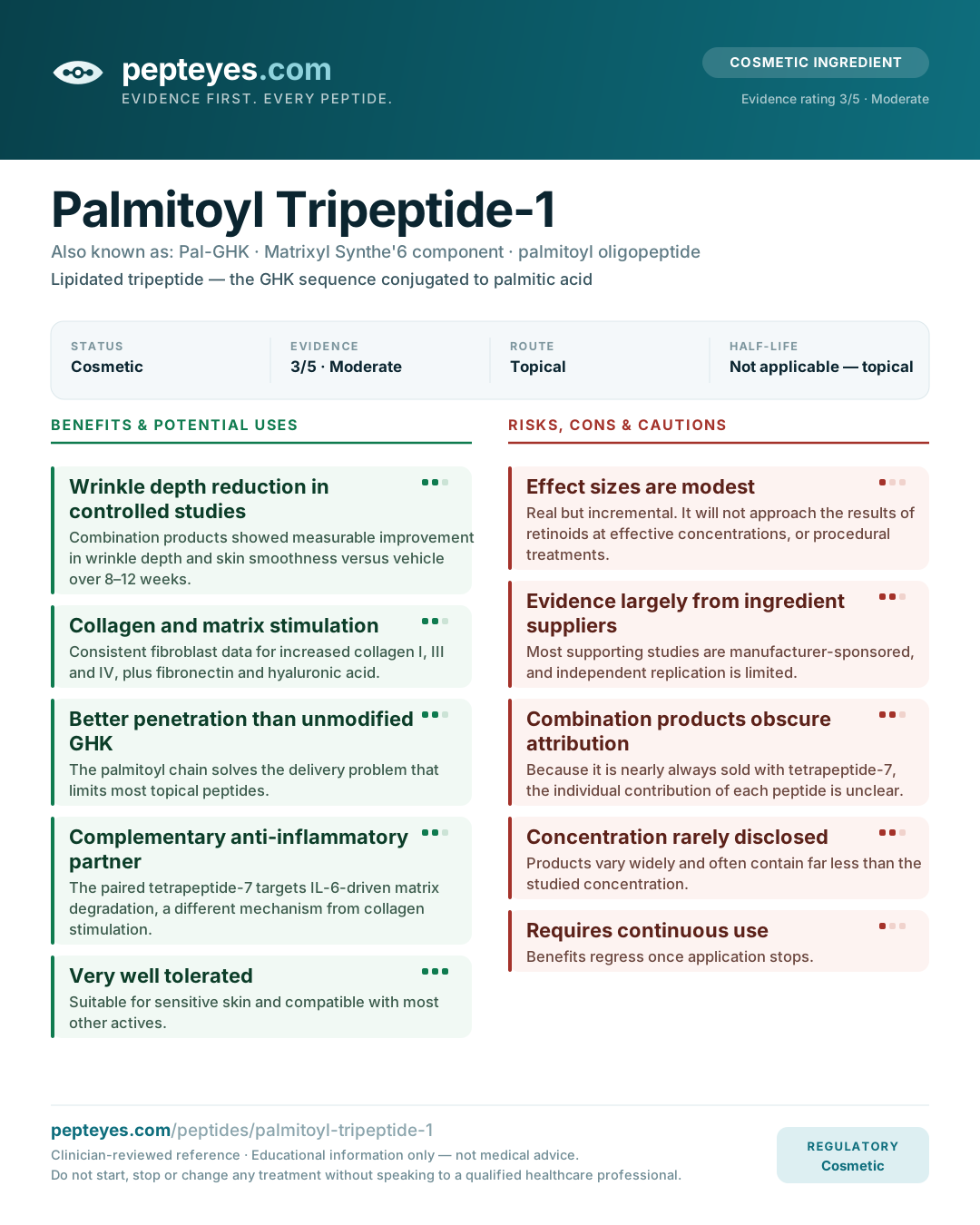
Wrinkle depth reduction in controlled studies
Combination products showed measurable improvement in wrinkle depth and skin smoothness versus vehicle over 8–12 weeks.
Evidence: Moderate evidence -
Collagen and matrix stimulation
Consistent fibroblast data for increased collagen I, III and IV, plus fibronectin and hyaluronic acid.
Evidence: Moderate evidence -
Better penetration than unmodified GHK
The palmitoyl chain solves the delivery problem that limits most topical peptides.
Evidence: Moderate evidence -
Complementary anti-inflammatory partner
The paired tetrapeptide-7 targets IL-6-driven matrix degradation, a different mechanism from collagen stimulation.
Evidence: Moderate evidence -
Very well tolerated
Suitable for sensitive skin and compatible with most other actives.
Evidence: Strong evidence
Risks and cautions
5 entries
-
Effect sizes are modest
Real but incremental. It will not approach the results of retinoids at effective concentrations, or procedural treatments.
Evidence: Minor -
Evidence largely from ingredient suppliers
Most supporting studies are manufacturer-sponsored, and independent replication is limited.
Evidence: Moderate evidence -
Combination products obscure attribution
Because it is nearly always sold with tetrapeptide-7, the individual contribution of each peptide is unclear.
Evidence: Moderate evidence -
Concentration rarely disclosed
Products vary widely and often contain far less than the studied concentration.
Evidence: Moderate evidence -
Requires continuous use
Benefits regress once application stops.
Evidence: Minor
Counts are not a score. A single serious risk can outweigh several well-supported benefits, and a long benefit list built on preclinical work outweighs nothing at all.
Opinion — what people actually report
4 themes · 2 reported benefits
This is the weakest tier on this site. These are themes drawn from public discussion — forums, subreddits and patient threads — not from trials. There is no control group, no denominator, and no way to confirm that what someone injected matched its label. People post when a result is dramatic and when something goes wrong, and rarely when nothing happens, so treat everything below as a description of the conversation rather than of the compound. The bars count how often a thing is said, not how well it is supported.
-
Considered a sensible collagen-support ingredient Reported benefit. Recurring: Raised regularly, though not by everyone.
Generally viewed positively in skincare communities, though rarely as the reason someone buys a product.
-
Almost always part of a blend Practical note. Dominant theme: Comes up in most discussions of this compound.
Rarely sold alone, which makes attributing any result to it essentially impossible.
-
Confused with GHK-Cu Practical note. Recurring: Raised regularly, though not by everyone.
Both contain the GHK sequence, and the difference — copper versus a fatty tail for penetration — is a recurring point of clarification.
-
No irritation, unlike copper peptides Reported benefit. Recurring: Raised regularly, though not by everyone.
A practical advantage frequently cited, along with not staining fabric.
Where the reports and the evidence part ways
There is reasonable topical evidence for signal peptides of this type improving skin appearance, with the usual cosmetic-industry funding caveat. Because it appears almost exclusively in blends, neither the community nor the literature can isolate its contribution from the other actives beside it. The community's clarification that it is not GHK-Cu is correct and worth repeating — the palmitoyl tail changes penetration, and the absence of copper changes the mechanism.
Readers on Palmitoyl Tripeptide-1
Questions and answers from readers, under generated names. Nothing here has been checked or reviewed by the site and none of it is medical advice. It is the least verified thing on this page — and it is here because people ask each other these things anyway, and most of the other places they can ask are run by sellers.
0 questions · 0 answers
No questions yet. Ask the first one above — it takes one box and an email address.
How names work, and the house rules
Names. Every verified address is given one generated name — two ordinary words — and keeps it. Nobody chooses a name and nobody can take another's. Posts marked desk were written by the site's own editorial desk, usually to open a thread; they carry a generated name like everyone else's and are held to the site's rules, which means they never state an amount.
What is not allowed. Selling, sourcing, vendor names, coupon codes and "message me" — posts that read that way are held and usually removed. Personal medical details you would not want public. Abuse. Instructions framed as what someone else should do.
What this is not. A reader's report of what happened to them is a report, not a finding, and an answer here is one person's view. Nothing in this section changes the evidence rating above it. If something you read here would change what you take, take it to a pharmacist or physician first.
Your data. Delete any post of yours at any time, or remove everything you have written together with your name. Details in the privacy notice.
Who should avoid it
- Known ingredient allergy
- Broken or actively irritated skin
If used under medical supervision, monitor
- None required
Commonly confused with
These mix-ups cause real harm — two products sold under one name, or two molecules whose effects run in opposite directions.
Same GHK tripeptide, different delivery. GHK-Cu carries a copper ion and works partly through copper delivery; palmitoyl tripeptide-1 carries a fatty tail for penetration and has no copper component.
Compare side by sideMatrixyl is palmitoyl pentapeptide-4 (Pal-KTTKS). "Matrixyl 3000" and "Synthe'6" are different blends that include palmitoyl tripeptide-1. The names are marketing, not chemistry.
Compare side by sideRegulatory & legal status
Lawful cosmetic ingredient.
Infographic
Where to read further
We link to live literature searches rather than a frozen citation list, so you always see current results — including anything published after our last review.
- PubMed — all published literature on Palmitoyl Tripeptide-1
- PubMed — randomized controlled trials only
- ClinicalTrials.gov — registered human trials
Related peptides in Skin & Cosmetic
Terms used on this page
- Percutaneous Absorption
- Percutaneous absorption is the passage of a substance through the stratum corneum and viable epidermis into the dermal microcirculation, and it is the rate limit on every topical active.
- Glycosaminoglycans (GAGs)
- Glycosaminoglycans are long unbranched sugar chains of repeating disaccharides that hold water in the dermal ground substance and, except for hyaluronan, are sulfated and attached to core proteins.
- Stratum Corneum
- The stratum corneum is the outermost epidermal layer of dead, keratin-filled corneocytes in a lipid matrix, and it is the rate-limiting barrier for essentially every topical ingredient.
- Lipidation and Fatty Acid Acylation
- Lipidation is the covalent attachment of a fatty acid to a peptide, usually at a lysine side chain, creating reversible albumin binding that dramatically extends circulating half-life.
- Hydrophobicity
- Hydrophobicity is the tendency of a residue or peptide to be excluded from water, and it governs solubility, aggregation, chromatographic behaviour and interaction with membranes.
- Fibroblast
- A fibroblast is the mesenchymal cell that produces and maintains connective tissue matrix, and which differentiates into a contractile myofibroblast during wound repair.
This page is educational information, not medical advice. It cannot account for your medical history, medications, or risk factors. Do not start, stop or change any treatment based on it. Speak to a qualified healthcare professional who knows your case.