Supplied as a finished topical
Skin & Cosmetic
At a glance
Ten answers, each one line. Open any row for the detail behind it.
What it does The copper complex of alanyl-histidyl-lysine, sold for hair as the sharper younger sibling…
The copper complex of alanyl-histidyl-lysine, sold for hair as the sharper younger sibling of GHK-Cu. It rests on a single 2007 laboratory paper: human scalp follicles in organ culture grew longer, and cultured dermal papilla cells divided more and shifted their apoptosis proteins, though the count of dying cells itself did not fall significantly. That is human tissue, but it is still a dish. No clinical trial of AHK-Cu has ever been run or registered, so what it does on an actual head is simply unknown.
Half-life Not characterised. No pharmacokinetic study of the complex in… — Nothing established
Not characterised. No pharmacokinetic study of the complex in humans has been published for any route.
Typical studied dose Set by the formulation, as a percentage of the finished cream or serum… — On the label
Set by the formulation, as a percentage of the finished cream or serum rather than as an amount taken. The concentration used in the published work is the figure worth comparing a product against.
How often it is used Applied as the product directs, usually once or twice a day. Topical… — On the label
Applied as the product directs, usually once or twice a day. Topical results in the published trials came from months of continuous use, not from a short course.
How it is taken Topical, in scalp and skin products; also injected into the scalp… — Documented
Topical, in scalp and skin products; also injected into the scalp outside any approved or studied use.
Main side effects No clinical trial exists · Copper loading if it is injected · Hazardous in impaired copper handling — Carries serious risk
No clinical trial exists — Nothing has been measured on a human head. There is no randomised trial, no open-label study, no photographic hair-count series and not even a published case series — only the 2007 laboratory work and the marketing built on top of it.
Copper loading if it is injected — Roughly a seventh of the complex's mass is copper, and scalp injection is a common grey-market use with nothing published behind it. The body clears copper slowly and mainly through bile; putting a copper chelate under the skin repeatedly bypasses the gut absorption control that normally holds copper balance, and nobody has measured where that leads.
Hazardous in impaired copper handling — Wilson's disease, other copper-storage disorders and significant cholestatic liver disease all impair copper excretion. Deliberately adding copper in those settings is a genuine hazard, and the hazard scales sharply with anything that puts the complex under the skin rather than on it.
Storage before mixing A finished cream or serum follows its own label — usually cool, dark and…
A finished cream or serum follows its own label — usually cool, dark and sealed. Copper peptides in particular discolour when they degrade, and a colour change is a reason to stop using it.
Shelf life after mixing Nothing to mix — it is not supplied as a powder. The relevant date is…
Nothing to mix — it is not supplied as a powder. The relevant date is the one printed on the product.
Evidence level 1/5 · Minimal — Nothing established
Animal or laboratory data only. No human efficacy evidence.
Regulatory status Cosmetic Ingredient — Nothing established
A lawful cosmetic ingredient, labelled copper tripeptide-3. No drug approval anywhere, no registered clinical trial, and no published human study of any design. AHK-Cu holds no marketing authorisation as a medicine anywhere in the world. In cosmetics it is used lawfully and appears on labels as copper tripeptide-3; the closely related GHK complex is the one with the long-established European cosmetic ingredient entry, copper tripeptide-1. Cosmetic lawfulness is a fact about naming and about ingredient safety review at cosmetic use levels. It is not a finding of efficacy, and it says nothing whatever about injecting the material. Powders move under a research-use-only label, which is a labelling convention and not permission to give the substance to a person. It is not a controlled substance.
Overview
The copper complex of alanyl-histidyl-lysine, sold for hair as the sharper younger sibling of GHK-Cu. It rests on a single 2007 laboratory paper: human scalp follicles in organ culture grew longer, and cultured dermal papilla cells divided more and shifted their apoptosis proteins, though the count of dying cells itself did not fall significantly. That is human tissue, but it is still a dish. No clinical trial of AHK-Cu has ever been run or registered, so what it does on an actual head is simply unknown.
Cosmetic IngredientA lawful cosmetic ingredient, labelled copper tripeptide-3. No drug approval anywhere, no registered clinical trial, and no published human study of any design.
| Regulatory status | A lawful cosmetic ingredient, labelled copper tripeptide-3. No drug approval anywhere, no registered clinical trial, and no published human study of any design. |
|---|---|
| Drug class | Copper(II) complex of the synthetic tripeptide Ala-His-Lys — GHK with alanine in place of the N-terminal glycine |
| Route | Topical, in scalp and skin products; also injected into the scalp outside any approved or studied use. |
| Half-life | Not characterised. No pharmacokinetic study of the complex in humans has been published for any route. |
| Evidence rating |
1/5 Minimal
Evidence rating 1 out of 5: Minimal
Animal or laboratory data only. No human efficacy evidence. |
| Studied in | One 2007 report from a Korean dermatology group: human hair follicles in ex-vivo organ culture plus cultured human dermal papilla cells, with flow-cytometric annexin V labelling and blots for Bcl-2, Bax, cleaved caspase-3 and PARP. No human in-vivo study of any kind, and no registered trial. |
AHK-Cu sequence & structure
AHK-Cu is a 3-residue linear peptide with a free C-terminal acid, carrying a bound metal ion; molecular weight 415.94 Da.
| Three-letter | H-Ala-His-Lys-OH |
|---|---|
| Length | 3 amino acid residues |
| Modifications |
|
| Molecular formula | C15H24CuN6O4 |
| Molecular weight | 415.94 Da (average, free base) |
| Identifiers | CAS 767286-83-9 · PubChem CID 168431292 |
| Which molecule | The name covers more than one substance. This record describes the neutral 1:1 Cu(II) complex of the free tripeptide (CAS 767286-83-9, C15H24CuN6O4, 415.94), which is what the 2007 hair study and the cosmetic ingredient name copper tripeptide-3 refer to. The material actually handled in the laboratory is usually the monohydrochloride (CAS 682809-81-0, C15H25ClCuN6O4, 452.40; PubChem CID 168431292, named there as AHK-Cu), and the copper-free tripeptide Ala-His-Lys is a separate substance again. A 2:1 peptide-to-copper complex is described alongside the 1:1 form in the originating patent and is not covered here. |
| Sources | PubChem CID 168431292 — AHK-Cu, names and identifiers including CAS 682809-81-0 and the systematic name [L-alanyl-N-L-histidyl-N,N3-L-lysinato(2-)]copper monohydrochloridePubChem CID 168431292 — computed properties for the hydrochloride (C15H24ClCuN6O4-, 451.39) and CID 178189140 for the free complexTargetMol T82681, Copper tripeptide-3 (AHK-Cu): CAS 767286-83-9, molecular formula C15H24CuN6O4, molecular weight 415.94, sequence Ala-His-LysUS Patent 6017888, Stimulation of hair growth by peptide copper complexes (Pallenberg, Patt and Trachy; ProCyte Corp, issued 2000) — names alanyl-histidyl-lysine:copper and gives 1:1 and 2:1 preparationsPyo et al., Arch Pharm Res 2007;30(7):834-839 — the primary study, which defines the compound as L-alanyl-L-histidyl-L-lysine-Cu2+ |
The Ala-His-Lys sequence is unambiguous and agrees across the 2007 paper, the ProCyte patent and chemical catalogue listings, but the identifiers do not line up cleanly, so this is a medium-confidence record. Two CAS numbers are in circulation — 767286-83-9 for the free complex and 682809-81-0 for the monohydrochloride — and the quoted mass depends on which is meant: 415.94 for the neutral chelate given here, and 452.40 for the hydrochloride. PubChem's free-complex record (CID 178189140) is drawn with an extra deprotonation and a radical carbon and returns C15H23CuN6O4(2-), 414.93, so it should not be used for the formula; CID 168431292, the hydrochloride, is the better-formed record and is the one cited. A formula of C14H25N7O4Cu appears on some ingredient pages and is wrong — that is neither AHK-Cu nor GHK-Cu. The copper coordination is assigned by analogy with GHK-Cu, whose Cu(II) site has been solved by X-ray; no crystal structure of AHK-Cu has been published.
Record confidence: medium — one authoritative source, or sources agree on the sequence but not on every identifier. Every sequence on the site is listed with its sources on the peptide sequences index.
How it works
Copper is the point. Ala-His-Lys carries a histidine at position two, so the free N-terminal amine, the deprotonated amide nitrogen between alanine and histidine, and the imidazole nitrogen together clamp a Cu(II) ion in a square-planar site — the same three-nitrogen arrangement that makes GHK a copper carrier, with a methyl group where GHK has a glycine hydrogen. Roughly a seventh of the complex's mass is copper. Copper is the cofactor of lysyl oxidase, which crosslinks collagen and elastin, so a chelate that hands copper to cells has an obvious story attached. What was measured is narrower: in the 2007 work AHK-Cu made cultured human dermal papilla cells divide faster, raised the Bcl-2 to Bax ratio, cut the cleaved forms of caspase-3 and PARP, and lengthened human scalp follicles held in organ culture. Whether any of it happens in a living scalp, with a barrier, a blood supply and androgens, has never been tested.
Evidence base
Rated 1 of 5 — Minimal. Animal or laboratory data only. No human efficacy evidence.
- The entire record is one 2007 ex-vivo and cell-culture paper. Human scalp follicles in organ culture and cultured human dermal papilla cells are human tissue, but they remain in-vitro work: no intact skin barrier, no circulation, no hormonal environment, no person. That is an evidence rating of 1, not 3.
- No clinical trial of AHK-Cu exists. A ClinicalTrials.gov query returns no study, and a literature search across Europe PMC returns the 2007 paper plus reviews citing it and unrelated copper-peptide chemistry.
- Much of what circulates about AHK-Cu is GHK-Cu evidence relabelled. They are different molecules with different literatures, and a result measured for one does not transfer to the other. Where a trialled multi-ingredient injectable hair formulation contains a copper tripeptide, it has been the GHK complex, and a trial of a mixture could not isolate a single peptide in any case.
- Being a lawful cosmetic ingredient is a regulatory fact about labelling and about safety at cosmetic use levels. It is not evidence that the ingredient does anything to hair.
- The origin of AHK-Cu as a hair-growth candidate is a 1990s industrial patent on peptide-copper complexes, not an academic discovery programme, which is worth knowing when reading claims made for it.
Benefits and risks, weighed against the evidence
Every entry below carries the strength of the evidence behind it — three bars for strong human data, two for moderate, one for preliminary or preclinical work. The two columns are not equal by design: where a compound has more documented risk than demonstrated benefit, the lists say so.
Reported benefits
4 entries
-
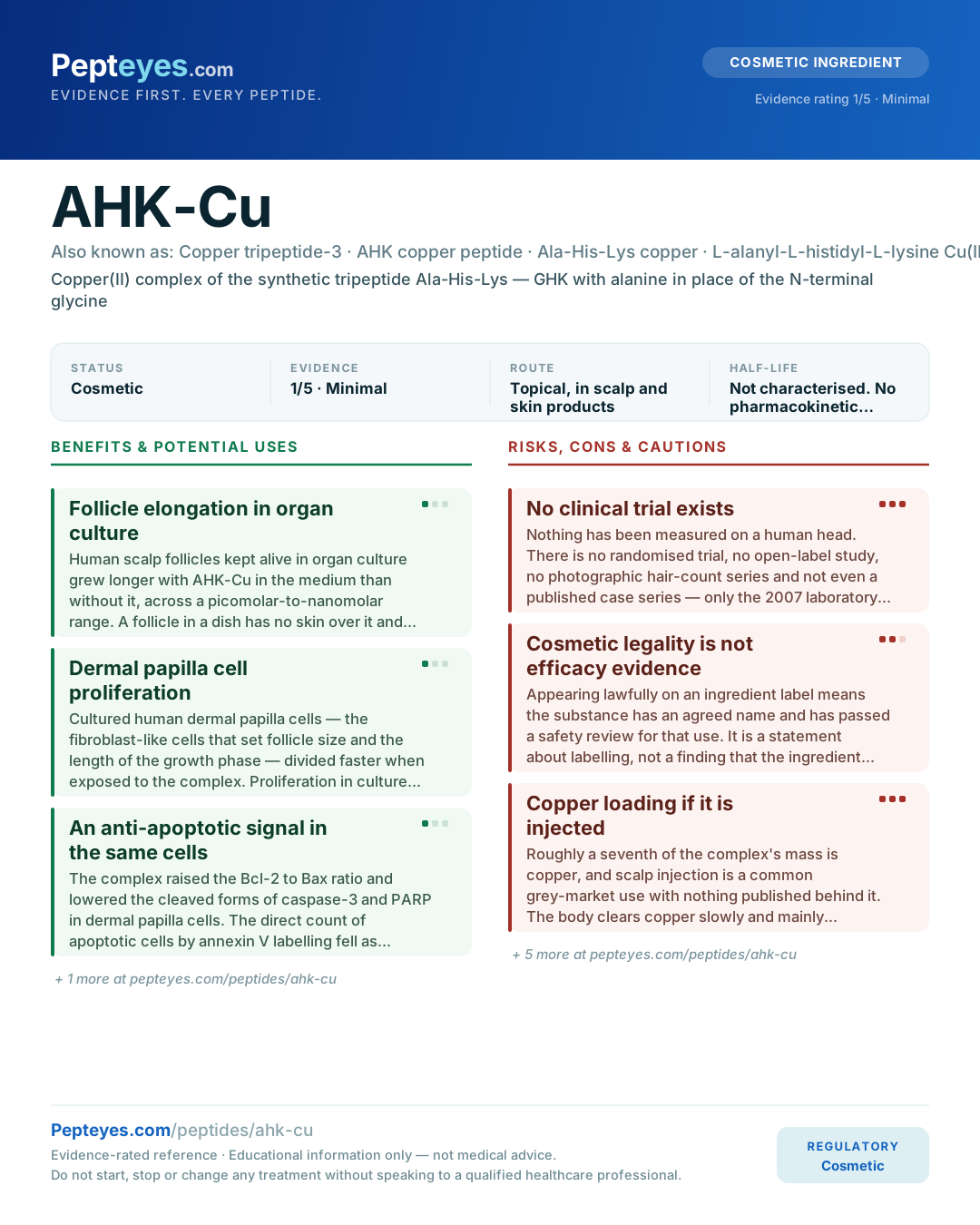
Follicle elongation in organ culture
Human scalp follicles kept alive in organ culture grew longer with AHK-Cu in the medium than without it, across a picomolar-to-nanomolar range. A follicle in a dish has no skin over it and no blood supply, so this is a starting point rather than a result about hair.
Evidence: Preliminary -
Dermal papilla cell proliferation
Cultured human dermal papilla cells — the fibroblast-like cells that set follicle size and the length of the growth phase — divided faster when exposed to the complex. Proliferation in culture is the standard first screen for a hair candidate, and also the standard place where candidates quietly stop.
Evidence: Preliminary -
An anti-apoptotic signal in the same cells
The complex raised the Bcl-2 to Bax ratio and lowered the cleaved forms of caspase-3 and PARP in dermal papilla cells. The direct count of apoptotic cells by annexin V labelling fell as well, but the authors report that particular fall as not statistically significant.
Evidence: Preliminary -
Presents copper in a chelated form
Copper is the cofactor of lysyl oxidase and of other enzymes involved in matrix crosslinking and pigmentation, and a peptide chelate is a gentler way to present it to cells than a copper salt. Whether follicles in an intact scalp are short of copper in the first place has never been shown.
Evidence: Preliminary
Risks and cautions
8 entries · 4 serious or common
-
No clinical trial exists
Nothing has been measured on a human head. There is no randomised trial, no open-label study, no photographic hair-count series and not even a published case series — only the 2007 laboratory work and the marketing built on top of it.
Evidence: Serious -
Cosmetic legality is not efficacy evidence
Appearing lawfully on an ingredient label means the substance has an agreed name and has passed a safety review for that use. It is a statement about labelling, not a finding that the ingredient grows hair, and the two are routinely conflated in product copy.
Evidence: Moderate evidence -
Copper loading if it is injected
Roughly a seventh of the complex's mass is copper, and scalp injection is a common grey-market use with nothing published behind it. The body clears copper slowly and mainly through bile; putting a copper chelate under the skin repeatedly bypasses the gut absorption control that normally holds copper balance, and nobody has measured where that leads.
Evidence: Serious -
Hazardous in impaired copper handling
Wilson's disease, other copper-storage disorders and significant cholestatic liver disease all impair copper excretion. Deliberately adding copper in those settings is a genuine hazard, and the hazard scales sharply with anything that puts the complex under the skin rather than on it.
Evidence: Serious -
Unregulated grey-market powder
Material sold under a research-use-only label carries no assurance of identity, copper content, purity, sterility or endotoxin load. Someone injecting it has no way to confirm what the vial holds, and copper content in particular is not something that can be checked at home.
Evidence: Serious -
Dish concentrations say nothing about a scalp
The active range in the 2007 work was picomolar to nanomolar in medium bathing a bare follicle. How much intact copper complex crosses a living stratum corneum and reaches the bulb has not been measured for this molecule at all.
Evidence: Moderate evidence -
Formulation clashes that destroy the complex
Copper chelates are sensitive to pH and to redox conditions. Layering them with strong acids, ascorbic acid or thiol-containing actives can strip or reduce the copper, and a decomposed complex is neither the peptide that was studied nor a controlled source of copper.
Evidence: Moderate evidence -
Irritation, staining and copper allergy
Copper peptide solutions are blue and will stain fabric and pale hair. Scalp irritation and contact dermatitis are uncommon but reported for copper peptides generally, and copper contact allergy does exist even though it is rare.
Evidence: Minor
Counts are not a score. A single serious risk can outweigh several well-supported benefits, and a long benefit list built on preclinical work outweighs nothing at all.
Opinion — what people actually report
7 themes · 1 reported benefit · 2 reported problems
This is the weakest tier on this site. These are themes drawn from public discussion — forums, subreddits and patient threads — not from trials. There is no control group, no denominator, and no way to confirm that what someone injected matched its label. People post when a result is dramatic and when something goes wrong, and rarely when nothing happens, so treat everything below as a description of the conversation rather than of the compound. The bars count how often a thing is said, not how well it is supported.
-
Discussed as GHK-Cu's more expensive cousin Practical note. Dominant theme: Comes up in most discussions of this compound.
Almost every thread is comparative. The claim that swapping one residue makes it the better hair peptide is repeated constantly, and the better-informed replies point out that it traces back to ingredient marketing rather than to anyone putting the two side by side on a head.
-
Hair looks thicker and the scalp feels calmer Reported benefit. Recurring: Raised regularly, though not by everyone.
The most common positive report is cosmetic rather than a count of hairs — better-conditioned, fuller-looking hair and less irritation, described over a couple of months.
-
Almost nobody reports regrowth Reported problem. Dominant theme: Comes up in most discussions of this compound.
The dominant outcome theme. People describe the hairline sitting exactly where it was, and the rare regrowth accounts nearly always come from someone simultaneously on finasteride, dutasteride or minoxidil.
-
Which supplier to believe takes up most of the conversation Practical note. Dominant theme: Comes up in most discussions of this compound.
More of the discussion is about identity, purity and third-party testing than about what the peptide does, and a serum containing what its label claims is treated as an open question. None of that practical detail is repeated here.
-
Nobody is using it alone Practical note. Recurring: Raised regularly, though not by everyone.
It is almost always layered onto an established treatment or blended with GHK-Cu in the same bottle. That makes every positive account uninterpretable, and the more careful posters say so themselves.
-
Injecting it into the scalp gets asked about regularly Reported problem. Recurring: Raised regularly, though not by everyone.
A persistent strand asks about needles and microneedling devices. There is no product made for that, no established amount and no safety record, and the objections raised in reply are about copper load and about what else is in a research powder.
-
Delivery is the question that never gets answered Practical note. Recurring: Raised regularly, though not by everyone.
Threads about carriers, penetration enhancers and whether a copper complex crosses the stratum corneum are more technically literate than most of this corner of the internet, and they reliably end without a conclusion.
Where the reports and the evidence part ways
The community is closer to right than the marketing is. Everything published on AHK-Cu comes from a single 2007 laboratory report — human scalp follicles growing longer in organ culture, dermal papilla cells dividing faster, a shift in apoptosis proteins without a significant fall in the count of dying cells. That is human tissue, but it is still a dish, and no clinical trial of AHK-Cu has ever been run or registered anywhere. So the forums reporting no regrowth are not contradicting the evidence; there is no human evidence to contradict. The claim that it outperforms GHK-Cu rests on no comparison in a person at all, in either direction. Where the community runs ahead of what is known is in injecting it, and in assuming a copper complex reaches the follicle through an intact scalp — the penetration question the more technical threads keep raising is genuinely open, and nothing published answers it.
Readers on AHK-Cu
Questions and answers from readers, under generated names. Nothing here has been checked or reviewed by the site and none of it is medical advice. It is the least verified thing on this page — and it is here because people ask each other these things anyway, and most of the other places they can ask are run by sellers.
0 questions · 0 answers
No questions yet. Ask the first one above — it takes one box and an email address.
How names work, and the house rules
Names. Every verified address is given one generated name — two ordinary words — and keeps it. Nobody chooses a name and nobody can take another's. Posts marked desk were written by the site's own editorial desk, usually to open a thread; they carry a generated name like everyone else's and are held to the site's rules, which means they never state an amount.
What is not allowed. Selling, sourcing, vendor names, coupon codes and "message me" — posts that read that way are held and usually removed. Personal medical details you would not want public. Abuse. Instructions framed as what someone else should do.
What this is not. A reader's report of what happened to them is a report, not a finding, and an answer here is one person's view. Nothing in this section changes the evidence rating above it. If something you read here would change what you take, take it to a pharmacist or physician first.
Your data. Delete any post of yours at any time, or remove everything you have written together with your name. Details in the privacy notice.
Who should avoid it
- Injection, which no published study supports
- Wilson's disease or any other condition of impaired copper excretion
- Broken, inflamed or freshly needled scalp skin
- Pregnancy and breastfeeding, where nothing at all has been studied
- Known copper contact allergy
If used under medical supervision, monitor
- Nothing is required for ordinary topical cosmetic use
- Scalp irritation or contact dermatitis during the first weeks
- Anyone injecting it sits outside every published study; copper status and liver chemistry are what a trial would have to follow
- Standardised photographs, if you want to know whether anything actually changed
Interactions
Not exhaustive. Always have a pharmacist or physician review your full medication list — including supplements.
- Penicillamine, trientine and other copper chelators — prescribed to strip copper out of the body, and a copper complex works directly against the point of them
- Zinc supplementation — zinc and copper compete for handling, so copper-balance effects are unpredictable in anyone taking either deliberately
- Topical ascorbic acid and strong acids — a formulation clash that can degrade the copper complex, rather than a drug interaction as such
- Minoxidil and finasteride — no study has combined either with this complex, so nothing is known in either direction
Commonly confused with
These mix-ups cause real harm — two products sold under one name, or two molecules whose effects run in opposite directions.
One residue apart and constantly swapped for each other. GHK-Cu is glycyl-histidyl-lysine copper, an endogenous plasma tripeptide with decades of wound-healing and skin literature behind it; AHK-Cu replaces that glycine with alanine, is not a natural human peptide, and has one ex-vivo hair paper. Claims made for GHK-Cu are routinely reprinted on AHK-Cu labels.
Compare side by sideRegulatory & legal status
AHK-Cu holds no marketing authorisation as a medicine anywhere in the world. In cosmetics it is used lawfully and appears on labels as copper tripeptide-3; the closely related GHK complex is the one with the long-established European cosmetic ingredient entry, copper tripeptide-1. Cosmetic lawfulness is a fact about naming and about ingredient safety review at cosmetic use levels. It is not a finding of efficacy, and it says nothing whatever about injecting the material. Powders move under a research-use-only label, which is a labelling convention and not permission to give the substance to a person. It is not a controlled substance.
Infographic
What this entry was checked against
The specific records this monograph was verified against on its last research pass. We link live literature searches below as well, because these are a snapshot and the literature is not.
- Pyo HK, Yoo HG, Won CH, Lee SH, Kang YJ, Eun HC, Cho KH, Kim KH. The effect of tripeptide-copper complex on human hair growth in vitro. Arch Pharm Res 2007;30(7):834-839 (PMID 17703734)
- Europe PMC record for the 2007 Pyo study via the REST API, returning the full abstract verbatim (AHK-Cu 10^-12 to 10^-9 M, ex-vivo follicle elongation, dermal papilla cell proliferation, a non-significant fall in annexin V-labelled apoptotic cells, raised Bcl-2/Bax, reduced cleaved caspase-3 and PARP)
- Europe PMC literature search for AHK-Cu and alanyl-histidyl-lysine — returns the 2007 paper, reviews citing it and unrelated copper-peptide chemistry, and no human study
- ClinicalTrials.gov API query for AHK-Cu — totalCount 0, no registered study
- PubChem CID 168431292 — AHK-Cu, names, CAS 682809-81-0 and computed properties
- TargetMol T82681, Copper tripeptide-3 (AHK-Cu) — CAS 767286-83-9, C15H24CuN6O4, 415.94, sequence Ala-His-Lys, described as a cosmetic ingredient
- US Patent 6017888, Stimulation of hair growth by peptide copper complexes (ProCyte Corp, issued 2000) — the origin of AHK:copper as a hair-growth candidate
- COSMILE Europe INCI entry for COPPER TRIPEPTIDE-1 (the GHK complex), declared function skin conditioning — the established cosmetic ingredient entry AHK-Cu is often conflated with
Where to read further
We link to live literature searches rather than a frozen citation list, so you always see current results — including anything published after our last review.
- PubMed — all published literature on AHK-Cu
- PubMed — randomized controlled trials only
- ClinicalTrials.gov — registered human trials
Related peptides in Skin & Cosmetic
Terms used on this page
- Metal Complex (Copper–Peptide Complex)
- A metal complex is a peptide holding a metal ion, usually copper(II), by coordinate bonds from its side chains and backbone, so the metal is a bound centre and not a residue in the sequence.
- N-Terminus
- The N-terminus is the end of a peptide chain bearing a free alpha-amino group, the point from which sequences are written and from which aminopeptidases and DPP-4 begin degrading the molecule.
- Elastin
- Elastin is the insoluble crosslinked protein that gives skin its recoil, deposited during development on microfibril scaffolds and effectively not replaced in adult life.
- Skin Barrier Function
- Skin barrier function is the stratum corneum's capacity to restrict water loss outward and chemical entry inward, sustained by corneocytes embedded in ordered intercellular lipid lamellae.
- Trial Registration and Prospective Protocol
- Trial registration is the public deposit of a study's design and prespecified outcomes before enrolment begins, creating a dated record against which the eventual publication can be checked.
- Carrier Peptide
- A carrier peptide is a cosmetic peptide that chelates a trace metal, almost always copper, and is marketed as delivering that metal into skin to support matrix-building enzymes.
This page is educational information, not medical advice. It cannot account for your medical history, medications, or risk factors. Do not start, stop or change any treatment based on it. Speak to a qualified healthcare professional who knows your case.