Supplied as a finished topical
Skin & Cosmetic
At a glance
Ten answers, each one line. Open any row for the detail behind it.
What it does Marketed as "topical Botox", which overstates it considerably.
Marketed as "topical Botox", which overstates it considerably. It does work by a related mechanism, and controlled studies do show measurable wrinkle-depth reduction — just far smaller than injectable neuromodulators.
Half-life Not applicable — topical, and it barely crosses the stratum… — Nothing established
Not applicable — topical, and it barely crosses the stratum corneum; no human pharmacokinetic data have been published for any route.
Typical studied dose Set by the formulation, as a percentage of the finished cream or serum… — On the label
Set by the formulation, as a percentage of the finished cream or serum rather than as an amount taken. The concentration used in the published work is the figure worth comparing a product against.
How often it is used Applied as the product directs, usually once or twice a day. Topical… — On the label
Applied as the product directs, usually once or twice a day. Topical results in the published trials came from months of continuous use, not from a short course.
How it is taken Topical — Documented
Topical
Main side effects Limited skin penetration · Industry-funded evidence base · Far weaker than injectable neuromodulators — Depends on the study
Limited skin penetration — A hexapeptide crossing the stratum corneum in meaningful quantity is a genuine formulation challenge; delivery system matters enormously.
Industry-funded evidence base — Much of the supporting research comes from ingredient manufacturers.
Far weaker than injectable neuromodulators — Comparing it to botulinum toxin sets expectations it cannot meet.
Storage before mixing A finished cream or serum follows its own label — usually cool, dark and…
A finished cream or serum follows its own label — usually cool, dark and sealed. Copper peptides in particular discolour when they degrade, and a colour change is a reason to stop using it.
Shelf life after mixing Nothing to mix — it is not supplied as a powder. The relevant date is…
Nothing to mix — it is not supplied as a powder. The relevant date is the one printed on the product.
Evidence level 3/5 · Moderate — Depends on the study
Small or early-phase human trials, or good controlled topical human data.
Regulatory status Cosmetic Ingredient — Nothing established
Widely used cosmetic ingredient with published human topical studies. Not a drug; makes cosmetic rather than therapeutic claims. Lawful cosmetic ingredient in the US, EU and most markets.
Overview
Marketed as "topical Botox", which overstates it considerably. It does work by a related mechanism, and controlled studies do show measurable wrinkle-depth reduction — just far smaller than injectable neuromodulators.
Cosmetic IngredientWidely used cosmetic ingredient with published human topical studies. Not a drug; makes cosmetic rather than therapeutic claims.
| Regulatory status | Widely used cosmetic ingredient with published human topical studies. Not a drug; makes cosmetic rather than therapeutic claims. |
|---|---|
| Drug class | Synthetic hexapeptide modelled on the N-terminal end of SNAP-25 |
| Route | Topical |
| Half-life | Not applicable — topical, and it barely crosses the stratum corneum; no human pharmacokinetic data have been published for any route. |
| Evidence rating |
3/5 Moderate
Evidence rating 3 out of 5: Moderate
Small or early-phase human trials, or good controlled topical human data. |
| Studied in | Several controlled topical studies measuring wrinkle depth by profilometry and image analysis over 4–12 weeks. |
Argireline (Acetyl Hexapeptide-8) sequence & structure
Argireline (Acetyl Hexapeptide-8) is a 6-residue linear peptide with a C-terminal amide; molecular weight 889 Da.
| Three-letter | Ac-Glu-Glu-Met-Gln-Arg-Arg-NH2 |
|---|---|
| Length | 6 amino acid residues |
| Modifications |
|
| Molecular formula | C34H60N14O12S |
| Molecular weight | 889 Da (average, free base) |
| SMILES | CC(=O)N[C@@H](CCC(=O)O)C(=O)N[C@@H](CCC(=O)O)C(=O)N[C@@H](CCSC)C(=O)N[C@@H](CCC(=O)N)C(=O)N[C@@H](CCCN=C(N)N)C(=O)N[C@@H](CCCN=C(N)N)C(=O)N |
| Identifiers | CAS 616204-22-9 · PubChem CID 11228338 |
| Which molecule | Acetyl Hexapeptide-8, Acetyl Hexapeptide-8 Amide (the current wINCI Dictionary name) and the retired names Acetyl Hexapeptide-3 / Acetyl Hexapeptide-24 all denote the same molecule, Ac-EEMQRR-NH2 (CAS 616204-22-9); this record describes that single compound. The un-acetylated hexapeptide H-EEMQRR-NH2 sold by some vendors as 'hexapeptide-3' is a different substance and is not covered here. |
| Sources | PubChem CID 11228338 (properties)PubChem CID 11228338 (synonyms and CAS RN cross-reference)CIR Expert Panel, Safety Assessment of Acetyl Hexapeptide-8 Amide as Used in Cosmetics (2020)Blanes-Mira et al. 2002, Int J Cosmet Sci 24:303-310 (PMID 18498523)ChemPep Acetyl Hexapeptide-8 product page (vendor cross-check) |
Sequence mimics the N-terminal six residues of SNAP-25. Formula and MW (889.0 Da; CIR quotes 889.1) are for the free peptide, which was independently recomputed from the residue composition; commercial Argireline is commonly supplied as the acetate salt or as a dilute aqueous tradename solution (~0.05% peptide), so vendor MW figures for the salt will be higher. A PubChem name lookup for 'acetyl hexapeptide-8' resolves to a mis-drawn structure (CID 71587772, C35H62N14O11S) that should be ignored; CID 11228338 is the correct record.
Record confidence: high — two independent authoritative sources agree on the sequence and modifications. Every sequence on the site is listed with its sources on the peptide sequences index.
How it works
Mimics the N-terminal of SNAP-25 and competes for a position in the SNARE complex required for vesicular acetylcholine release at the neuromuscular junction, modestly reducing muscle contraction. Botulinum toxin cleaves SNAP-25 outright, which is why the effect sizes differ so much.
Evidence base
Rated 3 of 5 — Moderate. Small or early-phase human trials, or good controlled topical human data.
- Objective outcome measures, small effect sizes, significant industry funding.
Benefits and risks, weighed against the evidence
Every entry below carries the strength of the evidence behind it — three bars for strong human data, two for moderate, one for preliminary or preclinical work. The two columns are not equal by design: where a compound has more documented risk than demonstrated benefit, the lists say so.
Reported benefits
4 entries · 2 on strong human evidence
-
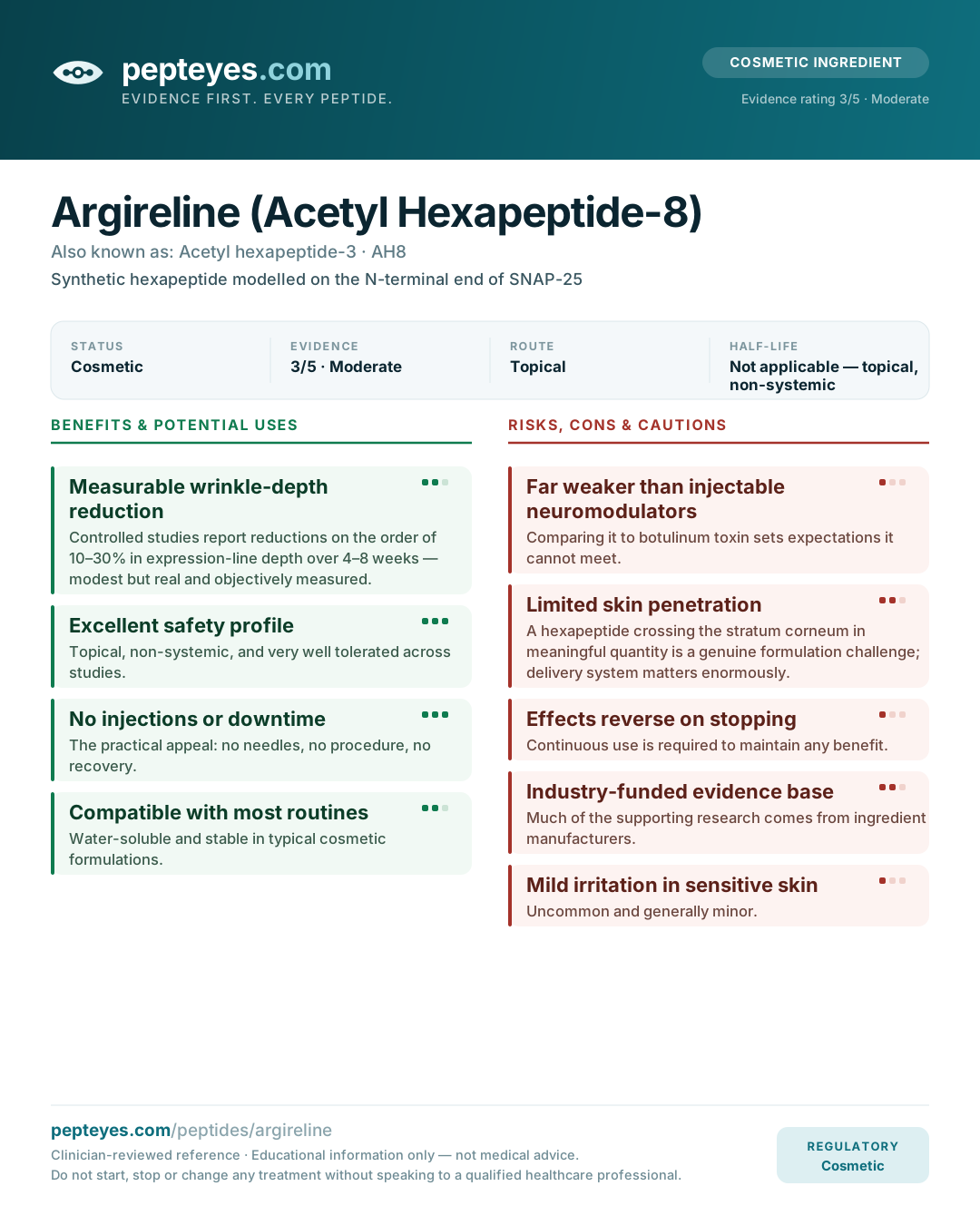
Measurable wrinkle-depth reduction
Controlled studies report reductions on the order of 10–30% in expression-line depth over 4–8 weeks — modest but real and objectively measured.
Evidence: Moderate evidence -
Excellent safety profile
Topical, non-systemic, and very well tolerated across studies.
Evidence: Strong evidence -
No injections or downtime
The practical appeal: no needles, no procedure, no recovery.
Evidence: Strong evidence -
Compatible with most routines
Water-soluble and stable in typical cosmetic formulations.
Evidence: Moderate evidence
Risks and cautions
5 entries
-
Far weaker than injectable neuromodulators
Comparing it to botulinum toxin sets expectations it cannot meet.
Evidence: Minor -
Limited skin penetration
A hexapeptide crossing the stratum corneum in meaningful quantity is a genuine formulation challenge; delivery system matters enormously.
Evidence: Moderate evidence -
Effects reverse on stopping
Continuous use is required to maintain any benefit.
Evidence: Minor -
Industry-funded evidence base
Much of the supporting research comes from ingredient manufacturers.
Evidence: Moderate evidence -
Mild irritation in sensitive skin
Uncommon and generally minor.
Evidence: Minor
Counts are not a score. A single serious risk can outweigh several well-supported benefits, and a long benefit list built on preclinical work outweighs nothing at all.
Opinion — what people actually report
4 themes · 1 reported benefit · 2 reported problems
This is the weakest tier on this site. These are themes drawn from public discussion — forums, subreddits and patient threads — not from trials. There is no control group, no denominator, and no way to confirm that what someone injected matched its label. People post when a result is dramatic and when something goes wrong, and rarely when nothing happens, so treat everything below as a description of the conversation rather than of the compound. The bars count how often a thing is said, not how well it is supported.
-
Mild softening of expression lines Reported benefit. Recurring: Raised regularly, though not by everyone.
Reports concentrate on forehead and crow's feet, and are consistently described as subtle.
-
Nothing like Botox, despite the marketing Reported problem. Dominant theme: Comes up in most discussions of this compound.
The dominant theme by a wide margin, and a recurring frustration with how the ingredient is sold.
-
Concentration in products is usually too low Reported problem. Recurring: Raised regularly, though not by everyone.
A common technical complaint, since brands rarely disclose the actual percentage.
-
Penetration is the fundamental question Practical note. Recurring: Raised regularly, though not by everyone.
Whether a hexapeptide crosses the stratum corneum in meaningful quantity is debated with more sophistication here than in most cosmetic discussions.
Where the reports and the evidence part ways
Argireline does have published studies showing wrinkle-depth reduction, so the effect is not nothing, but those studies are small, short and mostly funded by the ingredient supplier. The community's central point stands: the mechanism is loosely analogous to botulinum toxin at the level of SNARE complex interference, and the effect size is not remotely comparable. The penetration question is genuinely unresolved and is the right thing to be sceptical about.
Readers on Argireline (Acetyl Hexapeptide-8)
Questions and answers from readers, under generated names. Nothing here has been checked or reviewed by the site and none of it is medical advice. It is the least verified thing on this page — and it is here because people ask each other these things anyway, and most of the other places they can ask are run by sellers.
0 questions · 0 answers
No questions yet. Ask the first one above — it takes one box and an email address.
How names work, and the house rules
Names. Every verified address is given one generated name — two ordinary words — and keeps it. Nobody chooses a name and nobody can take another's. Posts marked desk were written by the site's own editorial desk, usually to open a thread; they carry a generated name like everyone else's and are held to the site's rules, which means they never state an amount.
What is not allowed. Selling, sourcing, vendor names, coupon codes and "message me" — posts that read that way are held and usually removed. Personal medical details you would not want public. Abuse. Instructions framed as what someone else should do.
What this is not. A reader's report of what happened to them is a report, not a finding, and an answer here is one person's view. Nothing in this section changes the evidence rating above it. If something you read here would change what you take, take it to a pharmacist or physician first.
Your data. Delete any post of yours at any time, or remove everything you have written together with your name. Details in the privacy notice.
Who should avoid it
- Known peptide or formulation ingredient allergy
- Broken or irritated skin
If used under medical supervision, monitor
- None required
Regulatory & legal status
Lawful cosmetic ingredient in the US, EU and most markets.
Infographic
Where to read further
We link to live literature searches rather than a frozen citation list, so you always see current results — including anything published after our last review.
- PubMed — all published literature on Argireline (Acetyl Hexapeptide-8)
- PubMed — randomized controlled trials only
- ClinicalTrials.gov — registered human trials
Related peptides in Skin & Cosmetic
Terms used on this page
- Effect Size
- Effect size is the magnitude of a difference or an association, expressed on a scale that does not depend on how many participants were studied, unlike a p-value.
- N-Terminus
- The N-terminus is the end of a peptide chain bearing a free alpha-amino group, the point from which sequences are written and from which aminopeptidases and DPP-4 begin degrading the molecule.
- Stratum Corneum
- The stratum corneum is the outermost epidermal layer of dead, keratin-filled corneocytes in a lipid matrix, and it is the rate-limiting barrier for essentially every topical ingredient.
This page is educational information, not medical advice. It cannot account for your medical history, medications, or risk factors. Do not start, stop or change any treatment based on it. Speak to a qualified healthcare professional who knows your case.